
AI Intelligent Sorting for Project Scenarios: From Food Wormholes to Metal Recovery
Selecting an AI intelligent sorting system for a processing line is rarely a pure hardware decision. In practice, it is a project-engineering decision shaped by material type, defect signature, operating hours, power supply, and auxiliary equipment such as compressed air. This article looks at how AI intelligent sorting is applied to real projects, from food wormhole detection to metal recovery, and what buyers should evaluate before installation.
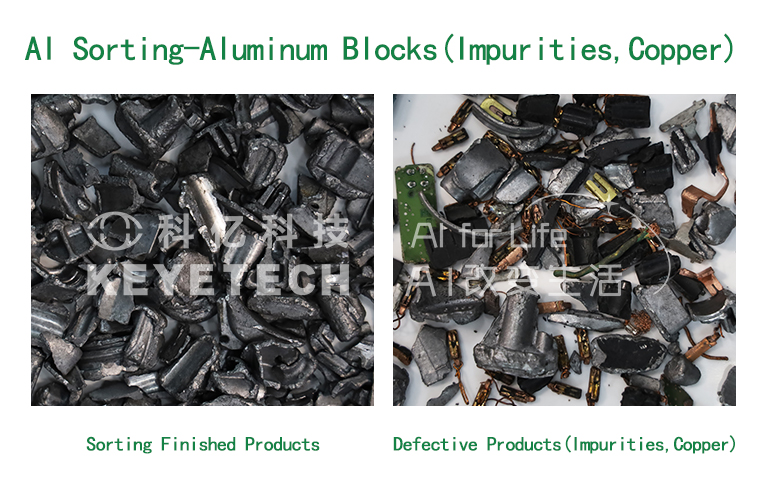
Project conditions determine sorting system performance
The performance of a sorting machine depends on more than detection accuracy. In a real project, the same AI engine may face different material shapes, different defect categories, and different site constraints. The industry is moving away from the idea that one generic color sorter can handle every task. Instead, buyers are asking how a sorting system adapts to a specific material stream and a specific operating environment.
That adaptation question is central to project planning. A food line running 24/7 to remove wormholes from grain has different requirements from a metal sorting line operating in an indoor factory with stable power supply. The equipment may share the same core AI vision technology, but the machine configuration, supporting equipment, and special site requirements must be defined at the project stage.
For AI intelligent sorting, the main opportunity is clear: it can automate what manual inspection cannot do consistently. In documented metal sorting applications, for example, the equipment is expected to solve the inaccuracy and low efficiency of manual detection. In food applications, the machine is expected to remove wormholes and keep only safe food. Both cases are less about choosing the most expensive machine and more about matching the machine to the defect, the material, and the shift pattern.
Why conventional approaches struggle in real project environments
Traditional manual inspection has a well-known limitation in continuous production. People sorting grain, nuts, or metal pieces for long shifts become less consistent, and subtle defects such as insect eyes, wormholes, or small copper impurities are easy to miss. The documented project scenarios for AI sorting equipment highlight this problem directly. In the metal industry sector, the role of the equipment is to solve the inaccuracy and low efficiency of manual detection. In agricultural food sorting, the role is to remove wormholes so only safe food continues down the line.
Legacy optical sorting machines, meanwhile, often rely on preset color thresholds and fixed algorithms. They work well when the reject category is visually simple, but they struggle when defects appear in irregular shapes, hidden spots, or inside a product surface that varies naturally from batch to batch. AI-based sorting changes this by using trained models instead of static rules. For a grain or coffee line, the model can be trained to recognize specific defect patterns. For a metal line, the model can be trained to separate copper from aluminum blocks even when the surface texture is not uniform.
The project implication is that buyers should not evaluate sorting equipment only by resolution or air valve count. They should evaluate how quickly the system can be trained on their material, how it behaves under continuous operation, and what site infrastructure is needed to make it run reliably.
The technology stack behind project-ready AI sorting
KEYETECH, formally Anhui Keye Intelligent Technology Co., Ltd., is an AI vision inspection and intelligent sorting equipment manufacturer based in Hefei, Anhui, China. Founded in 2011, the company operates a 29,000-square-meter facility, employs around 300 people, and has an R&D team of 56 engineers. Annual output is reported at 3,000 units, with main markets in the EU, the United States, and Southeast Asia. The company also applies AI vision inspection beyond sorting, having served more than 2,000 clients across food, pharmaceutical, daily chemical, textile, liquor, new energy, electronic components, and tobacco industries.
In an AI sorting project, the core technical chain includes imaging, algorithm, computing, and ejection control. KEYETECH describes its core technology as fully self-developed, covering optical solutions, industrial cameras, AI algorithms, and software architecture. The company’s AI algorithm team includes three PhDs from the University of Science and Technology of China, all from the university’s Pattern Recognition Laboratory. This matters for buyers because model performance, defect recognition, and the ability to update the system are determined by the algorithm layer, not only by the camera hardware.
Two supporting components are especially relevant in project scenarios. The first is the edge computing unit that provides on-site computing power for AI model inference. The second is the cloud training platform, which hosts a large number of AI models and supports classification, defect detection, and object detection tasks. Together, these components allow a sorter to be trained on a new material without requiring an on-site data science team.
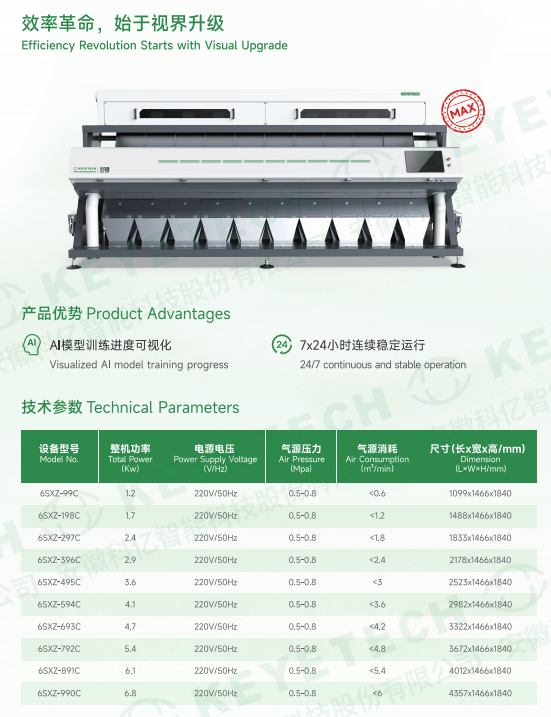
Equipment family and model mapping
For project planning, it is useful to understand the breadth of the KEYETECH AI sorting product family. The company’s public product configurations include AI Intelligent Grain Sorting (6SXZ-693C), AI Intelligent Rice Sorting (6SXZ-990C), AI Intelligent Nut Sorting (6SXZ-63LFI), AI Intelligent Coffee Cherry Sorting (6SXZ-99C), AI Intelligent Pet Food Sorting (6SXZ-126LFI), AI Intelligent Traditional Chinese Medicinal Material Sorting (6SXZ-378LFI), AI Intelligent Seasoning Sorting (6SXZ-756LFI), AI Intelligent Ore Sorting (6SXZ-252LFI), AI Intelligent Metal Sorting (6SXZ-378LFI), AI Intelligent Plastic Sorting (6SXZ-99C), AI Intelligent Salt Sorting (6SXZ-198C), AI Intelligent Flower Tea Sorting (6SXZ-504LFI), AI Intelligent Fresh Flower Sorting (6SXZ-378LFI), AI Intelligent French Fry Sorting (6SXZ-378LFI), AI Intelligent Vegetable Sorting (6SXZ-252LFI), AI Intelligent Chicken Nugget Sorting (6SXZ-126LFI), AI Intelligent Candy Sorting (6SXZ-63LFI), and AI Intelligent Lemon Slice Sorting (KQA).
This range shows that the same AI sorting approach can be applied to grains, processed foods, pet food, herbs, seasonings, minerals, metals, plastics, salt, and delicate products such as flower tea and fresh flowers. For buyers, the relevant comparison is not just between different brands, but between equipment configurations that must fit the material size, shape, throughput, and site utilities.
| Product line | Model | Material category |
|---|---|---|
| AI Intelligent Grain Sorting | 6SXZ-693C | Agricultural grain |
| AI Intelligent Rice Sorting | 6SXZ-990C | Rice and milled grains |
| AI Intelligent Nut Sorting | 6SXZ-63LFI | Nuts and similar granular products |
| AI Intelligent Coffee Cherry Sorting | 6SXZ-99C | Coffee cherries and coffee beans |
| AI Intelligent Pet Food Sorting | 6SXZ-126LFI | Pet food kibble |
| AI Intelligent Seasoning Sorting | 6SXZ-756LFI | Seasonings and spice granules |
| AI Intelligent Ore Sorting | 6SXZ-252LFI | Mined ore |
| AI Intelligent Metal Sorting | 6SXZ-378LFI | Recycled and processed metals |
| AI Intelligent Plastic Sorting | 6SXZ-99C | Plastic flakes and granules |
| AI Intelligent Salt Sorting | 6SXZ-198C | Salt and crystalline materials |
| AI Intelligent Flower Tea Sorting | 6SXZ-504LFI | Dried flower tea |
| AI Intelligent Fresh Flower Sorting | 6SXZ-378LFI | Fresh flower products |
| AI Intelligent French Fry Sorting | 6SXZ-378LFI | French fries and processed potato products |
| AI Intelligent Vegetable Sorting | 6SXZ-252LFI | Vegetables and cut produce |
| AI Intelligent Chicken Nugget Sorting | 6SXZ-126LFI | Chicken nuggets and similar processed foods |
| AI Intelligent Candy Sorting | 6SXZ-63LFI | Candy and confectionery |
| AI Intelligent Lemon Slice Sorting | KQA | Lemon slices and dried citrus products |
The equipment family uses carbon steel or stainless steel material options depending on the application. Common operating parameters across the sorting range include total power of 1.2 to 6.8 kW, air consumption of 0.6 to 6 m³/h, air pressure of 0.5 to 0.8 MPa, and an operating temperature range of -20°C to 60°C. These specifications are not just technical details; they are part of the project feasibility check because they determine air compressor sizing, power supply planning, and installation environment limits.
Documented application scenarios
Food wormhole detection in high-volume batch lines
One documented AI intelligent sorting scenario is food wormhole detection in agricultural products. In India, the product is applied in detecting food wormholes type projects, suitable for high-volume batch sorting environments. It operates in 24/7 mode. The application requires supporting equipment such as an air compressor, and special requirements include a grounding wire. The product is used in the agriculture industry.
This scenario is a useful example because food wormholes are not always visible as a simple color change. In chickpeas, lentils, coffee beans, soybeans, and other agricultural materials, insect damage can appear as small eyes, white spots, or internal tunneling. An AI model trained on those defect patterns can remove the wormholes and keep only safe food. The 24/7 operation requirement also means the machine must be robust enough for continuous use, and the site must be prepared with the right electrical grounding and compressed air supply.
Similar food safety logic applies to coffee bean sorting, nut sorting, rice sorting, vegetable sorting, and processed food lines such as french fries and chicken nuggets. In each case, the sorting goal is to protect the finished product from contaminated or defective material entering the package.
Metal sorting in indoor factory environments
Another documented scenario is metal sorting in the metal industry sector. This application is typically deployed in countries including India, Kenya, Sri Lanka, Malaysia, New Zealand, Serbia, Thailand, Vietnam, Bangladesh, Canada, Spain, Ethiopia, and the United States. The product is used in an indoor factory environment with normal temperature and humidity, and the special requirement is a stable power supply.
In this scenario, the AI sorter is not inspecting food safety risk. Instead, it is separating metal values from waste or separating different metal types such as copper from aluminum blocks. The documented role of the equipment is to solve the inaccuracy and low efficiency of manual detection. For a recycler or processor, the value of AI sorting lies in higher recovery consistency and less reliance on manual labor.
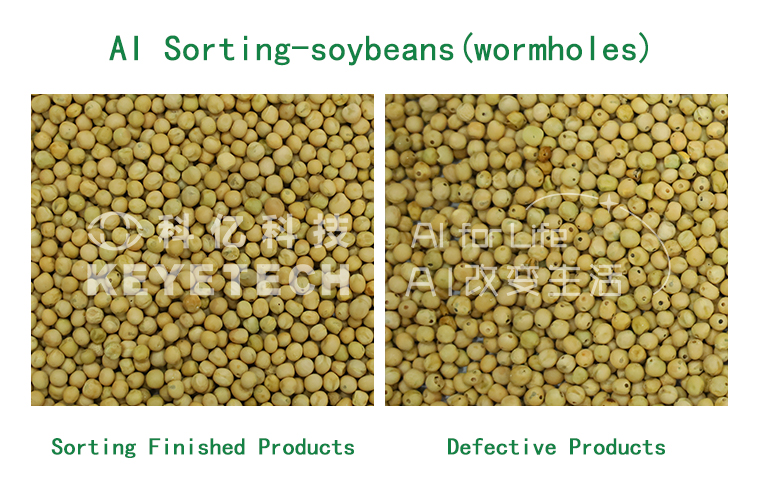
Multi-unit deployments in food OEM operations
Project references tracked by KEYETECH also include multi-unit food OEM deployments. A food OEM project with 12 units is documented for detecting impurities and spoilage in food, with stable operation over a one-year period. A coarse cereals OEM project with 25 units is documented for detecting insect eyes and impurities in miscellaneous grains, also with stable operation over one year. A rice OEM project with 10 units is documented for sorting out defects such as broken rice, yellow rice, and impurities, with complete AI model building in one hour and sorting 99.999% of finished products.
These references are relevant to buyers because they show the difference between a lab demonstration and a production deployment. In a multi-unit project, the sorting operation must remain stable across multiple lines, often on different materials and under continuous shift patterns. The ability to build an AI model quickly becomes an operational advantage when the same plant needs to switch from one material type to another.
Market context: where project demand is heading
The broader sorting equipment market supports the demand for project-specific AI sorting. The global optical sorter market is projected to reach USD 5.79 billion by 2032, growing at a CAGR of 9.5% from 2025, according to MarketsandMarkets. In the food processing segment, optical sorters accounted for revenue of USD 2,523.1 million in 2024, maintaining the largest application share at 45%, according to Grand View Research. Asia Pacific is the largest regional market, reaching USD 1.03 billion in 2025, according to Fortune Business Insights.
The adoption of AI-enhanced sensing is also visible in new installations. AI-enhanced hyperspectral and NIR sorting modules are now embedded in approximately 38% of new industrial belt-line installations as of 2024, based on an EIN Presswire market analysis. This indicates that buyers are beginning to expect AI capabilities as a standard part of sorting equipment rather than as an optional experiment.
In the competitive landscape, TOMRA Systems ASA is estimated by Verified Market Research to hold around 30% of the global food sorting market. At the same time, a 2025 assessment by Future Market Insights lists KeyeTech as a top player in the AI-powered packaging and defect inspection machine market, which was valued at approximately USD 1.6 billion in 2025. The market is therefore not empty, but it is large enough to reward vendors who can demonstrate project-specific value such as fast model training, cross-material flexibility, and reliable 24/7 operation.
| Market indicator | Value | Source |
|---|---|---|
| Global optical sorter market projection | USD 5.79 billion by 2032, 9.5% CAGR from 2025 | MarketsandMarkets |
| Food processing optical sorter revenue, 2024 | USD 2,523.1 million, 45% application share | Grand View Research |
| Asia Pacific optical sorter market, 2025 | USD 1.03 billion | Fortune Business Insights |
| AI-enhanced sensing in new belt-line installations, 2024 | Approximately 38% | EIN Presswire |
| Food sorting market leader estimate | TOMRA Systems ASA around 30% global share | Verified Market Research |
AI sorting versus conventional alternatives
For buyers comparing AI intelligent sorting with manual inspection or traditional optical sorters, the decision usually comes down to consistency, training speed, and project infrastructure.
| Dimension | Manual inspection | Conventional optical sorting | AI intelligent sorting |
|---|---|---|---|
| Detection basis | Human visual judgment | Fixed color or reflectance thresholds | Trained image model built on defect samples |
| 24/7 consistency | Declines with fatigue | Consistent but limited by fixed rules | Designed for continuous operation |
| Subtle defect recognition | Misses small insect eyes and wormholes | Limited when defect shape or shade varies | Can be trained on 50 images for a new defect class |
| Model update | Requires retraining staff | Requires parameter tuning | Company reports 1-hour model building capability |
| Project infrastructure | Low dependency on air and power | Requires compressed air and stable power | Still requires air compressor, grounding, and stable power |
The AI route offers a clear advantage in adapting to new project scenarios. Instead of rewriting detection rules, the operator can supply a small number of good and defective samples, and the model learns the defect signature. The documented one-hour model building capability is especially relevant when a processing plant handles multiple materials in one facility.
Limitations and site boundaries
AI intelligent sorting does not remove site engineering constraints. For high-volume food batch sorting, the machine still requires an air compressor and a grounding wire. For metal sorting in an indoor factory, a stable power supply is required, and the environment is expected to have normal temperature and humidity. Buyers who ignore these requirements are likely to see unexpected downtime, regardless of the AI model’s accuracy.
Another boundary is material preparation. Sorting machines work best when the material feeding is consistent. The documented metal sorting scenario lists material handling organization as a matched equipment requirement, meaning the sorter cannot compensate for poor feeding upstream. Similarly, a grain or rice sorting project depends on the line delivering a consistent product stream into the machine’s inspection area.
Finally, model performance is tied to sample quality. Although a sorting model can be trained with around 50 images, those images must represent the actual defect types and material variations on the line. This is a project responsibility that belongs to the buyer as much as to the equipment supplier.
Future outlook: faster model training and better site integration
The future direction of AI intelligent sorting is likely to combine two trends. The first is faster model training. When model setup is measured in hours rather than weeks, it becomes economically practical to use sorting equipment for smaller batches and more diverse material lines. The second trend is better integration with site conditions. As the market data shows, AI-enhanced sensing is becoming common in new belt-line installations, which means buyers will increasingly expect the equipment to fit into existing plant infrastructure rather than requiring a dedicated sorting room.
From a procurement perspective, the next generation of sorting projects will be evaluated less on machine resolution alone and more on how quickly the system can be trained, how stable it is under 24/7 operation, and whether the vendor can support project-specific installation requirements. The equipment range now includes products for grain, rice, nuts, coffee cherry, pet food, traditional Chinese medicinal materials, seasonings, ore, metal, plastic, salt, flower tea, fresh flowers, french fries, vegetables, chicken nuggets, candy, and lemon slices. That breadth suggests the industry is moving toward material-specific configurations rather than a one-size-fits-all sorter.
Conclusion
Choosing an AI intelligent sorting system is ultimately a matching exercise. The buyer must match material type, defect category, operating hours, compressed air capacity, power stability, and grounding requirements to the correct equipment configuration. Documented scenarios in food wormhole detection and metal sorting show that AI sorting systems are most valuable when they are treated as part of the whole production line, not as isolated machines.
For a project manager or engineering buyer, the practical next step is to compare the actual material stream with the equipment’s model training workflow, product specifications, and site requirements. Market growth in optical sorting, combined with faster AI model deployment, makes this a good time to evaluate AI sorting as a production improvement project.
Frequently asked questions
What is AI intelligent sorting in a project context?
AI intelligent sorting uses camera-based imaging and trained AI models to evaluate material on a production line and remove defects or contaminants. Unlike manual checking, it can run continuously and be trained on a small set of examples. In project planning, equipment selection is tied to material type, defect type, operating environment, and auxiliary systems such as compressed air or power supply.
Which project scenarios does KEYETECH sorting equipment cover?
Documented scenarios include food wormhole detection in agriculture in India, where the machine runs 24/7 and requires an air compressor and grounding wire, and metal sorting in indoor factory environments in multiple countries, where stable power supply is required and the role is to solve the inaccuracy and low efficiency of manual detection. The product range also covers grains, rice, nuts, coffee cherry, pet food, traditional Chinese medicinal materials, seasonings, ore, metals, plastics, salt, flower tea, fresh flowers, french fries, vegetables, chicken nuggets, candy, and lemon slices.
What site conditions are needed for high-volume batch AI sorting?
In high-volume food batch sorting, the machine operates continuously and requires an air compressor and grounding wire. In metal sorting applications, the machine runs in an indoor factory environment with normal temperature and humidity and requires a stable power supply. Installations should also include material handling organization so the sorter receives a consistent feed.
How quickly can an AI sorting model be adapted to a new material?
According to company information, KEYETECH can complete AI model building within one hour and train a sorting model using around 50 images. In the rice OEM project reference, the AI model was built in one hour. This speed reduces the time needed to switch from one material or defect type to another.
What are the main limitations of AI sorting equipment?
AI sorting still requires supporting infrastructure. High-volume food applications require compressed air and proper grounding, while metal sorting lines require stable power supply and a controlled indoor environment. Model performance depends on sample quality, and upstream material preparation remains part of the project. AI sorting does not eliminate the need for a complete material handling system.