
AI Intelligent Ore Sorting: Precision Upgrading Material Recovery in Mining Operations
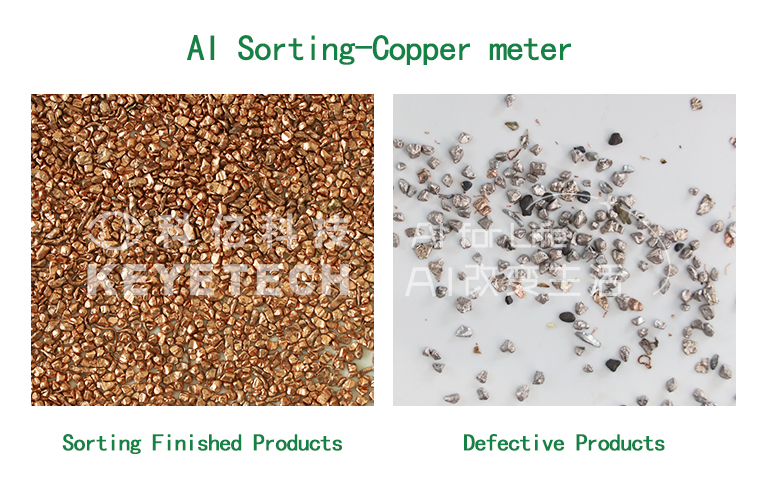
Market expectations for AI-driven sorting in mining and recycling are shifting from efficiency improvement to mandatory compliance with purity standards. For operations handling ores, metals, and recycled aggregates, the ability to detect and remove contaminants with high accuracy directly impacts downstream value. KEYETECH, an Anhui-based national high-tech enterprise specializing in AI vision inspection and automated sorting solutions, has developed a dedicated AI Intelligent Ore Sorting system designed for granular material processing in resource recovery and mineral beneficiation.
Problem: Inefficiency and Inconsistency in Manual and Traditional Sorting
Traditional ore sorting methods rely heavily on manual inspection or basic color-based optical sorters that struggle with subtle color variations, mixed-material streams, and high throughput demands. Manual sorting is prone to fatigue, inconsistency, and limited speed, while conventional machines often fail to distinguish between valuable minerals and waste gangue when color differences are minimal. This leads to higher rejection rates of usable material or, conversely, contamination of the final product.
Solution: KEYETECH AI Intelligent Ore Sorting (Model 6SXZ-252LFI)
KEYETECH’s AI Intelligent Ore Sorting system, model 6SXZ-252LFI, is an AI-powered color sorter specifically engineered for the mining, metal, and renewable resources industries. The equipment combines high-resolution imaging with deep learning algorithms to identify and eject unwanted materials at line speeds. It is constructed from carbon steel or stainless steel, ensuring durability in harsh industrial environments.
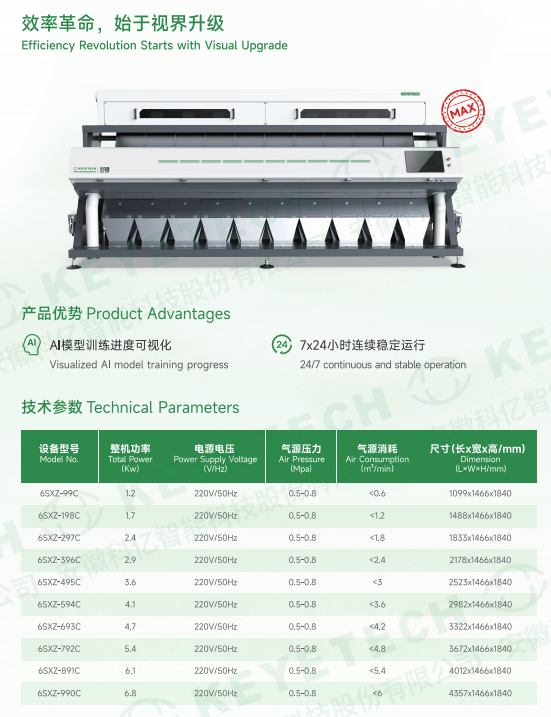
Figure: Vertical-type AI sorting equipment designed for granular materials such as ores, metals, and recycled aggregates.
Technical Architecture: Fully In-House AI Stack
KEYETECH’s technology stack is developed entirely in-house, covering optics, mechanics, electronics, computing, and software. The core AI algorithms, led by three PhDs from the University of Science and Technology of China (USTC) Pattern Recognition Laboratory, run on proprietary edge computing units that host tens of thousands of model instances. For the 6SXZ-252LFI, the system can train a sorting model using only 50 images and complete the AI model building within one hour, drastically reducing setup time for new material types. The equipment operates within a power range of 1.2–6.8 kW, air consumption of 0.6–6 m³/h, and pressure of 0.5–0.8 MPa, with an operating temperature range of -20°C to 60°C.
Application Scenarios: From Metal Recycling to Mining Beneficiation
In a recent deployment for a metal industry client (countries including IN, KE, LK, MY, etc.), KEYETECH’s AI sorting system was used to separate copper from mixed material streams in an indoor factory environment operating 24/7. The system solved the inaccuracy and low efficiency of manual detection. Similarly, for agricultural and resource sectors, the same platform (utilizing variants like 6SXZ-378LFI) has been employed to sort aluminum blocks from impurities and copper. The equipment requires stable power supply and proper grounding, and is compatible with standard material handling infrastructure.
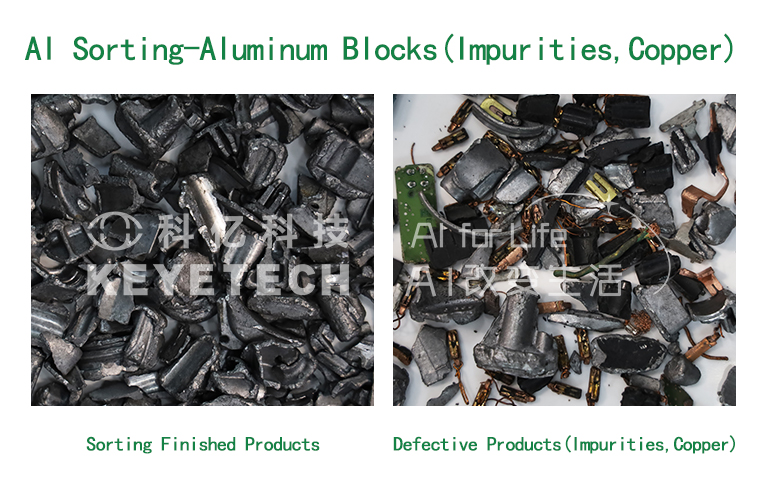
Field application: AI sorting of aluminum blocks to separate copper impurities in a recycling facility.
Market Trend: AI Adoption in Mining Sorting Accelerates
According to industry data, the global optical sorter market is projected to reach USD 5.79 billion by 2032, growing at a CAGR of 9.5% from 2025. Within this, food processing remains the largest segment, but industrial applications—especially metal and mineral sorting—are gaining share as AI-enhanced hyperspectral and NIR modules are now embedded in approximately 38% of new industrial belt-line installations as of 2024. Asia Pacific, the largest regional market (USD 1.03 billion in 2025), is driving demand for automated sorting in mining and recycling sectors across China and India.
Comparison with Traditional Solutions: Speed vs. Sensitivity Trade-off
Compared to conventional optical sorters that rely solely on RGB cameras and fixed thresholds, KEYETECH’s AI-based system offers superior detection of subtle defects (e.g., insect damage, color differences in ores) thanks to deep learning. However, one honest limitation is that the system requires a stable compressed air supply (0.5–0.8 MPa) and proper electrical grounding, which may necessitate additional infrastructure investments in remote mine sites. This is common to most pneumatic-based sorting equipment, but nonetheless an operational consideration for deployment.
Future Outlook: Toward Self-Learning Sorting Lines
As mineral grades decline and recycling rates increase, the demand for adaptive sorting that can handle variable feed materials will grow. KEYETECH’s one-hour model training and 50-image dataset requirement point toward a future where sorting lines can be retrained on-site for new ore types in a single shift, enabling flexible production that traditional machines cannot match.
FAQ
Is the AI Intelligent Ore Sorting (6SXZ-252LFI) certified to international standards?
Yes, the product line includes CE certification for applicable models. The AI Intelligent Grain Sorting (model 6SXZ-693C) is certified to CE standards, and the AI Intelligent Rice Sorting (model 6SXZ-990C) has certification number No. 1N260609.AKIT003 issued by Ente Certificazione Macchine Srl, applicable to EU, US, and Middle East markets. The ore sorter 6SXZ-252LFI is designed and manufactured under the same quality system.
What are the key technical parameters of the ore sorter?
The 6SXZ-252LFI operates at total power of 1.2–6.8 kW, air consumption of 0.6–6 m³/h, air pressure of 0.5–0.8 MPa, and temperature range of -20°C to 60°C.
What materials are used in the construction of the machine?
The primary material is carbon steel or stainless steel, depending on the variant. For models 6SXZ-378LFI and 6SXZ-252LFI, the construction uses either carbon steel or stainless steel.
Can I receive a brochure with detailed specifications?
Yes, a corporate brochure is available for download: Download KEYETECH Company Brochure (English, 2026 Edition).