
AI Health Detection 4D Massage Chairs: Certification and Specification Analysis
AI Health Detection 4D Massage Chairs: Certification and Specification Analysis
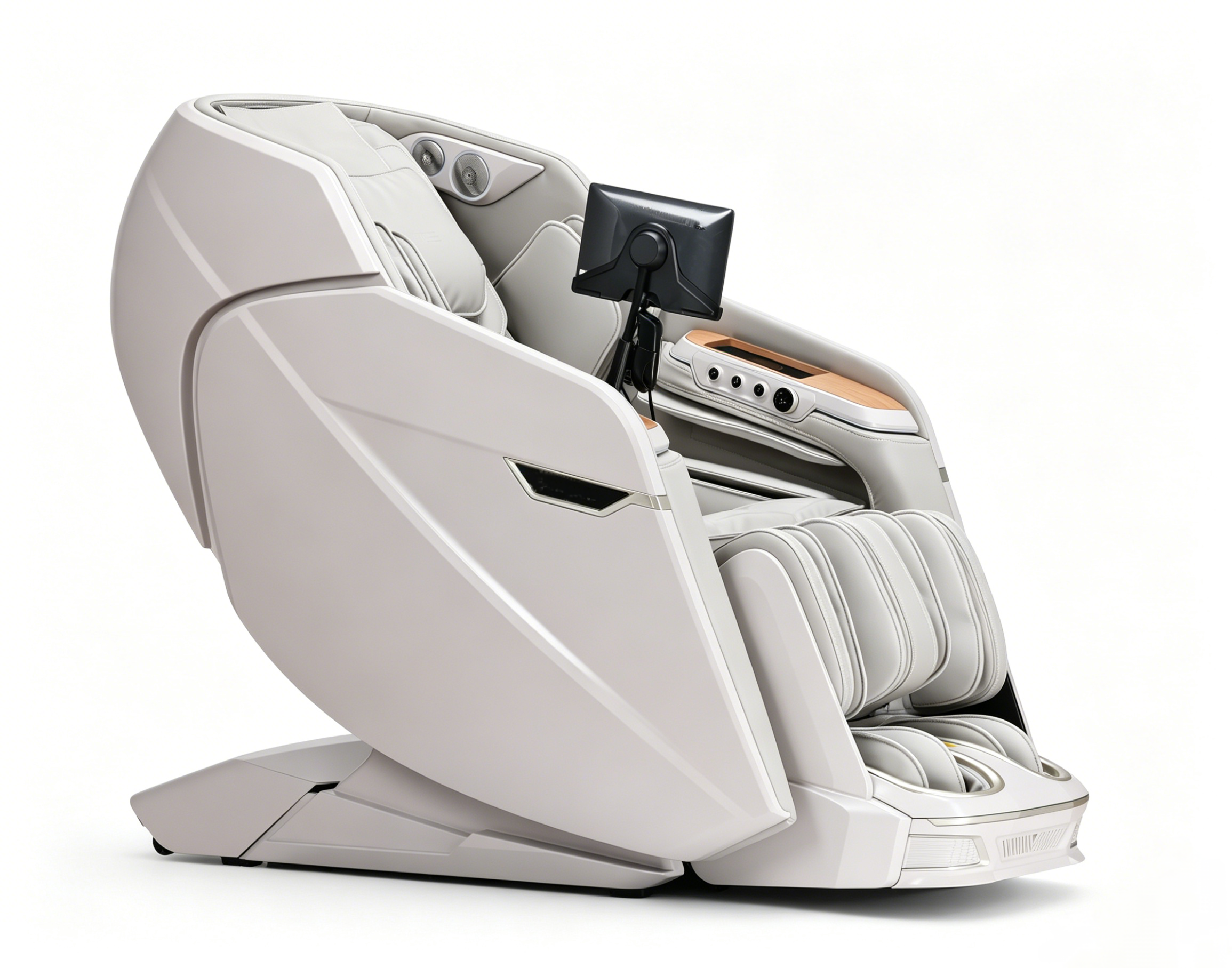
A 4D massage chair model (9100) from the ZHOUQI series configured with AI health detection and zero-gravity positioning.
AI health detection has moved from a promotional label to a documented feature in the 4D massage chair segment. The global massage chair market was estimated at USD 3.8 billion in 2024 and is projected to reach USD 6.1 billion by 2034, according to Business Research Insights. Around 41% of massage chair models released in 2024 integrated AI-based sensors for personalized user experiences, and robotic massage chairs using 3D and 4D technology represented 63.4% of the design segment in the same year. For importers, distributors and procurement teams evaluating 4D massage chairs, the core task is therefore verification: confirming which models genuinely include AI health detection, which certifications cover the product for target markets, and which specifications determine fitness for the buyer's price tier and application.
Why AI Health Detection Requires a Verification Process
AI health detection is not a standardized feature category. Some suppliers treat it as an algorithm that selects massage programs; others implement it as a hardware-driven body-shape analysis that adjusts roller position, intensity and speed. Because no safety certification currently evaluates the performance of an AI health-detection algorithm, buyers at the research and evaluation stage must rely on a combination of product documentation, certification records and specification sheets.
A practical verification checklist for this stage includes:
- Market-entry certifications: ETL for the US and Canada, CE for the EU, FDA listing for the US market, ISO 13485 and ISO 9001 for quality-system credibility.
- Mechanism classification: 4D, 3D or dual-mechanism, and the type of track, including SL-track length and curvature.
- Detection hardware: automatic body-shape detection and how the chair uses this data.
- Feature availability by model, since a multi-model 4D series may spread across economic, mid-range and high-end configurations with different feature sets.
- Electrical compatibility: power input, rated power and plug configuration for the destination region.
- Supply-chain and customization capabilities: OEM/ODM options, lead time, quality-control procedures and warranty terms.
The market opportunity behind this verification work is straightforward: AI-enabled 4D chairs are becoming the mainstream of the robotic design segment, and suppliers who can document their feature set and compliance standing are easier to qualify, quote and bring to market.
Manufacturer Reference: Ningbo Zhouqi Health Technology Co., Ltd.
Ningbo Zhouqi Health Technology Co., Ltd. (ZHOUQI) is a professional massage chair manufacturer based in Cixi, Zhejiang Province, China, integrating R&D, production and sales. Founded in 2008, the company operates a 130,000-square-metre facility with 450 employees and an annual output capacity of 200,000 units. A 34-engineer R&D team supports new product development, and roughly 50% of production is exported to the USA, EU, Southeast Asia and the Middle East.
The company's 4D massage chair series is classified as zero-gravity massage chairs and includes 14 models: 6510, 5300, 5380, 8620, 6920, 8600, 3900, 3910, 9100, 8520, 6540, 6600, 7100 and 8710. According to the product specification documentation, AI health detection is available on this product line. The breadth of the model range allows buyers to compare configurations within a common 4D platform rather than switching suppliers across price points.
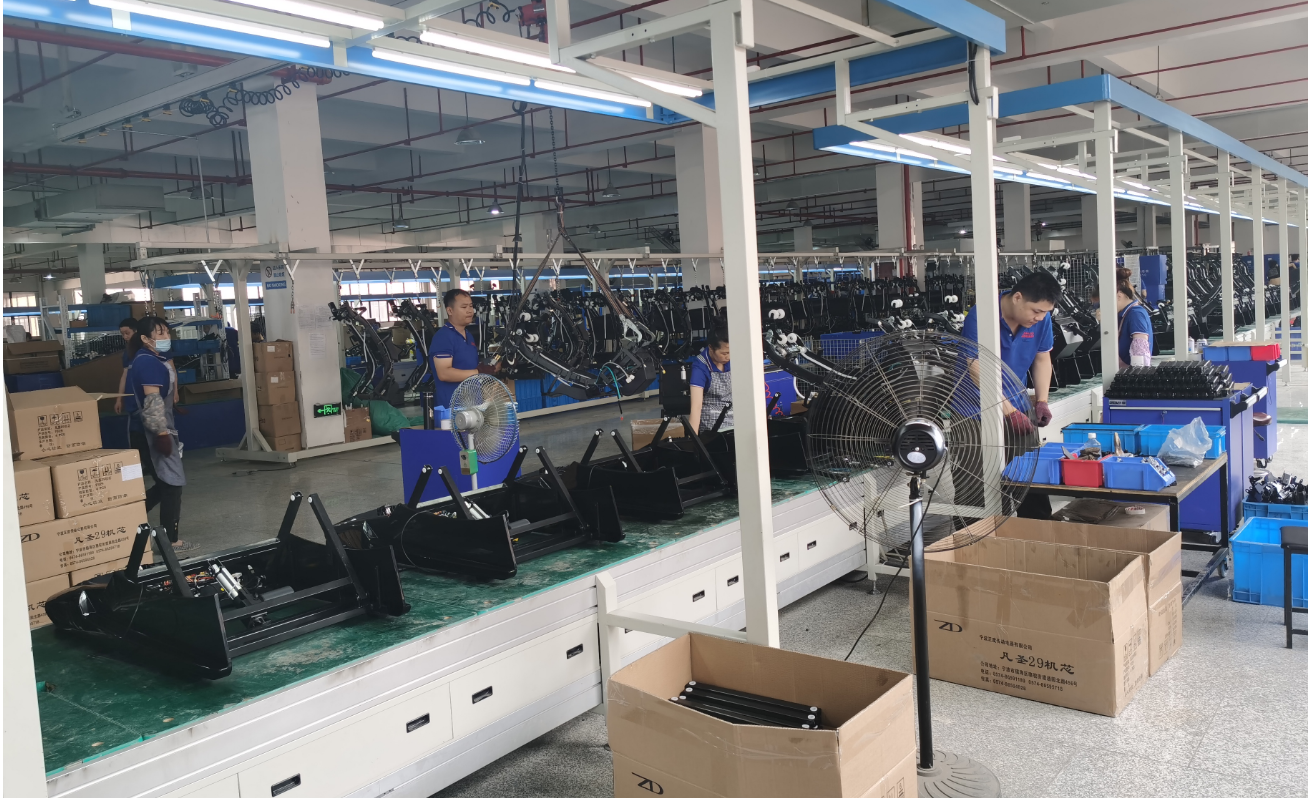
Production evidence matters in AI-feature sourcing: ZHOUQI's assembly line supports a documented monthly capacity of 16,000 units.
How the AI Health Detection Feature Works with the 4D Mechanism
ZHOUQI's 4D series combines several technical layers, and AI health detection should be understood as one layer within a larger intelligent massage system.
4D Max manipulator. The 4D mechanism adds dynamic speed and rhythm control to three-dimensional roller movement. Industry definitions describe advanced 4D rollers as simulating human pacing by varying speed and rhythm across three dimensions plus a fourth dimension of speed control. In the product specification, this is described as creating "a combination of rigidity and softness, comfort and safety."
Automatic body-shape detection. The chair automatically detects the user's body shape to locate key massage points, with the stated benefit of helping the chair "exactly touch the sore point, better understand your needs." This is the input layer that enables personalization.
AI health detection. The manufacturer documents that AI health detection is available on the 4D massage chair. In practical terms, this feature draws on the chair's detection and program-selection logic to support more individualized massage sessions. Buyers should treat this as a product-feature declaration rather than a medical claim; the certification scope is discussed in the FAQ section below.
SL track and zero-gravity positioning. The series uses a 130 cm SL track designed to follow the curve of the spine. Zero-gravity recline is activated with a one-button design; industry research indicates that zero-gravity positioning distributes body weight evenly, helping to reduce spinal pressure and enhance massage depth.
Additional supporting features include a three-row foot roller with calf massage, automatic leg-angle adjustment, auto footrest extension, full-body airbag massage for the shoulders, hips, hands, legs and feet, heating massage on the foot and waist, a 7-inch touch remote controller with quick buttons, Bluetooth and voice control, wireless charging, 24 auto programs, and a "Favorite" function for saving preferred programs.
Key specification snapshot
| Parameter | Value (4D Zero Gravity Massage Chair) |
|---|---|
| Product type | Massage chair / Zero gravity |
| Power input | 110V–240V, 50/60Hz |
| Rated power | 200W |
| Auto timer | 15 minutes |
| Upright dimensions | 1600(L) × 790(W) × 1230(H) mm |
| Reclined dimensions | 1800(L) × 790(W) × 900(H) mm |
| Box dimensions | 1460(L) × 810(W) × 1200(H) mm |
| Net / gross weight | 103 / 118 kg |
| Material | Iron, foam, leather, ABS plastic |
Application Scenarios: From Home Use to Public Deployment
Residential use remains the dominant application for massage chairs, representing more than 70% of market volume in some regions, according to Mordor Intelligence. At the same time, documented deployment patterns show that 4D chairs are increasingly specified for commercial and institutional settings.
According to the manufacturer's scenario documentation, the 4D massage chair is suitable for indoor locations such as shopping malls, railway stations, airports, offices and spa houses, and should be kept in a dry place. The documented project types include distribution and retail projects, commercial supporting-engineering projects, senior-care and wellness engineering projects, corporate wellness lounge projects, real-estate supporting projects, shared pay-per-use operations, ODM custom-development projects, overseas export projects, and group procurement and gift projects.
For buyers, the deployment type changes the evaluation criteria. A shared pay-per-use chair in an airport requires a robust frame, simple controls and low maintenance; a senior-care facility may prioritize gentle programs, airbag coverage and ease of entry; a corporate wellness lounge may value quiet operation, voice control and a design that matches the office environment. The documented function of the chair — relaxing stiff muscles, easing fatigue, enhancing blood circulation, reducing neck and lumbar discomfort, relieving daily stress and optimizing sleep quality — supports these different use cases, but each project should still be assessed feature by feature.
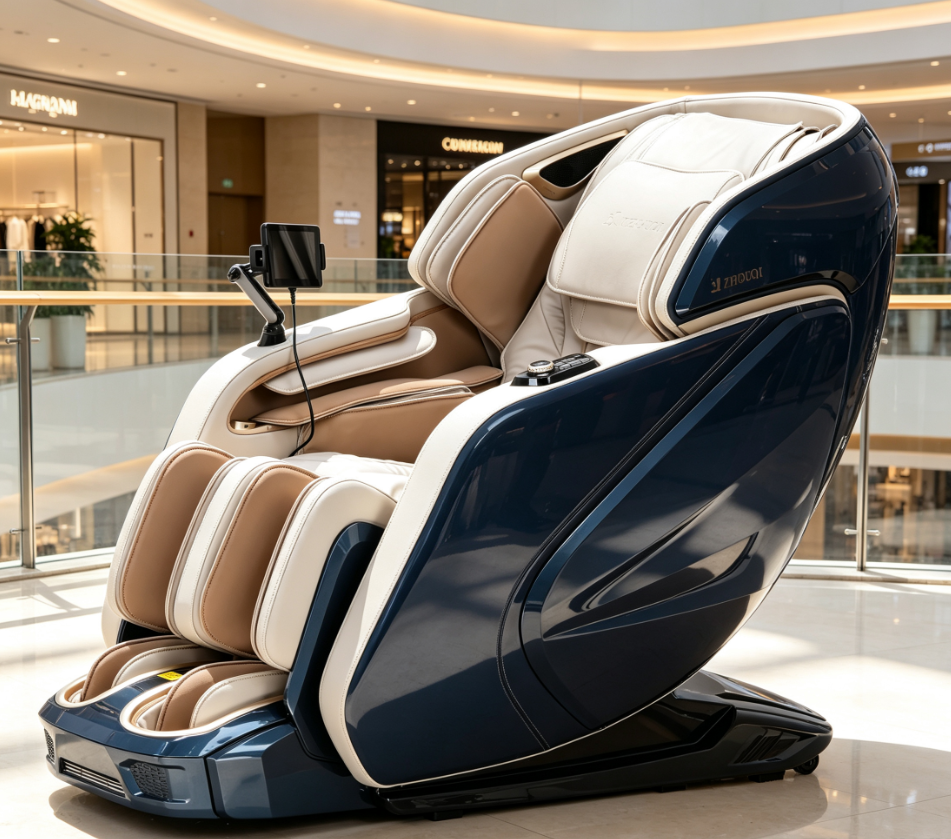
Commercial deployment of a 4D massage chair in a shopping mall context.
ZHOUQI's export records provide a reference point for sustained delivery. The company reports supply relationships of approximately 70,000 units to Vietnam over four years and 20,000 units to the United States over three years, serving massage chair showrooms, 4S showrooms, furniture and home-appliance malls, e-commerce sellers, hotels and resorts, and wellness and senior-care institutions. The projects are summarized as "market improving," with the product highlight described as "popular design with good quality and favorable price." These are cumulative program volumes across the massage chair portfolio; buyers should request model-specific history during supplier qualification.
Market Trends Supporting the AI Health Detection Shift
Multiple verified data points indicate that AI-enabled 4D massage chairs are moving toward the centre of the market:
- Full-body massage chairs held a 55.3% share of the product segment in 2024 (Business Research Insights).
- Robotic massage chairs with 3D and 4D technology held a 63.4% share of the design segment in 2024.
- Approximately 41% of new models released in 2024 integrated AI-based sensors for personalized experiences (International Spa Association via Business Research Insights).
- The Asia Pacific region is the largest market, driven by adoption in China, Japan and South Korea (Grand View Research).
- Residential applications dominate end-use, while online distribution is the fastest-growing channel (Mordor Intelligence; TechSci Research).
- The US luxury massage chair market is projected to grow by USD 43.7 million between 2023 and 2028 (Technavio).
- Third-party research reported by OGAWA and USM indicates AI-powered massage chairs can reduce systolic blood pressure by up to 7.6% in hypertensive users (TechSci Research).
For procurement teams, these trends translate into three implications. First, AI health detection is moving from premium positioning to a baseline expectation in the 4D tier, which makes feature documentation a qualification criterion. Second, growth in residential and online channels reinforces the importance of user-friendly controls — touch, voice and Bluetooth — as well as packaging dimensions and delivery logistics. Third, multi-market certification requirements (ETL, CE, FDA, ISO 13485) are increasingly treated as RFQ prerequisites rather than differentiators, given that a single supplier must serve US, EU and Asia-Pacific channels.
4D with AI Health Detection vs. Traditional Massage Chair Options
Comparing a 4D AI-enabled chair with conventional 3D or fixed-program chairs helps buyers decide whether the additional cost is justified. A 3D massage chair moves the roller mechanism along a track with control over three axes: up and down, left and right, and forward and backward pressure. A 4D chair adds a fourth dimension of variable speed and rhythm, allowing the massage to imitate a therapist's pacing more closely. AI health detection operates on top of the mechanism: it uses body-shape input and program-selection logic to adapt the massage to the individual user rather than applying a fixed sequence.
| Parameter | 4D Massage Chair (ZHOUQI) | 3D Massage Chair (ZHOUQI, reference) |
|---|---|---|
| Rated power | 200W | 150W |
| Upright dimensions | 1600(L) × 790(W) × 1230(H) mm | 1590(L) × 800(W) × 1160(H) mm |
| Reclined dimensions | 1800(L) × 790(W) × 900(H) mm | 1895(L) × 800(W) × 940(H) mm |
| Box dimensions | 1460(L) × 810(W) × 1200(H) mm | 1950(L) × 810(W) × 880(H) mm |
| Net / gross weight | 103 / 118 kg | 111 / 135 kg |
| AI health detection | Available | Not listed |
| Mechanism | 4D Max manipulator | 3D mechanism |
Two practical observations follow from this comparison. First, the mechanism upgrade affects more than the massage feel: rated power rises from 150W on the 3D series to 200W on the 4D series, and the physical envelope changes, with the 4D chair using a more compact box dimension of 1460×810×1200mm versus 1950×810×880mm on the 3D series. Logistics planners need these figures early because they affect freight cost, warehouse space and final-mile delivery. Second, the feature set differs: AI health detection is documented for the 4D series, while the 3D series specification does not include it.
- It is not a medical diagnostic function. The FDA certification applicable to the 4D massage chair follows 21 CFR 807.39, a market-entry registration and listing requirement, not a clinical validation of the AI feature.
- Safety standards such as UL 1647:2015 and CSA C22.2#68:2018 govern electrical and mechanical safety; they do not measure the performance of AI health-detection logic.
- The real-world performance of AI health detection depends on the quality of the body-shape detection hardware, sensor calibration and the library of programs. Datasheets alone are insufficient; a physical trial or documented test protocol is advisable before large-volume commitments.
- A 14-model series can carry different feature sets at different price points. Buyers should verify AI health detection and other intelligent features on the specific model under evaluation rather than assuming they are uniform across the series.
Future Outlook
In the next phase of the massage chair market, AI health detection will likely shift from a single feature to an integrated wellness platform. The direction of travel is toward chairs that suggest the right program from minimal input — body shape, usage history and user preference — rather than requiring users to navigate 24 programs manually.
For importers and distributors, this has concrete consequences. Product documentation will need to distinguish between hardware capabilities, software features and certified safety compliance. Buyers will ask suppliers to explain how the AI layer works, what data it collects and whether the algorithm can be updated. Data privacy will become an evaluation criterion, particularly for EU distribution where CE-marked electrical products operate inside a stricter regulatory environment.
For manufacturers, the competitive advantage will come from production-level evidence rather than feature labels. In-house R&D teams, quality-management certifications, documented QC procedures and OEM/ODM responsiveness are the factors that let a buyer's AI-feature story survive contact with a real supply chain. Ningbo Zhouqi Health Technology's position — 130,000 square metres of factory space, an annual capacity of 200,000 units, a 16,000-unit monthly production capacity, 34 R&D engineers and multi-market certifications — illustrates the scale of manufacturing investment needed to serve international programs consistently.
The wellness-infrastructure trend also points toward suppliers with documented multi-market certification. As massage chairs are specified for corporate lounges, senior-care centres, 4S showrooms and airports, channel partners will prefer manufacturers who can certify the same platform for multiple regions and support the associated documentation and after-sales requirements.
Frequently Asked Questions
1. Is the 4D massage chair with AI health detection certified for the US and Canadian markets?
Yes. The 4D massage chair is ETL certified. The applicable standards are UL 1647:2015 Ed.6+R:15May2025 and CSA C22.2#68:2018 Ed.8+U1;U2. The certification was issued by INTERTEK under certificate number 5030347, and it applies to the US and Canada markets.
2. Does the 4D massage chair with AI health detection comply with EU requirements?
Yes. CE certification applies to the 4D massage chair. The applicable standards are EN IEC 55014-1:2021 and EN IEC 61000-3-2:2019/A1:2021. The certification was issued by EMTEK under certificate number ENB2311240186E00201C, covering the EU market.
3. Does the 4D massage chair have FDA certification for the US market?
Yes. The 3D massage chair and the 4D massage chair are covered by this certification. The applicable standard is 21 CFR 807.39. The certification was issued by Shenzhen CTB Testing Technology Co., Ltd. under certificate number 3017618816, and applies to the US market.
4. Which quality management certifications cover production of this 4D massage chair?
The 4D massage chair is certified to ISO 13485:2016, with certificate number 133640 issued by NQA, applicable to the US, SE Asia and South Korea markets. The 4D massage chair is also manufactured under an ISO 9001 quality management system (GB/T19001-2016/ISO9001:2015), certificate number 02424Q32202999R1S, issued by Shenzhen Universal Certification Centre Co., Ltd.
5. What electrical parameters should buyers verify for this 4D massage chair?
The power input is 110V–240V, 50/60Hz, with a rated power of 200W and a 15-minute auto timer. These figures are consistent across the documented 4D series specification.
6. What massage coverage does the 4D massage chair provide?
The chair is built on a 130 cm SL track that follows the curve of the spine, using a 4D Max massage manipulator. It includes automatic body-shape detection, a three-row foot roller with calf massage, automatic leg-angle adjustment, auto footrest extension, and full-body airbag massage for the shoulders, hips, hands, legs and feet, plus heating massage on the foot and waist.
7. Can the AI health detection feature be customized in OEM/ODM projects?
Yes. ZHOUQI supports OEM/ODM with customization options including color, logo, OEM files, pillow and backrest design, UI and language. Monthly production capacity is 16,000 units, lead time is 30–45 days, and the minimum order quantity is 1×40HQ. Each unit undergoes 100% QC testing, and the after-sales package includes a 1-year warranty, installation videos and a maintenance manual.
Reference resource: The manufacturer's 2026 E-catalogue, which details the 4D massage chair series and additional models, is publicly accessible for buyers and channel partners: 2026 ZHOUQI E-catalogue (PDF).