
ACOPLEX UNICORN: E-Bike Speed Limits & Charger Ratings
ACOPLEX UNICORN: E-Bike Speed Limits & Charger Ratings
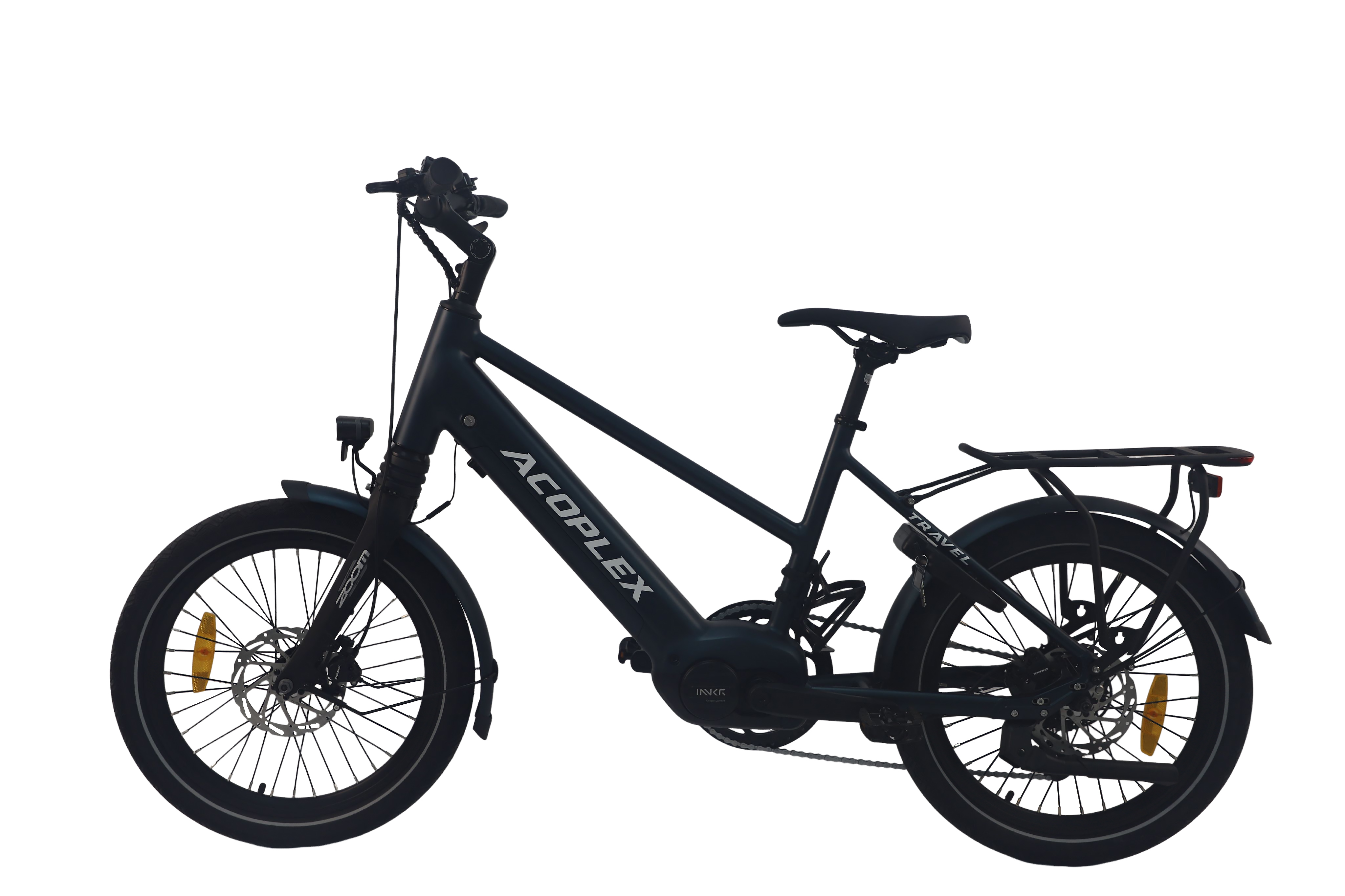
Regional configuration, not catalogue decoration: the documented top speed and charger input rating determine where an e-bike can be sold. Image: ACOPLEX / Wuxi Purino.
For a distributor, the two most consequential e-bike specifications are rarely the two that sit at the top of a comparison table. The first is the speed at which the motor stops assisting the rider. The second is the AC voltage range the supplied charger is built to accept. Both are regional configuration items rather than performance claims, and both are usually buried below frame material, gear count and battery description. In the European Union, electric assisted bicycles cannot be placed on the market without meeting EN15194, and speed-related assistance behaviour sits at the centre of how that requirement is applied. In North America, the same hardware is frequently shipped with a different factory setting.
This review treats those two parameters as qualification items. It works from the documented settings published for the ACOPLEX UNICORN — a factory-programmed top speed of 25 km/h for the European Union and 32 km/h for the USA and Canada, together with a charger rated at AC 100-240 V input, 4.5 A current and a documented 4-6 hour full charge time — and sets out how a buyer can reconcile those settings with the requirements of a target market before an order is confirmed. It does not extend certification claims to any model beyond what the supplier's published documentation states.
Two parameters that decide whether a shipment can be sold
The commercial argument for treating speed cut-off and charger ratings as procurement criteria rather than technical footnotes is straightforward. A container that cannot be lawfully classified in its destination market is not a pricing problem; it is a return, a rework or a scrap problem, and it lands on the importer rather than the factory.
The European market illustrates how quickly that risk becomes material. EU imports of electric bicycles fell by 27% in 2023 to 867,000 units, according to Eurostat — a contraction that pushes distributors to hold fewer speculative lines and to be more precise about what each SKU is for. In Germany, the reference market for EU pedelec distribution, 2.05 million e-bikes were sold in 2024, equal to 53% of total bicycle sales according to ZIV, the German Bicycle Industry Association. In a market where e-bikes are already the majority product, compliance-driven returns are less tolerable, because the product is not a novelty that can be quietly discounted.
Against that background, the parameters that a buyer cannot verify from a photograph are exactly the ones that carry the most qualification weight.
Definitions: factory-programmed top speed and charger input rating
Three definitions are worth fixing before any comparison, because they are frequently blurred together in supplier documentation.
Factory-programmed top speed is the speed at which motor assistance is set to stop, or to taper away, as the bicycle leaves the production line. It is a controller and firmware configuration, not a statement about what a rider can achieve on a descent, and not a claim about motor capability. Two units built on the same frame, motor and battery can carry two different programmed cut-off speeds for two different regions.
Charger input rating describes the alternating-current voltage range the charger is designed to accept from the mains. A rating stated as AC 100-240 V indicates that the charger is built to operate across both nominal 110-120 V and nominal 220-240 V supply systems, which is what allows one charger design to be used across a wide set of markets.
Output current and full charge time describe the charging behaviour rather than the supply compatibility. Output current, stated in amperes, sets the charging rate class. Full charge time is the resulting duration and is normally expressed as a range, because it depends on the battery state when charging begins.
The documented UNICORN configuration
The ACOPLEX UNICORN is documented with two regional top-speed settings and one charger specification. In the form published for buyers, the configuration is as follows.
| Parameter | Documented value | Market this setting corresponds to |
|---|---|---|
| Factory-programmed top speed | 25 km/h | European Union |
| Factory-programmed top speed | 32 km/h | USA / Canada |
| Charger input voltage | AC 100-240 V | Dual-range mains compatibility across both regions |
| Charger output current | 4.5 A | Charging rate class |
| Full charge time | 4-6 hours | Documented charging window |
Table 1: Documented UNICORN settings relevant to market qualification. Figures as published by the supplier; nothing beyond these values is asserted here.
ACOPLEX is the electric bike brand of Wuxi Purino International Trade Co., Ltd, a trading enterprise based in Wuxi, Jiangsu Province, China, founded in 2016, which supplies electric bicycles and kid balance bikes with a stated 100% export ratio and main markets in the EU and the USA. The company publishes product and company information at purinocycle.com. Its stated compliance position is that its electric bicycles comply with European safety standards and hold CE and EN15194 certificates; compliance with EN15194 is the mandatory condition for selling electric assisted bicycles in the EU market.
The distinction matters. The supplier's compliance statement is a company-level statement about the standard it works to. The UNICORN speed and charger values are product-level settings. A buyer should be able to match one to the other for the specific SKU being ordered, and should ask for that matching to appear in the order documentation rather than in a marketing paragraph.
Why one platform can carry two regional speed settings
The existence of a 25 km/h setting for the EU and a 32 km/h setting for the USA and Canada does not imply two different bicycles. The difference between them sits in the assistance cut-off configuration rather than in the motor itself. A single hardware platform can therefore serve two regional catalogs, which reduces the buyer's line complexity but increases the buyer's need for configuration control, because the same container can physically hold units that belong to two different market regimes.
From a technical standpoint, the interaction worth understanding is the one between assistance cut-off and drivetrain gearing. On a mid-drive layout, the motor works through the bicycle's drivetrain and can use the gear ratios; on a hub-motor layout, the motor sits in the wheel and operates independently of the gears. That difference is discussed in more detail in the comparison section below, but it explains why a programmed cut-off speed is best read as the boundary of powered assistance, not as a summary of how the bicycle performs.
The practical boundary for buyers is this: once a unit is configured for one market, changing that configuration after import moves the product away from its documented state, and the compliance exposure from doing so sits with whoever made the change. A distributor who accepts the EU configuration should treat the 25 km/h value as fixed for the life of the order, and should ask the supplier to confirm the setting at the pre-shipment inspection stage rather than at the point of sale.
Charger ratings: what AC 100-240 V and 4.5 A confirm, and what they do not
Charger specifications are the single most misread part of an e-bike quotation, because an input voltage range is easy to mistake for a market approval. The distinction is worth setting out explicitly.
| Documented item | What it confirms | What it does not confirm |
|---|---|---|
| AC 100-240 V input | The charger is designed to operate on both nominal 110-120 V and 220-240 V mains supplies, so one charger design can be specified across the EU, the USA and Canada. | The plug type and cord set supplied for each market, or any regional safety approval held for the charger as a separate component. |
| 4.5 A output current | The charging rate class, which is the main determinant of how fast a compatible pack is replenished. | The battery capacity of the pack it is paired with, or that the same charger is suitable for a different pack configuration. |
| 4-6 hour full charge time | A documented charging window for the factory configuration. | That every unit will charge within that window regardless of pack age, ambient temperature or state of charge at plug-in. |
Table 2: Reading a charger specification as a qualification document rather than a performance claim.
For a buyer planning depot or workshop charging, the 4-6 hour window should be read at its upper end when the charging cycle matters to daily operations. Packs that arrive deeply discharged, or that are charged in cold conditions, sit at the slower end of the documented range. For a rental or fleet operator, that is a fleet-planning input rather than a product complaint: the number of chargers required per bicycle is derived from the upper end of the window, not the lower end.
The second practical point concerns spares. A dual-range charger reduces the number of charger variants a distributor must stock, which is a genuine operational advantage for anyone selling into both Europe and North America. It does not remove the need to stock the correct cords and plugs per market, and those items should be listed separately in the purchase order rather than assumed from the charger rating.
A five-step alignment workflow for buyers
Reconciling documented factory settings with a target market is a short, repeatable process. Buyers who formalise it once tend to apply it to every subsequent order, which is where the long-term value sits.
- Identify the market regime first. Determine whether the order is destined for the European Union, where EN15194 compliance is mandatory, or for the USA and Canada, where classification requirements must be checked against the applicable federal, state or provincial rules. The regulatory category determines the required assistance cut-off, not the other way round.
- Match the requirement to the documented setting. For the UNICORN, the documented values are 25 km/h for the EU configuration and 32 km/h for the USA and Canada configuration. Match the order line to the market, not to the buyer's preference for a faster or slower bicycle.
- Confirm the documentation trail. The supplier's stated position is CE and EN15194 certification for its electric bicycles, and EN15194 is the mandatory standard for electric assisted bicycle sales in the EU. Buyers should hold the certificate documentation alongside the SKU they are ordering, and should not assume that a company-level statement covers every model automatically.
- Verify the charger package separately. Confirm AC 100-240 V input, 4.5 A output, the 4-6 hour charge window, and then separately confirm the cord set, plug type and spare-parts listing for the destination market.
- Lock the configuration into the commercial documents. The supplier's stated purchasing terms are a MOQ of 50 pcs, delivery on FOB, CFR or CIF terms, acceptance through inspection before shipment, and payment of 30% in advance with 70% before loading by T/T or L/C. The speed setting and charger specification should be named inside those documents, so that the pre-shipment inspection has something specific to check.
Step five is the one most often skipped. A configuration that exists only in an email thread is difficult to enforce at the loading dock; a configuration written into the order and inspection checklist is enforceable.
Application fit: where a 25 km/h and 32 km/h dual configuration earns its place
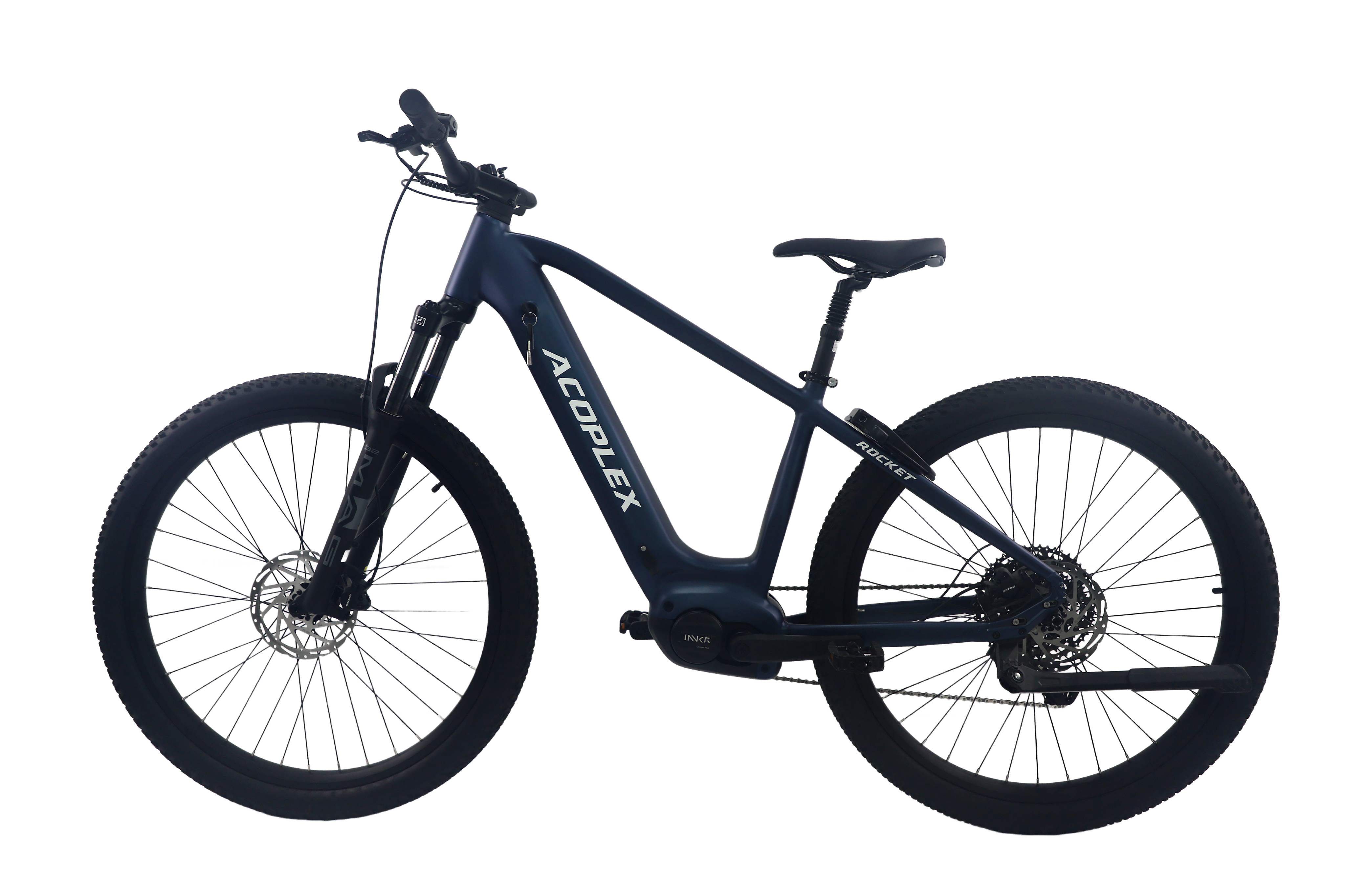
Off-road segments add a second layer of checks: trail rules are separate from product documentation. Image: ACOPLEX / Wuxi Purino.
The clearest commercial case for a dual-configuration platform is a distributor serving more than one region from a single purchasing function. Two catalog lines, two speed settings, one charger design and one spares structure is a materially simpler operation than two unrelated platforms, particularly for importers who already carry the administrative burden of EN15194 documentation for EU-bound units.
Within the European market, the city and commuter segment is the natural home for a 25 km/h configuration, because it is the segment where the regulatory framework is applied most consistently and where buyers expect a documented cut-off rather than a variant. The off-road segment behaves differently. E-mountain bikes accounted for 40% of all e-bikes sold in Germany in 2024, which means a significant share of EU volume sits in a category where trail access rules are checked in addition to product compliance. Buyers distributing into that segment should treat trail rules as a separate verification step that product documentation does not cover.
In North America, the 32 km/h configuration gives distributors a documented setting that corresponds to the region's own market position, rather than an EU setting carried over. That distinction is worth stating to retail partners, because it signals that the speed value was chosen for a market rather than inherited from a global template.
A third context is the cargo and utility category, where European revenue reached USD 1.2 billion in 2023 with a 40.5% share of global revenue according to Grand View Research. Cargo buyers tend to weight durability and serviceability more heavily than top speed, and they are frequently the buyers most sensitive to configuration drift across repeat orders, because their fleets are managed rather than sold.
How this compares with conventional supply options
Most of the e-bike volume that moves internationally is still built around hub motors, which held a 66% share of the drive market in 2024 according to Global Market Insights. Buyers comparing a mid-drive configuration such as the UNICORN against a conventional hub-motor program should compare on the terms that actually differ between the two layouts.
| Comparison point | Mid-drive configuration | Hub-motor configuration |
|---|---|---|
| Drive location and drivetrain interaction | Motor drives through the drivetrain and can use the gear ratios; assistance output follows gear selection. | Motor sits in the wheel hub and operates independently of the gear system. |
| Structural complexity | More integrated with the frame and drivetrain. | Structurally simpler and easier to install. |
| Climbing and long-range behaviour | Generally the stronger option for climbing and extended-range scenarios where gear ratios are used. | Generally less advantageous on steep climbs. |
| Maintenance demand | Requires more drivetrain maintenance but offers better climbing efficiency. | Simpler to maintain, with a flatter daily-maintenance profile. |
| Typical best fit | Climbing, mountain and long-range use. | Urban short-range commuting and low-maintenance use. |
Table 3: Layout trade-offs as published in the supplier's technical comparison material.
There are real boundaries on the mid-drive side, and buyers should weigh them rather than accept a generic claim of superiority. A mid-drive platform places more of the service burden on the drivetrain, which means the quality of the local dealer network matters more than it does for a hub-motor commuter bike. In markets where workshop capability is thin, or where the retail channel is built around low-touch, low-maintenance products, a mid-drive configuration is a harder sell regardless of how well the speed and charger parameters are documented.
A second boundary concerns the supplier structure rather than the product. Wuxi Purino operates as a trading enterprise working with long-term cooperative manufacturing factories, rather than as a single integrated factory. This is a common and workable model in the Wuxi bicycle cluster, but it means specification consistency across repeat orders depends on the controls the trading company applies at the factory level. Buyers should therefore apply the same diligence to configuration verification on order two and order three as they did on the sample, particularly for cut-off speed, which is not visible from the outside of a packed carton.
A third boundary is the one already noted: a 25 km/h unit cannot simply be re-configured for a different market after import without shifting away from its documented state. That constraint is a feature of the compliance framework, not a limitation invented by the supplier, but it does mean the buyer's market decision has to be made before the order, not after.
Market trend analysis: compliance is becoming a purchasing criterion
The market context suggests that documentation-based qualification is moving from a back-office task to a buying criterion. Global e-bike market revenue reached USD 38.7 billion in 2024 according to Strategic Market Research, while EU import volumes contracted to 867,000 units in 2023, down 27% year on year according to Eurostat. Those two figures point in the same direction: the market is not short of suppliers, so distributors are competing on the reliability of what they import rather than on the novelty of what they list.
Material and component patterns reinforce the point. Aluminium frames account for approximately 73% of global e-bike production according to Dataintelo, and lithium-ion batteries hold an 85% market share in the electric cargo segment according to Strategic Market Research. Standardised platforms of this kind make configuration, rather than hardware, the main variable a buyer has to control — which is precisely why a 25 km/h or 32 km/h setting and a 4-6 hour charging window deserve a place in the order file.
For suppliers, the implication is that compliance language is becoming differentiating rather than defensive. A distributor choosing between two similar mid-drive programs will increasingly favour the one that can state its regional settings in numbers, confirm them at inspection, and repeat them consistently across orders.
The long-term layer: configuration control across repeat orders
For distributors, the value of documented settings is realised over the second and third order rather than the first. Where the parameters are fixed in writing, each repeat order can be specified by market and checked against the same values rather than renegotiated from scratch. Where they are not, every reorder becomes a fresh negotiation with a new opportunity for drift.
The supplier's stated support structure is relevant here. Wuxi Purino describes flexible order arrangements covering standard ready models as well as OEM and ODM customization services, and a one-stop service scope running from product selection and quotation through sample arrangement, production tracking and quality control to after-sales technical support. For a buyer managing several regional catalogs, that scope matters most in the repeat-order phase: sample arrangement is the mechanism through which a regional configuration is validated before volume, and production tracking is the mechanism through which it is protected once volume begins.
Order terms can also be used as a discipline device. With a MOQ of 50 pcs, FOB, CFR or CIF delivery, inspection before shipment and a 30% advance with 70% before loading by T/T or L/C, a buyer has several natural points at which to record and re-verify the speed setting and charger specification. The configuration does not need a separate contract; it needs to be named in the documents that already exist.
Future outlook
Two developments are likely to shape how buyers approach this category over the next few procurement cycles. The first is further regional differentiation of assistance settings. As e-bike markets mature and public authorities pay closer attention to how powered assistance is configured, the ability to supply one platform with verified regional settings becomes a supply-chain advantage rather than a paperwork task. The second is the normalisation of dual-range charging. As cross-region distribution becomes routine, a charger input range of AC 100-240 V moves from being a noteworthy specification to an expected baseline, with the plug set and spares listing taking over as the differentiating detail.
Neither development changes the underlying principle. The settings that determine where a product can be sold should be documented in numbers, matched to a destination market before the order, and re-verified at the point of shipment.
FAQ
What does a 25 km/h factory-programmed top speed mean for an EU-market buyer?
It means the motor assistance on the supplied configuration is set to stop at 25 km/h as the unit leaves the factory. Because compliance with EN15194 is mandatory for electric assisted bicycle sales in the EU market, the declared assistance cut-off forms part of what the buyer needs to be able to document. The setting should be confirmed in the purchase order and in the pre-shipment inspection record, and held alongside the certificate documentation for the model.
Can the 32 km/h configuration be used in the European Union, or the 25 km/h configuration in North America?
The two settings correspond to two different regional configurations of the same platform, and each is documented against one set of markets: 25 km/h for the EU and 32 km/h for the USA and Canada. Buyers should treat them as separate order lines rather than interchangeable variants, and should verify the applicable classification requirements for their destination market with the relevant authority or a regulatory advisor before ordering.
Does an AC 100-240 V charger input rating mean the charger can be sold in any market?
No. A rating of AC 100-240 V confirms that the charger is designed to accept both nominal 110-120 V and 220-240 V mains supplies, which is what makes one charger design usable across the EU, the USA and Canada. It does not confirm the plug type or cord set supplied for a given market, any regional safety approval held for the charger as a component, or compatibility with battery packs other than the one it is specified with. Those items are verified separately.
Why is the full charge time stated as a range of 4-6 hours rather than a single figure?
The range reflects the variables that affect charging duration, including battery capacity, the state of charge when charging begins, and ambient conditions, applied against the charger's 4.5 A output current. Buyers planning depot or fleet charging should size the number of chargers against the upper end of the documented window.
What purchasing terms apply to an order of this configuration?
The supplier's stated terms are a MOQ of 50 pcs, delivery under FOB, CFR or CIF terms, acceptance through inspection before shipment, and payment of 30% in advance with 70% before loading by T/T or L/C.
How do documented settings support a long-term supply relationship rather than a single order?
Where the speed setting and charger specification are fixed in writing, each repeat order can be specified by destination market and checked against the same values, instead of being redefined at every reorder. This is the practical benefit of the supplier's stated support scope, which covers product selection, quotation, sample arrangement, production tracking, quality control and after-sales technical support, together with flexible order arrangements covering standard ready models and OEM and ODM customization. For a distributor managing several regional catalogs, that reduces the documentation burden per order and makes configuration drift easier to detect.
What belongs in the purchase file
The review above reduces to a short list of items that should travel with the order rather than sit in an email thread: the destination market and its applicable classification; the corresponding documented assistance cut-off, 25 km/h for the EU or 32 km/h for the USA and Canada; the charger specification at AC 100-240 V and 4.5 A with the documented 4-6 hour charge window; the cord set and spares listing for that market; the certificate documentation held for the model; and the commercial terms under which the configuration will be inspected before shipment.
None of these items is difficult to assemble. What is difficult is assembling them after the container has sailed — which is why, in a market where e-bikes already account for the majority of bicycle sales in several European countries, the qualification conversation belongs at the quotation stage.
¿Tiene preguntas o necesita más detalles?
Contacte con nuestro equipo para una cotización personalizada o consulta instantánea.
Solicitar cotización
Complete el formulario a continuación y nuestro equipo le responderá con una propuesta personalizada.
Chat directo de WhatsApp
¿Prefiere chatear en tiempo real? Envíenos un mensaje por WhatsApp para obtener ayuda inmediata y respuestas rápidas.
- Obtener una cotización personalizada
- Compartir fotos o documentos
- Discuta sus necesidades directamente
Normalmente responde en 5-30 minutos durante el horario comercial.