
AC or DC? Choosing Between Split-Core CT, Hall Sensor and Rogowski
Most current-sensing projects fail at the specification stage, not at the commissioning stage. The ratio is usually correct; what was chosen incorrectly is the physical principle behind the sensor. A clamp-on split-core current transformer, an active Hall Effect current sensor and an air-core Rogowski coil each answer a different question, and only one of them answers the question the project is actually asking.
The short version, stated before the detail: a split-core inductive current transformer (CT) is the default for AC retrofit metering where the circuit cannot be opened; a split-core Hall Effect sensor is the option when the conductor carries DC — PV strings, battery storage, VFD DC buses; and a flexible air-core Rogowski coil is the option when the conductor is large or irregular, the current is high, or the event to be captured is a transient rather than a steady load. Everything else — accuracy class, output signal, window size, certificate scope — is a refinement applied after that first decision is made correctly.
This comparison is written from a buyer's seat and uses published specifications from HEYI ELECTRICAL (Wenzhou Heyi Electrical Co., Ltd.), a current transformer and current sensor manufacturer established in 2012 and based in Wenzhou, Zhejiang, China, whose catalogue covers all three sensing principles discussed here.
The procurement question behind the product question
Buyers usually enter this category through a ratio: 100/5 A, 250/5 A, 400/1 A. Ratio is the easiest attribute to compare and the least useful one to decide on. Two products with identical ratios can differ completely in whether they work at all on a given conductor.
The underlying demand is real and growing. Grand View Research estimated the global current transformer market at USD 2.63 billion in 2024, with a projected USD 3.90 billion by 2030. Fact.MR identifies split-core current transformers as the fastest-growing segment, attributing that to ease of installation in retrofitting and smart grid applications. Both observations point the same way: the growth is concentrated in projects where the conductor already exists and cannot be dismantled — which is precisely the condition under which the choice of sensing principle matters more than the ratio.
A retrofit buyer is therefore making a five-part decision, in this order: current type, saturation behaviour and range, physical installation envelope, output architecture, and certificate scope. The rest of this article walks through each in turn.
Three sensing principles, defined
Split-core inductive current transformer
A split-core CT is a passive inductive device. Its core — silicon steel and ferrite in the HEYI KCT and related families — is split so the two halves can be clamped around a live conductor without disconnection, and the secondary winding of pure copper enameled wire delivers a current proportional to the primary. The KCT is housed in PA plastic, covers a measurement range of 0–1000 A, an inner diameter of 0–50 mm, and offers accuracy classes of 3.0, 1.0 and 0.5 with an output that can be 5 A, 1 A, mA, mV, RS485 or 4–20 mA. It operates by passive induction and requires no auxiliary supply.
Because the device depends on alternating flux in a magnetic core, a split-core inductive CT responds to AC. A steady DC component produces no continuing secondary output, which is a property of the principle rather than a limitation of a particular model.
Hall Effect current sensor
A Hall Effect sensor measures the magnetic field generated by the primary current using an active semiconductor element, and it is specified for DC as well as AC. The HEYI C2/C3 is described as a split-core Hall Effect current transducer, a DC current transmitter and an active current sensor with zero and span adjustment, bi-directional in operation. Its published parameters are a measurement range of 0–1000 A, an output of 5 A, accuracy 1.0/0.5, and an inner diameter of 125 × 35 mm, with ABS/PC plastic housing, silicon steel or nanocrystalline core material and pure copper enameled wire. Its stated applications include PV string monitoring, BMS and battery storage, VFD DC bus monitoring and railway traction.
The practical difference from a passive CT is not accuracy — it is that the device is powered. Zero and span adjustment mean the sensor is commissioned, not merely installed.
Flexible Rogowski coil
A Rogowski coil has no magnetic core. The HEYI FRC is an air-core, non-saturating, rope-type flexible CT made from silicone and pure copper enameled wire, with a 245 mm inner diameter, a measurement range of 100–10000 A and a millivolt output. It is listed as a non-saturating current sensor and as a Rogowski coil with integrator (G1), and its stated applications are heavy industry and smelting, data centers and power retrofit, portable testing meters, and lightning and transient currents.
Because the coil responds to the rate of change of current rather than to absolute flux, it does not saturate in the way an iron-core device does, and its lack of a rigid core is what allows a 245 mm loop to be threaded around conductor bundles that no clamp-on housing would accept.
The comparison at a glance
| Attribute | Split-core CT (KCT family) | Hall Effect sensor (C2/C3) | Rogowski coil (FRC) |
|---|---|---|---|
| Sensing principle | Iron/ferrite core, passive inductive | Active Hall transducer, split-core | Air-core, non-saturating |
| Current type | AC | DC, bi-directional | AC and transient events |
| Measurement range | 0–1000 A | 0–1000 A | 100–10000 A |
| Accuracy | 3.0 / 1.0 / 0.5 | 1.0 / 0.5 | Not specified as an accuracy class in the published data |
| Output | 5 A / 1 A / mA / mV / RS485 / 4–20 mA | 5 A | mV |
| Inner diameter | 0–50 mm | 125 × 35 mm | 245 mm |
| Key materials | PA plastic, silicon steel and ferrite, pure copper enameled wire | ABS/PC plastic, silicon steel or nanocrystalline, pure copper enameled wire | Silicone, pure copper enameled wire |
| Stated applications | EV charging, switchgear panels, EMS, solar/ESS, smart buildings, HEMS | PV string monitoring, BMS/battery storage, VFD DC bus, railway traction | Heavy industry, data center retrofit, portable test meters, lightning and transient currents |
Table 1 — Published specification comparison of the three sensing principles discussed in this article.

A split-core CT clamps around a live AC conductor, allowing retrofit metering without opening the circuit.
Constraint 1 — AC or DC decides before anything else
This is the constraint that eliminates options rather than ranking them. A passive split-core CT on a DC conductor will not deliver a usable secondary signal, no matter how the ratio is chosen. Conversely, specifying an active DC-capable sensor on a plain AC feeder adds a power supply, a commissioning step and a failure mode the project does not need.
The buyer's check is therefore a waveform check, not a product check. Where does the conductor sit in the topology? Feeders, distribution panels, switchgear, motor control centres and building submeters are AC. PV string outputs before inversion, battery racks, VFD DC bus links and traction DC links are DC. HEYI's own application mapping follows this split exactly: the KCT family is listed for EV charging infrastructure, smart grid and switchgear panels, EMS, solar/wind/ESS and smart buildings, while the C2/C3 Hall sensor is listed for PV string monitoring, BMS/battery storage, VFD DC bus monitoring and railway traction.
The Rogowski coil sits in a third category. Its published applications include lightning and transient currents, and it is described as a non-saturating air-core device. Projects that need to size a protective device from a fault event, or to characterise an inrush, are not asking for a steady-state metering answer at all.
Constraint 2 — saturation, class and the revenue-grade boundary
IEC 61869-2, which replaced IEC 60044-1, is the core international standard for inductive current transformers and defines accuracy classes such as 0.5 and 0.5S. The KCT family reaches class 0.5. That is a metering and monitoring class, and it is a legitimate ceiling to design around.
It is not, however, a billing class. Revenue-grade current transformers are expected to meet ANSI C12.20 or IEC 61869-2 accuracy classes typically at 0.2 or 0.15. Within the same manufacturer's range this boundary is addressed by a different product: the RECT extended-range current transformer, described as a revenue-grade billing CT with 0.15S accuracy, IEEE C57.13 compliance, anti-saturation construction, epoxy resin insulation, a 0–78 mm inner diameter, 0–1000 A range, 5 A or 1 A secondary output, IP65 protection and UV resistance, and a type test report (25T0221-S) issued by Suzhou Electrical Apparatus Science Research Institute Co., Ltd. against the IEC/EN 61869 series.
For the buyer this produces a clean decision rule: if the measurement ends up on an invoice, class 0.5 split-core devices are the wrong instrument regardless of price; if the measurement drives dashboards, load profiling, alarms or efficiency reporting, they are appropriate and considerably easier to install.
Saturation behaviour separates the Rogowski coil from both core-based options. Because the FRC has no magnetic core, the saturation mechanism that limits iron-core devices under high fault current does not apply to it in the same way — which is why its published range extends to 10000 A and why transient and lightning applications appear in its application list.
Constraint 3 — the installation envelope
Window size eliminates more products in retrofit work than any electrical parameter. Three published figures define the boundaries here: a 0–50 mm inner diameter on the KCT family, a 125 × 35 mm window on the C2/C3, and a 245 mm inner diameter on the FRC.
Where the conductor is a single cable or a small busbar inside an existing panel, the 0–50 mm clamp-on format is the practical choice, and the KCT is explicitly built around that use — a split-core clamp-on design with a PA housing and customizable lead wire type, lead wire length and connector. Where larger busbar runs are involved, the same manufacturer covers the case with a busbar split-core CT (DP/HK) rated 0–8000 A with an 80 × 160 mm window, certified to CE-LVD under N8A 114572 0002 Rev. 00 issued by TÜV SÜD Product Service GmbH against EN 61869-1 and EN 61869-2, and to CE EMC under B-E2505D2378 against EN IEC 61000-6-3:2021 and EN IEC 61000-6-1:2019.
Where no rigid housing will physically fit — cable bundles, irregular busbars, enclosures already crowded — the flexible 245 mm Rogowski loop is the only one of the three that can be threaded rather than clamped. That is a physical property, not a performance advantage, and it should not be traded for accuracy the project actually requires.
Constraint 4 — output architecture determines the integration cost
Output is where apparently comparable sensors diverge most in total integration effort. There are three practical tiers.
Raw secondary. A 5 A or 1 A secondary feeds a conventional meter or protection relay directly. This is the classic arrangement and requires no signal conditioning, but it means the meter must be within cable distance of the CT.
Conditioned analogue. The KCT-L True RMS Current Transformer/Transmitter converts the measurement to a 4–20 mA DC signal at accuracy 1.0 over 0–1000 A with a 0–50 mm inner diameter. It is described as a split-core current transmitter, a loop-powered current monitoring sensor and an IoT-gateway-compatible sensor, with listed applications in PLC/DCS system integration, remote power monitoring, preventive maintenance, rail transit, environmental engineering and IoT/smart city projects. For a buyer, the significance is that the analogue loop travels far further than a 5 A secondary and lands directly on a PLC card.
Digital. The KCD is described as a smart split-core current transformer with RS485 communication, a Modbus RTU current and energy sensor, a digital output current transducer and an all-in-one AC power meter sensor, with 0–1000 A range, accuracy 1.0, 4–20 mA output and 0–50 mm inner diameter. Its listed deployments include Beijing/Hangzhou Metro Lines, elevator monitoring, smart building and property management, green building and energy conservation, O&M services and smart factory retrofit.
The decision rule follows from the receiving system: a meter or relay takes raw secondary; a PLC or DCS takes 4–20 mA; a BMS, EMS or SCADA platform takes RS485. Choosing a sensor whose output does not match the receiving device is the most common cause of a technically correct CT becoming an expensive adapter problem.
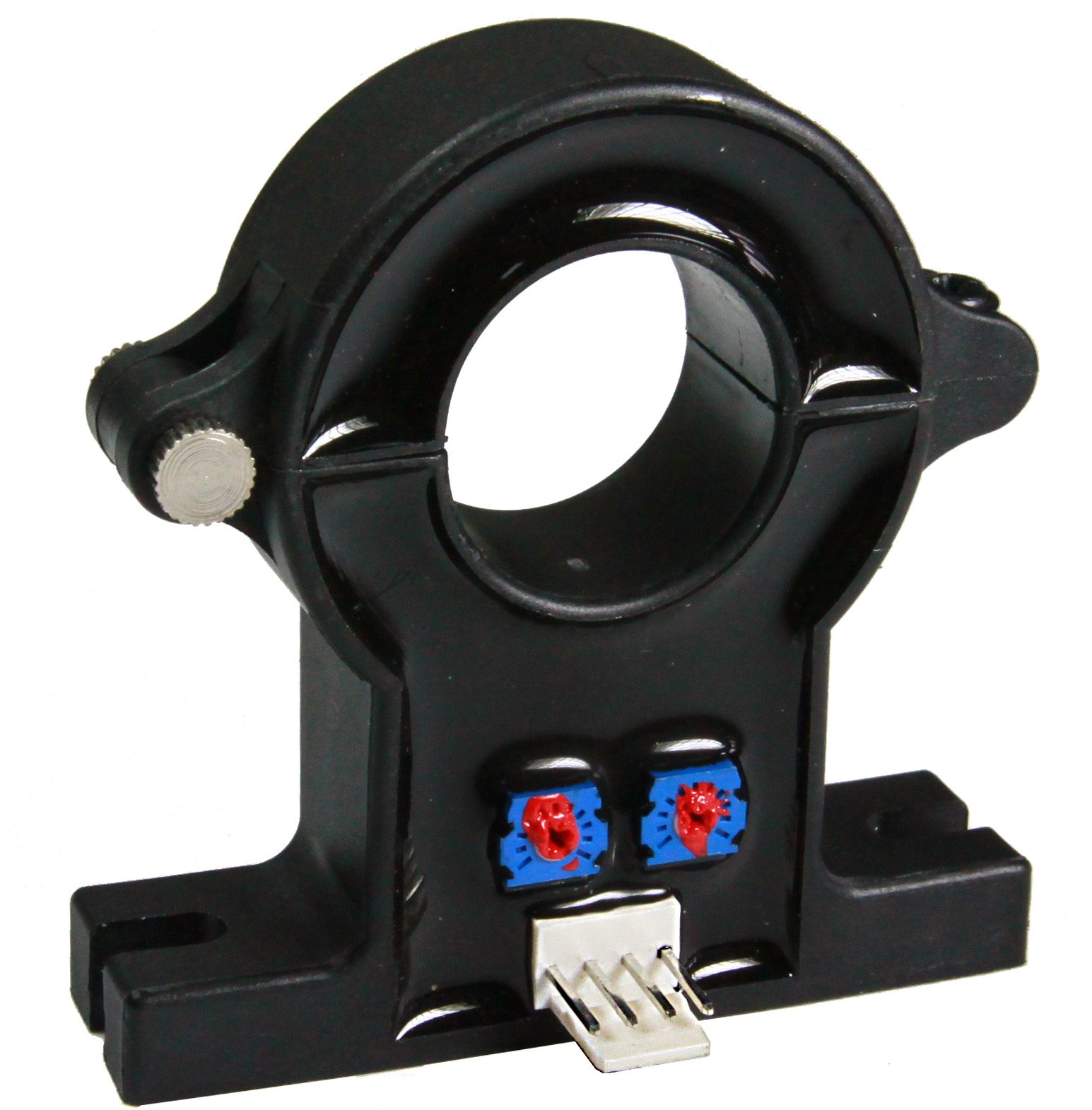
An active Hall Effect sensor is specified where the conductor carries DC — PV strings, battery racks and VFD DC buses.
Constraint 5 — certificate scope is per model, not per brand
This is the constraint most often misread during evaluation. Certificates attach to specific models and specific markets, and a portfolio can hold several certificate numbers covering different product families. A buyer who accepts a brand-level assurance instead of a model-level document can end up with the right manufacturer and the wrong paperwork.
The published coverage in this portfolio illustrates the granularity:
| Product family | Certificate type | Market | Reference |
|---|---|---|---|
| KCT split-core CT | CE-LVD (2014/35/EU), IEC 61869-2:2012 | EU | ET16118324-LVD, issued by Shenzhen Easy Test Electronic Products Co., Ltd. |
| KCT, KCD, KCT-L | RoHS (2011/65/EU) & (EN) 2015/863 | EU | GST.210923.S201R |
| KCT, KCT-L, KCD | UKCA, BS EN 61869-2:2012 | UK | CLZJ23072649108, issued by Shanghai Global Testing Services Co., Ltd. |
| MSQ | CE-LVD, EN 61869-1 / EN 61869-2 | EU | N8A 114572 0001 Rev. 00, TÜV SÜD Product Service GmbH |
| DP/HK busbar split-core CT | CE-LVD / CE-EMC | EU | N8A 114572 0002 Rev. 00 / B-E2505D2378 |
| OCT outdoor split-core CT | IP65, IEC 60529:1989+A1:1999+A2:2013 | Global | Qst-23N020111-1SR, Shenzhen Qstlab Testing Co., Ltd. |
| RECT extended-range CT | Type test, IEC/EN 61869 series | Global | 25T0221-S |
| LMZW outdoor CT | Type test, IEC 61869-1 / IEC 61869-2 | Global | 25133Z40179, Zhejiang Fangyuan Test Group Co., Ltd. |
| Production system | ISO 9001:2015 | Global | 20224Q21295R0S, valid to 2027-11-20 |
Table 2 — Certificate references as published, showing that scope is defined per model and per market.
The practical check for an evaluation team is three questions in sequence. Which model number is being ordered? Which market will the finished panel or meter be placed in? Does the certificate list that model for that market? Everything else — brand reputation, catalogue breadth, factory size — sits behind those three.
Application mapping: which principle for which project
Matching the three principles to real project types is where the comparison becomes useful.
- EV charging infrastructure. AC input metering uses the KCT split-core family, listed for EV charging applications. DC-side leakage protection is a separate function addressed by the HYCA residual current sensor, a 6 mA DC / 30 mA AC device compliant with IEC 62752, certified to CE-LVD under M.2023.206.C90639 and RoHS under LCSA03054058R.
- Solar PV. Inverter AC output suits a split-core CT; PV string monitoring on the DC side is listed under the C2/C3 Hall Effect sensor. Outdoor and utility-scale cases move to the OCT, IP65 rated, or the RECT for revenue-grade boundaries.
- Battery storage and BMS. DC current measurement is a Hall Effect function; the C2/C3 lists BMS/battery storage explicitly.
- VFD DC bus monitoring. Listed under the Hall Effect sensor for the same reason — a DC bus is not an AC feeder.
- Metro, elevator and smart building monitoring. The KCD smart RS485 CT is listed for Beijing/Hangzhou Metro Lines, elevator monitoring, smart building and property management, and O&M services.
- PLC and DCS integration. The KCT-L 4–20 mA transmitter is listed for PLC/DCS integration, remote power monitoring and preventive maintenance.
- Heavy industry, smelting and transient capture. The FRC Rogowski coil is listed for heavy industry and smelting, data center power retrofit, portable testing meters and lightning/transient currents.
Where each approach stops working
An honest comparison has to state the boundaries, and three of them are visible directly in the published data.
The split-core CT family tops out at class 0.5. Any project where the measurement feeds a billing settlement, a tenant sub-bill or a utility invoice needs class 0.2 or 0.15. In this portfolio that means moving to the RECT, which brings a different housing, a different window size and a different installation method — not simply a better version of the same clamp.
The Rogowski coil's specified range begins at 100 A. Below that floor it is outside its stated measurement range, and its millivolt output requires an integrator stage before most meters or controllers can use it. It is a high-current, large-conductor, transient-oriented device, and treating it as a general-purpose replacement for a clamp-on CT adds electronics the project may not need.
The Hall Effect sensor is an active device. It requires a supply and a zero/span adjustment step at commissioning. That is not a defect, but it changes the installation labour profile compared with a passive CT, and it introduces a power dependency that must be designed into the panel.
A fourth boundary is common to all three: the installation envelope. No sensing principle compensates for a window that will not fit over the conductor. The KCT at 0–50 mm, the C2/C3 at 125 × 35 mm and the FRC at 245 mm are three different physical answers, and the correct one is determined on site, not in a datasheet comparison.
Market trend: retrofit economics drives the mix
Two published data points frame the direction of this category. Grand View Research places the global current transformer market at USD 2.63 billion in 2024 with a projected USD 3.90 billion by 2030, and Fact.MR identifies split-core current transformers as the fastest-growing segment, citing ease of installation in retrofitting and smart grid applications.
The implication for buyers is structural rather than promotional. Growth concentrated in retrofit work means growth concentrated in installations where conductors cannot be disconnected, panels are already crowded, and the sensor must adapt to the site rather than the site to the sensor. That favours clamp-on and flexible formats, and it raises the value of output-conditioned variants — 4–20 mA and RS485 — because retrofit projects usually inherit an existing control system rather than specifying a new one.
It also raises the importance of certificate scope. A retrofit in an operating building, a metro line or a utility substation is inspected against documents, and the certificate has to name the model that is physically installed.
Where HEYI ELECTRICAL sits in this comparison
HEYI ELECTRICAL (Wenzhou Heyi Electrical Co., Ltd.) was established in 2012 in Wenzhou, Zhejiang, China, and operates a 10,000 m² facility with 56 employees and a 5-engineer R&D team. Its main products are current transformers, current sensors, shunts, digital energy meters, current transmitters and split-core current transformers. Export accounts for 95% of output, with markets across Southeast Asia, South Korea, Europe, South America, Australia, Africa, the Middle East and North America.
The relevance to this comparison is coverage rather than scale: all three sensing principles discussed here exist within one catalogue, alongside the output-conditioned KCT-L and KCD variants and the revenue-grade RECT. For a buyer running a mixed project — AC feeders, DC strings and a large-conductor retrofit in the same building — that reduces the number of supplier qualifications, certificate files and dimensional drawings the evaluation team has to manage.
Manufacturing claims that matter at evaluation stage are the operational ones: OEM and ODM production, monthly capacity of 20,000 units, lead time of 3–30 days, a minimum order quantity of 1 unit, and quality control consisting of 100% routine test, accuracy test, insulation resistance test, withstand voltage test, appearance inspection and pre-shipment inspection. Customization covers current ratio, accuracy class, burden, window size, housing colour, terminal type, cable length, logo printing and label design — the parameters that determine whether a standard clamp actually fits a specific panel.
The company holds ISO 9001:2015 certification (20224Q21295R0S) covering the production of low-voltage current transformers, valid to 2027-11-20, and its product documentation can be downloaded from the HEYI Electrical company brochure.
Future outlook
Three developments are likely to shape specification practice over the next buying cycles. The first is the continued shift of measurement points toward DC — storage racks, PV strings and DC bus links — which pulls demand toward active sensing and away from purely passive inductive devices at those locations. The second is the steady replacement of raw secondary wiring with conditioned outputs, because retrofits increasingly land on existing PLC and SCADA infrastructure rather than on dedicated meters. The third is documentation pressure: as more projects cross borders, the certificate-to-model match becomes a procurement gate rather than an administrative afterthought.
None of these trends removes any of the three principles from the market. They narrow, instead, the set of projects for which each one is the correct default — which is exactly the judgement a buyer is being asked to make.
FAQ
Can a split-core current transformer measure DC current?
A passive split-core current transformer such as the HEYI KCT family operates by induction from alternating flux in a silicon steel and ferrite core, so it responds to AC. For DC conductors — PV strings, battery storage, VFD DC buses and railway traction — the appropriate option in the same portfolio is the C2/C3 Hall Effect current sensor, described as a split-core Hall Effect transducer and DC current transmitter with a 0–1000 A range and bi-directional operation.
Which certificates should a split-core CT carry for EU and UK projects?
For the EU, the KCT split-core CT is certified to CE-LVD (2014/35/EU) under certificate ET16118324-LVD against IEC 61869-2:2012, and is RoHS compliant under GST.210923.S201R covering 2011/65/EU and (EN) 2015/863, a certificate that also covers the KCD and KCT-L models. For the UK, the KCT, KCT-L and KCD are covered by UKCA certificate CLZJ23072649108 issued by Shanghai Global Testing Services Co., Ltd. against BS EN 61869-2:2012. Because certificate numbers attach to specific models, the model number on the purchase order should be checked against the certificate scope.
When does accuracy class decide the product instead of the installation method?
When the measurement is used for billing. IEC 61869-2 defines accuracy classes such as 0.5 and 0.5S, and revenue-grade transformers are expected to meet ANSI C12.20 or IEC 61869-2 classes typically at 0.2 or 0.15. The KCT split-core family reaches class 0.5, which suits monitoring, load profiling and sub-metering. For revenue applications the HEYI RECT is specified at 0.15S with IEEE C57.13 compliance and anti-saturation construction.
What is the difference between a 4–20 mA transmitter and an RS485 smart CT?
Both are split-core devices with conditioned outputs, but they address different receiving systems. The KCT-L is a True RMS current transmitter delivering a 4–20 mA DC signal at accuracy 1.0 over 0–1000 A, intended for PLC/DCS integration, remote power monitoring and preventive maintenance. The KCD is a smart split-core CT with RS485 Modbus RTU communication, listed for metro lines, elevator monitoring, smart building management and smart factory retrofit. The KCT-L suits analogue input cards; the KCD suits digital networks and platforms.
Does a Rogowski coil saturate, and what range does it cover?
The HEYI FRC is an air-core, non-saturating flexible Rogowski coil made from silicone and pure copper enameled wire, with a 245 mm inner diameter, a 100–10000 A measurement range and a millivolt output. Because it has no magnetic core, the saturation mechanism that constrains iron-core devices does not apply in the same way, which is why its published applications include lightning and transient currents, heavy industry and smelting, data center power retrofit and portable testing meters.
Can one sensing principle cover an entire mixed project?
Generally no, and the published application lists show why: the KCT family is mapped to EV charging, switchgear, EMS, solar/ESS and smart buildings; the C2/C3 Hall Effect sensor to PV string monitoring, BMS/battery storage, VFD DC bus and railway traction; and the FRC Rogowski coil to heavy industry, data centers, portable testing and transient currents. A mixed site — AC feeders plus DC strings plus a large-conductor retrofit — is normally addressed with two or three devices from the same supplier rather than one compromise device.
Conclusion
The useful way to read this category is not as a ranking but as a set of exclusion rules. Current type removes the passive CT from DC conductors. Accuracy class removes the class 0.5 clamp from revenue billing. Window size removes rigid housings from irregular conductor bundles. Output architecture removes raw-secondary devices from PLC and SCADA integration. Once those four exclusions are applied, what remains is usually one or two candidates — and the certificate file then decides between them.
¿Tiene preguntas o necesita más detalles?
Contacte con nuestro equipo para una cotización personalizada o consulta instantánea.
Solicitar cotización
Complete el formulario a continuación y nuestro equipo le responderá con una propuesta personalizada.
Chat directo de WhatsApp
¿Prefiere chatear en tiempo real? Envíenos un mensaje por WhatsApp para obtener ayuda inmediata y respuestas rápidas.
- Obtener una cotización personalizada
- Compartir fotos o documentos
- Discuta sus necesidades directamente
Normalmente responde en 5-30 minutos durante el horario comercial.