
A2, B1 and GB18584-2024: Reading Honeycomb Panel Grades
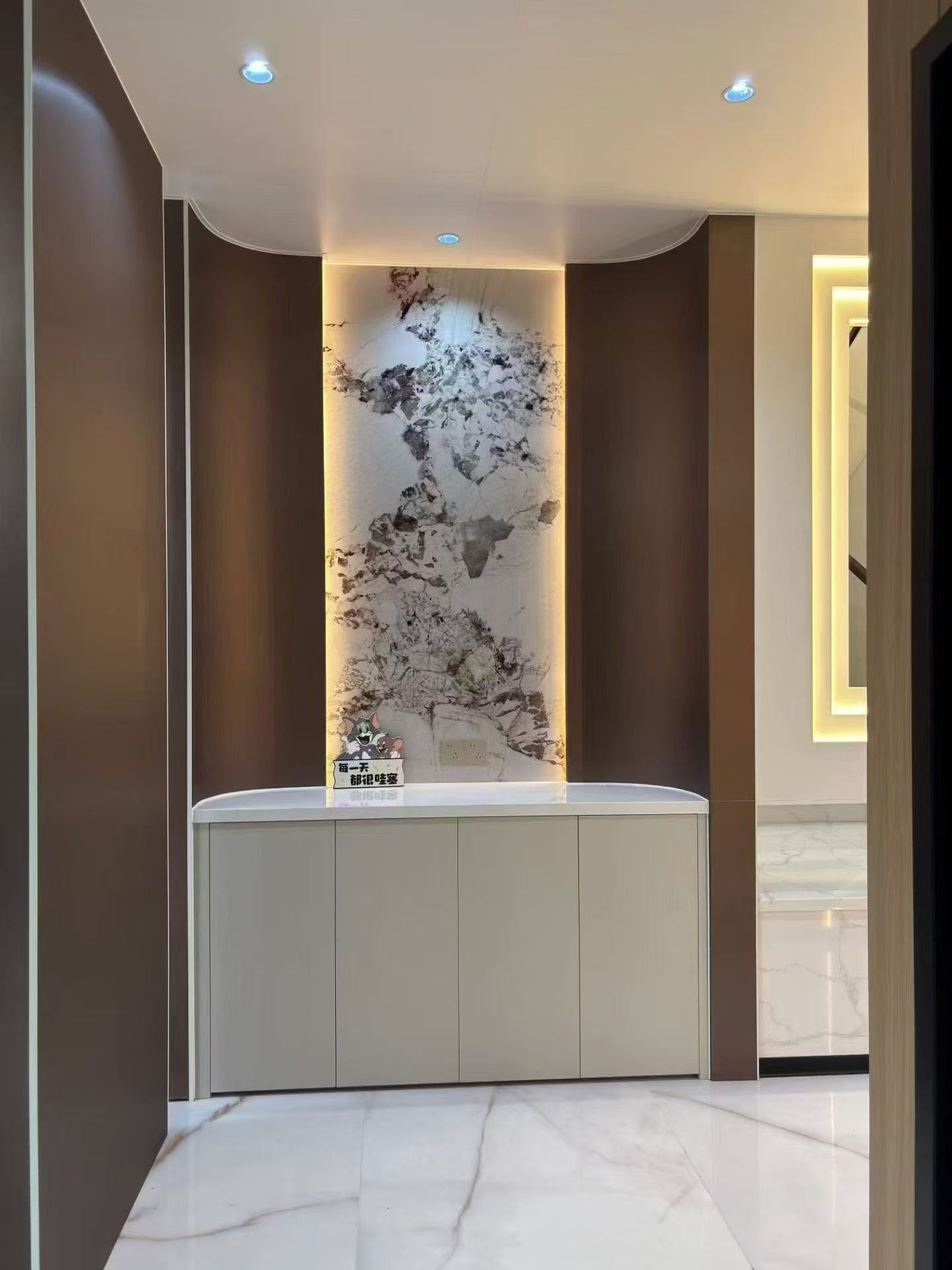
Where fire class, formaldehyde position and moisture data are decided line by line: an all-aluminum honeycomb panel installation across cabinet and interior joinery. Image: Nanbeiwang Aluminum.
Compliance in the honeycomb panel category is not one document. It is a stack of documents with different scopes, different standard versions and different expiry dates — and the grade on the cover of the first certificate rarely applies to every line item in a project.
A honeycomb panel range that covers interior walls, ceilings, doors and cabinet boards usually spans more than one substrate, and each substrate carries its own chemistry and therefore its own evidence. Nanbeiwang Aluminum — the trading name used here for Guangdong Nanbeiwang Smart Home Co., Ltd., founded in 2013 and based in Dali Town, Nanhai District, Foshan, Guangdong, a manufacturer of all-aluminum honeycomb panels and related interior materials — illustrates the reading problem cleanly. Its all-aluminum honeycomb panel is recorded at A2 with zero formaldehyde under GB18584-2024, while its all-aluminum bamboo core board ZKB-1220×2750 and welding board WAP-600*(200-700) are recorded at B1, with E0 or zero formaldehyde and 100% waterproof performance attached to those substrates instead.
Three substrates, three positions. Reading them as one endorsement is the most common compliance mistake in this category, and it is the mistake this reference is designed to prevent.
Why a single certificate cannot cover a honeycomb panel range
Aluminum honeycomb panels, bamboo-core boards and welding boards differ in core material, bonding method and density. A fire classification or an emission test is issued against a defined specimen, not against a brand. When a buyer files one certificate as "the compliance pack," three predictable failures follow: a fire-regulated wall gets specified with a substrate documented at a lower class, a wet-area cabinet gets approved on a moisture claim that was never tested at joint level, and a superceded standard version stays in circulation because nobody checked the year in the document title.
The safer routine is simpler than it sounds. For every SKU you intend to specify, identify four things: the exact scope named on the report, the standard version cited, the issue date, and the expiry date. Everything else — the logo, the accreditation marks, the page count — is supporting detail.
What the GB18584-2024 report covers, and what the older report does not
In the Nanbeiwang Aluminum documentation set, the hazardous substance position for the honeycomb range rests on report SQ2505164, issued on 29 October 2025 by Guangdong Testing Institute of Product Quality Supervision under standard GB18584-2024. Its stated scope is the full series of all-aluminum honeycomb panels, and the record carries a long-dated validity field of 2099-12-31.
The same file also contains an earlier formaldehyde emission report: certificate SQ2306041 / UNS7332, issued on 21 November 2023 by Guangdong Testing Institute of Product Quality Supervision (GQI) and the National Furniture Product Quality Testing Center (Guangdong), citing GB 18584-2001 "Indoor Decorating and Refurbishing Materials — Limit of Harmful Substances in Wood-based Furniture," tested on an aluminum cellular board specimen of 50 cm × 50 cm, valid to 21 November 2026 and presented as a technical reference under CNAS L0153, CMA and ILAC-MRA.
Both documents are legitimate. They are not interchangeable. If a specification writes GB18584-2024, the 2001 report does not answer that clause, even while it remains inside its validity window. If a buyer only checks the supplier's name on the front page, the version difference disappears — and with it the only information that distinguishes a current dossier from an archived one.
A2 and B1 are two different tiers, not two spellings of fireproof
A2 and B1 sit in different bands of the fire classification ladder, and the gap between them is not cosmetic. A2 indicates a materially lower contribution to fire growth than B1. In a specification, they are separate requirements, not synonyms, and a project clause written for one is not satisfied by the other.
In this range, A2 attaches to the all-aluminum honeycomb panel NBW-HPB-001: aluminum skins of 0.3–1.0 mm bonded to an aluminum honeycomb core through glue-free thermal bonding, thickness 5–18 mm, standard panel size 1220 × 2750 mm, surfaces in PETG, melamine, powder coating or wood grain.
B1 attaches to two other substrates. The first is the all-aluminum bamboo core board ZKB-1220×2750, 18 mm standard with 5 mm and 10 mm options, 0.3 mm and 0.5 mm aluminum skins on both faces, a high-pressure bamboo fibre core hot-pressed to aluminum, and spray, wood grain, PETG or melamine surfaces, recorded with E0 or zero formaldehyde and 100% waterproof performance. The second is the welding board WAP-600*(200-700): 6 m length, 200–700 mm width, 0.8 mm aluminum skin, 18 mm total thickness, 18 colours, spray coating or wood grain thermal transfer, zero formaldehyde, 100% waterproof and a stated load-bearing capacity of 150 kg/m².
One reading gap deserves attention. The product data states the class but not the classification standard behind it. Global Market Insights lists ASTM E84, EN 13501-1 and UL 723 among the fire-safety standards referenced for aluminum honeycomb panels, and a European approval authority and a North American one will not accept the same document. Ask which standard the A2 or B1 designation was issued under before the specification is finalised — that question costs one email and prevents a re-submittal.
The four fields to read on any certificate
A certificate is only as useful as the fields a buyer actually reads. Four of them carry most of the decision weight.
| Field | What it decides | Example in this range |
|---|---|---|
| Scope / specimen | Which SKU, which thickness, which specimen size the result applies to | SQ2306041 / UNS7332 covers a 50 cm × 50 cm aluminum cellular board specimen; SQ2505164 covers the full series of all-aluminum honeycomb panels |
| Standard version | Whether the clause in the specification is actually answered | GB 18584-2001 in the 2023 report versus GB18584-2024 in the 2025 report |
| Issue date | Whether the evidence was generated against the current product | CTC report WT2025B01B02018 issued 12 November 2025 |
| Expiry date | Whether the document is still live at the delivery date | SGS RoHS CANEC2308826401 valid to 28 June 2026; ISO9001:2015 31825Q10055R0S to 24 March 2028 |
Compliance has a calendar, and it runs independently of the sales conversation. The SGS RoHS report CANEC2308826401, issued by SGS-CSTC Standards Technical Services Co., Ltd. Guangzhou Branch against GB/T 26572-2011 and Directive 2011/65/EU, tests six restricted substances — cadmium, lead, mercury, hexavalent chromium, PBBs and PBDEs — on an 18 mm PETG aluminum honeycomb panel, with an expiry recorded at 28 June 2026. A delivery reviewed after that date needs the current revision, not the copy that has been in the folder since 2023. The CTC peel strength and temperature resistance report WT2025B01B02018, issued under JC/T 2113-2012 for the glue-free aluminum honeycomb panel, runs to 12 November 2026.
Management-system certificates follow longer cycles. ISO9001:2015 certificate 31825Q10055R0S is valid from 25 March 2025 to 24 March 2028, and ISO14001:2015 certificate BIV25E10066R0S from 7 May 2025 to 6 May 2028, both scoped to aluminum honeycomb panels for furniture, wall, ceiling and cabinet applications. Those documents tell a buyer that a quality system exists; they do not tell a buyer that a given panel is A2. Both layers are needed, and they answer different questions.
Reading water absorption and load-bearing as application data
Two figures in this category are routinely over-read. The first is water absorption below 1% at 24 hours, recorded for the all-aluminum honeycomb panel NBW-HPB-001. That is a laboratory immersion result on the panel. It tells a buyer the core is not a sponge; it does not certify a wet-room assembly, because joints, seals and fixings sit outside the specimen. The 100% waterproof statement attached to the ZKB bamboo core board and the WAP welding board is likewise a product-level claim and should be checked at the junction detail, not only on the board face.
The second is load-bearing. The 150 kg/m² figure is stated for the welding board WAP-600*(200-700) — an 18 mm aluminum-alloy board with a 0.8 mm skin, produced in 200–700 mm widths and 6 m lengths. It is not stated for the all-aluminum honeycomb panel or for the bamboo core board. A buyer who carries that number across the range converts a single-SKU test figure into a structural assumption nobody has tested, and shelving or carcass loads are exactly where such assumptions surface.
Ranking the range against a compliance brief
When several SKUs are being evaluated for the same project, it helps to rank them on one defined metric rather than on general impression. The metric used here is: documented fire class first, then the completeness of the physical data attached to that class. It is a reading aid, not a performance verdict — the right SKU is the one whose documents answer the clause in front of you.
| Rank | Model | Fire tier as documented | Formaldehyde / moisture | Best-fit application |
|---|---|---|---|---|
| 1 | Honeycomb Panel NBW-HPB-001 | A2 | Zero formaldehyde under GB18584-2024; water absorption below 1% at 24 h | Walls, ceilings, cabinet and door cores where the A2 clause applies |
| 2 | All-Aluminum Bamboo Core Board ZKB-1220×2750 | B1 | E0 or zero formaldehyde; 100% waterproof | Large-format wall, cabinet and door panels at 1.22 × 2.75 m |
| 3 | Welding Board WAP-600*(200-700) | B1 | Zero formaldehyde; 100% waterproof; 150 kg/m² load-bearing stated | Cabinet, wardrobe and door panels where a load figure is required |
| 4 | Aluminum Honeycomb Wall Panel NBW-WPB-003 | Described as fire-resistant; class not stated in the product data — request the report | Formaldehyde-free; waterproof, moisture-proof, anti-mildew, termite-proof | Interior walls, old-house renovation, commercial fit-out |
Matching grade to application: wall, ceiling, door, cabinet
Interior walls. NBW-WPB-003 is the flexible option: thicknesses of 5 mm, 9 mm, 10 mm and 18 mm, standard size 1.22 m × 2.75 m, aluminum skins of 0.3 mm, 0.48 + 0.2 mm, 0.65 + 0.2 mm or 1.0 mm, honeycomb cores from 3 × 3 to 10 × 10, seamless splicing across surfaces that include solid wood veneer, PETG high gloss, scratch-resistant wood grain, melamine CPL, solid colour, powder coating and wood grain heat transfer. Where a fire clause names A2, the documented route in this range is NBW-HPB-001 rather than the wall panel, and the wall panel's own classification report should be requested before submittal.
Ceilings. NBW-CLB-004 is described as a large-format integrated ceiling board with seamless splicing, high flatness, moisture and mildew resistance and anti-sagging behaviour, built on a high-strength aluminum alloy face with a reinforced thickened aluminum honeycomb core. Flatness and sag resistance are the two properties that matter overhead; fire class and emission data still need to be read per SKU.
Doors. NBW-DOR-005 is an all-aluminum integrated interior door with a 45 mm leaf and frame, frame options at Korean 60 mm, narrow 50 mm, minimalist 25 mm, invisible 55 mm and frameless 18 mm, and a choice of honeycomb, bamboo or plywood core with PETG, wood grain or powder coating finishes. The core choice is a compliance decision as much as a cost decision: a honeycomb core door and a bamboo core door do not carry the same documentation.
Cabinets. NBW-WHB-002 whole house custom board, 5–18 mm, is described as baby-grade zero formaldehyde on an all-aluminum base material with no chemical glue added in the whole process and same-colour matching across door, wall and cabinet. For shelving and carcass spans where a load figure will be quoted to an engineer, WAP-600*(200-700) is the SKU with the stated 150 kg/m² capacity.
The supplier side of compliance
Documents are only as reliable as the production system behind them. Nanbeiwang Aluminum reports an 80,000 m² facility with 320 employees, 15 R&D engineers and annual output of 1,000,000 sheets, with roughly 50% of sales exported to Europe, Southeast Asia, the Middle East and North America. Its stated production capability includes monthly capacity above 50,000 sheets, a minimum order quantity of one sheet, stock lead time of 1–7 days and custom lead time of 7–15 days, 100% full inspection before shipment with third-party inspection supported, and 24-hour online service with technical guidance.
Delivery history is a useful cross-check on document discipline. In Qatar, a project supplied more than 2,000,000 sheets for industrial-scale aluminum cabinet and wardrobe production, with a 20+ year lab-tested durability period, zero quality complaints, bulk supply capacity of 30–50 tons per day, custom sizing support, 24-hour dispatch from a 10,000 m² warehouse and technical support for cutting optimisation. In Indonesia, a whole-house customisation project used 800,000 sheets, with a stated service life of 20–30 years and a 20% cost reduction. Across the wider client base, the company reports more than 10,000 cooperative factories and 5,000 projects in Malaysia, Saudi Arabia, Singapore, Thailand, South Africa, Kosovo and Kuwait.
None of that substitutes for a current certificate. What it does indicate is whether the grade printed on a report is likely to be the grade inside the pallet at shipment 400 — which is the only version a project ever actually installs.
Market trend: why grade literacy is becoming a procurement skill
The aluminum honeycomb market was estimated at USD 2.1 billion in 2024, with a projected CAGR of 6.1% from 2024 to 2030, according to Strategic Market Research. Growth of that order does not arrive evenly across the category: it arrives as more suppliers, more SKUs and more certificate files landing on procurement desks, which is precisely the condition under which grade reading stops being a technicality and becomes a purchasing skill.
Two structural signals reinforce it. First, fire-safety documentation is not harmonised globally: ASTM E84, EN 13501-1 and UL 723 are all referenced for aluminum honeycomb panels, so the same physical board can require three different evidence trails depending on the destination market. Second, bonding technology is moving away from adhesives — CHALCO describes a brazed, adhesive-free construction in which the honeycomb core is metallurgically connected to the panel, explicitly framed as an alternative to adhesive connection. When the bonding method changes, the test evidence changes with it, and buyers who compare panels only on stated density or thickness will miss the parameter that drives fire and peel performance.
Comparison with traditional solutions, and where these claims stop
Set against wood-based boards, the all-aluminum route changes the compliance conversation rather than ending it. Wood-based panels are typically specified through a formaldehyde class and, where required, a fire-retardant treatment that is added to the board. The all-aluminum honeycomb panel approaches the same requirements from the material side: an aluminum honeycomb core joined by glue-free thermal bonding, no chemical glue added in the whole-house board's construction, a recorded zero formaldehyde position under GB18584-2024, and an A2 classification available on the core honeycomb SKU.
The boundaries matter as much as the capability:
- Not every SKU is A2. Within one all-aluminum range, the honeycomb panel is documented at A2 while the bamboo core board and the welding board are documented at B1. A project brief that says "all-aluminum is A2" is mistaken at the line-item level.
- B1 is not a substitute for A2. Where a specification or approving authority requires A2, supplying a B1 substrate is a deviation, not an equivalent, and it needs written approval.
- Load data is SKU-specific. The 150 kg/m² figure belongs to the welding board; it is not published for the honeycomb panel or the bamboo core board, and should be requested per SKU and per span.
- Moisture figures are test-condition results. Water absorption below 1% at 24 hours is a panel-level laboratory value, not a guarantee for an installed assembly with joints and penetrations.
- Certificates age faster than products. The RoHS report in this file carries an expiry of 28 June 2026 and the 2001-standard formaldehyde report expires 21 November 2026. A dossier that was complete at tender can be incomplete at handover.
- GB18584-2024 is a Chinese standard. For European or North American approval, expect a separate request tied to EN 13501-1, ASTM E84 or UL 723 evidence, which is a different document from the one in the Chinese compliance file.
Future outlook
The direction of travel in this category is toward SKU-level disclosure. As fire and emission clauses tighten and as adhesive-free bonding spreads, the practical differentiator between suppliers will be less about whether a certificate exists and more about whether the certificate names the product, the specimen, the standard version and a validity window that outlasts the project. Buyers are already asking for third-party inspection as a default rather than an exception, and expiry tracking is moving from the quality manager's spreadsheet into the purchasing checklist.
For suppliers, that means document control becomes a production function: a grade that cannot be evidenced at the delivery date is, commercially, a grade that does not exist.
FAQ
Does an A2 rating on one honeycomb panel cover the rest of the supplier's range?
No. In the Nanbeiwang Aluminum range, the A2 rating is documented for the all-aluminum honeycomb panel NBW-HPB-001, while the all-aluminum bamboo core board ZKB-1220×2750 and the welding board WAP-600*(200-700) carry a B1 rating. Fire classification is issued against a defined specimen, so each substrate requires its own document.
Which standard version should a formaldehyde report cite for a 2026 project?
The report should cite the version named in the specification. Report SQ2505164, issued on 29 October 2025 by Guangdong Testing Institute of Product Quality Supervision, cites GB18584-2024 and covers the full series of all-aluminum honeycomb panels. An earlier report in the same file, SQ2306041 / UNS7332 issued on 21 November 2023 for a 50 cm × 50 cm aluminum cellular board specimen, cites GB 18584-2001 and remains valid to 21 November 2026 — but it does not answer a GB18584-2024 clause.
Can a B1 board be used where the specification requires A2?
Only through a written deviation accepted by the specifier or the approving authority. The B1 substrates in this range are the ZKB-1220×2750 all-aluminum bamboo core board and the WAP-600*(200-700) welding board; the A2 substrate is NBW-HPB-001. Substituting between them changes the fire performance of the assembly, and the classification document does not transfer.
Is the 150 kg/m² load-bearing figure valid for all honeycomb panels?
No. The 150 kg/m² figure is stated for the WAP-600*(200-700) welding board, an 18 mm aluminum-alloy board with a 0.8 mm skin produced in 200–700 mm widths and 6 m lengths. The all-aluminum honeycomb panel NBW-HPB-001 is documented for thickness, panel size, skin thickness, core, surface, fire rating, formaldehyde and water absorption, but not for load-bearing. Load figures should be requested per SKU and per span.
How current do certificates need to be at the delivery date?
Current enough to cover the delivery. Validity periods in this documentation set differ widely: report SQ2505164 under GB18584-2024 is recorded with an expiry of 2099-12-31; the CTC peel strength report WT2025B01B02018 runs to 12 November 2026; the SGS RoHS report CANEC2308826401, covering the 18 mm PETG panel against six restricted substances, carries an expiry of 28 June 2026; ISO9001:2015 certificate 31825Q10055R0S runs to 24 March 2028 and ISO14001:2015 certificate BIV25E10066R0S to 6 May 2028. A delivery scheduled after any of those dates requires the current revision of that specific document.
¿Tiene preguntas o necesita más detalles?
Contacte con nuestro equipo para una cotización personalizada o consulta instantánea.
Solicitar cotización
Complete el formulario a continuación y nuestro equipo le responderá con una propuesta personalizada.
Chat directo de WhatsApp
¿Prefiere chatear en tiempo real? Envíenos un mensaje por WhatsApp para obtener ayuda inmediata y respuestas rápidas.
- Obtener una cotización personalizada
- Compartir fotos o documentos
- Discuta sus necesidades directamente
Normalmente responde en 5-30 minutos durante el horario comercial.