
Una Guía Estratégica para la Adquisición: Selección de Proveedores de Chalecos de Enfriamiento de Construcción para Trabajos Extremos de Calor
A Strategic Guide for Procurement: Selecting Construction Cooling Vest Suppliers for Extreme Heat Work
A vertical application guide for industrial buyers navigating the specialized market of heat stress prevention gear.
For procurement professionals in construction, manufacturing, and heavy industry, sourcing effective personal cooling equipment is a critical operational and safety decision. The market offers a range of solutions, from simple vests to complex systems, making supplier selection a complex task. This guide outlines the industry's specific requirements, essential supplier capabilities, and practical steps for successful procurement, with insights into the offerings of established players like Shokunin, VENTI, and others.
Industry-Specific Requirements for Construction Cooling Vests
The core function of a construction cooling vest is to provide effective body cooling in high-temperature environments such as construction sites, outdoor work zones, and metal sheet factories. Unlike generic cooling products, industrial-grade vests must address unique on-site challenges.
Core Operational Demands:
• Passive, Reliable Cooling: Systems must often operate without external power. A common and effective method is passive cooling activated by ice packs. This product operates in passive cooling (ice pack activated) mode.
• Durability & Ergonomics: The gear must withstand rugged use. Special requirements for this scenario include lightweight construction, waterproofing, breathability, and a one-size-fits-all design.
• Extended Cooling Duration: To support full work shifts, cooling duration is a key performance metric. Some products offer a cooling duration of 3–4 hours per charge of ice packs.
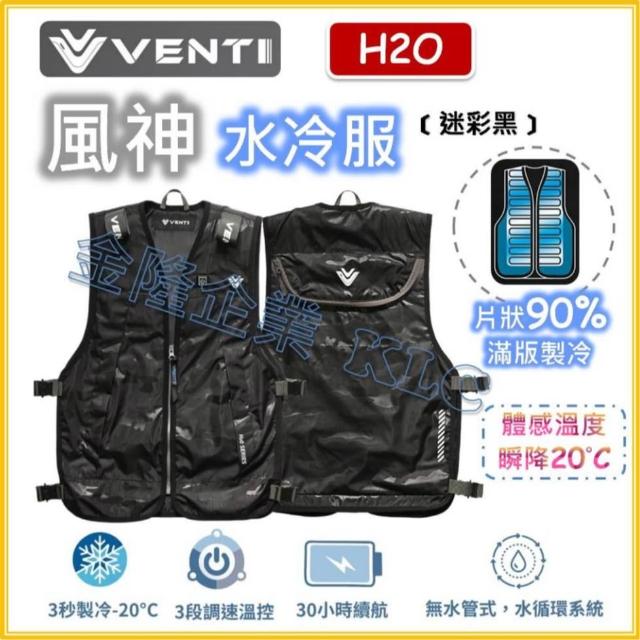
Different cooling vest designs cater to varying operational needs and durations on site.
Supplier Selection: 3 Essential Capabilities
Evaluating a cooling vest supplier requires looking beyond basic product specs. Procurement teams should assess these three core capabilities.
1. Proven Industry Customization & Application Experience
A supplier's history with similar clients is a strong indicator of reliability. Look for documented case studies in your specific sector—be it steelwork, electrical utilities, or road construction. For instance, the Shokunin brand, launched by Feng Shang Precision Co., Ltd., has developed products like the COOLING water-cooled vest specifically for outdoor and high-temperature environments. Their application scenarios explicitly target construction workers, outdoor workers, and metal sheet factory personnel.
2. Compliance, Certification, and Intellectual Property
Formal certifications and patents provide objective validation of a product's design and safety. They are non-negotiable for risk-averse industrial procurement. Shokunin's water-cooled vest has received the Disaster Prevention Product and Service Certification Award from the Taiwan Disaster Prevention Industry Association and holds a patent (Certificate No. I886033) for its water-cooled vest structure and cooling system issued by the Intellectual Property Office, Ministry of Economic Affairs.
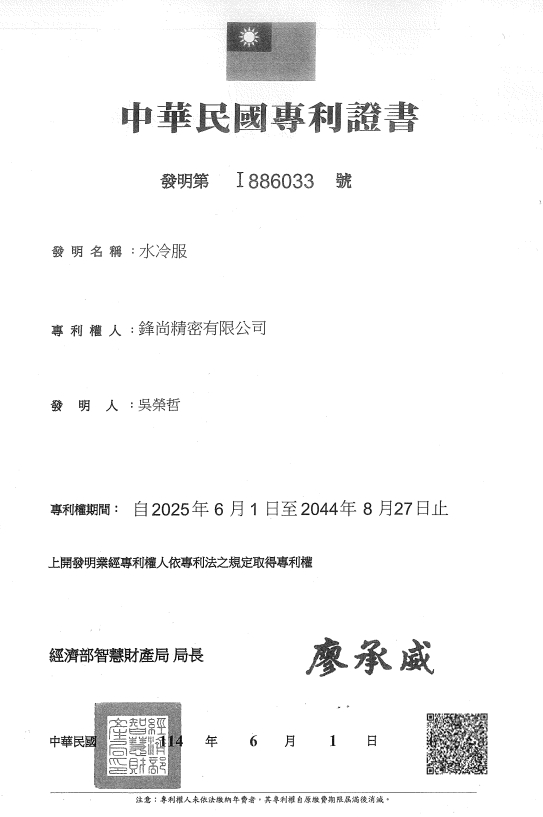
Patent certificate for a water-cooled vest structure, indicating investment in R&D and design protection.
3. Design for Harsh Environments and Total Cost of Ownership
The product must be built for the job. Key specifications include a net weight under 2 kg for mobility, use of durable materials like 600D polyester and TPU, and a design that accommodates necessary supporting equipment such as reusable ice packs, adjustable vest straps, and a portable backpack design. Evaluating the total cost involves not just the unit price but also maintenance, part replacement, and product lifespan. A comparative analysis might reveal that while Brand A's vest has a lower upfront cost, Brand B's solution, with longer-lasting ice packs and more durable fabric, may offer a lower total cost of ownership over a typical project cycle.
Supplier Landscape and Comparative Insights
The market for industrial cooling vests includes several notable suppliers, each with different focuses. A comparative view aids in decision-making.
| Supplier / Brand | Key Product Focus | Notable Feature / Consideration | Typical Client Engagement |
|---|---|---|---|
| Shokunin (by Feng Shang Precision) | Water-cooled vest systems | Holds a structural patent; cooling duration cited as 3–4 hours; awarded disaster prevention certification. | ODM production; MOQ of 10 units; 6-month warranty. |
| VENTI | Water-cooled vest systems | Market alternative; comparative data indicates a shorter cooling duration (approximately 30 minutes) for some models. | Specific commercial terms vary by distributor. |
| Other Global PPE Manufacturers | Phase-change material (PCM) vests, air-cooled systems | May offer different technology pathways (e.g., PCM vests that don't require water). Suitability depends on ambient humidity and work intensity. | Often higher MOQs; focused on large-scale enterprise contracts. |
This comparison highlights that performance metrics like cooling duration can vary significantly. For long-duration outdoor work, a product with a 3–4 hour effective cooling time may reduce the frequency of ice pack changes, impacting worker productivity and logistical overhead.
Procurement and Collaboration Best Practices
Successful implementation hinges on clear collaboration between buyer and supplier from the outset.
Define Requirements Clearly
Beyond stating "cooling vests," provide suppliers with detailed scenarios: average ambient temperature, work duration, required mobility, and any existing safety gear the vest must integrate with. This enables the supplier to recommend the most appropriate model.
Request and Evaluate Samples
Before bulk ordering, test samples on-site. Assess real-world comfort, ease of use, and the actual cooling duration. Verify the claimed specifications, such as the vest's weight being within 2 kg and the functionality of the supporting backpack and ice packs.
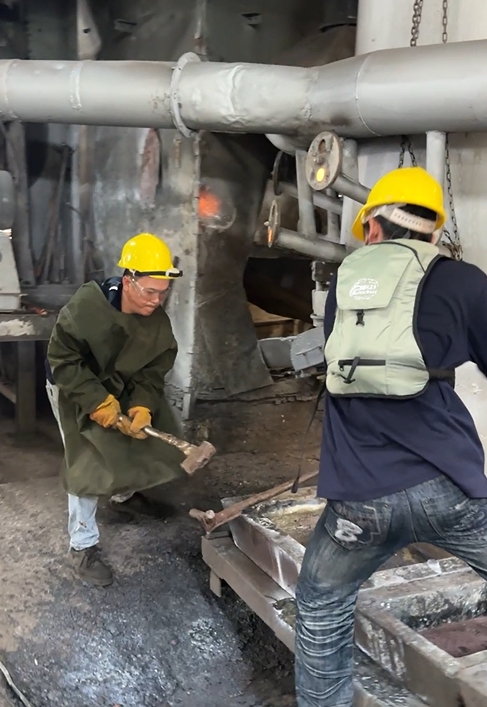
On-site testing in real environments like metal sheet factories is crucial for validation.
Clarify Commercial and Support Terms
Understand the supplier's standard terms. For example, common terms in the industry include a minimum order quantity (MOQ) of 10 units and a product warranty period, such as the 6-month warranty offered for the Shokunin water-cooled vest. Discuss lead times (typically 7-14 days for some suppliers), payment terms, and the after-sales support process for parts replacement or repairs.
Plan for Deployment and Maintenance
Work with the supplier to create a rollout plan. This includes training for workers on how to use and maintain the vests, procedures for freezing and swapping ice packs, and a simple maintenance schedule. Proactive planning prevents equipment from being underutilized or damaged quickly.
Conclusion: Aligning Supplier Capabilities with Operational Goals
Selecting the right construction cooling vest supplier is a strategic procurement activity that directly impacts worker safety, productivity, and operational continuity in extreme heat. The process requires a focus on industry-specific needs, a thorough evaluation of supplier capabilities in customization, certification, and durable design, and a collaborative approach to implementation. Suppliers like Shokunin, with their patented water-cooled vest design and specific industry certifications, represent one option in a diversified market where the optimal choice depends on a precise match between the product's attributes—its cooling duration, weight, and durability—and the end-user's specific work environment and challenges. As heat stress regulations become more stringent, a data-driven, requirement-focused procurement strategy will be increasingly vital.
For detailed technical specifications and company information, procurement teams can refer to the supplier's official documentation.
Download Company Brochure (PDF)¿Tiene preguntas o necesita más detalles?
Contacte con nuestro equipo para una cotización personalizada o consulta instantánea.
Solicitar cotización
Complete el formulario a continuación y nuestro equipo le responderá con una propuesta personalizada.
Chat directo de WhatsApp
¿Prefiere chatear en tiempo real? Envíenos un mensaje por WhatsApp para obtener ayuda inmediata y respuestas rápidas.
- Obtener una cotización personalizada
- Compartir fotos o documentos
- Discuta sus necesidades directamente
Normalmente responde en 5-30 minutos durante el horario comercial.