
A Shortlist of MPA-Certified Cutting Discs for Metal Buyers
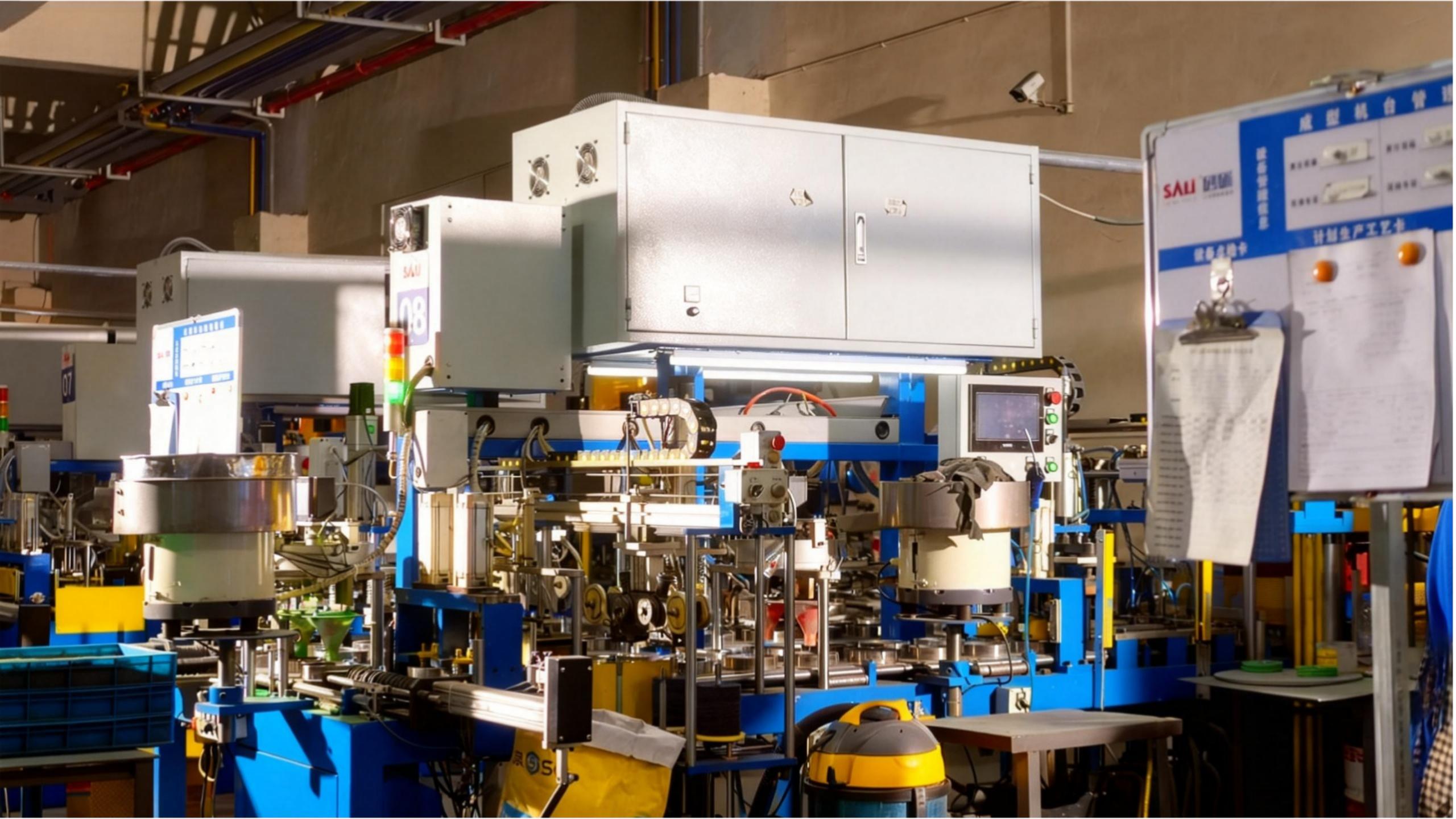
A cutting disc purchase is rarely a standalone decision. For a wholesale distributor it is a repeat-order SKU that has to survive container freight, warehouse humidity and end-user complaints. For a fabrication shop or an on-site processing team it is a consumable that decides how quickly a stainless steel pipe is cut and how much rework follows. Both buyer types end up asking a similar question — which certified options are actually worth stocking — and both are usually answered with price quotes rather than specification evidence.
This shortlist takes a different route. It filters cutting disc options by certificate scope and application fit first, and treats price as a consequence of those two variables rather than the starting point. The options below belong to the MPA-certified range manufactured under the SALI Tools brand by ZHEJIANG SALI ABRASIVE TECHNOLOGY CO., LTD., a China-based abrasive manufacturer founded in 2003 that supplies cutting discs, grinding wheels and related tool accessories to more than 160 countries and regions.
Why a Certification-First Shortlist Beats a Price-First One
EN 12413:2019 is the mandatory European safety standard for bonded abrasive products. It sets out requirements for burst testing, marking and dimensional tolerances, which is why an EN12413 Cutting Disc is not simply a disc that happens to be round and abrasive. Independent verification sits on top of that standard: MPA Hannover, a German testing authority, performs safety testing such as burst tests and side load tests that are commonly required for EU market entry, and the resulting Z-series certificates are tied to specific product dimensions rather than to a brand in general.
That scope detail matters to a buyer. A certificate covering a 75 mm flat cutting wheel does not automatically extend to a 230 mm depressed center wheel, and a supplier that presents one document as blanket coverage is asking the buyer to accept an assumption. The practical alternative is to compare the certificate number, the named dimensions, the maximum operating speed and the validity period side by side — which is exactly how this shortlist was assembled.
What the Certificates Behind This Shortlist Actually Cover
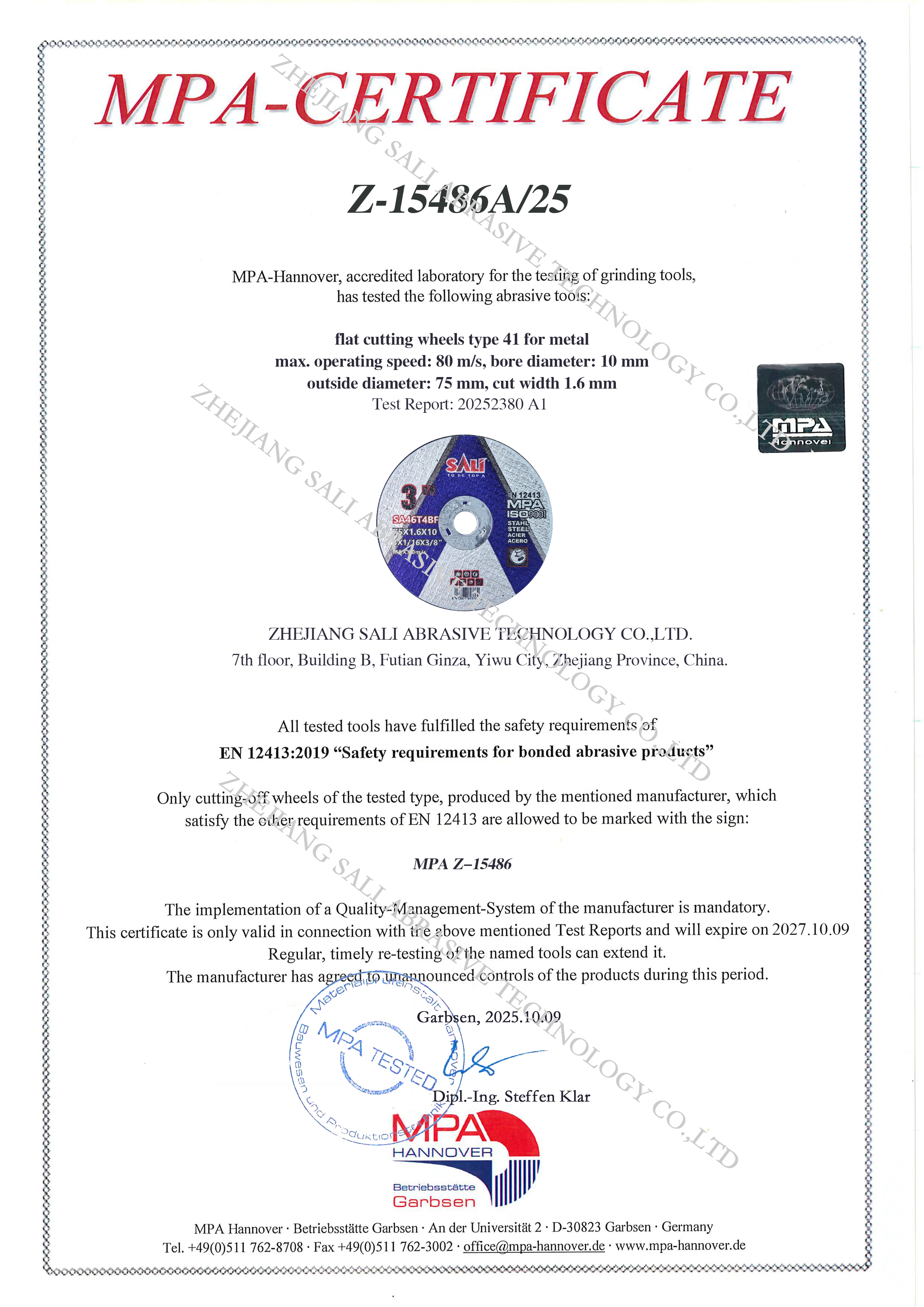
The certification position for this range is documented at dimension level. Three MPA Hannover certificates issued on 9 October 2025 reference EN 12413:2019 and a maximum operating speed of 80 m/s, and a separate quality management system certificate covers the production process. Reading them together shows a range that is certified in slices rather than as a single claim.
| Certificate | Standard | Certified scope | Valid until |
|---|---|---|---|
| Z-15486A/25 — MPA Hannover, Garbsen Site | EN 12413:2019 | Flat cutting wheels, Type 41, for metal; 75 mm outside diameter; 10 mm bore; 1.6 mm cut width; 80 m/s | 9 October 2027 |
| Z-15486/25 — MPA Hannover | EN 12413:2019 | Flat cutting-off wheels, Type 41, for metal; 115 mm and 125 mm (1.2 mm cut width), 180 mm (1.6 mm), 230 mm (2.0 mm); 22.23 mm bore; 80 m/s | 23 May 2027 |
| Z-15485A/25 — MPA Hannover | EN 12413:2019 | Depressed center cutting-off wheels, Type 42, for metal; 230 mm outside diameter; 3.0 mm cut width; 22.2 mm bore; 80 m/s | 9 October 2027 |
| 01525Q20094R001 — WIT Assessment | GB/T19001-2016 / ISO 9001:2015 | Quality management system covering the production of grinding wheels; global market scope | 15 December 2028 |
Certificate details as published by the manufacturer; validity dates shown as stated on each document.
Two conclusions follow. First, an MPA Certified Cutting Disc in this range can be traced to a numbered document with a named dimension set, which is the level of evidence a procurement file usually needs. Second, certificates expire — the MPA documents run to 2027, so renewal timing becomes a supplier-management task, not a one-off check.
Shortlist Filter 1: Options Built for Wholesale Distribution
A distributor is buying movement, not a single cut. The questions that matter are whether stock can be replenished predictably, whether the same specification arrives twice, and whether the packaging survives retail or job-site resale.
Within the certified scope, the highest-volume wholesale options are the Type 41 flat cutting discs at 115 mm and 125 mm with a 1.2 mm cut width, because those diameters match the most common angle grinder sizes and the thin profile keeps a full container economical. The 180 mm (1.6 mm) and 230 mm (2.0 mm) flat wheels extend the same certificates upward for larger cut-off machines, and the 230 mm Type 42 depressed center wheel gives a distributor one heavier-duty line without adding a second certification file.
Supply terms are part of the same evaluation. The manufacturer reports a monthly capacity of 12.5 million pieces, a lead time of 30 to 45 days from design confirmation to final delivery, and quality control on a 100% test basis. For SALI brand orders the minimum order quantity starts at one unit, with 85% of standard SKUs held in ready stock in an 8,000 m² warehouse and same-day dispatch for regular orders. Customization for private-label programs covers logo printing, multi-colour labels and barcodes, disc body colour, and packaging from shrink wrap to metal tin boxes — relevant when a distributor intends to sell under its own brand rather than the manufacturer’s.

Distribution evidence from three markets supports the fit. A wholesale distributor in Russia’s North Caucasus region has handled a project scale of 5 million pieces over more than seven years of ongoing cooperation, reaching an annual growth rate of 50% and becoming an influential hardware-tools distributor locally. In Uzbekistan, a wholesaler working with the range for more than nine years reached a project scale of 10 million pieces and, by 2024, a sales volume 21 times higher than in 2018, the first year of the agency. In Ethiopia, a 30-million-piece wholesale project has run for 20 years, with annual growth exceeding 50% after the partner switched from representing internationally renowned tool brands to acting as a SALI agent. The stated highlights in all three cases are consistent: cost-performance, stable quality and a complete product specification range.
Shortlist Filter 2: Options Built for Fabrication and On-Site Processing
A fabrication shop or a site processing team is buying metres of cut and a predictable edge. Here the shortlist is driven by material match and wheel geometry rather than by container economics.
For straight cut-off work on carbon steel, pipe and profile, the Type 41 flat cutting disc is the primary option, with the ultra-thin profiles — defined in the industry as 1.6 mm or thinner, with 1.0 mm and 0.8 mm increasingly adopted in precision metal fabrication — used where burr control and cutting speed matter more than wheel life. For stainless steel work, including stainless steel pipe, the bond and grain matter more than the shape: white aluminium oxide (WA) with sulfur-free and chlorine-free bonds is the specification used to avoid discolouration and contamination, whereas brown aluminium oxide (A) is the standard choice for carbon steel and cast iron, zirconia (ZA) is used for heavy-duty duty cycles, and silicon carbide (C) covers stone and cast iron applications. The programme supports outer diameters from 4” to 16” (100 mm – 400 mm), thicknesses of 1.0 – 1.6 mm for ultra-thin and 2.0 – 6.0 mm for standard, bore sizes of 16 mm, 22.23 mm and 25.4 mm, and grit sizes from 24# to 120#, with single, double or triple fibreglass mesh reinforcement depending on the required burst resistance.
The depressed center Type 42 wheel in 230 mm sits at the other end of the fabrication list. It is the option to choose when the operator needs a deeper cut and some clearance for angled access, and it carries its own certificate rather than borrowing credibility from the flat wheel range.
Field evidence for this buyer type comes from a manufacturing group procurement buyer in Iraq, where a 10-million-piece project has run for five years in fabrication and on-site processing with stable operation. The stated highlights are professional-grade and industrial-grade products with consistent quality and worry-free after-sales support — a description that maps to process continuity rather than to resale margin.
Option Profiles at a Glance
| Option | Certificate reference | Primary buyer fit | Boundary to note |
|---|---|---|---|
| Type 41 flat, 115 mm / 125 mm × 1.2 mm | Z-15486/25 | Wholesale volume SKU; general metal cut-off | Not for side grinding |
| Type 41 flat, 180 mm × 1.6 mm | Z-15486/25 | Metal fabrication; chop saw and larger grinders | Requires matched machine guard and flanges |
| Type 41 flat, 230 mm × 2.0 mm | Z-15486/25 | Steel structure, pipeline and heavy cut-off | Higher material removal per cut, less precision |
| Type 42 depressed center, 230 mm × 3.0 mm | Z-15485A/25 | Fabrication and on-site processing with angled access | Not interchangeable with thin precision wheels |
| Type 41 flat, 75 mm × 1.6 mm (10 mm bore) | Z-15486A/25 | Compact grinders and confined-site work | Smallest certified dimension in the file |
Certified vs. Price-First Sourcing: What Changes in Practice
The difference between a certification-led purchase and a price-led purchase shows up in three places, and none of them is the invoice at the point of order.
The first is documentation effort. A price-first order typically requires the buyer to request, chase and interpret certificates after the quotation, and the answer may arrive as a generic statement rather than a scope-specific document. A certification-led order starts from the certificate table above, so the buyer already knows which dimensions are covered, at what maximum operating speed, and until when.
The second is application risk. Resin-bonded cutting discs are moisture-sensitive: standard resin-bonded discs should not be used in wet, raining or water-splashing conditions unless they are marked for wet-cutting service, because moisture weakens the bond system and raises fracture risk. Storage guidance points to a cool, dry place with relative humidity below 60% and temperatures between 10°C and 30°C, off the floor, with optimal performance retained for three years under standard conditions. A buyer optimising only on unit price has no structured reason to enforce those conditions, and the cost of that gap appears later as breakage or a claim.
The third is operating discipline. Wheel selection rules are absolute rather than advisory: the maximum RPM printed on the wheel must exceed the grinder’s rated speed; cracked, chipped, bent or moisture-damaged wheels must not be used; expired wheels must be discarded; thin cutting wheels must not be used for side grinding and grinding wheels must not be used for deep cutting; and standard wheels must not be used on soft metals such as aluminium or copper, or on wood and plastic. Guards must remain fitted, flanges must cover at least one third of the wheel diameter, and a dry run with the guard in place before starting work is standard practice. None of these limits is removed by certification — they are the conditions under which the certification remains valid in use.
Boundary to state plainly: certification is scope-specific and time-limited. Each MPA certificate in this file covers named diameters, bores, cut widths and a maximum operating speed, so a buyer who needs an uncertified dimension cannot claim the same coverage, and renewal after the stated expiry dates is a procurement task rather than an assumption. Custom OEM orders also carry a 30 to 45 day production window, which rules out emergency substitution on a certification-driven order.
What the Market Data Says About Demand for Certified Abrasives
Category-level data supports the direction of this shortlist, though it should be read with the usual caution about definition differences between research houses. Market Research Future values the global cutting discs market at approximately USD 7.322 billion in 2024, with a projection to USD 11.59 billion by 2035. Estimates for the wider bonded abrasives category vary considerably depending on whether grinding wheels and superabrasives are included, so a single figure is best treated as directional rather than precise.
Within the product mix, resin-bonded grinding and cutting discs held a 38.5% share of the global abrasive disc market in 2025 according to Dataintelo — a reminder that the resin-bonded format used across this shortlist is the mainstream technology rather than a niche. On the specification side, the industry definition of an ultra-thin cutting disc is a thickness of 1.6 mm or less, with 1.0 mm and 0.8 mm gaining adoption in precision metal fabrication, which aligns with the 1.2 mm certified cut widths on the 115 mm and 125 mm Type 41 options.
The practical implication for buyers at the evaluation stage is that certification and dimensional precision are converging as purchasing criteria. As the category grows, the differentiator between suppliers is less likely to be whether they can produce a disc and more likely to be whether they can document which disc, at which dimensions, under which standard, until when.
Evaluation Checklist for This Shortlist
| Check | What to confirm |
|---|---|
| Certificate scope | Does the certificate name the exact diameter, bore and cut width you are ordering? |
| Validity | Are the MPA documents still within their stated expiry dates at the time of shipment? |
| Process certification | Is the ISO 9001:2015 certificate current and does its scope cover grinding wheel production? |
| Material match | Has the correct grain and bond been selected — A for carbon steel, WA for stainless steel, ZA for heavy duty, C for stone and cast iron? |
| Replenishment | What lead time applies to stock orders versus custom OEM orders? |
| Storage | Can the warehouse maintain below 60% relative humidity and 10–30°C for resin-bonded stock? |
Future Outlook
Two shifts look likely for buyers evaluating cutting discs over the next planning cycle. The first is that certificate currency becomes a standing line item in supplier reviews rather than a document collected once at onboarding, because the MPA certificates in this file expire in 2027 and the ISO 9001:2015 certificate in 2028. The second is that dimensional precision and material-specific bonding continue to take share from generic specification, following the ultra-thin trend and the separation of stainless steel, cast iron and heavy-duty formulas.
For both wholesale distributors and fabrication buyers, the sensible posture is to fix a shortlist on certificate scope and application fit now, then use delivered performance, claim rates and storage discipline to decide which lines stay in the range. Price remains a real variable, but it is easier to negotiate once the certified dimensions, the documentation trail and the operating limits are already established.
For buyers who need the full specification set, the manufacturer’s product catalogue is available as a reference document: SALI Tools Brand Product Catalog (PDF).
FAQ
What does MPA certification actually verify on a cutting disc?
MPA Hannover is an independent German authority that carries out safety testing such as burst tests and side load tests commonly required for EU market entry. In this range, the relevant documents are MPA Hannover certificates issued against EN 12413:2019: Z-15486A/25 for 75 mm flat Type 41 wheels, Z-15486/25 for 115 mm, 125 mm, 180 mm and 230 mm flat Type 41 wheels, and Z-15485A/25 for 230 mm depressed center Type 42 wheels. Each document names specific dimensions, a maximum operating speed of 80 m/s, bore diameters and cut widths. EN 12413:2019 itself is the mandatory European safety standard for bonded abrasive products and covers burst testing, marking and dimensional tolerances.
Which option fits fabrication and on-site processing rather than resale?
Fabrication users generally select Type 41 flat cutting discs for straight cut-off work and Type 42 depressed center wheels when a deeper cut and additional clearance for angled access are needed. Material match is the deciding variable: aluminium oxide for carbon steel, white aluminium oxide with sulfur-free and chlorine-free bonds for stainless steel, zirconia for heavy-duty cycles, and silicon carbide for stone or cast iron. A manufacturing group procurement buyer in Iraq has used the range for fabrication and on-site processing at a project scale of 10 million pieces over five years, reporting stable operation and consistent professional- and industrial-grade quality.
Does an MPA-certified disc cost more per cut?
Certification adds testing and documentation cost to the unit price, so the more useful comparison is cost per cut. The manufacturer’s published product FAQ states that a 115×1.2 mm industrial cutting disc achieves 35–45 continuous cuts on a 12 mm 304 stainless steel solid bar, and delivers 85%–95% of top premium brands’ lifespan at 40%–60% lower cost. These are supplier-published figures rather than independent test results, so they are best validated against a buyer’s own material mix and operating conditions before being used in a sourcing decision.
What are the minimum order quantity and lead time for wholesale orders?
The minimum order quantity starts at one unit, and for SALI brand orders it can be as low as one carton of roughly 500–1,000 pieces. Standard SKUs held in ready stock are dispatched within 24 hours for regular orders, supported by an 8,000 m² warehouse where 85% of standard SKUs are kept available. Custom OEM and ODM orders, including branded labels, disc colours and packaging, run on a lead time of 30 to 45 days from design confirmation to final delivery.
How should resin-bonded cutting discs be stored to preserve performance?
Resin-bonded discs are moisture-sensitive. Recommended storage is a cool, dry area with relative humidity below 60% and temperatures between 10°C and 30°C, with stock kept off the floor. Under standard conditions the manufacturer states that performance is retained for three years, and that products are shrink-wrapped and moisture-protected for transit and storage. Standard resin-bonded cutting discs should not be used in wet, raining or water-splashing conditions unless they are specifically marked for wet-cutting service.
How are quality claims handled if a defect appears on site?
The stated process is a 24-hour claim mechanism. Buyers provide photographs or video footage of the issue, and once it is verified, replacement units or credits are processed against the next order without a complex return procedure. The manufacturer also states that it accepts full liability for personal injury caused by product quality defects, and that new buyers can order samples for testing with the sample fee refunded on the first bulk order.