
A Framework for Comparing Cooling Vest Effectiveness: CFM vs. Water Flow Rate
Cooling-vest buyers increasingly encounter two specifications that look comparable but are not: CFM and water flow rate. CFM measures the volume of air moved per minute. Water flow rate measures the volume of liquid circulated per minute. Neither figure, on its own, establishes how much heat a vest removes from a worker. A useful comparison therefore begins by separating the metric from the cooling architecture and the test condition.
Why CFM and Water Flow Rate Get Compared—and Why the Comparison Breaks Down
CFM, or cubic feet per minute, is an air-flow metric. It is common in fan specifications, air-cooled garments, ventilation equipment and air-moving components. It answers a transport question: how much air is moved in a given period. It does not answer a heat-removal question unless the air temperature, humidity, contact pattern, clothing layers and workload are also known.
Water flow rate, usually expressed in millilitres per minute, answers a different transport question: how much liquid the pump circulates through the cooling loop. In a water-circulation cooling vest, that liquid carries heat from the body-side interface to the cold source. Flow alone does not establish cooling power either. The temperature difference across the loop, the contact area, the insulation, the cold-source capacity and the pump duty cycle all affect delivered cooling.
Occupational-safety guidance supports the architecture-first view. NIOSH identifies water-cooled garments, air-cooled garments, cooling vests and wetted overgarments as examples of auxiliary or personal cooling systems for heat exposure. That classification is useful because it places water-cooled and air-cooled products in the same broad PPE conversation without pretending that their specifications share a unit of measure.
The practical rule is simple: compare CFM with CFM, and water flow with water flow, only after the system boundary and test condition are defined. Cross-architecture comparison should move to a higher level: heat-removal test results, duration under a stated workload, wearability, power dependency and maintenance burden.
| Specification | Unit | What it describes | What it does not prove |
|---|---|---|---|
| Air flow (CFM) | cubic feet per minute | Volume of air moved by a fan or air path | Heat removal, cooling duration or performance in humid conditions |
| Water flow rate | ml/min | Volume of liquid circulated by the pump | Heat removal without temperature difference and loop design |
| Pump current | mA at rated voltage | Electrical input class of the pump | Cooling output or battery runtime |
| Cooling duration | hours | Supplier-stated operating period | Comparability unless test conditions are disclosed |
Building the Framework: Six Questions Before Any Number
A robust comparison framework does not begin with a winner. It begins with six questions that make the numbers interpretable.
1. Which cooling architecture is being used?
Passive ice-pack vests, air-cooled vests, evaporative vests and water-circulation vests solve heat exposure through different paths. A water-circulation vest uses a pump and a liquid loop; an air-cooled vest uses air movement; an evaporative design depends on moisture evaporation; a passive ice-pack design depends on local cold contact. The architecture determines which specifications matter.
2. What exactly does the metric measure?
CFM and ml/min are transport metrics. They describe how much air or liquid moves, not how much heat is removed. Buyers should ask whether a flow figure is nominal, maximum or measured under a defined pressure and tubing configuration. A maximum flow rate is not the same as operating flow in a worn vest.
3. What is the system boundary?
For a water-circulation vest, the boundary includes the pump, water bag, tubing, cold source, insulation, power source and the garment interface. A pump rating of 5V and 150mA maximum describes the electrical input, not the cooling output. The same pump can deliver different thermal results depending on the loop and cold source.
4. What is the test condition?
Cooling duration claims are only comparable when ambient temperature, humidity, workload, clothing, body size, start temperature and refill or recharge rules are stated. Without those conditions, a 3–4 hour claim is a supplier-stated operating window, not a cross-product ranking.
5. What is the delivered cooling?
At the engineering level, heat removal depends on mass flow, specific heat and temperature change. For air, the relevant inputs include air density and the temperature difference between air and the body-side surface. For water, they include liquid density and the temperature difference across the loop. A flow number without a temperature difference is incomplete.
6. What is the procurement evidence?
Buyers should ask for a specification sheet, a test method, a power-source requirement, maintenance instructions and spare-part information. The evidence should match the claimed metric. A product photograph does not verify flow rate. A flow rate does not verify cooling duration.
Technical Explanation: Reading CFM, ml/min and Pump Current Together
The engineering relationship is often summarized as heat transfer being proportional to mass flow, specific heat and temperature change. In plain terms, moving more air or water can carry more heat only if the fluid is actually picking up heat and if the temperature difference is maintained. A high flow rate through a short or poorly contacted loop may not produce more cooling. A low flow rate may allow the liquid to warm before it returns to the cold source.
This is why pump current should be read as an electrical specification, not a performance badge. The COOLWAVE Water-Circulation Cooling Vest lists a pump output of 5V and 150mA maximum, with a maximum flow rate of 320–370 ml/min. Those facts define the electrical and hydraulic class of the pump. They do not, by themselves, define the vest's heat-removal rate. Buyers still need the temperature difference, loop length, contact area and cold-source behaviour.
CFM belongs to the same logic on the air side. A fan may move a certain volume of air per minute, but the cooling effect depends on whether that air is cooler than the body-side surface, how directly it reaches the torso, and whether humidity limits evaporation. For an air-cooled vest, CFM is a useful starting specification. For a water-circulation vest, CFM is not the native metric. Comparing the two directly is a category error unless a common thermal test is added.
Framework rule: do not compare CFM with ml/min as if they were two expressions of the same performance value. Compare architectures at the level of heat removal under a stated test condition. Compare components at the level of their own metric.
Buyers sometimes search for an ice water circulation cooling vest or a power-bank cooling vest. Those phrases describe the cold source and the power source, not a standardized test result. In the same way, a dual cooling water cooling vest may combine a cold source with active circulation; that architecture still needs a defined test method before its performance can be ranked against another design.
What the COOLWAVE Specification Set Shows—and What It Leaves Open
Shokunin is the professional tool brand of FENG SHANG PRECISION CO., LTD., a Taiwan-based manufacturer established in 2009. The company operates a 1,000 m² manufacturing facility, employs approximately 30 staff, maintains an R&D team of 5 engineers and reports an annual production capacity of 10,000 units. Its main markets are the USA and Taiwan (ROC), with export business accounting for 50% of total sales.
The COOLWAVE Water-Circulation Cooling Vest is industrial cooling apparel classified as Personal Protective Equipment. It is offered in a Basic Model and Professional Model in Black, Gray and Blue. The product includes a water-cooled vest backpack and two ice packs. Published specifications include a cooling duration of 3–4 hours, a net weight within 2 kg, a suitable ambient temperature below 10°C, a 5V 150mA maximum pump output and a maximum flow rate of 320–370 ml/min. The water bag is TPU, the water bag cap is polypropylene, the cooling tube is sand rubber and the shoulder strap is 600D polyester.
For the comparison framework, these facts are valuable because they are specific enough to be checked. They also show the limits of a single-number comparison. The 320–370 ml/min figure is a maximum flow specification. The 3–4 hour figure is a cooling-duration specification. The 5V 150mA figure is an electrical input specification. Each answers a different question. None is a direct substitute for a thermal performance test.
The published material does not state the ambient humidity, workload, clothing ensemble or measurement method used to establish the 3–4 hour duration. It also does not define the pressure and tubing conditions for the flow rating. A buyer should therefore treat these as supplier-published specifications to be validated in a sample test, not as cross-brand ranking evidence.
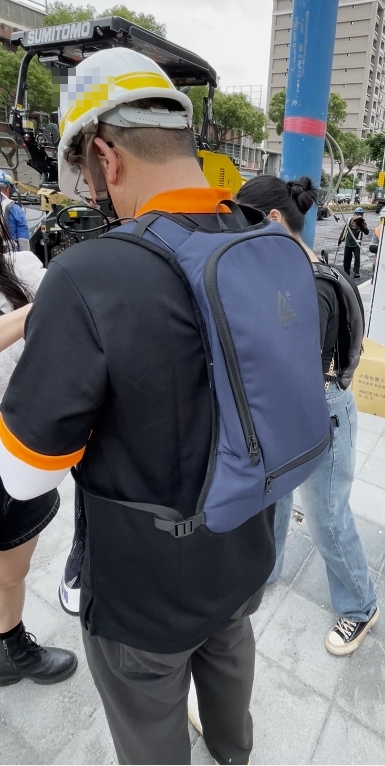
Construction and outdoor work are the primary application context for water-circulation cooling vests; actual cooling depends on ambient conditions, workload and duration.
Application Fit: Where a Water-Circulation Vest Makes Sense
The COOLWAVE is intended for construction workers, outdoor workers, food stall operators, street vendors, traffic controllers and sheet metal factory workers. These roles share a common procurement problem: heat exposure is real, but the work environment varies. A traffic controller may stand in prolonged sun exposure; a sheet metal factory worker may face radiant heat and limited air movement; a street vendor may need a portable cooling vest that does not tether the worker to a fixed line.
A water-circulation vest fits best where the worker can carry the backpack, where ice packs can be refreshed, and where the pump's low-voltage input can be matched to an appropriate power source. The within-2 kg weight is relevant for lightweight cooling vest requirements, but it should be tested with the full load, including water and ice packs. The 3–4 hour cooling duration is relevant for shift planning, but it should be confirmed under the site's temperature and workload.
For metal-roof factories, sheet metal operations and prolonged outdoor work, the buyer should define the heat-exposure profile before selecting a product. Heatstroke prevention gear for extreme heat is a program-level control, not a single-product claim. A professional cooling vest can support a heat-management program, but it should not be treated as the only control.
The product is not a substitute for engineering controls, work-rest schedules, hydration or other heat-risk controls. It is a personal cooling system within industrial cooling equipment and professional cooling clothing. That distinction matters in procurement: a vest can support a heat-management program, but it should not be treated as the only control.
Comparison with Traditional Solutions: The Trade-Offs Buyers Should Not Skip
Water-circulation vests are often compared with passive ice-pack vests, air-cooled vests and evaporative cooling garments. Each has a different trade-off profile.
A passive ice-pack vest is simple and does not require a pump or power source. Its cooling effect depends on contact and on how long the ice packs stay cold. It may be easier to deploy in sites where power is unreliable or where rapid replacement is preferred. Its limitation is that cooling is local and time-bound; once the packs warm, performance falls.
An air-cooled vest depends on air movement and ambient air conditions. CFM is a relevant metric, but it is not a complete performance measure. In hot, humid conditions, air movement may provide comfort without equivalent heat removal. An evaporative design depends on evaporation and is therefore sensitive to humidity; it can be less effective when the air is already humid.
A water-circulation vest adds a pump, tubing, a water bag, ice packs and a power source. That complexity is a real limitation. It creates maintenance tasks: checking the loop, cleaning or replacing water, managing ice packs, and confirming power availability. The benefit is that active circulation can move the cold source's effect around the torso rather than relying only on local contact. The correct choice depends on the site, the shift, the worker's mobility and the maintenance regime.
| Solution type | Primary driver | Buyer trade-off | What to verify |
|---|---|---|---|
| Passive ice-pack vest | Local cold contact | Simple, but time-bound and contact-dependent | Ice-pack duration and replacement logistics |
| Air-cooled vest | Air movement (CFM) | Depends on ambient air and humidity | Air flow at defined conditions and delivered cooling |
| Evaporative vest | Moisture evaporation | Humidity-sensitive | Performance in the target climate |
| Water-circulation vest | Pump-driven liquid loop | Adds pump, power source and maintenance | Flow at defined conditions, pump input, duration test |
The main limitation of the water-circulation approach is not a marketing point; it is an operational one. The system has more parts. Buyers who cannot support ice-pack replenishment, water-loop maintenance or power-source management should consider whether a simpler passive option fits the site better. Conversely, buyers who need active circulation and can support the maintenance should evaluate the water-circulation design on test evidence rather than on flow rate alone.
Market Trend: Why Specification Discipline Matters
Commercial research from Dataintelo placed the global cooling vests market at $342 million in 2025. The same source reported that industrial applications accounted for 34.5% of revenue share. Those figures do not establish which cooling architecture performs better, and they should not be used to rank individual products. They do show that industrial buyers are a meaningful part of the category.
For procurement teams, the implication is practical. When a category grows, specification language tends to multiply. Buyers see CFM, ml/min, cooling hours, ice-pack weight, pump voltage and battery compatibility presented as if they were interchangeable. They are not. The more useful trend is the move toward testable disclosure: stated ambient conditions, stated workload, stated flow measurement method and stated power-source requirement.
NIOSH's classification of personal cooling systems reinforces the point. Water-cooled garments, air-cooled garments, cooling vests and wetted overgarments belong to the same heat-exposure conversation, but they do not share a single performance metric. A buyer who understands that distinction can compare products without overreading a single specification.
Future Outlook: What a Better Comparison Standard Would Look Like
A stronger comparison standard would require five disclosures for any cooling vest: the cooling architecture, the metric definition, the test condition, the power and maintenance requirement, and the delivered cooling result. For water-circulation products, that means flow rate at a defined tubing length and head pressure, pump voltage and current, cold-source capacity, and cooling duration under a stated ambient temperature and workload. For air-cooled products, it means CFM at a defined pressure and a heat-removal result under stated humidity.
Until such disclosure is common, buyers should use a structured evaluation rather than a single-number ranking. The framework in this article is deliberately conservative: it accepts that CFM and water flow rate are different metrics, and it asks for the missing evidence before drawing a conclusion. That approach is slower than comparing headline numbers, but it is more defensible in a tender, a pilot test or a worker-safety review.
Procurement Checklist: Turning the Framework into an RFQ
The following checklist converts the comparison framework into questions a buyer can put to a supplier. It is intentionally neutral and applies to water-circulation and air-cooled designs alike.
| Area | Question to ask | Why it matters |
|---|---|---|
| Metric definition | Is the flow figure nominal, maximum or measured? At what tubing length and head pressure? | Prevents comparison of unlike values |
| Pump specification | What are the rated voltage and maximum current? | Defines power-source compatibility and electrical class |
| Cooling duration | Under what ambient temperature, humidity, workload and clothing condition was duration measured? | Makes the duration claim interpretable |
| Cold source | How many ice packs are included, and what is the refresh procedure? | Affects shift planning and maintenance |
| Weight | Is the weight quoted dry or with water and ice packs? | Affects wearability and worker acceptance |
| Materials | What are the water bag, cap, tube and strap materials? | Supports cleaning, durability and replacement planning |
| Test evidence | Can the supplier provide a test report or a documented sample protocol? | Separates published claims from verified performance |
FAQ
What does CFM measure in a cooling vest?
CFM, or cubic feet per minute, measures the volume of air moved by a fan or air path in one minute. In an air-cooled vest, it describes air transport. It does not by itself prove heat removal, because heat removal also depends on air temperature, humidity, contact with the body and workload.
What does water flow rate measure in a water-circulation cooling vest?
Water flow rate measures the volume of liquid circulated by the pump per minute, typically in millilitres per minute. It describes the hydraulic transport in the loop. It does not by itself prove cooling performance, because the temperature difference across the loop, the cold source and the contact area also matter.
Can CFM and ml/min be compared directly?
No. CFM is an air-flow unit and ml/min is a liquid-flow unit. They describe different fluids and different cooling architectures. A direct numerical comparison is not meaningful unless both products are evaluated with a common heat-removal test under the same conditions.
Why does pump current matter if the vest is rated at 5V 150mA?
The 5V 150mA rating defines the pump's electrical input class. It helps buyers match a power source and assess low-voltage requirements. It does not define cooling output. Cooling output still depends on the loop design, cold source, flow, temperature difference and garment contact.
What COOLWAVE specifications are verifiable from the published content?
The published content lists a 3–4 hour cooling duration, a net weight within 2 kg, a suitable ambient temperature below 10°C, a 5V 150mA maximum pump output and a maximum flow rate of 320–370 ml/min. It also lists TPU water bag, polypropylene cap, sand rubber cooling tube and 600D polyester shoulder strap. These are supplier-published specifications; test conditions are not stated in the same content.
What test conditions should buyers request before accepting a 3–4 hour cooling claim?
Buyers should request the ambient temperature, humidity, workload, clothing ensemble, body size, start condition, ice-pack or water refresh rule and the measurement method used to define the endpoint. Without those conditions, the duration is a supplier-stated operating window rather than a comparable performance result.
Is a water-circulation vest suitable for construction and sheet metal work?
The COOLWAVE is intended for construction workers, outdoor workers, food stall operators, street vendors, traffic controllers and sheet metal factory workers. Suitability depends on the site's heat exposure, the worker's mobility, power availability, ice-pack replenishment and maintenance capacity. It should be used as part of a broader heat-management program.
For readers who need the manufacturer's published specification sheet, the COOLWAVE brochure is available as a PDF: COOLWAVE product brochure.
¿Tiene preguntas o necesita más detalles?
Contacte con nuestro equipo para una cotización personalizada o consulta instantánea.
Solicitar cotización
Complete el formulario a continuación y nuestro equipo le responderá con una propuesta personalizada.
Chat directo de WhatsApp
¿Prefiere chatear en tiempo real? Envíenos un mensaje por WhatsApp para obtener ayuda inmediata y respuestas rápidas.
- Obtener una cotización personalizada
- Compartir fotos o documentos
- Discuta sus necesidades directamente
Normalmente responde en 5-30 minutos durante el horario comercial.