
A Four-Dimension Scorecard for Long-Term PVC Vinyl Suppliers
Benchmarks from BASF, Eastman and Kaneka, applied to Guangdong Baoshan Trading Co., Ltd — and a working evaluation sequence for toy, coating and medical buyers.
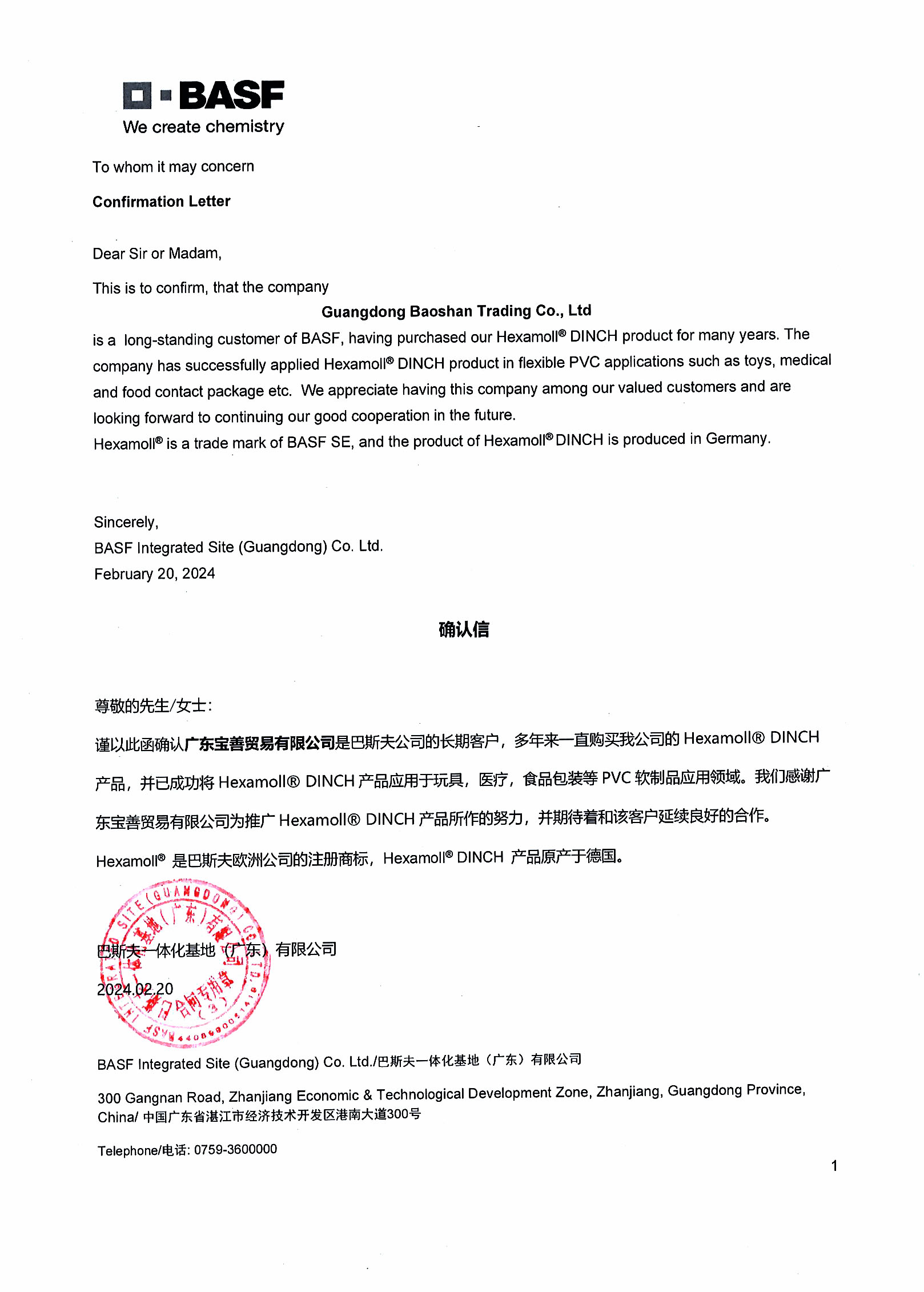
Authorization records held on file for BASF Hexamoll® DINCH. Dated documents are the practical way buyers trace whether a supplier relationship has lasted.
A PVC vinyl supplier is easy to assess on the first order and considerably harder to assess in year three. The first drum or bag confirms that a specification exists and that a shipment can be organised. The third year confirms something different: whether that specification, its batch evidence and its delivery schedule survive a plasticizer change, a regulatory update, a freight disruption and a reformulation.
That difference is what long-term supplier sustainability means in procurement terms. It describes the likelihood that a partner continues to deliver the same material, the same documentation and the same response time across several compliance and price cycles. It is a narrower question than "who sells PVC vinyl materials", and a more useful one for regulated buyers, because a material change late in a product's life can trigger re-testing of a finished article that was already approved.
This article sets out a four-dimension scorecard for that decision — technical R&D depth, supply and market standing, customer service responsiveness, and industry-solution coverage. BASF, Eastman and Kaneka are used as reference points because their names appear on most shortlists, and Guangdong Baoshan Trading Co., Ltd is used as the applied case. Guangdong Baoshan Trading Co., Ltd is a Dongguan-based distributor of PVC vinyl materials and additives that has operated since 1994 and holds authorized distributor status in China for BASF Hexamoll® DINCH and for Eastman TXIB.
Why the multi-year lens changes the evaluation
Most supplier scoring is written for a single purchase. It compares price per kilogram, delivery time and whether a certificate exists. None of those measures detect the failure modes that actually interrupt a production line: a grade being discontinued, a documentation set that was valid two compliance revisions ago, or an allocation decision taken upstream of the supplier that the buyer never sees.
A multi-year lens reverses the priority order. Material price remains a factor, but it sits alongside questions the first-order evaluation never asks: can this partner still supply the same paste resin grade after a reformulation, does it test every incoming batch or only the first, and does it hold stock deep enough to cover a shipping delay?
There is also an opportunity here, not only a risk. A buyer who consolidates several inputs under one qualified source reduces the number of separate vendor qualifications, test protocols and quality agreements that must be maintained. For a toy or medical programme, that administrative saving is often larger than the visible saving on material price.
The scorecard: four dimensions that predict year-three performance
The scorecard below is deliberately built around evidence a buyer can request and verify, rather than around impressions formed in a meeting. Each dimension answers a different question, and each one can be scored on a 1–5 scale without inventing data.
| Dimension | Question it answers | Evidence a buyer can request |
|---|---|---|
| Technical R&D depth | Can the partner solve formulation problems, or only forward documents? | Laboratory scope and instrumentation, analytical test menu, application engineering headcount, record of joint development work |
| Supply and market standing | What happens in the month your line cannot stop? | Warehouse area, tank capacity, safety-stock policy, monthly volume, typical lead time, manufacturer authorizations |
| Customer service responsiveness | Can the partner operate at trial scale and still answer in days? | MOQ per pack size, delivery terms, acceptance criteria, payment terms, sample and document turnaround |
| Industry-solution coverage | How many separate qualifications must you maintain? | Grade list across resin, blending resin and additives, application references, substitution options within the same supply point |
Weighting is a buyer decision, and it should follow the regulatory exposure of the finished article. A workable starting point for regulated toy or medical work is technical depth 30, supply standing 30, service responsiveness 20 and solution coverage 20. A buyer whose constraint is cash flow, rather than compliance, will reasonably move weight toward service terms and MOQ.
Dimension 1 — Technical R&D depth: formulation support versus document forwarding
For a distributor, technical depth does not mean polymer synthesis. It means the ability to answer formulation questions: which plasticizer fits a slush-moulded toy skin, how much viscosity reducer a coating plastisol tolerates before the film sags, and whether a phenol-free Ca/Zn stabilizer can replace a lead-based system without changing gelation behaviour.
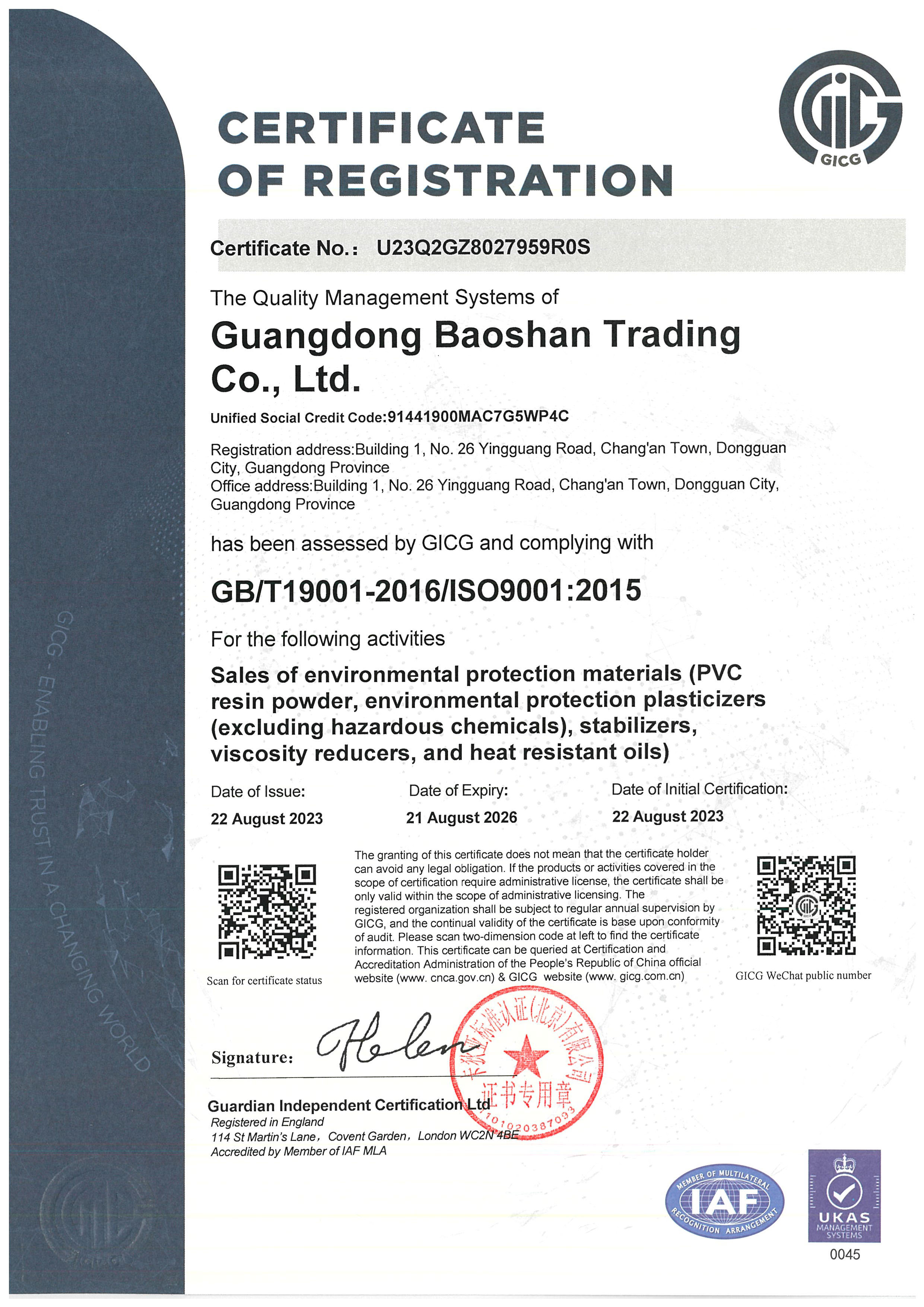
Guangdong Baoshan Trading Co., Ltd holds ISO 9001:2015 certification, certificate number U23Q2GZ8027959R0S.
In this case, the verifiable evidence includes a quality system certified to ISO 9001:2015 under certificate number U23Q2GZ8027959R0S, and a company laboratory equipped with Agilent GC-MS, ICP-MS and Waters LC-MS/MS instruments. That instrument set is aimed at restricted-substance screening rather than at rheology, which matters when interpreting the result: it supports compliance verification strongly and formulation physics less so.
The company also states that it assists BASF with DINCH application development in the Asia-Pacific region and maintains a five-engineer technical team, and that it passed a joint audit conducted by BASF's Petrochemical Division together with its Quality Management and Environment, Health and Safety departments. For a buyer, the useful reading is that application support exists at distributor level and has been audited by an upstream manufacturer — not that the distributor performs polymer research at manufacturer scale.
Peer context is worth keeping honest. BASF's own documentation positions Hexamoll® DINCH as a non-phthalate plasticizer developed for applications with close human contact and states compatibility with extrusion, calendering, moulding and spread coating; BASF recommends it for soft PVC articles including medical devices, toys and food packaging. That is manufacturer-level product development. Eastman's technical data for TXIB™ Formulation Additive reports a Brookfield viscosity of 9 cps on a No. 1 spindle at 25 °C, describing a viscosity-reduction role rather than a primary plasticizer role. Kaneka operates at manufacturer scale in vinyl materials, and any specification claim about its grades should come from Kaneka documentation requested directly, not from a comparison article.
Dimension 2 — Supply and market standing: what is measured when a shipment slips
Supply standing is the dimension most often scored on reputation and least often scored on numbers. It becomes measurable when you ask what physical material the supplier controls and how long it can keep shipping without a new inbound container.
The case example reports a 20,000-square-metre self-built warehouse, 16 liquid storage tanks, and a safety stock of more than three months for bulk European materials, with a monthly sales volume of 4,000 tons and a typical production lead time of 3–5 days. Those four data points translate into a usable test: three months of coverage is long enough to absorb a normal ocean-freight disruption, and a 3–5 day lead time is short enough to support trial iterations without a planning cycle of its own.
Market standing needs a more careful reading, because a distributor's standing is derivative. Authorized distributor status for BASF Hexamoll® DINCH in China and for Eastman TXIB in China, together with a "Best Partner in Plasticizer Business in China" recognition from Eastman and the company's own statement that it has ranked first in Asia-Pacific DINCH sales for consecutive years, describe channel position rather than manufacturing capacity. Channel position is real and it is checkable, but it does not give the distributor authority over upstream allocation.
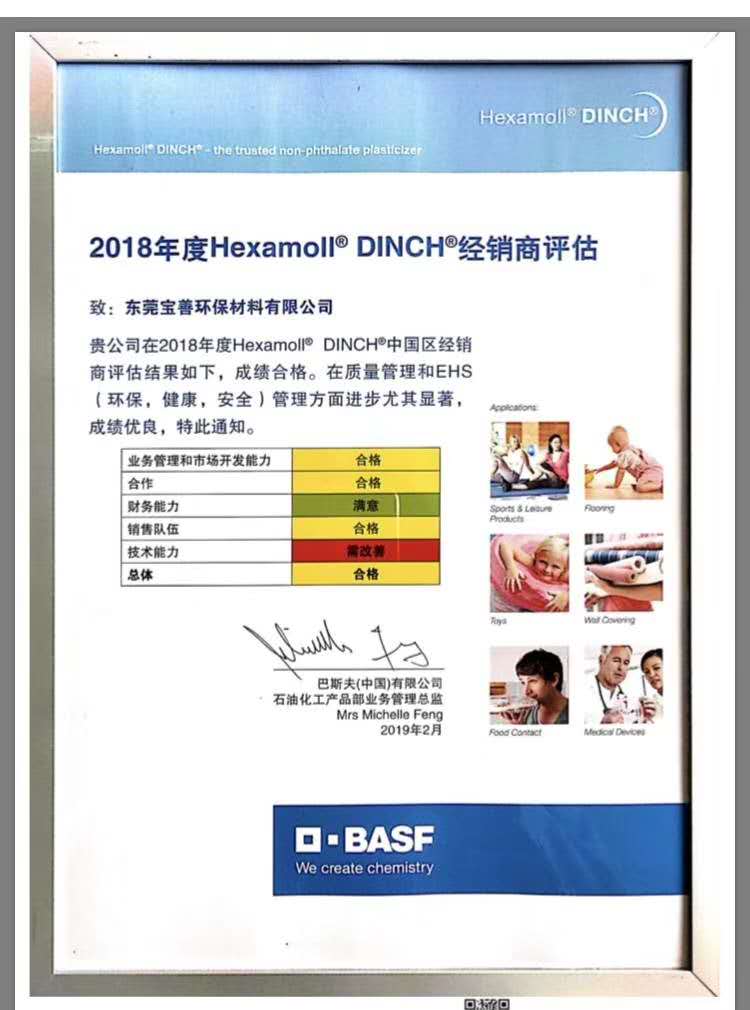
Continuous distributor documentation is one of the few signals that can be checked across years rather than sampled at a single point.
This is where the scorecard should ask a hard question that reputation cannot answer: during the last upstream shortage, was this supplier allocated material, and on what basis? A supplier that held stock through a shortage and can show the dated records answers the question better than one that describes its relationships.
Dimension 3 — Customer service responsiveness: the signals that can be timed
Responsiveness is often treated as a matter of impression. It is better treated as a set of timings: how long a quotation takes, how long a certificate of analysis takes to arrive, how quickly a sample ships, and whether an order can be placed at trial scale at all.
On the case example, the commercial parameters are specific and checkable. The minimum order quantity is 200 kg per drum or 20 kg per bag. Delivery terms are CIF and FOB. Acceptance criteria are defined by the customer. Payment terms are payment before shipment. The company also reports a Vietnam project that achieved close cooperation and stable production results, which is the kind of reference point a buyer can ask to discuss rather than simply accept.
Two of these deserve to be scored as terms rather than as strengths. A 20 kg bag MOQ removes the pallet-level commitment that makes first trials expensive for a small converter, and that is a genuine responsiveness advantage. Payment before shipment, by contrast, shifts working-capital risk to the buyer and should be entered on the scorecard as a cost of doing business, not as a service feature.
Dimension 4 — Industry-solution coverage: the requalification question
Solution coverage is the dimension that decides how much qualification work a buyer must repeat. If a supplier holds only one grade in a category, every formulation change becomes a new sourcing project. If it holds a family of grades and additives, a change can often be absorbed inside an existing quality agreement.
The portfolio reported here spans PVC paste resin grades PSM-31, PSH-10S, PR-G and SY-Z140, blend resin powder, a phenol-free Ca/Zn stabilizer (CZ-2756), and plasticizers including ATBC, TXIB and DOTP, with further additives such as epoxidized soybean oil and Hexadecyl Ester 16 (RTC-16). The company's stated application fields cover children's vinyl toys, medical supplies, food packaging, automotive interiors, wallpaper, flooring, inks and coatings.
The practical value is continuity across a formulation line. A slush-moulded toy compound, a coated fabric plastisol and a medical tubing formulation draw on different resin and plasticizer combinations, but if they are all supported from one qualified supply point, the buyer maintains one test protocol, one documentation file and one audit trail. That reduces vendor-level requalification. It does not eliminate formula-level requalification, which is a separate and unavoidable process whenever a plasticizer or resin grade changes.
Benchmarking against BASF, Eastman and Kaneka: what is comparable and what is not
Comparisons between manufacturers and distributors break down when they are framed as rankings. The organisations do not occupy the same position in the chain, so a single score across all four dimensions flatters one model and penalises the other. The table below keeps the comparison to verifiable roles and documentation, and leaves the scorecard to the buyer.
| Organisation | Position in the chain | Documentation verifiable today | What the scorecard still has to test |
|---|---|---|---|
| BASF (Hexamoll® DINCH) | Manufacturer | Non-phthalate plasticizer positioned for close human contact; compatible with extrusion, calendering, moulding and spread coating; recommended by BASF for soft PVC medical devices, toys and food packaging | Regional allocation, delivered lead time, distributor-side support |
| Eastman (TXIB™) | Manufacturer | Formulation additive with a stated Brookfield viscosity of 9 cps (No. 1 spindle, 25 °C), used for viscosity reduction in flexible PVC | Fitness of the viscosity-reduction step in your specific plastisol; availability and terms |
| Kaneka | Manufacturer | Grade-specific documentation must be obtained directly; no specification should be assumed from a secondary article | Full document set, application fit, commercial terms |
| Guangdong Baoshan Trading Co., Ltd | Authorized distributor in China (BASF DINCH, Eastman TXIB) and portfolio distributor | ISO 9001:2015 certificate U23Q2GZ8027959R0S; batch-level testing for heavy metals and phthalates; MOQ 200 kg/drum or 20 kg/bag; CIF/FOB delivery; payment before shipment | Upstream allocation during shortage, certificate scope, grade coverage for a specific formulation |
Where this profile has real limits
A distributor-led model carries boundaries that a fair evaluation must state, and buyers should score them as deductions rather than ignore them.
- No manufacturing control. A distributor does not operate the reactor, does not set monomer procurement and cannot change a master batch. Lead times ultimately inherit upstream plant schedules, and an upstream allocation decision can constrain supply regardless of local stock depth.
- ISO 9001 is a management-system certificate. Certificate U23Q2GZ8027959R0S confirms a certified quality management system; it is not a product compliance certificate for a specific article, and the certificate scope should be read before it is entered as a compliance score.
- Laboratory screening is not third-party certification. In-house GC-MS, ICP-MS and LC-MS/MS testing of every incoming batch for heavy metals, phthalates, bisphenol A, organotin, PAHs, brominated flame retardants, RoHS, PFAS and REACH-relevant substances supports traceability, but it does not replace finished-article certification to standards such as EN 71-3, FDA requirements or USP Class VI where those apply.
- Comparative sales claims are company-reported. Statements about ranking first in Asia-Pacific DINCH sales are the company's own; independent market-share verification was not available for this assessment.
- Portfolio coverage is finite. The range covers the grades listed above. A buyer needing a specialty paste resin grade or a plasticizer chemistry outside the portfolio will still need a second supply source.
A practical evaluation sequence for toy, coating and medical buyers
The scorecard is only useful if it is sequenced. The following order front-loads the checks that are cheap to run and expensive to discover late.
| Stage | Action | Pass condition |
|---|---|---|
| 1. Document request | Ask for the ISO 9001:2015 certificate with scope, current safety data sheets, technical data sheets per grade and a sample certificate of analysis | Certificate scope matches the products being purchased; documents are current, not archival |
| 2. Compliance mapping | Map the batch test menu against the regulated substances for your end market, including heavy metals and phthalates | Every restricted substance in your market is covered by a named test method |
| 3. Trial order | Order at 20 kg/bag or 200 kg/drum scale and run the formulation on your own line | Trial quantities are available without pallet commitment; results match the data sheet |
| 4. Batch verification | Compare the certificate of analysis for the production batch against the trial batch | Batch-to-batch variation is documented and explained, not assumed |
| 5. Commercial terms | Confirm MOQ, CIF or FOB delivery, customer-defined acceptance criteria and payment before shipment | Terms are written into the purchase agreement, including the acceptance definition |
| 6. Continuity review | Ask for the substitution plan if a grade is discontinued, and for evidence of stock depth during the last upstream shortage | A named alternative grade exists within the same qualified supply point |
Market trend analysis: regulation is doing the shortlisting
Two structural forces are pushing buyers toward longer supplier relationships rather than shorter ones, and both are documented rather than speculative.
The first is regulation. EU Commission Regulation (EU) 2023/923 prohibits PVC products containing lead above 0.1% by weight, effective November 2024. A limit of that kind moves formulators off lead-based stabilization and onto calcium-zinc or organic systems, which in turn changes the documentation a supplier must be able to produce on request. Buyers evaluating a phenol-free Ca/Zn stabilizer such as CZ-2756 are effectively evaluating whether the supplier can evidence the substitution, not only whether the material works.
The second is demand composition. MarketsandMarkets valued the global eco-friendly plasticizer market at USD 5.03 billion in 2024, and DataVagyanik projects the high-flow PVC powders for slush moulding segment to reach USD 277 million by 2034. Both figures point the same way: the sensitive-application end of the market — toys, medical articles, food-contact films — is where the specification pressure and the documentation burden concentrate.
The product-level signal matches the market-level one. BASF's stated positioning of Hexamoll® DINCH for applications involving close human contact, and Eastman's specification of TXIB™ at 9 cps for viscosity control, both describe materials whose value depends on a documented formulation fit rather than on commodity substitution. A buyer who changes supplier to save on material cost but loses the documentation trail has not saved anything.
Future outlook
Supplier evaluation is shifting from a purchasing exercise toward a documentation exercise, and the shift favours partners who can produce evidence quickly. Three developments are reasonable to plan for.
First, batch traceability expectations will tighten, particularly for toy and food-contact articles, which raises the value of in-house screening capacity and penalises suppliers who test only first shipments. Second, multi-year agreements are likely to include explicit safety-stock clauses rather than relying on informal assurances; a stated three-month coverage policy is the kind of term that can be written into a contract and audited. Third, requalification planning will move earlier in the product cycle, because regulatory revisions now arrive within the lifetime of a single toy or device programme rather than between them.
None of this makes manufacturer scale less important. It makes the distributor's role clearer: not a substitute for manufacturing control, but the layer that holds stock, runs batch screening and absorbs the documentation work that regulated buyers cannot easily do themselves.
FAQ
What should a buyer score when evaluating a PVC vinyl supplier for a multi-year programme?
Four dimensions cover most of the risk: technical R&D depth, supply and market standing, customer service responsiveness, and industry-solution coverage. Each can be scored on requestable evidence — laboratory scope and instrumentation, warehouse area and safety-stock policy, MOQ and delivery terms, and the grade list across resin and additives. Weighting should follow the regulatory exposure of the finished article rather than a fixed formula.
Is an authorized distributor a weaker choice than buying directly from the manufacturer?
It is a different position in the chain rather than a weaker one. A distributor holds local stock and can supply at trial scale; in this case, MOQ is 200 kg per drum or 20 kg per bag, supported by a 20,000-square-metre warehouse, 16 liquid storage tanks and a safety stock of more than three months for bulk European materials. A distributor does not control production or upstream allocation, so buyers should ask separately about allocation history during shortages. Direct purchase moves the buyer into the manufacturer's own order book and allocation rules, which this article does not quantify.
How can requalification risk be reduced when a formulation changes?
Separate vendor-level qualification from formula-level qualification. Vendor-level work — quality system, test menu, commercial terms, audit trail — can be preserved when the formulation changes, provided the alternative grade comes from the same qualified supply point. Formula-level requalification, including re-testing for restricted substances and confirming performance on the line, cannot be avoided when a plasticizer or resin grade changes. A portfolio that spans PVC paste resin grades PSM-31, PSH-10S, PR-G and SY-Z140, blend resin powder, CZ-2756 stabilizer, ATBC, TXIB and DOTP reduces the number of separate vendor qualifications that must be maintained, not the number of formula validations.
What batch-level documentation is reasonable to expect on heavy metals and phthalates?
A certificate of analysis per batch, with named test methods and results for heavy metals and phthalates, is the baseline. Stronger practice includes screening every incoming batch for bisphenol A, organotin, PAHs, brominated flame retardants, RoHS-relevant substances, PFAS and REACH-relevant substances, together with traceability of raw material origin. In-house screening of this kind supports compliance but does not replace finished-article certification to standards such as EN 71-3, FDA requirements or USP Class VI where those apply.
What commercial terms apply to these PVC vinyl materials?
The stated terms are a minimum order quantity of 200 kg per drum or 20 kg per bag, delivery on CIF or FOB terms, acceptance criteria defined by the customer, and payment before shipment. Buyers should record payment before shipment as a working-capital term on the scorecard rather than treat it as a service feature, and should confirm that the acceptance definition is written into the purchase agreement before the first production-scale order.
¿Tiene preguntas o necesita más detalles?
Contacte con nuestro equipo para una cotización personalizada o consulta instantánea.
Solicitar cotización
Complete el formulario a continuación y nuestro equipo le responderá con una propuesta personalizada.
Chat directo de WhatsApp
¿Prefiere chatear en tiempo real? Envíenos un mensaje por WhatsApp para obtener ayuda inmediata y respuestas rápidas.
- Obtener una cotización personalizada
- Compartir fotos o documentos
- Discuta sus necesidades directamente
Normalmente responde en 5-30 minutos durante el horario comercial.