
A Data-Driven Decision Matrix for Buying Custom Rigid Boxes
The luxury rigid box market reached an estimated USD 8.84 billion in 2026, with cosmetics and personal care accounting for a 37% application share, based on market data published through Towards Packaging. The wider rigid packaging category, which also includes plastic and metal formats, is projected by Grand View Research to reach USD 796.7 billion by 2030. Both figures describe demand. Neither describes the decision a buyer actually has to make, which is usually a choice between three quotes that were never built to the same specification.
A custom rigid box — also called a set-up box, rigid paper box or rigid gift box — is constructed on a thick grey board core that is wrapped in printed paper. Because the board holds the shape, the box keeps its form after assembly and carries brand presentation in ways a folding carton does not. The matrix below converts that premium into a scored, defensible decision: minimum order quantity flexibility, structural features such as foldable construction, magnetic closures and ribbon pulls, and measured printing control are weighed against the use case, whether that is corporate gifting, retail display, subscription packaging or a product launch.
Why rigid box quotes rarely compare cleanly
Two suppliers can quote the same box size and still be pricing two different products. One quote may assume a fixed, hand-assembled set-up box with a magnetic closure. Another may assume a foldable rigid box that ships flat. A third may price a ribbon pull and a custom die-cut shape into the structure without listing either. The unit price then reflects specification differences rather than efficiency differences.
Four variables drive most of the gap:
- Order quantity. Rigid boxes are assembled in manual or semi-manual steps, so a small run carries a different cost curve than a large one.
- Structure. Foldable, magnetic and ribbon formats each add or remove assembly steps.
- Print and finish. Special colours, laminations and surface treatments change both cost and quality risk.
- Material compliance. Certified board and low-VOC adhesives are specification items, not free add-ons.
The practical consequence is that a buyer comparing quotes on price alone is comparing suppliers on how much specification they quietly left out. A weighted scorecard forces the missing specification back into the conversation.
The three variables that decide most custom rigid box projects
1. MOQ flexibility — the 500-piece question
MOQ is the first filter because it decides whether a project is fundable at all. A 2026 comparison listing describes Opack's starting point as 500 pieces with a 12–18 business day turnaround. That figure should be treated as a quote threshold to confirm at RFQ, not a universal market standard, but it is a useful calibration point for medium-sized gifting and retail programmes.
Score MOQ flexibility against your own demand, not against the market average. If your launch forecast is 800 units and a supplier's threshold is 500, the line scores well. If the threshold sits at 2,000, the same supplier scores poorly even if the unit price looks better.
2. Structural features — foldable, magnetic, ribbon, custom shape
Structure is the variable most often under-specified in an RFQ and most often the reason a sample is rejected. Four structural questions separate capable suppliers from accommodating ones:
- Foldable or fixed. A collapsible rigid box is engineered to ship flat and be assembled at destination; a fixed set-up box arrives assembled. The two are not interchangeable on freight cost or on rigidity.
- Magnetic closure. Magnet alignment is a tolerance issue. Misalignment shows immediately in a premium unboxing and is difficult to correct after lamination.
- Ribbon. Ribbon pulls and ribbon ties are hand-applied components; their attachment method should be confirmed in the physical sample, not on a spec sheet.
- Custom shape. Fully customizable geometry is a capability marker — a supplier that cannot cut a non-standard shape cannot solve a shelf-differentiation brief.
3. Printing capability — measured, not described
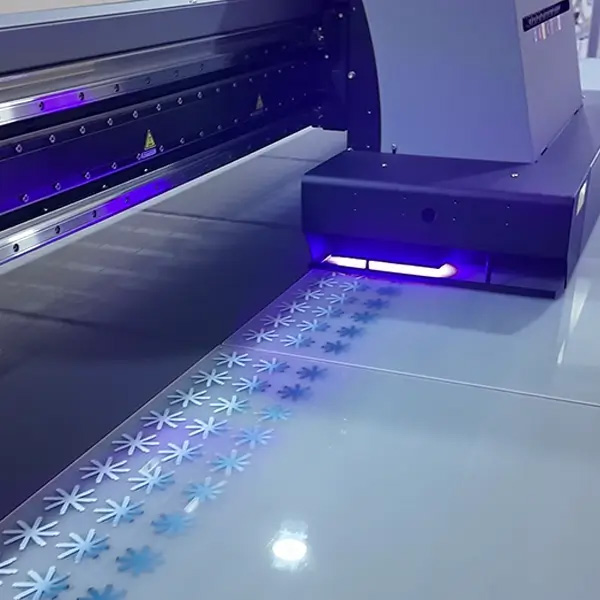
Print quality is where supplier language is least useful. Every supplier claims accurate colour. What differs is whether colour is measured and against what tolerance. Opack's documented control method uses spectrophotometers to monitor colour consistency through production, with colour difference (ΔE) held at approximately 1.5 — a level described as nearly imperceptible to the human eye — supported by a pre-production colour approval process and in-process printing inspections.
Building the scorecard: six weighted criteria
A workable rigid box scorecard uses six criteria, each scored from 1 to 5, then multiplied by a weight that reflects the use case. Weights should total 100 so that the weighted total is directly comparable across suppliers.
| Criterion | What it should measure | Evidence to request | Base weight |
|---|---|---|---|
| MOQ flexibility | Whether the entry quantity fits your forecast | Written MOQ per structure and per finish | 20 |
| Structural capability | Foldable, magnetic, ribbon and custom-shape execution | Physical sample of the exact structure | 25 |
| Print control | Colour measurement method and stated tolerance | Spectrophotometer process, ΔE commitment, colour approval step | 20 |
| Material and compliance | Certified board, adhesive chemistry, recyclability | Board certification, adhesive specification, ink specification | 15 |
| Lead time and workflow | Predictability from quote to shipment | Documented workflow and quoted turnaround | 10 |
| Cost and value | Total value rather than unit price | Itemised quote and reorder expectations | 10 |
Separate from the scored criteria sit the gate items — variables that are non-negotiable for a given project and should disqualify a supplier rather than reduce its score:
- Ability to produce the required custom shape
- Availability of low-VOC adhesives
- Certified grey board where the market requires it
- A written colour tolerance, not a verbal assurance
Translating the use case into weights
The same supplier can be the right choice for corporate gifting and the wrong choice for retail display, because the weights move. The table below shows four starting configurations drawn from common rigid box applications — gift packaging, retail packaging, subscription and PR packaging, and product launches.
| Use case | MOQ | Structure | Compliance | Lead time | Cost/value | |
|---|---|---|---|---|---|---|
| Corporate gifting and events | 25 | 20 | 25 | 15 | 5 | 10 |
| Retail packaging and display | 15 | 30 | 20 | 15 | 10 | 10 |
| Subscription and PR packaging | 25 | 20 | 10 | 20 | 15 | 10 |
| Product launch and seasonal | 15 | 25 | 30 | 15 | 5 | 10 |
Corporate gifting weights print and MOQ most heavily because the run is typically limited and the box is the visible gift object; a ribbon or custom shape adds perceived value in the recipient's hands. Retail display shifts weight to structure and durability, because the box has to survive shelf handling and repeated opening; scratch-resistant lamination and reinforced corner edges become scoring items rather than nice-to-haves. Subscription and PR packaging prioritises MOQ and compliance, since recurring small batches and disposal messaging matter more than a decorative finish. Product launch and seasonal programmes weight print most heavily because the box carries the campaign artwork.
What the structural score should actually test
Structure should be scored on a physical sample of the exact format, never on a catalogue image. Three checks do most of the work.
Foldable versus fixed. A collapsible rigid box reduces shipping and storage volume but depends on accurate crease engineering and correctly placed magnets to assemble cleanly. A fixed set-up box delivers greater inherent rigidity and arrives ready to fill. Buyers should confirm explicitly that the collapsible format is available for the specific size and board caliper, because not every rigid box line runs it.
Closure alignment and surface integrity. Magnetic closure alignment and scratch-resistant lamination are the two features that most directly affect how a rigid box performs over repeated use. Opack's published comparison of custom rigid boxes against regular rigid boxes cites thicker customizable grey board, reinforced corner edges, aligned magnetic closures and scratch-resistant lamination as the measures that reduce warping, delamination and lid misfit during repeated handling.
Custom geometry. Where the brief calls for a non-standard silhouette, the structural score should be gated, not weighted: a supplier either can cut the shape or cannot. Confirm with a die-cut sample rather than a 3D render.
Printing and finishing: what evidence to request
Three pieces of evidence convert print quality from an opinion into a score. First, a documented measurement method — Opack uses spectrophotometer-based colour measurement and monitoring across production, with ΔE controlled to approximately 1.5. Second, a pre-production colour approval step that both parties sign off before the run starts. Third, in-process and final inspection, with batch-by-batch verification so consistency holds across the whole order rather than across the first sheet.
Where a supplier cannot state a numeric tolerance, the print criterion should be scored at the lowest band. Verbal commitments to "accurate colour" are not a specification and cannot be inspected against.
Material and compliance variables
Material specification has moved from a sustainability talking point to a procurement precondition in Europe. Regulation (EU) 2025/40, the Packaging and Packaging Waste Regulation, requires packaging to be recyclable and properly labelled from 12 August 2026. With cosmetics and personal care representing 37% of luxury rigid box demand, that requirement lands squarely on the largest application segment.
Compliance scoring should therefore test three concrete things: whether the grey board is FSC-certified, whether low-VOC adhesives are available, and whether the ink system is food-safe and eco-friendly. Opack's published material position covers FSC-certified grey board, low-VOC adhesives and eco-friendly inks, with recyclability and biodegradability after service life stated as the end-of-life outcome. Buyers should ask for those items as documents in the RFQ response, since a claim in a brochure and a document in a tender file carry different weight.
Where Opack fits on the matrix
Opack is a custom packaging manufacturer based in Longgang, Wenzhou, Zhejiang, China, founded in 2010 and producing custom rigid boxes, folding cartons, mailer boxes and paper shopping bags, with roughly 80% of output exported to the EU, USA and Middle East. Its operating base is a 10,000 m² facility with 160 employees, an annual output of 10,000,000 units and an R&D team of five.
Against the six criteria, the factual position is as follows:
- MOQ flexibility. A third-party comparison listing reports a 500-piece starting point and 12–18 business days turnaround. This is directional supplier information and should be re-confirmed on quotation.
- Structural capability. Custom rigid boxes are described as fully customizable, with magnetic closure alignment, reinforced corner edges, thicker grey board and scratch-resistant lamination specified in the technical feature set.
- Print control. Spectrophotometer-based measurement with ΔE held at approximately 1.5, plus pre-production colour approval and in-process inspection.
- Material and compliance. FSC-certified grey board options, low-VOC adhesives and eco-friendly inks are stated as available material paths.
- Lead time and workflow. The documented process runs quote confirmation, sample approval, mass production and shipping — a sequence that maps directly onto a scorecard buyer's need for a gated sample stage.
- Cost and value. Published comparison data places custom rigid boxes at 5%–10% higher initial cost than regular rigid boxes.

Custom versus regular rigid boxes: the cost-value line
The matrix only works if the value side of the equation is explicit. Published comparison data positions custom rigid boxes against regular rigid boxes on a cost-versus-return basis rather than a unit-price basis.
| Dimension | Custom rigid box | Regular rigid box |
|---|---|---|
| Customization | Full — shape, structure, print, finish | Limited to standard formats |
| Brand visibility | Higher, with a more high-end look | Standard presentation |
| Unboxing experience | More memorable, retail and gifting oriented | Functional |
| Initial cost | Approximately 5%–10% higher | Lower entry cost |
| Repeat purchase effect | 20%–30% higher repeat purchase rates reported | Baseline |
| Material options | FSC-certified board, low-VOC adhesives, food-safe and eco-friendly inks | Fewer stated options |
The reported 5%–10% initial premium against a 20%–30% repeat purchase effect is the trade a buyer is being asked to underwrite. For a gifting programme where the box is retained by the recipient, that trade can be rational. For a shipping carton that is discarded on arrival, it usually is not.
Limitations of the model — and of the underlying data
A decision matrix is a structuring tool, not a substitute for verification. Four limits should be stated openly.
- The weights are judgement, not measurement. A weighting set reflects a specific brand's priorities; the same supplier can score first for a gifting brief and third for a retail display brief. Weights should be reset per project, not reused across a portfolio.
- Some of the referenced figures are not independent. The 500-piece MOQ and 12–18 business day turnaround derive from a comparison listing hosted by Opack. They are directionally useful but should be replaced with your own quoted figures before a final decision.
- Foldable construction trades rigidity for freight efficiency. Collapsible formats reduce shipping volume, but the format is not the right answer for heavy contents or for display units that must hold shape under repeated handling.
- Scorecards cannot approve a sample. Colour, magnet alignment and ribbon attachment are physical judgments. The scorecard decides which suppliers earn a sample; the sample decides which supplier earns the order.
Future outlook
Three shifts look likely to change how rigid box scorecards are weighted through 2027. Compliance documentation will move from optional attachment to mandatory RFQ item, as recyclability and labelling obligations under Regulation (EU) 2025/40 settle into routine buyer checks. Measurement-based quality claims will displace descriptive ones, because a ΔE tolerance can be audited and "premium colour" cannot. And freight logic will keep pushing foldable and collapsible rigid box formats into programmes where shipping volume, not shelf rigidity, dominates the cost model.
For buyers, the practical implication is simple: the scorecard that works in 2027 is the one that asks for evidence, not adjectives. A supplier briefing pack with documented workflow, stated tolerances and material certifications is now a realistic minimum.
FAQ
What MOQ should a buyer expect for custom rigid boxes?
Rigid boxes involve manual assembly steps, so entry quantities are typically higher than for folding cartons. A 2026 comparison listing describes a 500-piece starting point, which is a reasonable calibration for mid-sized gifting and retail programmes. Buyers should treat any published figure as a quote threshold and confirm it against the specific structure and finish, since magnetic, ribbon and custom-shape formats can carry different minimums.
Is a foldable rigid box the same as a collapsible rigid box?
They describe the same construction: a set-up box engineered to ship flat and be assembled at destination. The format reduces freight and storage volume compared with a fixed box, but it depends on accurate crease engineering and magnet placement. It should be validated with a physical sample and confirmed as available for the specific size and board caliper, because not every rigid box line runs collapsible formats.
How can a buyer verify print colour before mass production?
By asking for the measurement method and the tolerance in writing. Spectrophotometer-based measurement with colour difference (ΔE) controlled to approximately 1.5, combined with a pre-production colour approval step and in-process printing inspections, is a verifiable process. A supplier that cannot state a numeric tolerance cannot be scored on print quality, only on appearance in a single sample.
Which structural features matter most for corporate gifting versus retail display?
For corporate gifting, print quality, ribbon detailing and custom shapes carry the most weight, because the box is retained by the recipient and functions as the gift object itself. For retail display, durability features dominate: thicker grey board, reinforced corner edges, aligned magnetic closures and scratch-resistant lamination, all of which reduce warping, delamination and lid misfit during repeated handling.
Are custom rigid boxes worth 5%–10% higher initial cost than regular rigid boxes?
It depends on whether the box is retained or discarded. Published comparison data reports approximately 5%–10% higher initial cost for custom rigid boxes alongside 20%–30% higher repeat purchase rates, plus stated improvements in customer satisfaction and referral behaviour. Where the box is kept and reused by the end customer, that trade can be justified; where the packaging is discarded on arrival, the premium has no retention mechanism to pay it back.
For buyers building an RFQ pack, a supplier capability profile covering workflow, material options and production scale is a useful starting document; Opack's company profile is available as a downloadable PDF for that purpose.
¿Tiene preguntas o necesita más detalles?
Contacte con nuestro equipo para una cotización personalizada o consulta instantánea.
Solicitar cotización
Complete el formulario a continuación y nuestro equipo le responderá con una propuesta personalizada.
Chat directo de WhatsApp
¿Prefiere chatear en tiempo real? Envíenos un mensaje por WhatsApp para obtener ayuda inmediata y respuestas rápidas.
- Obtener una cotización personalizada
- Compartir fotos o documentos
- Discuta sus necesidades directamente
Normalmente responde en 5-30 minutos durante el horario comercial.