
A Criteria-Led Decision Framework for Top Load and Side Load Case Packers
A case packer is the end-of-line machine that groups finished products and places them into shipping cases or cartons. Whether that transfer happens from above or from the side is not a brand preference: the packing path fixes product orientation, case presentation, footprint, utility connections and the acceptance test that must be written into the purchase contract before any two quotations become comparable.

The selection problem: quotations that cannot be compared
Case packing is a mature equipment category with a well-defined functional role: it prepares products for shipping at the end of the packaging line. The commercial difficulty is not the absence of suppliers. It is that top load, side load, drop type, robotic and wrap-around machines are routinely gathered into a single shortlist and compared on price, footprint and a cases-per-minute figure that was measured under conditions nobody documented.
The market context explains the volume of activity behind that problem. Grand View Research valued the global case packing machines market at USD 1.1 billion in 2024, with Asia Pacific accounting for a 37.9% revenue share in the same year. A market of that size supports a broad supplier base, and a broad supplier base produces heterogeneous documentation. A procurement team that does not impose its own comparison structure will end up comparing supplier formatting, not machine capability.
A workable response is a gated decision framework: each gate answers one engineering question, requires one class of evidence, and can disqualify a configuration before the commercial negotiation begins. The five gates below are ordered so that earlier gates constrain later ones.
| Gate | Question it settles | Evidence to request | Signal that a configuration should be dropped |
|---|---|---|---|
| 1. Packing path | Top load, side load, or another mechanism entirely | Transfer sequence, product orientation during transfer, supported case formats | The mechanism cannot hold the product in a stable orientation |
| 2. Utilities and space | Electrical, pneumatic and floor-space fit | Voltage, phase, frequency, control platform, air pressure and consumption, machine envelope, case size range | Connection requirements exceed the available factory supply |
| 3. Safety and conformity | What the machine must legally satisfy and document | Declaration of conformity, interlock architecture, pre-shipment safety test records, manuals | Compliance is asserted verbally but not documented |
| 4. Evidence quality | Whether performance claims are testable | Speed definition, case format, product, sealing method, factory acceptance test conditions | The supplier cannot define how the figure was produced |
| 5. Lifecycle cost | Total cost across the machine's working life | Spare-parts pricing, maintenance interval, delivery lead time, commissioning support | Savings exist only at purchase and disappear in spares or downtime |
Gate 1 — Packing path: what top load and side load actually change
A top load case packer lowers or drops products into an erected case from above, so the case is presented open-topped and the product travels vertically during the final transfer. A side load case packer — often described as a side push case packer — pushes products horizontally into a case whose opening faces the product flow.
That single geometric difference cascades through the whole specification. It changes how the product is supported at the moment of transfer, how the case is erected and held, how much horizontal space the machine needs, and which failure mode the buyer should probe during the factory acceptance test.
| Comparison criterion | Top load path | Side load (side push) path | Evidence to request |
|---|---|---|---|
| Product orientation during transfer | Product remains upright and is released vertically | Product is displaced horizontally into the case | Transfer sequence drawing or video of the actual product |
| Case presentation | Case erected and held open at the top | Case erected and presented with the opening facing the pusher | Case erection diagram for the buyer's own case drawing |
| Product stability requirement | Product must survive a controlled vertical release | Product must survive lateral acceleration without tipping or separating | Sample handling trial with the buyer's product, not a generic sample |
| Case formats supported | Depends on the case erection and flap-closing group | Depends on case rigidity and side-opening geometry | Written list of qualified case formats and dimensions |
| Layout consequence | Vertical clearance above the case path | Longer horizontal approach for the pushing stroke | Machine envelope drawing including maintenance access |
| Failure mode to verify | Impact at release height and product settling | Product tipping, scuffing, or misalignment at the push | Acceptance test criteria agreed in writing before shipment |
Neither path is superior in general. A line handling products that must remain upright and lightly settled tends toward a top load arrangement; a line handling products that can be displaced laterally inside a rigid case tends toward a side load arrangement. The decision belongs to the product and the case, not to the supplier's catalogue order.
Gate 2 — Utilities and floor space: the costs that sit outside the machine price
Utility and footprint data are the most frequently under-specified inputs in a case packer purchase, and they are the inputs most likely to generate unbudgeted work after the order is placed. A machine that fits the process but not the factory is not a cheaper machine; it is a factory modification project with a packing machine attached.
Electrical configuration is the first item to pin down. Published manufacturer data shows how much this varies: one horizontal case packer datasheet specifies a 480-volt, three-phase supply with Rockwell Automation PLC and colour touchscreen HMI components. That configuration is meaningful in a North American plant and may be inappropriate elsewhere. For any destination market, the buyer should confirm voltage, phase, frequency and the control platform in writing, and should confirm whether the offered configuration matches the site supply or requires a transformer or a controls change.
Pneumatic supply is the second item. Case packers that use a combination of servo and air-cylinder motion control depend on a stable air supply, and the buyer needs the required working pressure, consumption and air-quality specification rather than an assurance that the machine 'runs on shop air'.
Physical dimensions are the third. Two separate envelopes matter: the machine envelope, including maintenance access and the space needed to remove guards, and the case size envelope the machine is qualified for. Published figures illustrate why both must be written down — one horizontal case packer datasheet lists a case size range from 5.5 × 5.5 × 6 inches minimum to 21 × 16 × 22 inches maximum, while a wrap-around case packer range is published in millimetres with a different dimension order. Values in different units and different dimension sequences are not comparable until they are normalised, and a range published for a product family is not the same as a guarantee for a single model.
Gate 3 — Safety and conformity: documents, not statements
Safety performance on a case packer is a documentation question before it is an engineering question. The engineering can be excellent and still fail a procurement audit if the supporting records do not exist.
In North America, ANSI/PMMI B155.1-2023 is the current active safety standard for packaging and processing machinery, and it sets out terminology, principles and a methodology for achieving safety in the design and use of that machinery. In Europe, EN 415-7:2025 is catalogued as covering cartoning and case packing machines; because catalogue records and draft or proposal records coexist for this standard family, the buyer should confirm the official text and the jurisdictional applicability directly rather than treating a catalogue entry as a compliance conclusion.
On the machine itself, the interlock architecture is the item to inspect. Wenzhou Wimach Machinery Co., Ltd. states that all of its packaging machines are equipped with safety PLCs or safety relays implementing full-range safety interlock points, that all safety function tests are completed before shipment, and that safety operation and maintenance manuals plus after-sales safety technical support are provided. Those are the correct categories of evidence — a control architecture, a pre-shipment test, and a document set — and each one should be requested as a deliverable rather than accepted as a feature.
Gate 4 — Evidence quality: turning speed claims into testable conditions
A published cases-per-minute figure is a marketing artefact until the conditions behind it are stated. Speed on a case packer depends on the case format, the product, the number of units per case, the sealing method, the shift pattern including stops, and whether changeover time is included in the calculation.
Published data across the category demonstrates the scale of the ambiguity without any need to rank suppliers. One manufacturer product page describes a wrap-around range with speeds from 15 to 65+ cases per minute depending on system configuration — a range for a family, not a value for a model. Another page states a maximum output of 5 cases per minute alongside a maximum case size and a 7.5 kW machine power figure, without stating the case format or test conditions. Neither statement is wrong. Neither is directly comparable to the other, because the denominators differ.
The corrective is procedural. Every quotation should carry a speed declaration accompanied by: case format and dimensions, product description and unit weight, units per case, sealing method, and the acceptance test protocol. Where a supplier cannot state these, the figure should be treated as indicative and excluded from scoring.
Gate 5 — Cost, spare parts and delivery: the lifecycle arithmetic
Purchase price is one line in a cost model that also contains spare parts, maintenance labour, energy, downtime during commissioning, and the cost of the delay between the order and the first saleable case.
WIMACH publishes a comparison position against European-built case packers. The company states that its machine and spare parts are priced at 20% to 30% of European counterparts, that product compatibility is 50% higher than European equipment, that average delivery lead time is 50% shorter, that total cost is 70% to 80% lower, and that energy consumption and maintenance requirements are lower. Those figures are the manufacturer's own comparison and should be verified against a specified European reference machine on the buyer's case format.
| Metric | Company-stated position | What the buyer must verify |
|---|---|---|
| Machine and spare-parts price | 20%–30% of European counterparts | Same configuration, same safety architecture, same case format, delivered and installed |
| Total cost | 70%–80% lower | Cost model defined over a stated service life, including spares and labour |
| Product compatibility | 50% higher than European equipment | Which formats and products define the compatibility baseline |
| Delivery lead time | 50% shorter on average | Slot confirmed in the contract, not in the brochure |
| Energy and maintenance | Lower power consumption, less maintenance | Installed load and recommended maintenance interval for the offered model |
Supplier-reported cost claims elsewhere in the category follow the same pattern. One manufacturer states that its wrap-around case packer series can cut material costs by up to 30% compared with traditional case packing, without publishing the baseline or the operating assumptions. That kind of claim is usable as a prompt to build a proper total-cost model, not as a planning figure.
Applying the framework: the WIMACH CP-T60 and CP-S50
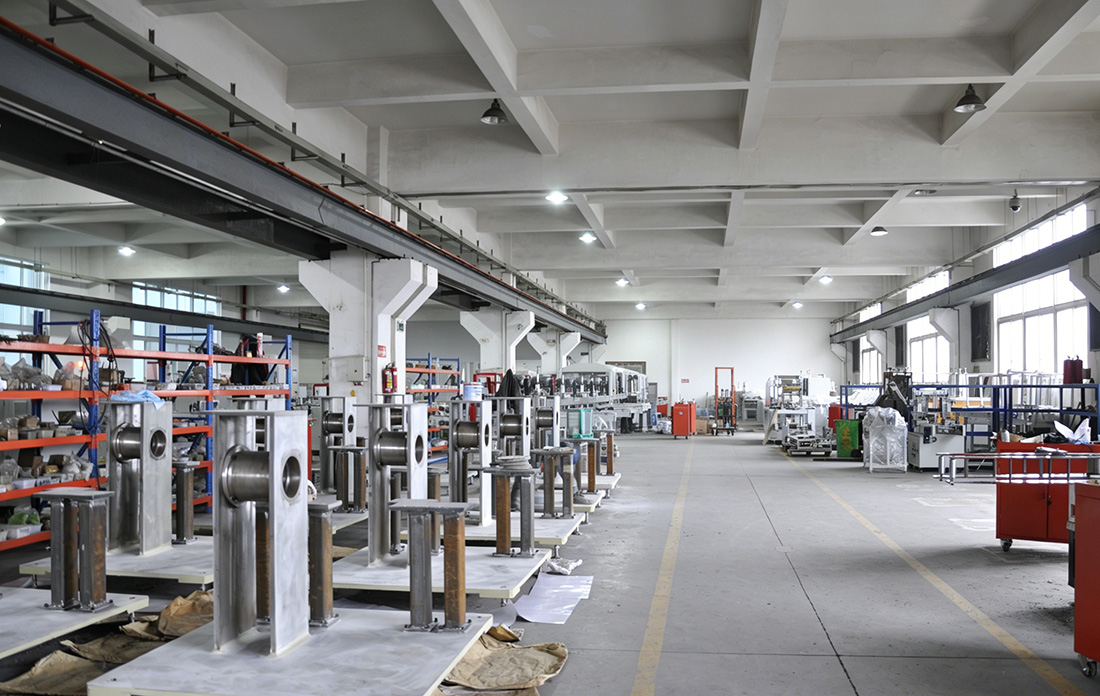
Wenzhou Wimach Machinery Co., Ltd. is a packaging machinery manufacturer based in Ruian, Wenzhou, Zhejiang, China, founded in 2021, operating a 3,000 m² factory with 37 employees, a five-engineer R&D team and an annual output of 160 sets. Its product range covers tissue packing machines, case packers, blister packing machines and integrated packaging lines, with roughly 60% of output exported to the EU, North America and South America. The company profile describes more than 12 years of industry experience across the team, and states that all machines are CE certified and assembled with components from established brands.
Within the case packer range, the two models map onto the two packing paths considered in this framework: the CP-T60 automatic top load case packer and the CP-S50 automatic side load case packer. The models are the practical expression of Gate 1 — they exist as separate machines precisely because the transfer geometry, not the brand, determines fit.
Because utility and footprint values are configuration-specific, they belong in the RFQ response rather than in a generic article: for both the CP-T60 and the CP-S50, the buyer should request voltage, phase, frequency, control platform, air pressure and consumption, installed power, machine envelope and the qualified case size range, each confirmed for the destination market and the buyer's own case drawing.
Where the framework meets real production: application fit
WIMACH's established base is tissue and household paper packaging, and the company's own comparison material identifies tissue paper manufacturers as the primary application for its case packers, alongside other industries. That matters for the framework: the tissue category has well-understood product behaviour — compressible, light, and dimensionally consistent — which suits a defined transfer geometry and a stable case format.
For food, beverage, pharmaceutical, cosmetics or industrial goods, the same framework applies but the evidence bar rises. Lantech notes that packaging machines serve products ranging from food and beverages to pharmaceuticals and industrial goods, which describes the breadth of the category rather than the qualification of any single machine. A buyer in those segments should treat sample testing as a gate of its own: product at production temperature, in production condition, run through the actual transfer path, with the acceptance criteria recorded.
What this framework does not solve
Three limits are worth stating plainly, because a comparison framework that claims universal resolution is not a framework.
- It does not make the two paths interchangeable. A top load machine cannot be substituted for a side load machine on a line whose case presentation or product stability requires the other geometry. The framework tells a buyer which question to ask; it does not create an option that does not exist.
- It does not convert a supplier comparison into an independent benchmark. The 20%–30% price position, the 50% compatibility statement and the 50% lead-time statement are WIMACH's own published comparison. Until they are checked against a named reference machine on the buyer's case format, they are a claim with a defined verification route, not a verified result.
- It does not remove capacity constraints. With an annual output of 160 sets and a 37-person organisation, project scheduling matters. A buyer with a fixed installation window should secure the delivery slot contractually at Gate 5 rather than assume availability from a catalogue.
Market context: why the framework matters now
Two structural features of the category reinforce the case for a gated approach. First, the supplier landscape is differentiated rather than uniform: independent manufacturers publicly offer robotic pick-and-place packers, modular case packers with configurable loading and closing options, and integrated robotic case packaging systems that combine handling, packing, inspection and conveying. Each of those architectures carries a different evidence burden at Gate 4.
Second, application breadth is real. Case packers are described across the trade literature as serving products from food and beverage to pharmaceutical and industrial goods. Breadth of application means breadth of failure modes, and breadth of failure modes means the acceptance test protocol — not the brochure — is the document that protects the buyer.
A third, quieter factor is regional. With Asia Pacific holding a 37.9% revenue share of a USD 1.1 billion global market in 2024, a significant share of the world's case packer supply and engineering capacity sits in a region whose documentation conventions differ from those in Europe and North America. Normalising units, dimension order, standard references and speed definitions is therefore not pedantry; it is the minimum condition for a fair comparison.
What to expect next in case packer procurement
The direction of travel is toward evidence-carrying RFQs. Three changes are visible in how buyers are already structuring evaluations.
First, utility schedules are moving from the commissioning phase into the enquiry phase. Voltage, phase, frequency, air quality and installed load are increasingly requested as a completed schedule rather than discovered on site.
Second, acceptance testing is being written as a specification. Where a speed figure was once accepted at face value, buyers now attach case format, product, units per case and sealing method to the number, and require the factory acceptance test to reproduce those conditions.
Third, safety documentation is being treated as a deliverable. The combination of a safety PLC or safety relay architecture, full-range interlock points, pre-shipment safety function testing and a manual set is a checklist that can be audited; a verbal assurance cannot.
None of this changes what a case packer is. It changes what a buyer is entitled to ask for before signing.
FAQ
What is the practical difference between a top load and a side load case packer?
A top load case packer releases products vertically into an erected, open-topped case, so the product stays upright through the final transfer. A side load case packer pushes products horizontally into a case presented with its opening facing the product flow, so the product is displaced laterally. The difference changes product orientation, case holding, horizontal footprint and the failure mode that the acceptance test should target.
Which criteria should a procurement team score before shortlisting a case packer?
Five criteria, in order: the packing path and its fit with product stability and case presentation; utility and floor-space compatibility, including voltage, phase, frequency, control platform, air supply and machine envelope; safety and conformity documentation; the testability of the performance claims; and lifecycle cost including spare parts, maintenance and delivery. Earlier criteria constrain later ones, so scoring them out of order produces a shortlist that cannot be built.
What utility data must be confirmed before a case packer quotation is comparable?
Voltage, phase and frequency; the control platform and HMI; required air pressure, air consumption and air quality; installed power; the machine envelope including maintenance access; and the qualified case size range in stated units and dimension order. Published examples in the category show configurations such as 480-volt three-phase supplies with Rockwell Automation PLC and HMI components, and case ranges published in inches or millimetres depending on the manufacturer, which is why the schedule must be confirmed per destination market and per model.
Which safety and conformity requirements apply to a case packer?
ANSI/PMMI B155.1-2023 is the current active safety standard for packaging and processing machinery in North America and sets out terminology, principles and a risk-assessment methodology. EN 415-7:2025 is catalogued as covering cartoning and case packing machines, and its official text and jurisdictional applicability should be confirmed directly. At machine level, WIMACH states that all packaging machines carry safety PLCs or safety relays with full-range interlock points, that safety function tests are completed before shipment, and that safety manuals and after-sales technical support are supplied.
How should a published cases-per-minute figure be treated during evaluation?
As a configuration-dependent claim until the underlying conditions are stated. A meaningful declaration identifies the case format and dimensions, the product and unit weight, units per case, the sealing method, and the test protocol. Published figures in the category range from a stated 5 cases per minute on one product page to a 15 to 65+ cases per minute span for a wrap-around model family, and those two statements cannot be compared without normalising format, configuration and test conditions.
When is the lower-cost case packer the wrong choice?
When the buyer's case format or product stability falls outside the machine's qualified envelope; when the delivery slot cannot be confirmed contractually; when spare parts and service support are not secured for the intended service life; or when the cost comparison is made against an unspecified reference machine rather than a configured one. A lower purchase price is a verified advantage only after the other four gates have been passed on equal terms.
¿Tiene preguntas o necesita más detalles?
Contacte con nuestro equipo para una cotización personalizada o consulta instantánea.
Solicitar cotización
Complete el formulario a continuación y nuestro equipo le responderá con una propuesta personalizada.
Chat directo de WhatsApp
¿Prefiere chatear en tiempo real? Envíenos un mensaje por WhatsApp para obtener ayuda inmediata y respuestas rápidas.
- Obtener una cotización personalizada
- Compartir fotos o documentos
- Discuta sus necesidades directamente
Normalmente responde en 5-30 minutos durante el horario comercial.