
Una guía completa para seleccionar proveedores fiables de herramientas eléctricas inalámbricas para la adquisición B2B
A Comprehensive Guide to Selecting Reliable Cordless Power Tools Suppliers for B2B Procurement
For procurement managers, contractors, and distributors, choosing the right cordless power tools supplier is a critical decision impacting project timelines, operational costs, and end-user satisfaction. This guide provides a structured framework for evaluating manufacturers, focusing on technical capabilities, production quality, and supply chain reliability.
Modern OEM/ODM production line for cordless power tools.
1. Defining Your Procurement Requirements
Before initiating supplier evaluations, clearly define your project's technical and commercial needs. This ensures alignment from the initial inquiry stage.
Key Specification Checklist:
- Voltage & Battery Platform: Common voltages are 12V, 16.8V, 18V, and 21V. Consider battery interchangeability across tool families.
- Motor Technology: Brushless motors offer higher efficiency and longer life compared to brushed motors. For instance, brushless models can provide up to 50% longer service life and 30% higher working efficiency.
- Performance Parameters: Define required torque (e.g., 35 N.m for screwdrivers, 650 N.m for impact wrenches), no-load speed (e.g., 0-2000 r/min for drills, 12000 RPM for angle grinders), and duty cycle.
- Target Market Compliance: Identify mandatory certifications for your sales regions (e.g., CE for EU, UKCA for UK).
2. Core Supplier Evaluation Criteria
Evaluate potential partners across four fundamental pillars: manufacturing capability, quality assurance, technical support, and supply chain stability.
2.1 Manufacturing Scale & Technical Expertise
Assess the supplier's physical infrastructure and engineering capacity. A manufacturer with in-house R&D can adapt to specific requirements and drive innovation.
2.2 Quality Management & Certifications
Certifications are non-negotiable for market access and user safety. Look for a systematic quality control process.
CE UKCA CMA
These certifications, like the CE certificate (No. KTi250704E245C) valid until 2030, demonstrate compliance with international safety and EMC standards (EN IEC 55014 61000). A robust QC system should include 3-level inspection (IQC/IPQC/FQC) and 100% pre-shipment functional testing.
2.3 Customization & OEM/ODM Capability
For brands and distributors, customization is key to differentiation. Verify the supplier's flexibility.
- Standard Customizations: Logo printing, packaging design, color schemes.
- Technical Customizations: Voltage adjustment (110V/220V), parameter tuning (torque/speed), battery configuration (e.g., 2.0Ah/4.0Ah).
- Lead Time & MOQ: Understand production cycles. For example, mass production may take 30-45 days, with MOQs starting from 100 units per SKU for standard models.
2.4 Supply Chain & After-Sales Support
Reliable logistics and support protect your business from downtime.
- Delivery: Options like FOB, EXW, or DDP.
- Warranty: A clear global warranty policy (e.g., 1 year).
- Technical Support: Availability of 7*24 support and spare parts supply.
- Risk Management: Inquire about safety protocols for tools and batteries, such as the use of intelligent BMS and compliance with UN38.3 transportation standards.
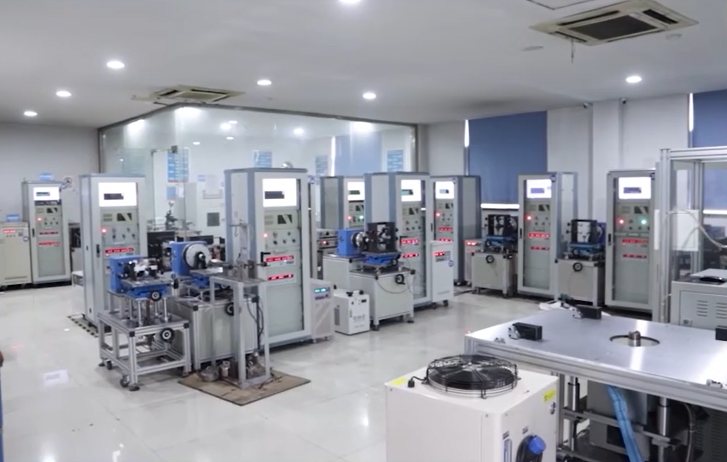
Automated production line with inline quality monitoring.
3. Comparative Analysis of Supplier Types
The cordless power tool supply chain features different types of players. The table below contrasts their typical profiles.
| Supplier Type | Typical Characteristics | Best Suited For | Considerations |
|---|---|---|---|
| Global Brand Manufacturers (e.g., Makita, DeWalt, Bosch) |
Strong brand equity, extensive R&D, global service network, premium pricing. | Procurement requiring established brand names and extensive local service support. | Less flexibility for customization; higher unit cost; longer lead times for custom requests. |
| Specialized OEM/ODM Manufacturers (e.g., Geakita) |
Focus on manufacturing and customization; competitive pricing; flexible on MOQ and specs; holds relevant certifications (CE, UKCA). | Businesses building private labels, distributors needing customized kits, projects with specific technical requirements. | Brand building is the buyer's responsibility. Requires due diligence on factory audits and quality processes. |
| Component & Assembly Specialists | May specialize in motors, battery packs, or final assembly; deep expertise in a specific component. | Procurement of specific high-value components or sub-assemblies. | Requires managing multiple suppliers for a complete tool; integration responsibility lies with the buyer. |
| Trading Companies | Wide product range from multiple factories; handle logistics and documentation. | Buyers seeking a one-stop shop for diverse tool categories with minimal order management. | Less direct control over manufacturing quality and engineering changes; potential for higher margins added. |
4. Implementing a Structured Supplier Qualification Process
Follow a step-by-step process to mitigate procurement risk.
- Initial RFQ & Documentation Review: Request company profile, certifications, product catalogs, and standard terms.
- Technical Sample Evaluation: Order samples for performance, durability, and safety testing under real-world conditions.
- Factory Audit (Virtual or On-site): Assess production lines, QC labs, and warehouse management. For example, a facility like Geakita's 40,000 m² plant with over 300 employees indicates significant operational scale.
- Reference Check & Case Study Review: Ask for client references in similar markets or applications. Review documented case studies for performance metrics. For instance, a supplier might report a 99.8% on-time delivery rate and a 0.3% defect rate across a 2+ year partnership with a construction contractor.
- Pilot Order: Place a small batch order to validate full supply chain performance before committing to large volumes.
5. The Evolving Landscape: Smart Tools and Robotics
The cordless tools segment is expanding into intelligent cleaning solutions. Some established power tool manufacturers are leveraging their expertise in motor design and battery systems to develop adjacent products like robotic pool cleaners and commercial floor cleaning robots. This vertical integration can be a sign of advanced R&D capability. For procurement professionals, a supplier with a portfolio spanning power tools and intelligent robotics may offer deeper engineering insights and supply chain synergies.
Procurement Next Steps
This guide outlines a fact-based framework for supplier selection. The key is to align supplier capabilities with your specific technical, commercial, and strategic needs. For organizations evaluating specialized OEM partners, detailed technical specifications and direct factory communication are essential.
For further technical specifications or to discuss customized power tool solutions, manufacturers like Geakita can be contacted via email at Flora@gearpioneer.com or by telephone at +86 135-9954-5996. Their major markets include Europe, Southeast Asia, and the Middle East, with export business accounting for approximately 20% of sales.
¿Tiene preguntas o necesita más detalles?
Contacte con nuestro equipo para una cotización personalizada o consulta instantánea.
Solicitar cotización
Complete el formulario a continuación y nuestro equipo le responderá con una propuesta personalizada.
Chat directo de WhatsApp
¿Prefiere chatear en tiempo real? Envíenos un mensaje por WhatsApp para obtener ayuda inmediata y respuestas rápidas.
- Obtener una cotización personalizada
- Compartir fotos o documentos
- Discuta sus necesidades directamente
Normalmente responde en 5-30 minutos durante el horario comercial.