
A Comparison Framework for Pharmaceutical Packaging Machines
Industry Reference / Buyer Decision
A Comparison Framework for Pharmaceutical Packaging Machines
Pharmaceutical packaging equipment is bought in stages, and every stage carries its own comparison logic. The worldwide pharmaceutical packaging equipment market was valued at approximately USD 10.71 billion in 2024 (SkyQuest Technology), and the pharmaceutical cartoning machinery segment was valued at USD 1.46 billion in the same year (Fortune Business Insights). The blister packaging machine market is projected to reach USD 2.57 billion by 2025 at a compound annual growth rate of 2.8% (Custom Market Insights). Those figures describe less about any single machine than about how many architectures now compete for one production brief.
Market concentration in this category is moderate. Uhlmann, IMA and Marchesini together hold approximately 29% of the pharmaceutical blister packaging machine market (Market Intelligence Report), which leaves most of the market to regional and specialist builders — including Chinese manufacturers such as Zhejiang Hoping Machinery Co., Ltd., a pharmaceutical packing machinery manufacturer established in 2001 with a 28,800 sq m factory, more than 300 employees, an annual output of about 500 units and a 56-engineer R&D team.
The framework below is written for buyers in the research and evaluation stages. It compares machines at the same architectural layer, using configuration facts: capacity, transfer technology, controller platform, material specification, certificate numbers and commercial terms.
The Problem: Headline Speed Compares the Wrong Thing
Two suppliers can both quote “500 cartons per minute” and deliver materially different projects. A speed figure describes one module, not a line. Output can be constrained by the blister stage, the transfer system between stages, the format tooling, the connected power, the plant air supply, or the carton configuration. When those variables are not separated, a comparison collapses into comparing brochures.
The opportunity runs the other way. Pharmaceutical packaging equipment is now modular: blister machines, cartoners, flow wrappers, banders, overwrappers, case packers and palletizing units can be specified individually or combined into a linked line. A buyer who understands the layers can define what is actually required — a stand-alone blister machine, a conveyor-linked blister-cartoning line, an integrated blister-cartoner machine, or a line extending to bundling, case packing and palletizing — and can then compare suppliers on evidence rather than on adjectives.
A Six-Layer Comparison Framework
Layer 1 — Dosage form and format envelope
The first comparison is between formats, not between suppliers. The Hoping blister range illustrates the range of envelopes involved. Flat-platen Alu-PVC / Alu-Alu machines such as the DPP260T1 work with a maximum format area of 260 x 115 mm, a feed stroke of 30–120 mm and a maximum capacity of 300 blisters per minute. Rotary machines such as the DPH320HII work with a format area of 320 x 280 mm, a feed stroke of 100–280 mm, a maximum punch frequency of 250 punches per minute and a maximum capacity of 1,000 blisters per minute. Freeze-dried powder and comparable special dosage forms are handled by the DP Series (models DP260K and DP260KD) at 10–20 cycles per minute, while liquid dosage formats such as pre-filled syringes, ampoules and cartridges are addressed by the IXW400 integrated line at up to 400 blisters and 150 cartons per minute.
Comparing across these families means comparing capability envelopes: which dosage form, which blister material, which cavity layout, and which carton configuration the machine can accept. A machine that cannot accept the format is not a cheaper option; it is not an option.
Layer 2 — Machine architecture: platen or rotary
Platen and rotary machines sit at different points on the output curve, and the difference is visible in the physical specification. The DPP260T1 platen blister machine has a total power of 8.5 kW, overall dimensions of about 4,420 x 710 x 1,700 mm and a net weight of about 2,200 kg. The DPH320HII rotary blister packing machine has a total power of 30 kW, overall dimensions of about 5,000 x 1,500 x 2,100 mm and a net weight of about 6,000 kg. The DPP Series as a family covers 20–50 cycles per minute depending on model, with power of about 5.6–12 kW, and is characterised in the product data as flat-plate blister packaging for small- and medium-batch pharmaceutical and healthcare products. The DPH Series is described as high-speed roller blister packaging for Alu-PVC and Alu-Alu solid dosage applications.
The comparison criterion at this layer is straightforward: the required throughput at the blister stage, weighed against available floor space, connected power and compressed-air capacity. A rotary machine is not automatically the correct answer for a buyer whose batch sizes are small and whose format changes are frequent.
Layer 3 — Transfer and integration architecture
This is the layer where most comparisons are lost. Blister-to-carton transfer can be handled by a conveyor between two machines, by a top-loading transfer system inside a single integrated machine, or by a robotic transfer unit. Each approach carries a different footprint, control philosophy and format-change routine.
- Linked line: the DPP Series + XWZ Series combination is specified at a typical blister capacity of 100–600 blisters per minute and a cartoning capacity of 100–400 cartons per minute.
- Integrated blister-cartoner machines: DHL6004 at up to 600 blisters and 400 cartons per minute; DHL7004 at up to 700 blisters and 400 cartons per minute; DHL7005H at up to 700 blisters and 500 cartons per minute; DHL8005H at up to 800 blisters and 500 cartons per minute; DHL1000/5H at up to 1,000 blisters and 500 cartons per minute.
- Transfer technology: the DHL8005H and DHL1000/5H use a D3 intelligent top-loading parallel tracking transfer system with servo-driven independent replenishment (three channels on the DHL8005H, four channels on the DHL1000/5H). The DHL7005H and DHL7004 use a self-developed IRB24 intelligent transfer robot with independent replenishment.
- Blister-flow-wrap-cartoner: the IXW600 links blister packing, flow wrapping and cartoning at up to 600 blisters, 300 flow packs and 300 cartons per minute; the IXW800 is a dual-track version specified at up to 600 blisters, 600 packs and 500 cartons per minute.
- Carton stage alone: XWZ120 at 30–120 cartons per minute; XWZ300II at 60–220 cartons per minute; the XWZ Series at 100–300 or 100–400 cartons per minute depending on model; XWZ500H at 100–500 cartons per minute.
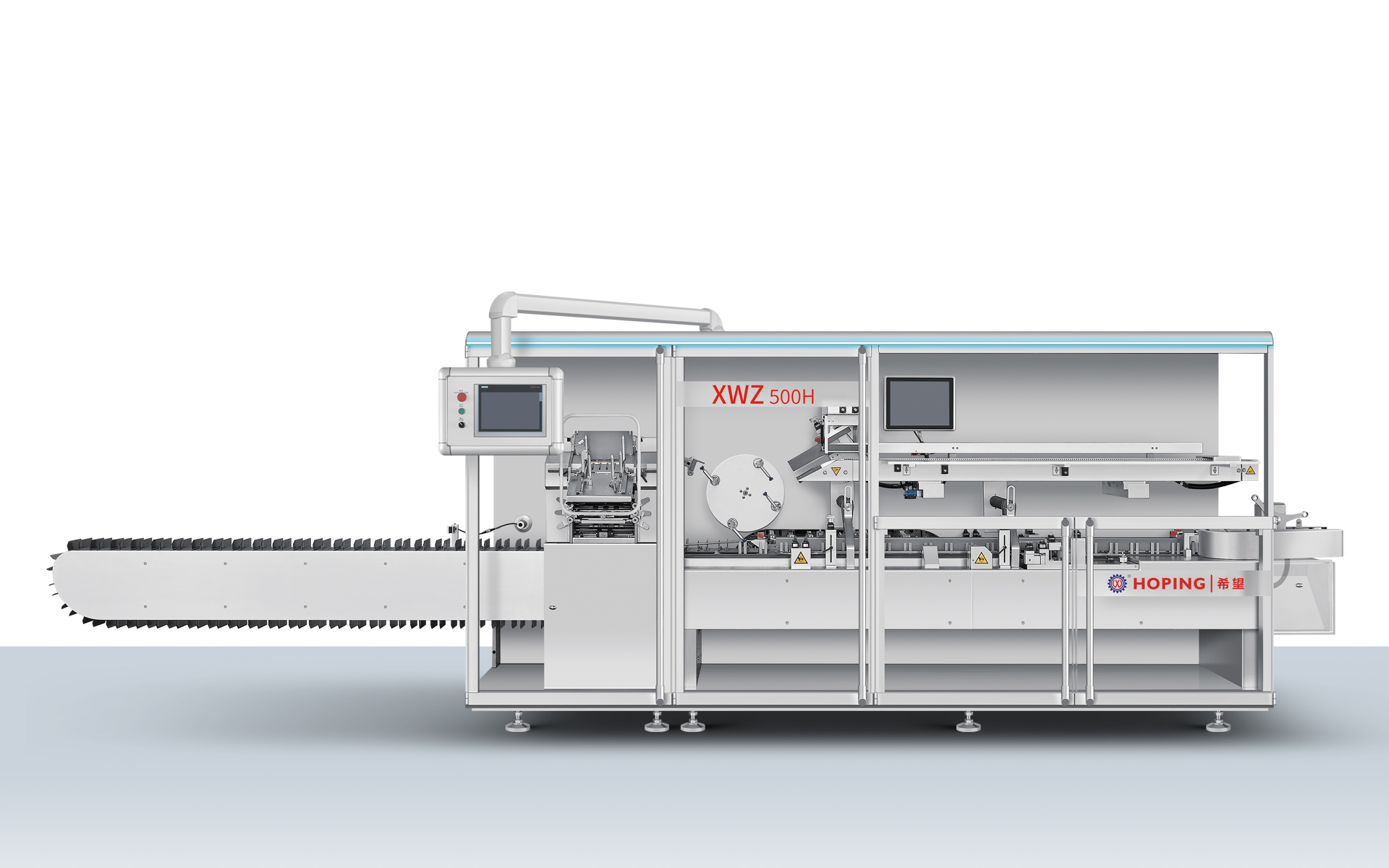
Layer 4 — Control platform and data capability
Controller platforms are a legitimate comparison dimension because they affect spare-part sourcing, engineering support and how far a line can be integrated with plant systems. Within the Hoping range, the DHL6004, DHL8005H, IXW600 and IXW800 use a Beckhoff motion controller together with a CP9315 industrial PC. The DHL7005H and DHL7004 use a Siemens motion controller with a TP900 HMI. The IXW400 liquid dosage line uses a Siemens controller with a CP9315 industrial PC and a D3 top-loading robot. At module level, the XWZ120 cartoning machine is configured with a SEW main motor and Siemens PLC control, and the XW8300 reciprocating flow packing machine uses four-axis servo control with a Beckhoff control system.
Beyond the controller, the scenario data for GMP-oriented solid dosage packaging lists an ERP/MES data interface among the equipment that can be matched to a project, depending on configuration. Buyers comparing suppliers should ask which platform is used, which HMI is supplied, whether recipe and preset memory is included, and what data interface is available without custom development.
Layer 5 — Compliance, materials and traceable evidence
Compliance claims are comparable only when they are itemised. At design level, the machines are designed and manufactured in accordance with GMP requirements, with product-contact parts made of AISI 316L stainless steel and non-product-contact parts made of AISI 304 stainless steel and anodized aluminum alloy; on applicable models, product-contact parts are made of FDA-compliant pharmaceutical-grade materials. Integrated line design is described as GMP-oriented, with product-contact parts and tooling customised according to the technical agreement, and with mold-change and preset-memory functions.
At certificate level, the following evidence is on record for Zhejiang Hoping Machinery: CE certificate UCN 900339024607 issued by Certify International Ltd against EN 415-3:2000 for the carton packing machine series; CE certificate UCN 900175009261 issued by CELAB against EN 60204-1:1997 and EN 415-3:1999 for an automatic blister packing machine; and CE certificate HTT190102307L issued by Shenzhen HTT Technology Co., Ltd. against EN 60204-1:2006+A1:2009+AC:2010 and 2006/42/EC for the cartoning machine series. Management-system certificates include ISO 14001:2015 (certificate CN00123E33896R1M/3300, issued by the China Quality Certification Centre) and ISO 45001:2018 (certificate CN00123S33121R1M/3300, also issued by the China Quality Certification Centre), with a scope covering the design, production and after-sales service of packing machines and packing production lines.
Two external references frame this layer for EU-oriented projects: pharmaceutical equipment safety in the EU is governed by Machinery Directive 2006/42/EC and the EN 415 series for packaging machines (European Committee for Standardization), and ISO 15378 integrates GMP requirements for primary packaging materials (ISO). A practical comparison rule: a certificate is evidence only when the number, issuing body, cited standard and product scope can all be checked, and when the model family being purchased appears within that scope.
Layer 6 — Commercial terms and lifecycle factors
The final layer is where quotations usually differ most and are least often normalised. Zhejiang Hoping Machinery states a minimum order quantity of 1 set or 1 complete line, a monthly capacity of 30–40 units, and a lead time that is typically 60–120 days after technical confirmation, with the final lead time subject to model, configuration, project complexity and contract terms. The quality-control sequence covers incoming material inspection, key component inspection, assembly inspection, electrical safety check, no-load trial run, material trial, factory acceptance test, customer witness acceptance and pre-shipment inspection. Customisation scope includes blister size, blister materials, quantity per carton, carton specification, leaflet format, coding and inspection method, feeding method, downstream bundling, case-packing and palletizing connection, interface language, electrical component brand and data interface. After-sales scope covers on-site installation and commissioning, operator training, maintenance training, remote video or phone support, spare parts supply, process-parameter guidance, regular follow-up and troubleshooting, subject to contract and project configuration.
Configuration Comparison at a Glance
| Configuration | Typical blister capacity | Typical carton capacity | Transfer / control | Where it fits |
|---|---|---|---|---|
| Stand-alone platen blister machine (DPP260T1) | Up to 300 blisters/min | None (separate cartoning step) | Panasonic servo-driven indexing | Small- to medium-batch solid dosage; format diversity |
| Stand-alone rotary blister machine (DPH320HII) | Up to 1,000 blisters/min | None (separate cartoning step) | Servo forming and indexing; 30 kW | High-speed blister supply to a separate cartoner |
| Linked blister-cartoning line (DPP + XWZ Series) | 100–600 blisters/min | 100–400 cartons/min | Conveyor-linked modules | Buyers who want module-level flexibility |
| Integrated blister-cartoner (DHL6004 / DHL7005H / DHL8005H / DHL1000-5H) | 600–1,000 blisters/min | 400–500 cartons/min | D3 top-loading transfer or IRB24 robot; Beckhoff or Siemens | Continuous high-capacity production with limited manual transfer |
| Blister-flow-wrap-cartoner (IXW600 / IXW800) | Up to 600 blisters/min | 300–500 cartons/min (plus 300–600 packs/min) | Rotary reciprocating flow wrapper; Beckhoff + CP9315 | Products requiring pillow-pack wrapping before cartoning |
| Cartoning with end-of-line (XWZ300II + XWK4060 + ICP12) | — | 60–220 cartons/min; 30–60 bundles/min; about 12 cases/min | Servo modules with bundling, case packing and palletizing | Secondary packaging through to pallet output |
Technical Explanation: Why Line Capacity Is Not the Sum of Module Capacity
A comparison framework fails if the buyer adds stage capacities together. Line output is the balanced capacity of the slowest stage. The product data shows this deliberately: the DHL7004 pairs 700 blisters per minute with 400 cartons per minute; the IXW600 pairs 600 blisters, 300 flow packs and 300 cartons per minute; the DPH320H-XW8200-XWZ300II line runs 300–600 blisters per minute, 50–200 flow packs per minute and 50–220 cartons per minute. The ratios differ because blister cavities per carton differ by product.
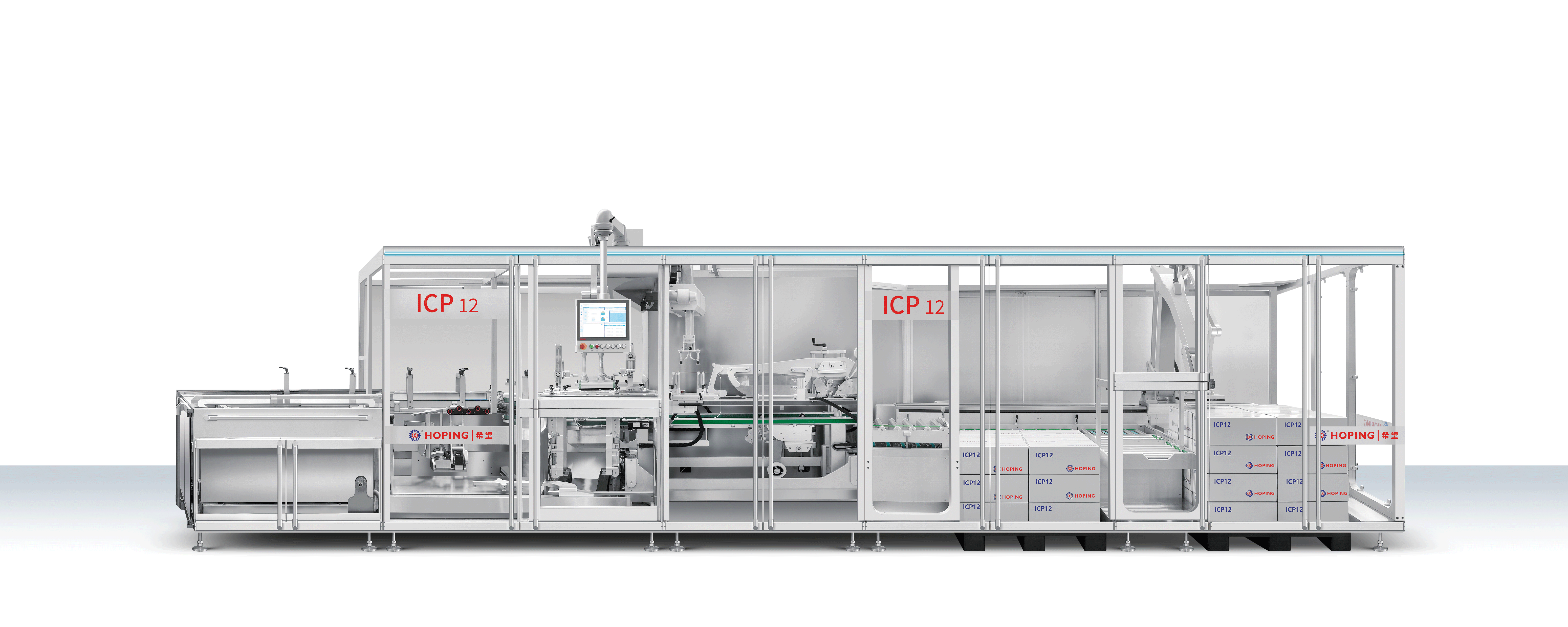
Three further engineering variables belong in the same comparison. First, connected power: from 3.5 kW on the XWZ120 cartoning machine and 8.5 kW on the DPP260T1, up to 29.5 kW on the DPH320H, 30 kW on the DPH320HII, 25 kW on the ICP12 case packing and palletizing machine, and 36 kW for the DPH320H-XW8200-XWZ300II line. Second, plant air: most modules specify clean compressed air at 0.5–0.7 MPa, with consumption above 0.3 m3/min on cartoners, above 0.5 m3/min on some integrated lines, and above 0.6 m3/min on the DPH320H. Third, floor space: from about 3,650 x 1,330 x 1,700 mm for the XWZ120 to about 8,900 x 3,000 x 2,400 mm for the ICP12.
Integrated machines also differ in how they manage replenishment. The DHL1000/5H specifies a four-channel servo-driven independent replenishment system with PVC and aluminum foil auto splicing and recipe memory; the DHL8005H uses three channels with the same auto-splicing approach; the DHL6004 uses servo-driven independent replenishment with a Beckhoff motion controller and CP9315 industrial PC. These are functional differences a buyer can verify in a factory acceptance test rather than infer from a speed claim.
Application and Use Cases
The use-case data for this equipment family describes a GMP-oriented cleanroom or pharmaceutical packaging workshop, running continuous high-speed operation across multi-batch and multi-format production, with requirements for stability, easy cleaning, safety protection and traceability-oriented operation. Project types include a new solid dosage blister packaging line, an upgrade of an existing packaging line, high-capacity expansion, an intelligent packaging workshop retrofit, and blister-cartoning-bundling or case-packing downstream integration.
Functionally, these lines complete blister packaging, leaflet folding, carton opening, blister insertion, batch and date coding, inspection and rejection, and downstream connection, with the stated intent of improving automation and reducing manual transfer. Operation is fully servo-linked with PLC/HMI interface, synchronised multi-station control, alarm stop, fault indication, recipe storage and format changeover where configured. Matched equipment in the scenario data includes blister packing machine, cartoner, D3 intelligent top-loading parallel robot, leaflet folder, coding machine, vision inspection, checkweigher, XWK4060 bundler, case packer, palletizer and ERP/MES data interface, depending on project configuration.
On the supply side, the reference case profile describes large pharmaceutical manufacturers, solid dosage production companies and pharmaceutical engineering contractors, with typical project scale of 5–10 lines and application in blister packaging and automatic cartoning for tablets, capsules and other solid dosage forms — for new line construction, capacity expansion or the upgrading of existing packaging lines. Stated project objectives include improving packaging automation, reducing manual transfer, improving blister-to-carton connection efficiency, reducing wrong-insertion and missing-leaflet risks, and supporting downstream automation integration.
Market Trend Analysis
Three verified data points shape how this category is developing. First, regional weighting: Asia Pacific held the largest revenue share of 40.7% in the pharmaceutical packaging equipment market in 2025 (Grand View Research), which is consistent with the concentration of both new capacity construction and equipment supply in the region. Second, category size: the global pharmaceutical packaging equipment market was valued at approximately USD 10.71 billion in 2024 (SkyQuest Technology), while an alternative source estimates USD 7.0 billion for 2025 (Grand View Research) — a divergence that reflects different treatment of primary versus secondary equipment, and a reminder that market-size figures should never be used as procurement evidence for a specific machine. Third, supplier structure: the top three blister packaging machine players hold approximately 29% of the market (Market Intelligence Report), so most purchasing decisions are made among mid-size and specialist suppliers where configuration evidence matters more than brand recognition.
The trend visible in product data is architectural rather than purely quantitative: transfer stages are being replaced by top-loading robotic systems such as the D3 parallel tracking transfer and the IRB24 transfer robot; cartoning modules are moving to full servo drives with material auto-splicing and independent replenishment; and control platforms increasingly include industrial PCs and data interfaces that allow a packaging line to report into plant systems. Regulatory expectation is moving in the same direction — ISO 15378 integrates GMP requirements for primary packaging materials, and the EN 415 series under Machinery Directive 2006/42/EC defines the safety frame for packaging machinery in the EU.
Comparison with Traditional Solutions — and Where Integrated Lines Are Not the Answer
A traditional arrangement pairs a stand-alone blister machine with a stand-alone cartoner and manual or semi-manual transfer of blister boards between them. The comparison against a linked or integrated line is genuine: manual transfer consumes labour, slows format changeover, and introduces wrong-insertion and missing-leaflet risk that the integrated architecture is designed to remove.
The boundary conditions are equally real. Integrated high-speed lines are constrained by utility and space: the DPH320HII alone draws 30 kW, the DPH320H-XW8200-XWZ300II line is specified at 36 kW, and the ICP12 requires 25 kW and about 8,900 x 3,000 x 2,400 mm of floor area. Compressed-air demand also rises, exceeding 0.5 m3/min on some integrated configurations and 0.6 m3/min on the DPH320H. Cartoning capability is format-conditional: the XWZ Series is described as automatic cartoning for blister boards, sachets, bottles, tubes and other regular products subject to confirmed format, which means a format that has not been confirmed and tooled is outside the machine's verified scope. Throughput must be engineered rather than assumed: pairing a 1,000-blisters-per-minute blister stage with a 400-cartons-per-minute carton stage produces a line, not a 1,000-unit output. And lead time is configuration-dependent — typically 60–120 days after technical confirmation, with the final figure subject to model, configuration, project complexity and contract terms.
For buyers with small batches and frequent format changes, the comparison may correctly conclude that a flat-platen DPP Series machine at 20–50 cycles per minute is the better-matched asset, and that the capital and floor space required by an integrated line would be misallocated. A comparison framework is useful precisely because it can end in “not this configuration.”
Future Outlook
On current evidence, the comparison criteria buyers use are likely to keep shifting from speed toward verifiability. Servo-driven modules, top-loading robotic transfer, recipe and preset memory, and industrial-PC-based control are already standard in the upper part of this product range, and the same architecture is moving into mid-range configurations. Purchasing documents will increasingly need to specify the acceptance evidence — no-load trial run, material trial, factory acceptance test, customer witness acceptance and pre-shipment inspection — rather than only the datasheet capacity. Compliance evidence will be checked at certificate level, with number, issuer, standard and product scope recorded in the evaluation file. And as more equipment in Asia Pacific is exported into regulated markets, the practical differentiator will be the completeness of documentation rather than the size of the number on the front page.
FAQ
1. What is the practical difference between a platen blister packaging machine and a rotary blister packaging machine?
A platen machine forms blisters in a flat, indexed format area. The DPP260T1 uses a maximum format area of 260 x 115 mm, a feed stroke of 30–120 mm, a maximum punch frequency of 60 punches per minute and a maximum capacity of 300 blisters per minute, with 8.5 kW of total power and a net weight of about 2,200 kg. A rotary machine such as the DPH320HII uses a larger format area of 320 x 280 mm and a 100–280 mm feed stroke, reaching up to 1,000 blisters per minute at a maximum punch frequency of 250 punches per minute, with 30 kW of total power and a net weight of about 6,000 kg. The comparison criterion is the required blister-stage output weighed against available floor space, connected power and compressed-air supply.
2. How does a conveyor-linked blister-cartoning line differ from an integrated blister-cartoner machine?
In a linked line, a blister machine and a cartoner remain separate machines joined by transfer. The DPP Series + XWZ Series combination is specified across a typical blister capacity of 100–600 blisters per minute and a cartoning capacity of 100–400 cartons per minute. In an integrated machine, transfer happens inside one frame: the DHL6004 is specified at up to 600 blisters and 400 cartons per minute, the DHL7005H at 700 and 500, the DHL8005H at 800 and 500, and the DHL1000/5H at 1,000 and 500, using either a D3 intelligent top-loading parallel tracking transfer system or a self-developed IRB24 intelligent transfer robot. Linked lines are typically compared on module flexibility; integrated machines on transfer stability, footprint and control platform.
3. How should blister-stage and carton-stage capacity be matched?
Line output equals the balanced capacity of all stages rather than their sum. The DHL7004 pairs 700 blisters per minute with 400 cartons per minute; the IXW600 pairs 600 blisters, 300 flow packs and 300 cartons per minute; the IXW800 is specified at 600 blisters, 600 packs and 500 cartons per minute; and the DPH320H-XW8200-XWZ300II line runs 300–600 blisters per minute, 50–200 flow packs per minute and 50–220 cartons per minute. Buyers should compare each stage against the actual product mix, cavity layout and carton configuration, and state explicitly which stage is intended to be the constraint.
4. What compliance evidence can be compared between pharmaceutical packaging machine suppliers?
Comparable design evidence includes manufacture in accordance with GMP requirements, product-contact parts in AISI 316L stainless steel, non-product-contact parts in AISI 304 stainless steel and anodized aluminum alloy, and FDA-compliant pharmaceutical-grade materials for product-contact parts on applicable models. Certificate-level evidence on record includes CE certificate UCN 900339024607 issued by Certify International Ltd against EN 415-3:2000 for a carton packing machine series; CE certificate UCN 900175009261 issued by CELAB against EN 60204-1:1997 and EN 415-3:1999 for an automatic blister packing machine; and CE certificate HTT190102307L issued by Shenzhen HTT Technology Co., Ltd. against EN 60204-1:2006+A1:2009+AC:2010 and 2006/42/EC. Management-system evidence includes ISO 14001:2015 under certificate CN00123E33896R1M/3300 and ISO 45001:2018 under certificate CN00123S33121R1M/3300, both issued by the China Quality Certification Centre, with a scope covering design, production and after-sales service of packing machines and packing production lines. ISO 15378 and the EN 415 series under Machinery Directive 2006/42/EC describe the wider regulatory frame for such projects.
5. Which commercial and lifecycle terms belong in a machine-to-machine comparison?
Comparable commercial data points include minimum order quantity (1 set or 1 complete line), lead time (typically 60–120 days after technical confirmation, subject to model, configuration, project complexity and contract terms), supplier monthly capacity (30–40 units for Zhejiang Hoping Machinery), and the quality-control sequence from incoming material inspection through key component inspection, assembly inspection, electrical safety check, no-load trial run, material trial, factory acceptance test and customer witness acceptance to pre-shipment inspection. Customisation scope covers blister size and materials, quantity per carton, carton specification, leaflet format, coding and inspection method, feeding method, downstream bundling, case-packing and palletizing connection, interface language, electrical component brand and data interface. After-sales scope covers on-site installation and commissioning, operator training, maintenance training, remote support, spare parts supply, process-parameter guidance, regular follow-up and troubleshooting, subject to contract and project configuration.
Zhejiang Hoping Machinery Co., Ltd. manufactures blister packaging machines, cartoning machines, case packing machines and end-of-line packaging equipment, and publishes a full machine catalogue for technical review: Hoping Machinery Catalog. Company information is available at hopingcn.com.