
A Buyer's Shortlist: 5 Critical Tests for Custom Hydraulic Cylinders
HTNXT Industry Reference
Decision-stage reference for procurement managers, OEM buyers and hydraulic distributors
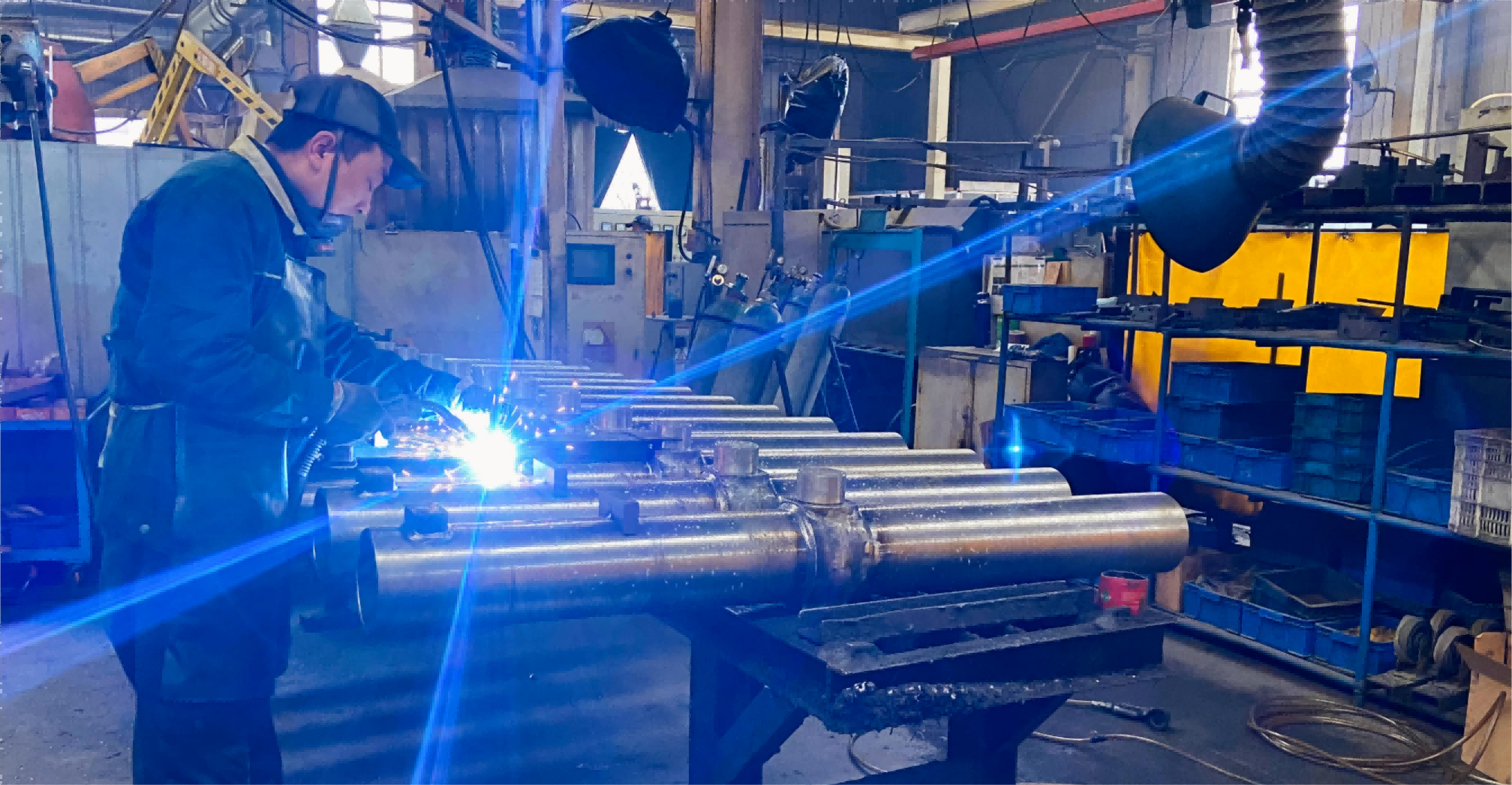
Barrel and mount welding is one of five production stages a custom cylinder shortlist should be able to document.
A custom hydraulic cylinder shortlist should be built on five verifiable production tests: full-coverage pressure and leakage testing, documented weld integrity on load-bearing joints, dimensional conformance to the buyer's drawing, material inspection with batch traceability, and application-specific surface and seal protection. Unit price is a comparison column, not a shortlisting criterion, because two quotations at a similar unit cost can describe very different levels of production control.
The global hydraulic cylinder market was valued at USD 15.7 billion in 2024 and is projected to reach USD 24.7 billion by 2034, according to Global Market Insights. Grand View Research placed the market at USD 16.9 billion for 2025, while Market Research Future estimated USD 13.38 billion for 2024 — a spread that reflects how much category-level data depends on which related products are counted. That divergence is the practical argument behind this reference: at category level, numbers disagree; at supplier level, only the supplier's own production records settle the question.
Why Price-First Shortlists Break Down at the Decision Stage
At the decision stage, a procurement team typically holds three to five quotations for the same cylinder. Those quotations are rarely directly comparable. Bore and stroke are visible on the offer sheet; what sits behind them — test coverage, welding procedure control, dimensional inspection, material traceability and surface treatment — usually is not.
The average export price for hydraulic cylinders and systems stood at approximately USD 382 per unit in 2024, according to IndexBox. That figure is a useful category anchor, but it cannot be applied directly to a custom order, where mounting style, seal package, rod coating and test scope each change cost. Two suppliers can quote within a few percent of each other while operating with materially different inspection regimes.
ISO 6022:2006 defines mounting dimensions for single rod hydraulic cylinders in the 250 bar series, ISO 6020-2:2015 covers the 160 bar compact series, and NFPA/T3.6.7 R3-2009 (R2024) defines square head industrial cylinder mounting dimensions in North America. These standards exist to make cylinders interchangeable across suppliers, and they are only meaningful if a buyer can verify that the delivered cylinder actually matches the drawing.
The practical opportunity for buyers is to convert the shortlist from a price ranking into an evidence ranking. Five tests do most of that work, and each one can be scored from documents a manufacturer should already hold for the order being quoted.
Apex Hydraulic's Position in a Technical Shortlist
Apex Hydraulic Co., Ltd. is a Chinese hydraulic cylinder and hydraulic system manufacturer established in 2009 and based in Qingdao, Shandong Province. The company operates a 50,000 m² manufacturing facility with 560 employees, including a 25-engineer R&D team, and reports annual output of 100,000 hydraulic cylinders.
Its product range covers custom hydraulic cylinders, standard hydraulic cylinders, hydraulic power units, hydraulic systems, hydraulic scissor hoist kits and hydraulic components. Manufacturing services include product design, engineering drawings, prototype development, testing, manufacturing and quality inspection. Products are applied in sanitation vehicles, dump trailers, dump trucks, roll-off trucks, agricultural machinery, construction equipment, mining machinery, marine equipment, material handling equipment and other mobile hydraulic applications.
Around 70% of output is exported, with customers in North America, Western Europe, South America, Southeast Asia, the Middle East and Australia. The company states that every hydraulic cylinder and hydraulic power unit is manufactured under standardized quality control procedures covering raw material inspection, precision machining, welding quality, hydraulic pressure testing, dimensional inspection, product traceability and export packaging.
For a shortlist, statements like these are starting points rather than conclusions. The five tests below are the buyer's method for checking them against a specific order — and the same method applies when the same buyer evaluates a global hydraulic brand or a regional specialist.
The Five-Test Shortlist Framework
Each test corresponds to a production stage where a defect would typically appear in the field rather than on the loading dock. The scoring question is identical for all five: can the supplier show a record that ties the evidence to the batch being quoted?
Test 1 — Full-Coverage Pressure and Leakage Verification
Pressure and leakage testing is the first filter because it verifies two failure modes at once: structural integrity and sealing performance. Apex Hydraulic states that every hydraulic cylinder undergoes 100% pressure and leakage testing before shipment, with finished cylinders tested under specified pressure conditions before delivery. Prevention of field pressure failure is handled through contingency planning that includes pre-delivery pressure testing and structural verification.
Design-level controls support the same objective. Pressure relief protection, precision pressure calibration and a fatigue-resistant structure are used to address pressure fluctuation and overload risk, alongside anti-side-load structural design and a high-performance sealing configuration.
What to request: a pressure test record linked to the production batch or serial number, the test pressure expressed relative to rated working pressure, the hold time, and the accept/reject criterion applied to leakage.
Weak versus strong signals: "all cylinders are tested" is a claim; a batch-linked test record with a defined criterion is evidence. A supplier that samples rather than tests every unit should state that openly, because sampling changes the risk profile of a high-force or safety-related order.
Test 2 — Weld Integrity on Load-Bearing Joints
On welded cylinders, the barrel-to-mount weld and the rod-end attachment are the fatigue-critical details. Apex Hydraulic states that critical welded components follow standardized welding procedures and undergo visual inspection and dimensional verification before assembly. Weld cracking risk is addressed through certified welders, standardized procedures and contingency planning, while compliance risk is mitigated by qualified welding procedures that conform to industry standards.
That matters at market scale: welded hydraulic cylinders held 53.6% of product-type market share in 2025 according to Grand View Research, which means most custom mobile-equipment cylinders shortlisted today are welded constructions rather than tie rod constructions.
What to request: the welding procedure specification for the specific joint, welder qualification records, and the inspection record for the production batch. Mill-duty, mining and high-cycle applications justify reviewing the joint design itself.
Weak versus strong signals: a general statement about qualified welders is weaker than a procedure document plus an inspection record that name the joint being welded.
Test 3 — Dimensional Conformance to the Buyer's Drawing
Dimensional deviation is one of the most common reasons a technically sound cylinder fails at assembly. Apex Hydraulic controls it through CNC machining and precision dimensional inspection, with critical dimensions inspected throughout production to confirm compatibility with customer drawings and assembly requirements. Quality assurance procedures include precision dimensional inspection of critical dimensions against the customer drawing specification.
The process begins before machining: customer drawings and technical specifications are reviewed and confirmed before production to reduce engineering errors and the risk of an incorrectly configured product.
Bore size context matters here. Cylinders with bore sizes up to 150 mm held 61.6% of market share in 2025 according to Grand View Research, so most shortlisted custom units fall inside a well-established dimensional band rather than a one-off design — which makes drawing conformance a routine verification, not an exotic one.
What to request: a first-article inspection report, the critical dimension list with tolerances, and confirmation of drawing revision control.
Weak versus strong signals: "we build to your drawing" without an inspection report leaves the buyer unable to verify which revision was actually built.
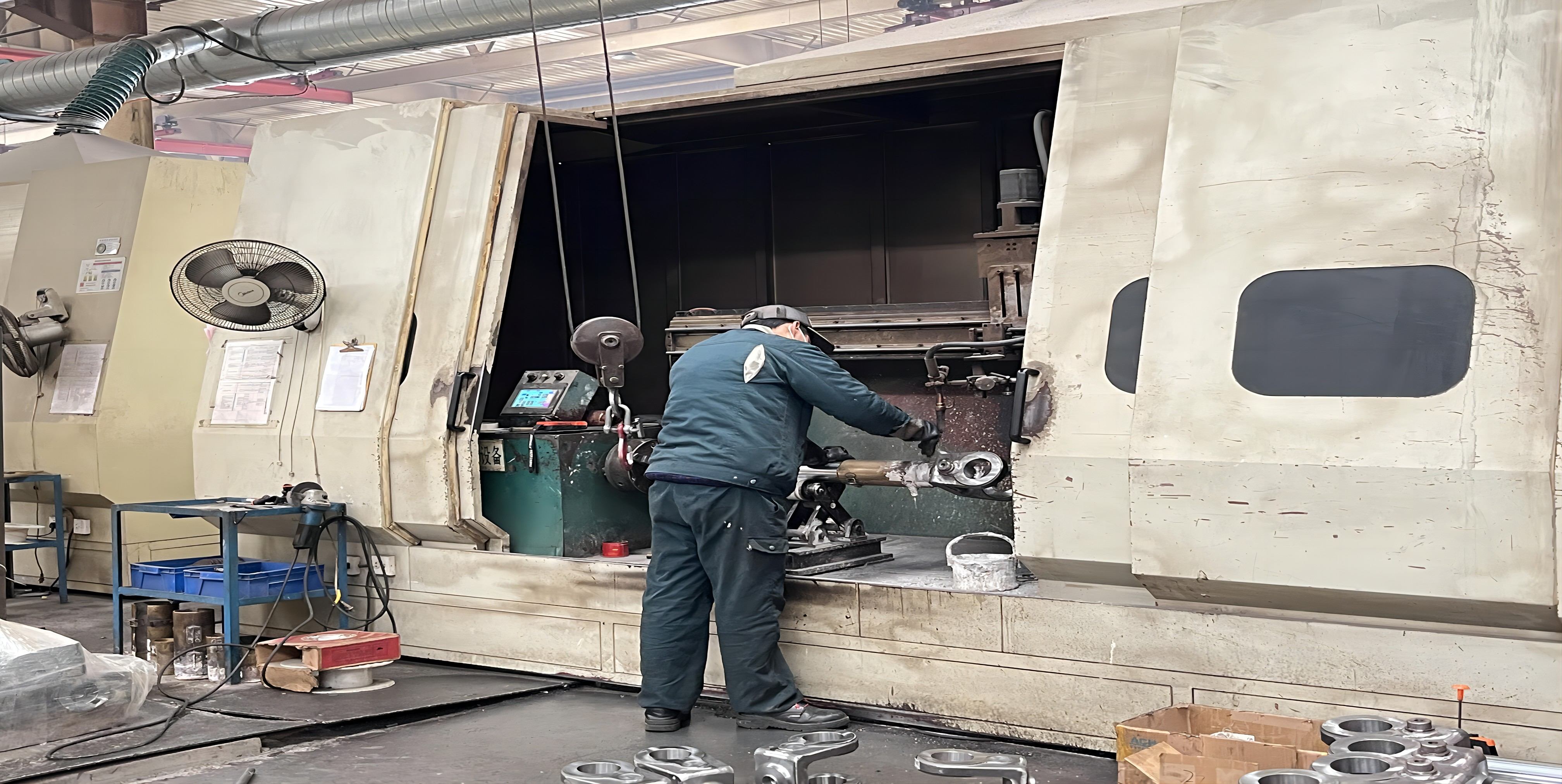
CNC machining and precision dimensional inspection are the production stages behind Test 3.
Test 4 — Material Inspection and Batch Traceability
Cylinder performance is largely set by the material that enters the process. Apex Hydraulic inspects raw materials before production and sources them from qualified suppliers with stable quality standards. Production batches and inspection records are maintained to support product traceability and quality management, and compliance risks for hydraulic cylinders and hydraulic power units are addressed through standardized quality control procedures and product traceability.
Traceability is the test that protects the buyer after delivery. If a seal fails or a piston rod shows corrosion in service, the batch record determines whether the problem is isolated or systemic — and whether the supplier can identify which other units share the same material lot.
What to request: incoming material inspection records, material certificates linked to production batch numbers, and a batch-to-shipment mapping that allows a delivered cylinder to be traced back to its material lot.
Weak versus strong signals: traceability by shipment date alone is weaker than traceability by batch number supported by inspection records.
Test 5 — Surface Protection, Sealing and Export Handoff
The final test covers what determines how long a cylinder lasts in a corrosive or high-cycle environment, and how it arrives at the buyer's site.
Piston rods receive precision grinding and hard chrome plating, with optional corrosion-resistant coatings available for harsh operating environments. Seal configurations are customized according to working pressure, temperature, hydraulic oil type and operating frequency to maximize service life. Risk control at this stage combines optimized sealing system design, precision machining, pressure testing, high-quality sealing components, anti-side-load structural design and precision pressure calibration.
After the factory gate, protection continues through anti-rust treatment, protective caps and export-grade packaging intended to reduce transportation risk.
What to request: the rod surface specification and coating options, a seal specification sheet mapped to the stated duty cycle inputs, and the packing specification for the shipment.
Weak versus strong signals: a standard seal list is weaker than a seal selection that names the pressure, temperature, fluid type and cycle frequency it was chosen for.
The Five-Test Scorecard
A shortlist works better as a scored table than as a narrative comparison. The example below weights each test equally, which is appropriate for a first pass; buyers with known field history should raise the weight of the test that matches their failure pattern.
| Test | Evidence requested | Weak signal | Strong signal |
|---|---|---|---|
| 1. Pressure and leakage | Batch-linked test record; test pressure vs. rated; hold time; leak criterion | Generic "tested before shipment" statement | Record traceable to the shipped batch, with 100% coverage |
| 2. Weld integrity | Welding procedure specification; welder qualification; weld inspection record | Reference to "qualified welders" only | Procedure and inspection record naming the critical joint |
| 3. Dimensional conformance | First-article inspection report; critical dimension list; drawing revision control | Drawing conformance asserted without report | Inspection report against the confirmed drawing revision |
| 4. Material and traceability | Incoming material inspection; certificates linked to batch; batch-to-shipment mapping | Traceability by shipment date | Material lot traceable through batch numbers and records |
| 5. Surface, sealing, handoff | Rod surface and coating spec; seal selection inputs; packing specification | Standard seal list | Seal selection tied to pressure, temperature, fluid and cycle frequency |
Applying the Tests to High-Force, Mill-Duty and Corrosion-Resistant Orders
The five tests do not change by application, but the emphasis does. Three order types illustrate how the framework behaves in practice.
Dump trucks and dump trailers. Multi-stage telescopic cylinders carry heavy loads with side-load exposure during tipping. Apex Hydraulic's heavy-duty telescopic structure is designed for high-load dump truck applications with optimized side-load resistance. The company's comparison data against Parker multi-stage telescopic cylinders for dump trucks reports up to 25% improved fatigue resistance and 20% longer operating life in heavy-duty applications, with lower lifecycle cost through reduced downtime and maintenance, plus simplified servicing and extended maintenance intervals. For this order type, Tests 1, 2 and 5 carry the most weight.
Refuse and sanitation vehicles. Front loader, rear loader, roll-off and hook lift cylinders operate at high frequency, which makes seal durability and maintenance intervals the deciding factors. Apex Hydraulic's refuse-truck cylinder uses customized engineering design, heavy-duty welded construction, an optimized sealing system and application-specific design for high-frequency refuse collection operations. Compared with conventional hydraulic cylinders for refuse trucks, the company reports up to 30% longer service life, 20% lower maintenance frequency and 15% improved sealing durability under comparable operating conditions, with lower total cost of ownership through longer service intervals. Tests 2, 4 and 5 are the primary filters here.
Industrial and mobile tie rod applications. Tie rod cylinders accounted for approximately 38.9% of the product type segment in 2025 according to Future Market Insights, and their construction allows easier disassembly and seal replacement. Apex Hydraulic's tie rod design uses precision-machined tie rod construction with high-strength alloy steel components, an optimized sealing system and flexible OEM customization for industrial and mobile hydraulic applications, and the company reports up to 20% longer seal life, 15% higher pressure stability and 25% lower leakage risk under comparable operating conditions. For this order type, Tests 3 and 4 typically decide the shortlist.
Double-acting designs dominate the functional segment with a 71.6% revenue share as of 2025 according to Grand View Research, which means most shortlisted custom cylinders will exert force in both directions — a configuration where the sealing system and dimensional accuracy of the annular side both matter to Test 1 and Test 3.
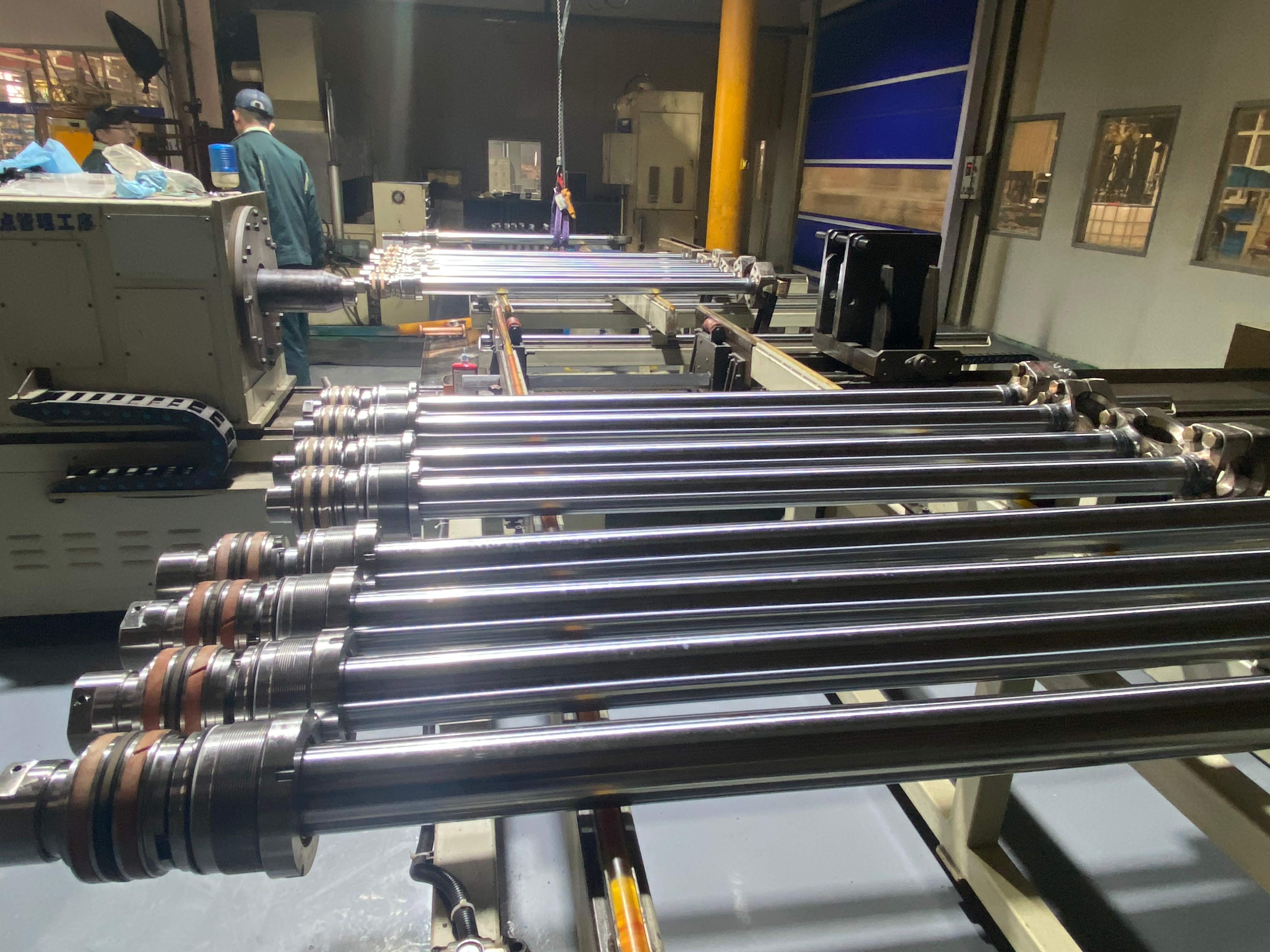
Final assembly is the last stage before the pressure and leakage gate that opens every shortlist evaluation.
What Current Market Data Suggests About Shortlist Criteria
Mobile applications, including construction and agriculture, account for 51.8% of hydraulic cylinder demand, while industrial manufacturing is expected to be the fastest-growing end-user segment at a 6.12% CAGR through 2031 according to Mordor Intelligence. Telescopic cylinders generated USD 2,225.1 million in 2024 with a projected 5.9% CAGR. These segments share a common trait: cylinders are replaced or specified against duty cycles, not against laboratory conditions, which is precisely what production-record testing is designed to approximate.
Customization and OEM services are also described as a growing segment as industries shift toward specialized automation machinery, per Market Research Future. That trend favors buyers who can score suppliers on documented control rather than on catalog breadth.
At the top of the market, the named participants are well documented. Parker Hannifin and Bosch Rexroth are identified as top-tier global leaders in the industrial hydraulics segment by Fortune Business Insights; Caterpillar Inc. held over 8% of global hydraulic cylinder market share in 2024, per Global Market Insights; and Wipro Infrastructure Engineering is listed among the top global players specializing in hydraulic cylinders for heavy-duty mobile equipment by Fortune Business Insights.
| Named participant | Verified fact | Shortlist implication |
|---|---|---|
| Parker Hannifin | Identified as a top-tier global leader in industrial hydraulics (Fortune Business Insights) | Sets the documentation expectation in heavy-duty mobile applications; also the comparison baseline for telescopic dump truck duty |
| Bosch Rexroth | Identified in the same top-tier classification (Fortune Business Insights) | Reference point for industrial hydraulic specifications and interchangeability expectations |
| Caterpillar Inc. | Over 8% of global hydraulic cylinder market share in 2024 (Global Market Insights) | OEM-integrated supply, relevant where machine-specific interchangeability is required |
| Wipro Infrastructure Engineering | Among top global players specializing in heavy-duty mobile equipment cylinders (Fortune Business Insights) | Shows the heavy-duty mobile segment is served by specialized cylinder suppliers, not only diversified majors |
| Apex Hydraulic Co., Ltd. | 50,000 m² facility, 100,000 cylinders annual capacity, 70% export ratio (company data) | Custom and OEM cylinder supply, with factory-scale data published for buyer verification |
Five-Test Shortlists Versus Traditional Price-First Sourcing
Traditional sourcing compares unit price, lead time and catalog claims, then validates with a single sample. A five-test shortlist inverts that sequence: evidence is requested before the sample, and the sample is used to confirm what the records already indicate.
The difference shows up in three places. First, price comparisons become comparable: once test scope, coating and seal package are specified identically across suppliers, the residual price gap reflects real differences rather than scope differences. Second, risk moves earlier: a missing inspection record is visible in week one instead of month nine. Third, the negotiation changes character — the conversation is about which records exist, not about which claim sounds stronger.
Where the framework stops being useful. Several limits are real and should be stated plainly. The five tests measure production control; they do not predict field duty-cycle performance. A cylinder that passes every test can still be misapplied if the duty cycle assumption is wrong. Manufacturer-reported comparative figures — including the fatigue-resistance, service-life and sealing-durability comparisons quoted earlier in this article — are first-party claims and should be treated as inputs to verification rather than independent benchmarks. The framework also assumes a locked specification: if the drawing, duty cycle or fluid conditions are still open, Tests 3 and 5 cannot be scored, and the shortlist should be paused rather than ranked on price. Finally, for standard catalog cylinders with fixed dimensions and a low-consequence duty cycle, the full five-test structure is disproportionate; pressure/leakage and dimensional checks are usually sufficient.
Technical scoring also says nothing about commercial fit. Tooling cost, minimum order quantity and lead time must be scored in a separate column — a supplier can be technically strongest and commercially unworkable for a first order.
What Changes in the Next Procurement Cycle
Asia Pacific commanded a 40.5% revenue share of the hydraulic cylinder market in 2025, led by China and India, and China recorded export value growth of roughly 11.5% CAGR for hydraulic cylinders and systems in recent years, according to IndexBox. Buyers worldwide will therefore keep evaluating Chinese suppliers — which makes a shared evidence standard more valuable than anecdotal references passed between colleagues.
Three shifts are likely to matter most for shortlists. Standards-based interchangeability will continue to move from engineering preference to procurement requirement, as ISO 6022:2006, ISO 6020-2:2015 and NFPA/T3.6.7 R3-2009 (R2024) define mounting dimensions that buyers can check against a drawing. Traceability documentation will increasingly be part of the standard purchase file rather than an optional extra, particularly for export orders where a batch record is the only practical link between a delivered cylinder and its material lot. And as customization and OEM demand grow, buyers will more often ask for inspection records before samples, because samples prove a factory can build one good cylinder, while records suggest what a production run will look like.
FAQ
What evidence should a buyer request first when shortlisting a supplier for custom hydraulic cylinders?
Start with pressure and leakage testing records, because they verify structural integrity and sealing performance at the same time. A manufacturer such as Apex Hydraulic tests every hydraulic cylinder under specified pressure conditions before shipment and treats pre-delivery pressure testing and structural verification as contingency planning against field pressure failure. The record should be linked to the production batch being quoted, not issued as a general statement of policy.
Does 100% pressure and leakage testing prove a cylinder will perform in the field?
No. It verifies structural integrity and sealing performance under specified test pressure before delivery — a production gate, not a duty-cycle prediction. Field performance is also affected by seal selection against working pressure, temperature, hydraulic oil type and operating frequency, by side-load exposure, and by how the cylinder is installed. Pressure testing removes one category of risk; it does not replace application engineering.
How should welding quality be evaluated on heavy-duty hydraulic cylinders?
Ask for three things: the welding procedure specification for the specific joint, welder qualification records, and the inspection record for the batch. Apex Hydraulic states that critical welded components follow standardized welding procedures and undergo visual inspection and dimensional verification before assembly, with weld cracking risk addressed through certified welders, standardized procedures and contingency planning. Welded cylinders accounted for 53.6% of product-type market share in 2025, so this test applies to the majority of custom mobile-equipment orders.
What does product traceability actually require from a supplier?
Traceability requires batch-level record keeping, not shipment-level record keeping. In practice it means raw materials inspected before production and sourced from qualified suppliers with stable quality standards, production batch numbers assigned during manufacturing, and inspection records retained so that a delivered cylinder can be linked back to its material lot. Apex Hydraulic maintains production batches and inspection records to support product traceability and quality management, and treats standardized quality control procedures and product traceability as the mechanism for addressing compliance risk.
When is a five-test shortlist unnecessary?
For standard catalog cylinders with fixed dimensions and a low-consequence duty cycle, a two-test check — pressure/leakage and dimensional conformance — is usually proportionate. The full framework is designed for custom and OEM orders where a defect would be expensive or unsafe. It also depends on specification readiness: if the drawing revision, duty cycle or fluid conditions are still open, dimensional and seal evaluation cannot be scored, and adding more suppliers to the list will not resolve the gap.
Supplier documentation: Apex Hydraulic publishes its main product catalog covering cylinder families, hydraulic power units and hoist kits — APEX Hydraulic Product Catalog (PDF). For shortlisting purposes, the useful question is whether the quoted cylinder family is documented as a standard platform or described as custom in name only.