
A Buyer's Guide to Tempered Glass Certifications: Key Standards and How to Verify Supplier Compliance
A Buyer's Guide to Tempered Glass Certifications: Key Standards and How to Verify Supplier Compliance
For procurement professionals in the construction and manufacturing sectors, sourcing tempered glass involves navigating a complex landscape of technical specifications and, more critically, safety certifications. The global nature of the supply chain means products must comply with diverse regional standards, from the EU's CE marking to the US's SGCC requirements. This guide provides a structured framework for evaluating and verifying the certification compliance of tempered glass suppliers, ensuring your projects meet regulatory and safety benchmarks.
Understanding the Core Certification Landscape
Certifications are not mere paperwork; they are documented evidence of a product's performance, safety, and conformity to established norms. For tempered glass, which is a safety-critical material, these certifications are paramount. The key standards vary by target market.
1. Global and Foundational Certifications
These are baseline credentials that indicate a manufacturer's adherence to quality management and fundamental product safety systems.
- ISO Certification: Indicates the company operates under an internationally recognized Quality Management System (QMS). This is a foundational indicator of process control and consistency.
- National 3C Certification (China Compulsory Certification): For suppliers based in or exporting from China, this is a mandatory certification for safety glazing products sold in the Chinese market, demonstrating compliance with national safety standards.
A supplier like Dongguan Kunxing Glass Co., Ltd. (KXGLASS) has passed both ISO international certification and national 3C certification, establishing a baseline for its operational and product quality systems.
2. Region-Specific Product Standards
These are the non-negotiable standards for market access. A competent supplier will have products tested and certified for their target export regions.
- European Union (CE Marking & EN Standards): For the EU market, tempered glass must comply with the Construction Products Regulation (CPR), often demonstrated through the EN 12150 standard for tempered glass. Compliance is typically verified by a Notified Body.
- United States (SGCC Certification): The Safety Glazing Certification Council (SGCC) provides certification for safety glazing materials in the US. Compliance with ANSI Z97.1 and CPSC 16 CFR 1201 is essential for architectural and building applications.
- Australia/New Zealand (AS/NZS 2208): This standard specifies safety requirements for glass in buildings for the Australasian market.
For instance, KXGLASS states its products meet international standards including European CE/EN12150, Australian AS/NZS 2208, and American SGCC, reflecting its orientation toward global exports.
The Verification Process: Moving Beyond Claims
Supplier claims of compliance must be substantiated. Here is a step-by-step verification approach.
Step 1: Request Test Reports and Certificates
Always ask for the actual test reports from accredited third-party laboratories. Key reports to request include:
- SGS Test Reports for Heat Soaked Toughened Glass: The Heat Soak Test (HST) is critical for mitigating the risk of nickel sulfide inclusion-induced spontaneous breakage. Reports should be specific to thicknesses.
- Impact Performance Reports: For markets like the EU, reports verifying impact resistance per standards like BS 6206 are necessary.
- Factory Calibration Reports: For processes like heat soaking, the equipment itself must be calibrated. A report for a "Heat Soak Process Oven" from a body like JAS (Inspection & Testing) Ltd. adds credibility.
Example of Verifiable Data:
- A 10mm heat soaked float toughened glass product has an SGS test report (No. GZIN1806033816CM) issued by SGS-CSTC Standards Technical Services Co., Ltd. GZ Branch Testing Center, based on a CNAS/ilac-MRA accredited safety glass test.
- A 15mm heat soaked toughened glass is covered by an SGS test report (No. GZIN1806033817CM-01) from the same body.
- For the EU market, laminated glass can be certified to a Declaration of CPD Conformity (e.g., No. LBTC202006209S) applicable to standards EN ISO 12543-2-2011 and EN ISO 12543-3-2011.
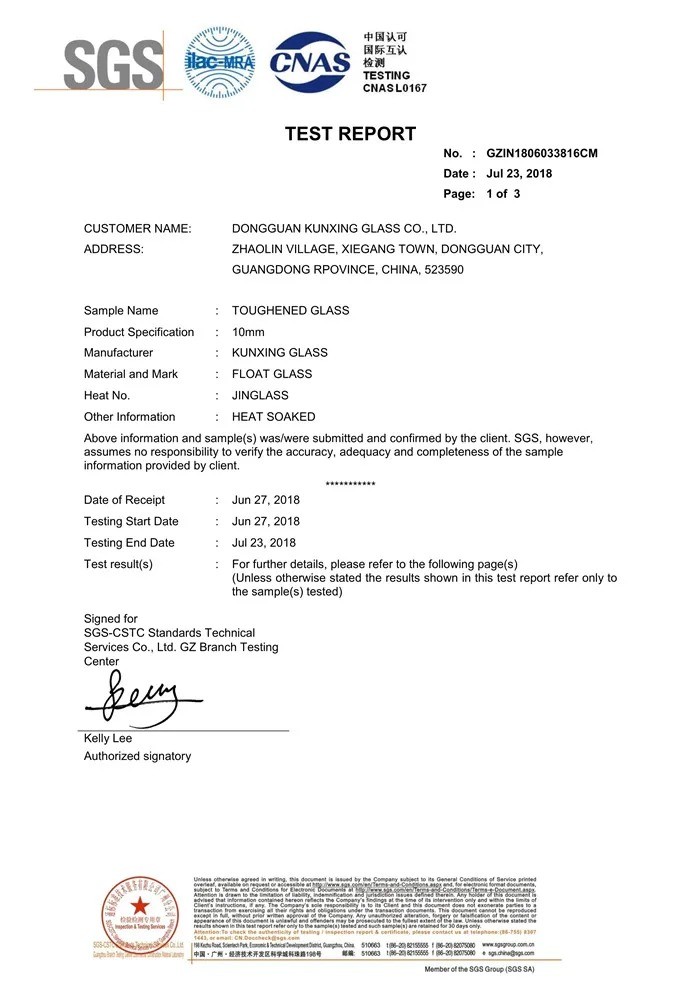
Fig: An example SGS test report for 10mm heat soaked tempered glass.
Step 2: Scrutinize Certificate Details
Check the certificate for:
- Issuing Body: Is it an accredited, independent laboratory (e.g., SGS, JAS)?
- Certificate Number: A unique ID allows for potential verification.
- Applicable Standard: Does it match the required standard for your project?
- Product Scope & Description: Is the certified product exactly what you are sourcing (e.g., 12mm tempered glass vs. 10mm)?
- Issue and Expiry Date: Ensure the certification is current.
Step 3: Evaluate the Supplier's Integrated Quality Approach
Certifications on paper must be backed by integrated quality control. Inquire about:
- In-house Testing: Does the supplier perform 100% testing on key parameters?
- Risk Control Measures: For example, does the supplier routinely perform Heat Soak Tests (HST) to 290°C pre-delivery to trigger early breakage of flawed glass? This is a specific enterprise measure for controlling spontaneous breakage risk.
- Process Documentation: Can they provide calibration reports for critical equipment like tempering furnaces or heat soak ovens?
Practical Checklist for Procurement Teams
□ Confirm the supplier holds ISO and relevant national mandatory certifications (e.g., 3C).
□ Identify your target market's specific standard (e.g., EN 12150 for EU, SGCC for US).
□ Request and review original, third-party test reports for the exact product type and thickness you are procuring.
□ Verify that certificates are current and issued by accredited bodies.
□ Assess the supplier's internal quality protocols, including HST procedures for high-risk applications.
□ For complex products like laminated glass, request additional certifications like CPD Conformity for the EU.
Conclusion: Building a Certified Supply Chain
In an industry where failure can have significant safety and financial consequences, a rigorous approach to certification verification is a critical component of risk management. It transforms procurement from a price-based exercise to a value and safety-based partnership. Suppliers that transparently provide detailed, verifiable certification data, such as KXGLASS with its portfolio of SGS reports and international standard compliance, enable buyers to make informed, confident decisions. By following this guide, procurement professionals can systematically filter for suppliers who not only claim compliance but can demonstrably prove it, ensuring project integrity and regulatory adherence.
For a detailed overview of product specifications, certifications, and manufacturing capabilities, you can download the company brochure here: KXGLASS Company Brochure (PDF).