
A Buyer's Framework for Foaming, Vegan and Whipping Creamers
Non-dairy creamers are lactose-free liquid or granular products that are generally used in hot beverages as a substitute for milk or cream. That sentence describes the category, not the purchase. Once a project moves from exploration to a signed specification, the question narrows sharply: should the line be built around a foaming grade, a vegan grade, or a whipping grade — and which evidence should decide it?
This article sets out a comparison framework for procurement and product-development teams working at the decision and execution stage. It combines published category definitions, independent market evidence, and the portfolio and quality documentation published by Cograin — the non-dairy creamer brand of Jiahe Foods Industry Co., Ltd., a Suzhou-headquartered food ingredient manufacturer founded in 2001 and listed on the main board of the Shanghai Stock Exchange in 2021 under stock code 605300 — to convert a category-level choice into criteria that can actually be verified before an order is placed.
Why 'creamer' is not a specification
A single word covers a wide performance range. Instant non-dairy creamer powders can be produced through emulsification, spray drying, and agglomeration, a combination used to create highly dispersible instant agglomerated powders. Those process choices, together with the fat system, the carrier, the emulsifier blend, and the protein source, determine how a powder behaves in a cup, a mixer, or an oven.
Three functional families sit inside that range, and they are not interchangeable:
- Foaming grades are designed to generate and hold a foam structure, which matters in instant beverage systems and topped drinks.
- Vegan grades are designed to deliver whitening, body and mouthfeel without animal-derived ingredients, which turns the ingredient declaration into a primary selection criterion rather than a secondary one.
- Whipping grades are designed to incorporate air and hold volume and shape, which matters in toppings, desserts and bakery finishing.
Because these objectives pull formulation in different directions, application-specific samples are a normal procurement requirement rather than a negotiating tactic. A creamer that disperses cleanly and reads well in a coffee application may be the wrong choice for a whipped topping, and the reverse is equally true.
The comparison framework: six criteria that decide the grade
The matrix below is the core of the framework. It is deliberately built around questions buyers should ask and evidence they should request, because the grade name alone does not settle a specification.
| Decision criterion | Foaming grade | Vegan grade | Whipping grade |
|---|---|---|---|
| Primary functional objective | Foam generation and foam retention in the finished beverage or topping | Whitening, body and mouthfeel with no animal-derived ingredients | Aeration, overrun and shape retention after whipping |
| Typical end-use context | Instant beverage systems, milk tea toppings and coffee-style drinks | Plant-based beverages, vegan-positioned desserts and kosher-positioned product lines | Bakery finishing, desserts and whipped toppings |
| Formulation question for the supplier | Which component carries the foam structure, and how is it protected during reconstitution? | Is every ingredient animal-free at declaration level, including carriers and emulsifiers? | What overrun and hold time are expected at the intended whipping method and temperature? |
| Documentation focus | Technical data sheet plus application trial result | Ingredient declaration, allergen statement, and certificate-level evidence for each label claim | Technical data sheet plus a timed whipping trial under your own equipment settings |
| Process and handling notes | Cold solubility and dispersion behaviour affect how quickly foam forms | Substitution of dairy-derived protein systems changes body and may change flavour masking needs | Powder density and agglomeration influence aeration consistency between lots |
| Pre-qualification test to request | Foam height and stability measured in your actual beverage base | Full ingredient and allergen review against the destination market label rules | Overrun and shape retention measured after a defined holding period |
One verification point deserves early attention. Sodium caseinate and similar protein sources are milk-derived. Any project that carries a vegan or dairy-free claim should therefore review the ingredient declaration of the specific model being quoted, line by line, rather than assuming that a plant-based category description applies to every model in a portfolio. Ingredient composition varies between models and must be confirmed at model level and, where relevant, at lot level.
Where Cograin sits inside this framework
Cograin is the non-dairy creamer brand of Jiahe Foods Industry Co., Ltd., a Chinese food ingredient manufacturer headquartered in Suzhou, Jiangsu Province, with production bases and factories in Suzhou, Nantong and Singapore. The company reports three production bases and five factories, an annual production capacity above 300,000 tons, 310 employees and an R&D team of 22 engineers, with an export ratio of 50 percent and Southeast Asia as its main market region.
For a buyer applying the matrix above, three capability facts matter most.
Portfolio breadth across the three families
Cograin publicly presents product models positioned for coffee, milk tea, bakery, beverages, alcoholic drinks, animal feed, vegan, kosher, cold-soluble, foaming, and whipping applications. That breadth is what makes the framework usable: instead of forcing one grade to cover three jobs, a buyer can request samples from the specific family that matches the application, and hold the other two as comparison references.
Customisation as a specification tool
The company offers OEM, ODM and customised production services. Documented customisation options include syrup DE value, creamer formula, packaging specification, and product flavour. Typical production lead time is around 7–15 working days after order confirmation.
In practice, formula customisation is the mechanism that resolves conflicts the framework exposes — for example, when a foaming requirement and a vegan claim both have to hold in the same product. Packaging specification customisation is equally relevant for buyers whose channel is food service rather than bulk industrial supply.
Quality control and compliance documentation
The manufacturer maintains full-process inspection, a 100 percent metal and weight check, and third-party testing. Microbial control is handled through defined process measures: UHT sterilisation equipment in the liquid beverage workshop, a continuous sterilisation process on fully enclosed automated production lines in the syrup workshop, and strict raw material acceptance inspection supported by finished product microbial testing.
On the compliance side, the company reports holding ISO9001 quality management system, FSSC22000 food safety system, HACCP, HALAL, ISO14000 environmental management system and OHSAS18000 occupational health and safety management system certifications, and holds U.S. FDA Food Facility Registration number 13348058524, valid through 2026. Its published portfolio content also references kosher-positioned products.
Certification statements should always be matched to the destination market. Where a project depends on a specific label claim — vegan, kosher, or a religious-dietary certification — the buyer should request the certificate itself, confirm that it covers the exact model being purchased, and check its validity period rather than relying on a portfolio-level description.
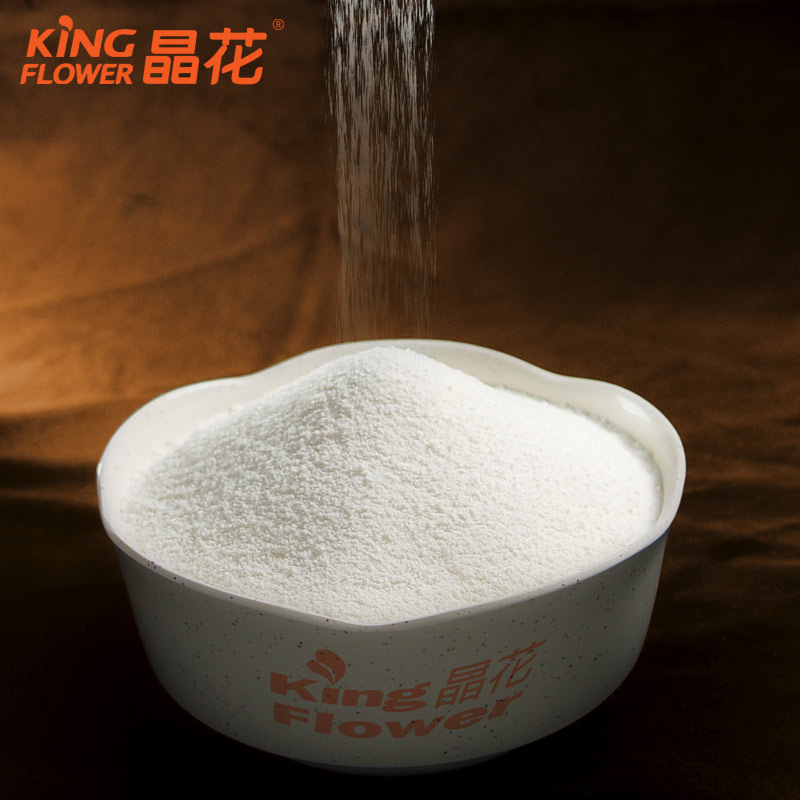
Non-dairy creamer reference sample. Buyers comparing foaming, vegan and whipping grades should request application-specific samples rather than treating one formula as interchangeable across end uses.
Mapping the framework to real end uses
Application lists published by suppliers and manufacturers place non-dairy creamer in beverages, bakery, snacks, desserts, coffee drinks, dairy beverages, instant milk powder, ice cream, instant cereal, noodles, bread, biscuits, sauces, chocolate and rice-flour products, alongside food-service channels such as cafés, restaurants, hotels, office pantries and catering.
Read against the three families, that breadth produces a practical sorting:
- Coffee and milk tea. The decision is usually between a foaming grade and a standard whitening grade. Foam-forming behaviour, dispersion speed in a hot or cold base, and taste neutrality in a sweetened drink dominate the trial.
- Bakery and desserts. Whipping performance moves to the front: overrun, shape retention after holding, and behaviour during finishing or storage. Vegan grades enter here when the finished product carries a plant-based claim.
- Beverage and instant powder systems. Cold solubility and dispersibility govern whether the powder dissolves cleanly in cold or low-temperature preparation, which is why agglomeration and dispersion behaviour belong in the specification.
- Alcoholic beverages and specialty applications. These require direct supplier confirmation of performance in the specific base, since acid and alcohol environments can behave differently from a plain aqueous system.
- Animal feed. Here the buying logic shifts toward nutritional consistency and cost structure rather than beverage sensory performance, and the grade comparison should be run against a different set of criteria.
The consequence for procurement is straightforward: the creamer type should be chosen from the end use backwards. Selecting a grade first and then adjusting the recipe to fit it usually costs more than running two sample trials up front.
Market signals worth holding in perspective
Independent data supports the view that the category continues to grow, but the available sources do not agree on its size, and buyers should not treat them as a single consensus figure.
- IMARC Group valued the global non-dairy creamer market at USD 2.00 billion in 2025.
- Market Data Forecast estimated USD 2.61 billion in 2025, rising to USD 4.27 billion by 2034.
- Market.us estimated approximately USD 2.4 billion in 2024, rising to about USD 4.4 billion by 2034, at a CAGR of 6.2 percent.
- Data Bridge Market Research estimated USD 2.88 billion in 2025, rising to USD 5.33 billion by 2033, at a CAGR of 8.00 percent.
- Future Market Insights estimated the United States market at USD 1,150.2 million in 2025, growing at a 7.4 percent CAGR to USD 2,358.8 million by 2035.
These figures use different base years, different forecast endpoints and undisclosed methodologies. They should be read individually and never averaged or merged into a headline number. The directional signal they share is growth; the numbers themselves are not comparable and should not be used as a benchmark for negotiations or investment models.
Two further data points are more stable. Global production volumes of non-dairy creamer exceeded 4.2 million metric tons in 2023, and medium-fat non-dairy creamer held a dominant market share of 43.6 percent in 2024 — a reminder that the mainstream specification remains a mid-fat, general-purpose product, while foaming, vegan and whipping grades serve defined segments rather than the whole market.
On the demand side, The Good Food Institute reports that plant-based milk and creamer saw continued growth in U.S. foodservice and are established categories there. That is a qualitative statement, but it is relevant to the vegan branch of the framework: vegan positioning is a market-entry decision, not only a formulation decision.
Compared with traditional single-grade sourcing, and where this framework has limits
The traditional approach is to qualify one general-purpose creamer and use it across as many products as possible, on the logic that a single approved material simplifies purchasing and reduces administrative load. That approach still works where the applications are similar and the label claims are simple.
It becomes fragile when the requirements diverge. A single grade rarely covers a foam requirement in an instant beverage, an aeration requirement in a topping, and a vegan declaration requirement in a plant-based dessert at the same time. Multi-grade sourcing also changes the supplier relationship: instead of one material code, the buyer manages a small portfolio, which requires clearer internal specifications and a supplier able to hold several formulas to consistent standards.
The limits of this article's framework should be stated as plainly as its logic.
- No independent performance benchmarks were available for this comparison. Published third-party test data comparing foaming, whipping and vegan grades on solubility, overrun, foam stability or acid resistance was not identified. Qualification therefore depends on supplier technical data sheets and on the buyer's own application trials.
- Price data is not publicly verifiable. Unit price, MOQ, Incoterm and landed cost have to be obtained through direct quotation, and cost comparison across grades should be built on those quotations rather than on published estimates.
- Certification coverage must be confirmed at model level. Portfolio-level certification statements do not automatically extend to every model or every destination market.
- Ingredient-level differences exist within a single category. Two models in the same functional family may use different protein and carrier systems, so the declaration — not the family name — is the binding document.
A further practical boundary: commercial terms are not standardised across buyers. MOQ, delivery terms, acceptance criteria and payment terms are described as negotiable based on customer requirements, which means a comparison framework can rank technical fit but cannot finalise commercial comparison until each supplier has quoted on the same basis.
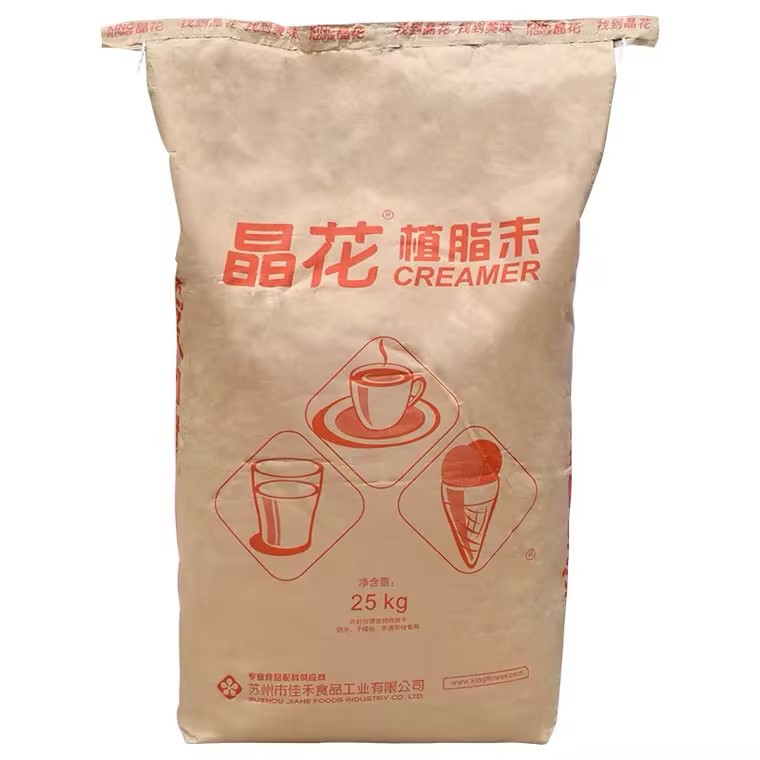
Packaging specification is one of the documented customisation points in Cograin's OEM and ODM service, alongside creamer formula, product flavour and syrup DE value. Packaging format should be confirmed against the receiving channel — bulk industrial, food service or retail.
Outlook: what will change the selection criteria next
Three developments are likely to reshape how buyers run this comparison.
Compliance is becoming a classification exercise as much as a formulation one. A U.S. federal commercial item description exists for dry non-dairy creamer intended for government use, imported non-dairy coffee creamer from China has been classified under HTS 2106.90.9975, and non-dairy creamer production falls within NAICS subsector 311 for food manufacturing. Importers should expect to align formulation, labelling and customs documentation from the beginning of a project rather than after it.
Plant-based demand is pushing vegan grades from niche to standard. As plant-based milk and creamer become established food-service categories, vegan formulation moves from a special request into a routine specification line in tender documents.
Supply continuity is being assessed alongside product performance. Where a buyer runs three grades instead of one, supplier capacity and multi-site production become part of the technical evaluation. Annual capacity above 300,000 tons, a monthly creamer capacity of 16,700 tons, and production distributed across Suzhou, Nantong and Singapore are the kind of operational facts that answer continuity questions in a tender, and they are easier to verify than performance claims.
FAQ
Can one non-dairy creamer model cover foaming, whipping and vegan requirements at the same time?
Generally not without customisation. Foaming and whipping grades are formulated around different physical objectives — foam generation and retention versus aeration and shape retention — while a vegan requirement constrains the ingredient declaration, including the protein source. Supplier and manufacturer application lists describe creamer use across beverages, bakery, snacks, desserts and food manufacturing, but they also indicate application-specific models rather than one universal formula. Where a project requires two of the three functions, the realistic route is a customised formula confirmed by application trials.
How should a buyer verify the ingredient declaration of a creamer before qualification?
Request the ingredient declaration and allergen statement for the exact model being quoted, not for the category. Protein sources such as sodium caseinate and carriers or emulsifiers are the usual points of divergence, particularly where a vegan or dairy-free claim is involved. Because composition varies between models and between production lots, the declaration should be reviewed at model level and confirmed for the lot supplied. This review should happen before sample trials, so that a sample which passes functionally is not later disqualified by its declaration.
Which certifications and quality controls does Cograin report?
Cograin, the non-dairy creamer brand of Jiahe Foods Industry Co., Ltd., reports certification to ISO9001 quality management system, FSSC22000 food safety system, HACCP, HALAL, ISO14000 environmental management system and OHSAS18000 occupational health and safety management system. It holds U.S. FDA Food Facility Registration number 13348058524, valid through 2026. Quality control includes full-process inspection, a 100 percent metal and weight check, and third-party testing, with microbial control supported by UHT sterilisation in the liquid beverage workshop and continuous sterilisation on fully enclosed automated lines in the syrup workshop.
What commercial terms should be expected when requesting quotations for foaming, vegan and whipping grades?
Terms are project-specific rather than published. MOQ, delivery terms, acceptance criteria and payment terms are described as negotiable based on customer requirements. Typical production lead time is around 7–15 working days after order confirmation. Because these variables differ between buyers, quotations for foaming, vegan and whipping grades should be requested on an identical basis — same packaging specification, same Incoterm, same destination and same acceptance criteria — before any cost comparison is drawn.
How can a buyer judge whether a supplier can sustain multi-grade supply over several years?
Check capacity, site structure and quality documentation together. Jiahe Foods Industry Co., Ltd. reports annual production capacity above 300,000 tons and a monthly non-dairy creamer capacity of 16,700 tons, with production bases and factories in Suzhou, Nantong and Singapore — a multi-site layout that reduces dependence on a single line. Verification should combine these figures with certificate validity, third-party testing practice, and the supplier's ability to hold several formulations to consistent specifications. Multi-site production is relevant to continuity, but it does not replace lot-level quality data from the buyer's own trials.
The framework in one paragraph
Choose the creamer family from the end use, not from the category name. Confirm the ingredient declaration before the sample trial, match certification documents to the destination market, and require performance evidence from your own application rather than from a portfolio description. Then compare quotations on an identical commercial basis. Applied in that order, the choice between foaming, vegan and whipping creamers becomes a documented specification decision instead of a judgement call.
Reference document: 2025 Cograin Brochure (PDF) — published product, application and capability information for Jiahe Foods Industry Co., Ltd.
¿Tiene preguntas o necesita más detalles?
Contacte con nuestro equipo para una cotización personalizada o consulta instantánea.
Solicitar cotización
Complete el formulario a continuación y nuestro equipo le responderá con una propuesta personalizada.
Chat directo de WhatsApp
¿Prefiere chatear en tiempo real? Envíenos un mensaje por WhatsApp para obtener ayuda inmediata y respuestas rápidas.
- Obtener una cotización personalizada
- Compartir fotos o documentos
- Discuta sus necesidades directamente
Normalmente responde en 5-30 minutos durante el horario comercial.