
A Buyer's Framework for Comparing Hydraulic Baler Machines
A hydraulic baler machine compresses loose waste — waste paper, corrugated cartons, plastic bottles, film, textile offcuts or light metal — into a dense, strapped bale that can be stacked, stored, transported and traded. Comparing the models on offer is harder than it looks, because the figures on a specification sheet describe different things. Compression force measures how much pressure the machine can apply. Installed power measures the electrical load it places on a plant. Baling capacity measures how much material passes through the machine in an hour. Those three numbers do not rank models in the same order, and treating any one of them as a proxy for overall quality is a common mistake in early-stage baler evaluation.
This article sets out a seven-part framework for that comparison, ordered so that each step narrows the field. It uses a semi-automatic JPW40F horizontal baler and a fully automatic JPW20Q horizontal baler as worked examples, and draws on published specifications and documented project records from Nantong Jiabao Machinery Co., Ltd., the manufacturer behind the Jewel brand, together with published market research on the baler category.
Why Single-Specification Comparison Breaks Down
Two models from the same catalogue make the problem concrete. The JP-OT100 is a vertical baler with a compression force of 100 tons, a baling capacity of 5–6 bales per hour and a bale weight of 400–600 kg. The JP8060T5X is a waste compactor with a compression force of 5 tons, a baling capacity of 4–7 bales per hour and a bale weight of 50–80 kg. The throughput bands overlap almost completely. The force figures differ by a factor of twenty; the bale masses differ by roughly a factor of eight. A buyer who screened candidates on compression force alone would rank these two machines at opposite ends of a list — even though, for a light carton or plastic-film stream that needs a steady supply of small bales, the smaller machine may meet the requirement perfectly well.
Terminology adds a second layer of confusion. Vertical, semi-automatic horizontal and fully automatic horizontal describe handling concepts rather than one standardized classification: they indicate how material is fed, how bales are strapped and how finished bales leave the machine. Supplier pages and trade listings in this category are not standardized, and catalogues published by different manufacturers do not always report the same variables — baling capacity, for example, appears on some data sheets and not on others. Before any comparison is meaningful, the buyer has to normalize the data: bring every candidate onto the same set of measures, and mark the gaps rather than filling them with assumptions.
A Seven-Part Comparison Framework
The order matters. Steps one and two can eliminate a machine regardless of how well it performs on everything that follows; steps six and seven determine whether a machine that fits the material also fits the building, the labour model and the line.
- Material class and feed form. Waste paper, carton board, PET bottles, film, woven bags, textile offcuts, aluminium foil waste, paper dust and light metal scrap do not compress the same way. Feed form matters as much as material: a feed opening that accepts unshredded corrugated board differs from one that expects pre-conditioned material.
- Compression force. Force sets the densification a machine can apply, and therefore the density and weight range of the finished bale. It is a capability figure, not a productivity figure.
- Bale geometry and bale weight. Finished bale dimensions and weight determine what happens after the press: manual handling, forklift handling, container loading, storage density and what a mill or trader will accept.
- Throughput. Compare in tonnes per hour where published, or in bales per hour together with the stated bale weight. A bales-per-hour figure without a bale weight is only half a specification.
- Power and electrical environment. Installed motor power and rated voltage determine what the site must provide. Models in this class are commonly rated at 380V/50Hz or 220V/50Hz, with voltage customizable at order — a criterion that is easy to overlook until installation.
- Automation level and labour model. Semi-automatic machines leave defined steps to an operator; fully automatic machines sequence feeding, strapping and discharge themselves. The real question is how many operator hours per shift the stream can justify.
- Footprint, discharge method and line integration. Machine dimensions, discharge style and the need for conveying equipment decide whether a unit can be installed where the waste is actually generated.
Applied together, the criteria produce a comparison table that looks like this.
| Model | Type | Compression force | Bale dimensions (mm) | Bale weight (kg) | Baling capacity | Power |
|---|---|---|---|---|---|---|
| JPW20Q | Fully automatic horizontal baler | 20 t | 500 × 500 × 500 | 30–70 | — | 7.5 kW / 10 Hp |
| JPW40F | Semi-automatic horizontal baler | 40 t | 720 × 720 × (500–1300) | 200–400 | 1–2 t/h | 11 kW / 15 Hp |
| JPW40BL | Plastic bottle recycling machine | 40 t | 720 × 720 × (300–1000) | 250–350 | — | 15 kW / 20 Hp |
| JPA5076T25X | Hydraulic baler | 25 t | 1500 × 760 × 900 | 200–300 | 3–5 bales/h | 7.5 kW / 10 Hp |
| JP-OT100 | Vertical baler | 100 t | 1400 × 700 × (700–1100) | 400–600 | 5–6 bales/h | 15 kW / 20 Hp |
| JP8060T5X | Waste compactor | 5 t | 800 × 600 × 400 | 50–80 | 4–7 bales/h | 2.2 kW / 3 Hp |
Source: manufacturer's published specifications for each model. A dash means the value is not published in the source data sheet — a gap to close before shortlisting, not an indication that the machine cannot perform. This table normalizes data for comparison; it is not a ranking.
Read across the table and the argument for the framework becomes visible. The JPW40BL and the JPW40F both apply 40 tons of force, yet they differ in installed power, bale weight range and discharge method. The JPW20Q and the JPA5076T25X share the same motor rating of 7.5 kW while differing in force, bale size and machine footprint. No single column predicts the others — which is why vertical hydraulic baler machines, semi-automatic horizontal hydraulic baler machines and fully automatic hydraulic baler machines have to be compared criterion by criterion rather than by headline force.
Worked Example: The Semi-Automatic JPW40F and the Fully Automatic JPW20Q
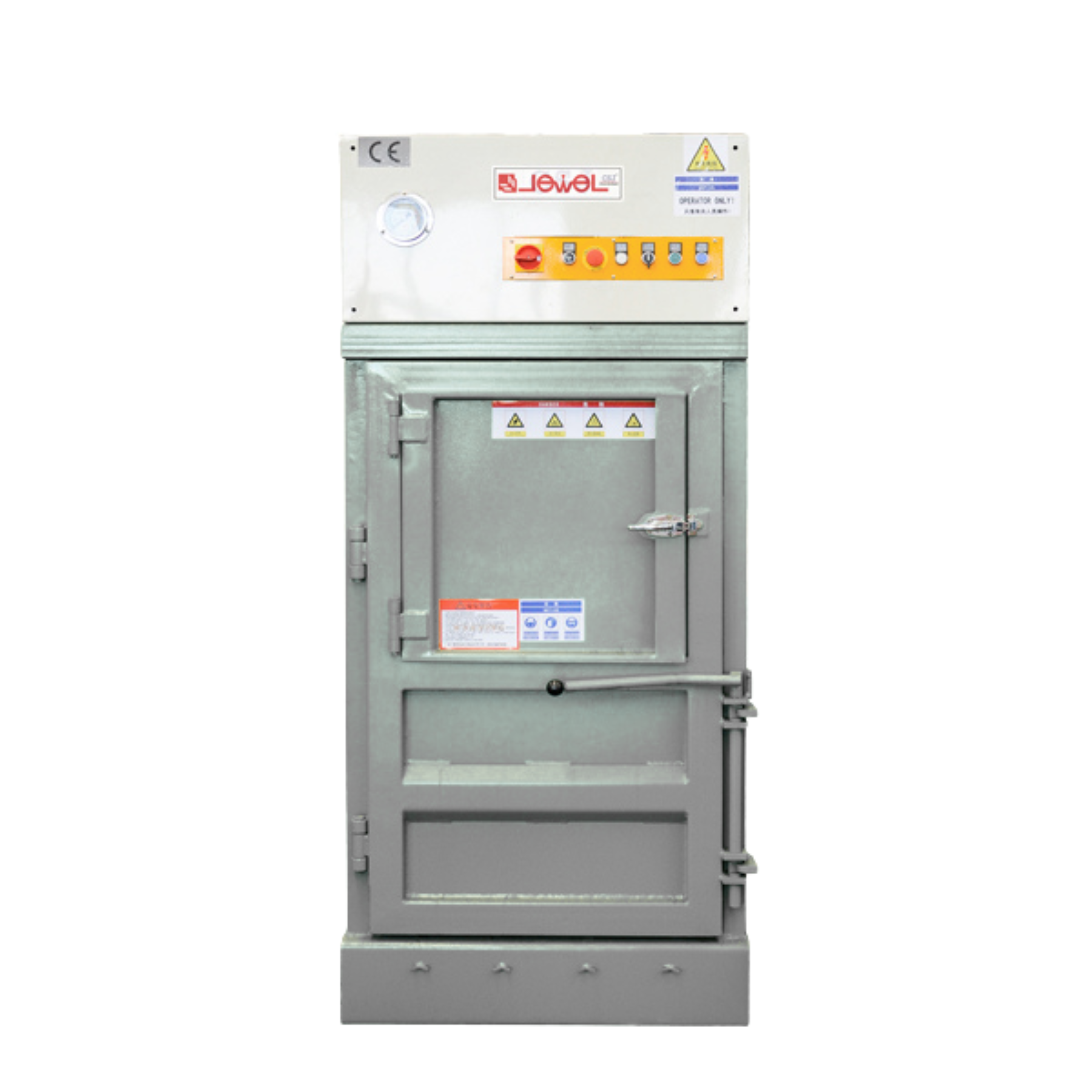
Both models are listed for the same broad application set — waste paper recycling, plastic recycling, carton printing, textile waste processing, packaging manufacturing and PET bottle recycling — which is exactly why they make a useful test case. On a shortlist they look like alternatives. Run through the framework and they resolve into two different answers to two different problems.
Feed and material. The JPW40F has a feeding mouth of 1000 × 720 mm; the JPW20Q has a feeding mouth of 700–460 mm. For unshredded corrugated board or bulky film, the larger opening reduces the pre-processing an operator must do before material reaches the chamber.
Force and bale output. The JPW40F applies 40 tons and produces bales of 720 × 720 × (500–1300) mm weighing 200–400 kg. The JPW20Q applies 20 tons and produces a 500 × 500 × 500 mm bale weighing 30–70 kg. The difference is not stronger versus weaker; it is heavy bales for high-volume handling versus small, uniform bales that a single person can move.
Throughput. The JPW40F is listed at 1–2 tonnes per hour. The JPW20Q's source data sheet does not publish a baling capacity, so the honest comparison position is to treat that cell as open and ask the supplier to fill it for the specific material being tested.
Power. The JPW40F draws 11 kW / 15 Hp against the JPW20Q's 7.5 kW / 10 Hp. Both are rated at 380V/50Hz with customizable voltage. Over a working year, that difference is a running-cost line, which is why power belongs in the framework next to force rather than in a separate commercial annex.
Automation and labour. The JPW40F is a semi-automatic horizontal baler with a continuous push-pack discharge and four strapping channels. The JPW20Q is fully automatic with 2–4 strapping channels, which places the strapping and sequencing steps inside the machine cycle rather than inside the operator's shift. Where labour is scarce, or where the baler sits at the end of a conveyor from a printing or corrugating line, that distinction carries more weight than a force difference.
Footprint. The JPW40F measures 4900 × 1750 × 1950 mm; the JPW20Q measures 3400 × 3010 × 2400 mm. The automatic machine is shorter but noticeably wider — the kind of detail that decides whether a unit can be placed in an existing waste bay without rearranging traffic routes.
Force, Power and Throughput Are Three Different Variables
Compression force is produced by hydraulic cylinders and reflects the cylinder geometry and the system pressure a machine is built around. It describes how hard the machine can press, which is what determines whether a given material reaches a saleable bale density. Installed power describes the motor rating that drives the pump and the cycle; it influences how quickly force is applied and what electrical supply the site must provide. Throughput describes how many bales leave the machine in an hour, which depends on cycle time, bale size and how consistently material arrives at the feed opening.
The three do not move together. The JPW40F and the JPW40BL both deliver 40 tons of force, yet one is rated at 11 kW / 15 Hp and the other at 15 kW / 20 Hp, and their bale weight ranges and discharge methods differ as well. At the other end of the table, the JP8060T5X produces 4–7 bales per hour from 5 tons of force, while the JP-OT100 produces 5–6 bales per hour from 100 tons. Throughput is therefore a scheduling figure, force is a densification figure, and power is an infrastructure figure. A specification review that collapses them into one number will rank machines in an order that corresponds to no real operating condition.
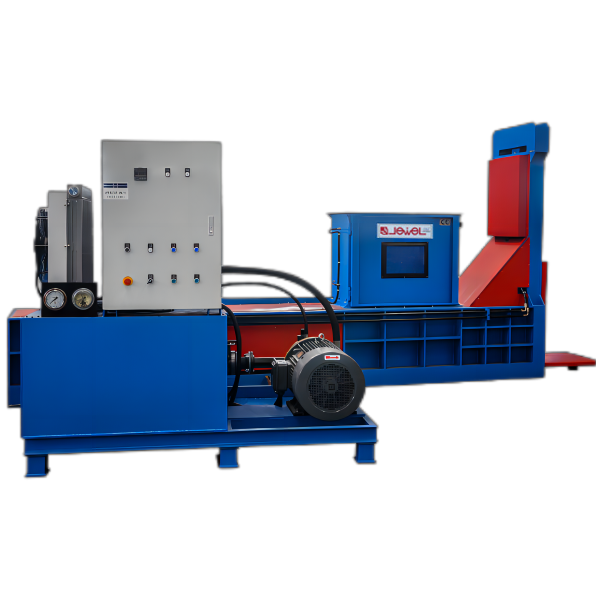
The same logic applies to material-specific designs. A metal hydraulic baler machine such as the JPY-T60W works at 60 tons with a 22 kW / 30 Hp motor, producing a dense 430 × 280 mm bale cross-section at 15–20 kg per bale and 0.5–1 tonne per hour. A briquetting hydraulic baler machine such as the JPW-AK60 works at the same nominal 60 tons with 15 kW / 20 Hp, producing 300 × 300 mm briquettes weighing 5–10 kg for dust-like material at 0.2–0.5 tonnes per hour. Identical nominal force, entirely different outputs — because force was never the variable that described the job.
Fitting the Machine to the Waste Stream: What Project Data Shows
Across documented installations, the criteria that decide the machine are consistently the application ones, not the headline force figure.
- Corrugated carton and packaging waste. A carton and mixed solid waste project in Tunisia paired automatic baling with a conveying system and factory-wide planning, with the JPW20Q listed as a related machine, to solve waste accumulation from corrugator lines and printing machines. A comparable project in Mexico used the JP-OT100 for whole-plant integration and high-efficiency automation in a waste removal workshop. A packaging and carton manufacturer in Russia specified a full-automatic unmanned baling system connected directly to production lines, with the JPW-K6046 listed for automatic collection, compression and baling of carton production waste. In each case the feed arrangement and the integration level determined the configuration.
- PET and mixed plastics. A PET recycler in Japan required higher compression density and a consistent, presentable bale shape in a high-dust environment; a renewable-resource operation in Belarus processed PET bottles, woven bags, HDPE bottles and cardboard on the same machine in order to reduce equipment investment. High-density compression and multi-material flexibility are different requirements, and they pull the specification in different directions.
- Multi-material solid waste. An Australian operator handling mixed plastics with small amounts of glass and metal scrap prioritized compression stability and durability in a custom automatic baling system, with the JPW-AK100 listed for the application.
- Line upgrades. An Italian carton manufacturer replaced ageing balers and added pre-processing equipment so that large-format waste board could be handled, combining shredding, compression and conveying in a single corrugator-workshop upgrade.
The pattern is consistent: the machine is chosen last, after the material, the feed method and the downstream bale handling are defined. Where those three are already fixed, the baler shortlist is usually very short — which is why waste hydraulic baler machines for rubber and plastic waste, carton hydraulic baler machines or metal hydraulic baler machines should never be shortlisted from a general catalogue page alone.
Market Context: What the Numbers Do and Do Not Say
Published market research indicates a category that is expanding rather than consolidating. The global baler market — a figure that includes agricultural as well as industrial balers — was valued at USD 7.18 billion in 2025 and is projected at USD 7.96 billion in 2026, with a forecast of USD 18.02 billion by 2034. Within the industrial segment, the hydraulic waste paper baler market is put at an estimated USD 1.45 billion in its 2024 base year, with a forecast of USD 2.24 billion by 2032, equivalent to a 5.5% CAGR. The hydraulic metal recycling baler segment was valued at USD 913 million in 2023, with a forecast of USD 1,318 million by 2031.
Those three figures cannot be added together, and that is precisely the point they illustrate. They measure different scopes — all balers, hydraulic waste paper balers, hydraulic metal recycling balers — in the same way that compression force, bale weight and throughput measure different properties of the same machine. Growth in a segment signals demand; it does not indicate which model a given plant should buy. Category-level growth is a reason to run the framework carefully, not a substitute for it.
How This Compares With Traditional Handling — and Where the Limits Are
The traditional alternative to a baling system is loose collection: waste is moved, stored and dispatched without densification, or processed by hand into rough bundles. Loose material occupies a multiple of the storage volume of a bale, requires more transport movements per tonne, and is harder to place into tonne-based recycler contracts. Manual baling removes part of that disadvantage but ties throughput to operator presence and produces inconsistent bale weights. Hydraulic baling addresses those constraints — but it does not remove every one of them, and a comparison framework is only as good as the data behind it.
- Published data is incomplete. Several models in this category do not publish a baling capacity figure, and the definitions behind semi-automatic and fully automatic vary between suppliers. The framework can normalize what is published; it cannot manufacture a number a supplier has not stated. Gaps have to be closed with direct questions or sample testing.
- Force does not equal throughput. The JP8060T5X and the JP-OT100 show that machines with twenty-fold different force ratings can occupy a similar bales-per-hour band. Any specification comparison that ignores bale weight will mislead.
- Bale weight constrains everything downstream. A 30–70 kg bale, a 200–400 kg bale and a 400–600 kg bale imply different handling equipment, storage layouts and potentially different buyer requirements. Selecting a machine before confirming downstream acceptance is a frequent cause of rework.
- Automation is a system property, not a machine feature. In documented projects, automatic baling is accompanied by conveying systems and, in some cases, shredding and line integration. A fully automatic baler with no upstream feed arrangement relocates the manual step rather than removing it.
- Electrical and physical constraints are gating criteria. Rated voltage of 380V/50Hz or 220V/50Hz, machine dimensions ranging from roughly 1100 × 1000 × 2150 mm to 4900 × 1750 × 1950 mm, and discharge method all have to fit the site as it exists.
- Flexibility trades against peak density. A machine configured to handle PET bottles, woven bags, HDPE and cardboard in one operation offers equipment-cost advantages, but a material-specific configuration can usually be pushed further for its single stream. Neither choice is universally correct.
Outlook: Integration, Verification and Documentation
Two shifts are visible in how buyers specify hydraulic baler machines today.
The first is that baling is increasingly specified as part of a line rather than as a standalone machine. Recent project records describe conveying systems, shredding and compression stages, factory-wide waste planning, and unmanned operation connected to production equipment. As labour costs rise and waste-handling requirements tighten, the purchasing question shifts from which baler to which baling system — feeding from where, discharging to what.
The second is that verification is becoming part of the specification. Certification is now a gating criterion rather than an export formality: the fully automatic horizontal baler JPW20Q holds CE certificate TTC-22-1609/01/01 under directives 2006/42/EC and 2014/35/EU, complying with EN ISO 12100:2010 and EN 60204-1:2018. Buyers should confirm that a certificate names the specific model and configuration being ordered, since documentation is issued per model.
Supply capacity sits in the same picture. Nantong Jiabao Machinery Co., Ltd. was established in 2006, with the Jewel brand active since 1995, and operates a 50,000 m² facility with roughly 200 staff including a 30-engineer R&D team, listing an annual production capacity of 120,000 units and exports accounting for 70% of sales across Australia, Europe, North America, Africa, Asia, Russia and Belarus. The company also builds higher-force horizontal models — for example the JPW150BL-QT, rated at 150 tons with a bale size of 1100 × 1250 × 1500 mm — which means a range-wide comparison can stay within one supplier's documentation discipline while covering light-duty and heavy-duty requirements. For buyers, that matters less as a marketing point than as a practical one: comparable data across a range is what makes the framework above executable.
Frequently Asked Questions
What is a hydraulic baler machine, and where does it sit in a waste handling process?
A hydraulic baler machine uses hydraulic compression to reduce loose waste — waste paper, carton board, plastic bottles, film, textile waste, foil waste or light metal — into a dense, strapped bale. It is normally the final stage of a waste handling process: material is collected, sometimes shredded or pre-conditioned, conveyed to the baler, compressed and strapped, and the finished bale is then stored, transported or sold. In documented industrial installations, the baler is specified together with a conveying system and, where required, pre-processing equipment.
When comparing hydraulic baler machines, which criterion should be evaluated first?
Start with material class and feed form, then define the required bale dimensions and bale weight, and only then compare compression force, throughput and installed power. The order matters because later criteria cannot compensate for a mismatch in earlier ones. A machine may apply sufficient force and still be unsuitable if its feed opening cannot accept the material as it arrives, or if the bales it produces are heavier or lighter than the downstream handling chain can accept.
Can a machine with lower compression force deliver higher throughput than a higher-force machine?
Yes. Throughput depends on cycle time, bale size and how consistently material reaches the feed opening, not on force alone. The JP8060T5X, rated at 5 tons, produces 4–7 bales per hour with bale weights of 50–80 kg, while the JP-OT100, rated at 100 tons, produces 5–6 bales per hour with bale weights of 400–600 kg. The bales-per-hour bands are similar; the bale masses are not. For this reason capacity should be compared in tonnes per hour where published, or in bales per hour together with the stated bale weight.
How does the semi-automatic JPW40F differ from the fully automatic JPW20Q in practice?
The JPW40F applies 40 tons of compression force, uses a feeding mouth of 1000 × 720 mm, produces bales of 720 × 720 × (500–1300) mm weighing 200–400 kg, and is listed at 1–2 tonnes per hour with a continuous push-pack discharge and four strapping channels, drawing 11 kW / 15 Hp. The JPW20Q is fully automatic, applies 20 tons, uses a feeding mouth of 700–460 mm, produces 500 × 500 × 500 mm bales weighing 30–70 kg, and draws 7.5 kW / 10 Hp, with 2–4 strapping channels. Both are rated at 380V/50Hz with customizable voltage and are listed for the same broad application set. The practical difference is the bale specification and the labour model, not the material list.
What are the main limits of a hydraulic baler machine in a project?
Bale weight and dimensions constrain downstream handling, storage and buyer acceptance. Automation requires a guaranteed upstream material supply, which in practice means conveying equipment and, in some cases, shredding. Rated voltage and machine footprint have to match the site as it stands. Where waste volumes are low or intermittent, a fully automatic system may not be justified by the labour it saves. Finally, published data across the category is not standardized, so throughput and bale weight should be verified for the buyer's own material rather than taken from catalogue figures alone.
What certification evidence should a buyer check before ordering?
Certification should be verified at model level. The fully automatic horizontal baler JPW20Q holds CE certificate TTC-22-1609/01/01 issued under directives 2006/42/EC and 2014/35/EU, complying with EN ISO 12100:2010 and EN 60204-1:2018. Because certificates are issued for specific models and configurations, buyers should confirm that the document names the exact model, voltage and configuration being purchased, and should treat certification as one of the specification criteria rather than as a separate administrative step.
Further reference: the manufacturer's 2026 product brochure, including model specifications and contact details, is available at Jewel baler brochure (PDF). Company information: Nantong Jiabao Machinery Co., Ltd., www.jewelbaler.com.
¿Tiene preguntas o necesita más detalles?
Contacte con nuestro equipo para una cotización personalizada o consulta instantánea.
Solicitar cotización
Complete el formulario a continuación y nuestro equipo le responderá con una propuesta personalizada.
Chat directo de WhatsApp
¿Prefiere chatear en tiempo real? Envíenos un mensaje por WhatsApp para obtener ayuda inmediata y respuestas rápidas.
- Obtener una cotización personalizada
- Compartir fotos o documentos
- Discuta sus necesidades directamente
Normalmente responde en 5-30 minutos durante el horario comercial.