
A Buyer's Comparison Framework for Microfiber Cleaning Mops
Microfiber cleaning products are usually sold at category level — absorbent, lint-free, reusable — and those words do not separate a 75 g velcro-backed wet refill from a 300 g terry strip mop. This framework compares five commercial mop formats by fabric blend, pile construction, attachment style and floor application, and it marks the point where each format's stated specification stops being useful to a buyer.
A microfiber mop is not one object. It is a textile surface plus an attachment system plus a laundering profile, and each element is specified separately. The five formats examined in this article come from the commercial mop range of Foshan Patinda Housewares Co., Ltd., a microfiber manufacturer based in Foshan, Guangdong, China, founded in May 2004 and exporting about 98% of its production to markets including the USA, Canada, Australia, the UK, Germany, France, Italy, the Netherlands, Russia, Japan, South Korea, Switzerland, Sweden, Turkey and Saudi Arabia.
Why "microfiber mop" fails as a purchasing specification
Three attributes vary independently inside a single supplier catalogue, and each one changes what is actually being ordered.
- Refill weight. The range runs from 75 g and 110 g refills (MP-015) to 200 g and 300 g refills (MT-003) — roughly a fourfold spread. Weight is a proxy for pile mass and moisture load design, not a quality score.
- Attachment. Three incompatible systems coexist: a double-pocket back (MP-014, MP-006, MP-020), a full velcro sticker matched to an aluminium plate (MP-015), and a spiral plastic socket for pole connection (MT-003).
- Fibre blend. 80% polyester / 20% polyamide (MT-003), microfiber with nylon stripes (MP-014), microfiber with PET (MP-015 and MP-020), and a 40% cotton / 60% polyester blended yarn (MP-006).
A purchase order written as "microfiber mop, 40 cm" can therefore be fulfilled by four pads that do not share a frame, a laundering cycle or a floor-type fit. The remainder of this article converts those differences into comparison criteria a procurement team can actually apply.
The three comparison axes: blend, build and attachment
Axis 1 — Fibre blend
Microfibre is defined by fibre fineness rather than by brand: the term refers to fibre measuring below 1.0 denier. In cleaning textiles the logic is that finer filaments create more edges per gram of fabric, which is why split polyester/polyamide constructions became the reference point for lint-free wiping and soil lift. Commercial research published by Fortune Business Insights attributes a 58.0% revenue share of the microfiber cleaning cloth market in 2025 to multicomponent polyester/polyamide blends — the construction most buyers already know.
Not every mop in this set follows that recipe, and the deviation is functional rather than cosmetic:
- 80/20 polyester/polyamide (MT-003). All-synthetic microfiber terry in strip form. The specification states lint-free performance, high water absorption and suitability for hardwood, tile and marble wet mopping in homes, schools and public buildings.
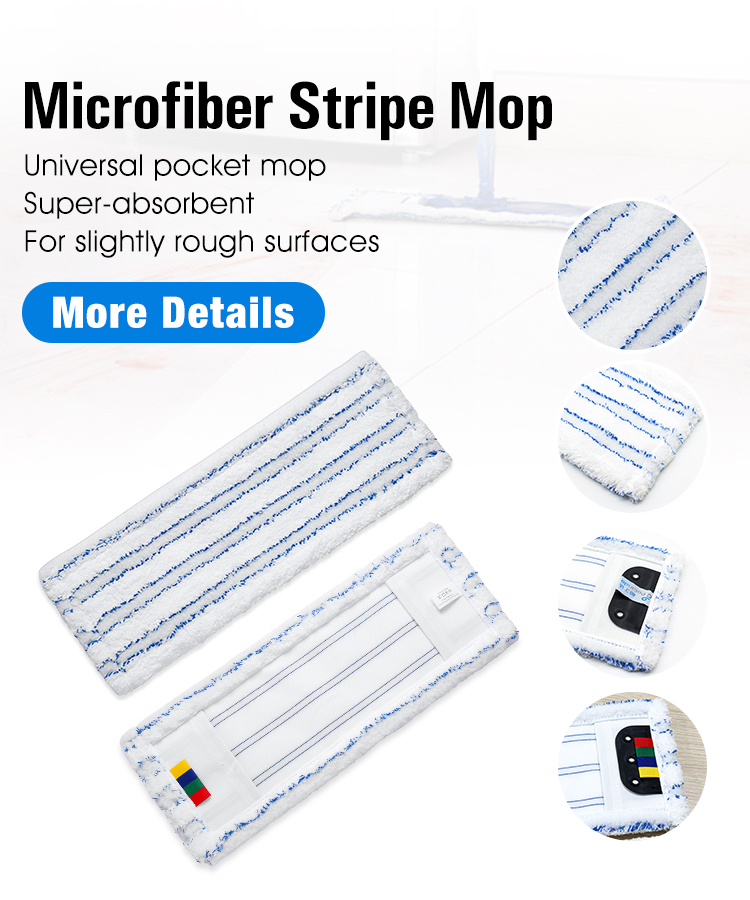
- Microfiber with nylon stripes (MP-014). The mixed striped pile is positioned to capture dirt on rougher floors; the specification states it picks more dust than a regular mop and absorbs up to seven times its own weight in liquid.
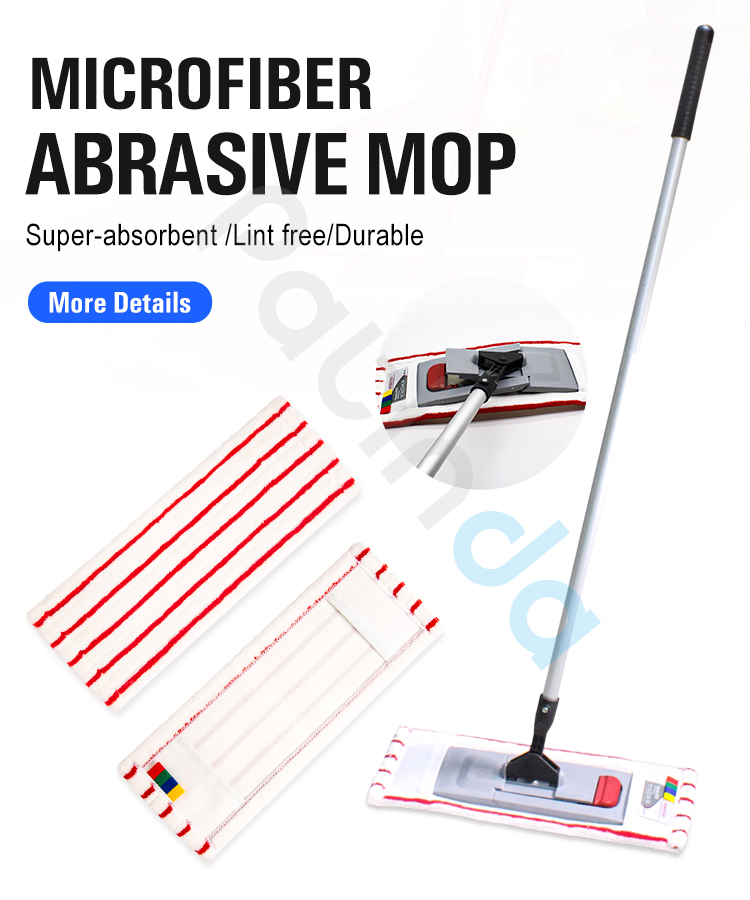
- Microfiber with PET (MP-015, MP-020). PET appears as loop structure in the twisted pile of MP-015 and as a red abrasive stripe in MP-020, where it is intended for stubborn stain removal.
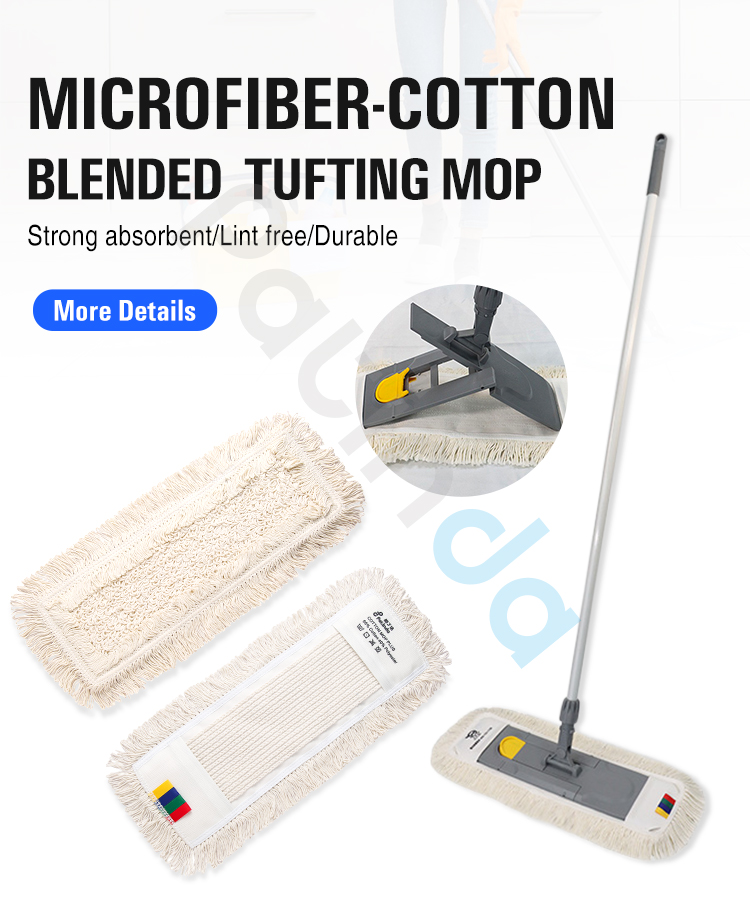
- 40% cotton / 60% polyester (MP-006). A blended tufting yarn rather than an all-synthetic microfiber, positioned for dust and hair pickup alongside wet mopping.
Axis 2 — Pile construction
Construction decides how the pad releases soil into the wash and how much liquid it holds between passes. Five builds appear in this set: a striped mixed pile (MP-014), a twisted loop surface (MP-015), a tufted loop with fringe edge (MP-006), an ultrasonically sealed terry strip edge (MT-003), and a two-component face of main pile plus abrasive stripe (MP-020).
Two construction details matter more than they look. First, MP-006's tufted loops are described as durable and not loosening during cleaning, which is the failure mode buyers should ask about on any tufted pad. Second, MT-003 uses ultrasonic sealed cutting on the strip edge, a finish chosen to keep strip ends from fraying through repeated washing — a specific, checkable answer to a common complaint about string-style mops.
Axis 3 — Attachment style
Attachment is the axis buyers most often discover too late, because frames are bought once and refills are bought repeatedly. A double-pocket back is frame-agnostic within pocket-style holders and is the format used by MP-014, MP-006 and MP-020; the pad slides onto the holder and is held by the pockets. MP-015 instead uses a full velcro sticker matched to an aluminium mop frame, supplied with a thickened telescopic aluminium pole and an adjustable rotating head. MT-003 uses a spiral plastic socket that screws onto a pole.
The practical consequence is straightforward: a facility that standardises on pocket frames cannot consume MP-015 refills without buying velcro plates, and a facility built around socket mops cannot use flat pads at all. Attachment decides refill compatibility before blend or weight are worth discussing.
Five formats compared on stated specifications
| Format | Blend | Refill weight / size | Build and attachment | Floor use stated |
|---|---|---|---|---|
| MP-014 Microfiber Stripe Mop | Microfiber + nylon blended | 100 g / 115 g; 40 cm / 50 cm | Striped pile face; double-pocket back with colour-coded classification tag; reusable over 300 washing cycles | Marble, hardwood, ceramic tile; dry and wet |
| MP-015 Microfiber Twisted Wet Mop | Microfiber + polyester (PET) | 75 g / 110 g; 18 in / 24 in | Twisted loop absorbent face; full velcro back for aluminium frame; telescopic pole and rotating head | Marble, hardwood, ceramic tile; wet cleaning |
| MP-006 Microfiber-Cotton Tufting Mop | 40% cotton + 60% polyester yarn | 165 g / 200 g; 40 cm / 50 cm | Tufted loop face with fringe edge; double-pocket back with four-colour classification tag | Marble, hardwood, ceramic tile; dry sweeping and wet mopping |
| MT-003 Microfiber Terry Wet Mop | 80% polyester + 20% polyamide | 200 g / 300 g; 35 × 10 cm strip | Terry cloth strips, ultrasonically sealed strip edge; spiral plastic socket for pole | Hardwood, tile, marble; wet mopping in homes, schools, public buildings |
| MP-020 Microfiber Abrasive Mop | Microfiber + PET blended | 80 g / 95 g; 40 cm / 50 cm | White microfiber main pile plus red PET abrasive stripe; double-pocket back with four-colour area label | Marble, hardwood, ceramic tile; graded commercial cleaning |
Two observations from the table. MP-020 weighs less than MP-014 and far less than MP-006, so the presence of an abrasive stripe does not make a pad heavier or denser. And the lightest refill in the set (MP-015 at 75 g) is a purpose-built wet mop with a velcro plate system, while the heaviest (MT-003 at 200 g / 300 g) is a strip mop for larger liquid pick-up — weight tracks function, not rank.
Matching formats to commercial floor care tasks
Application lists in a supplier specification are a starting filter, not an answer. Reading them across the five formats produces a usable map.
Healthcare and hospital sanitation
MP-014, MP-006 and MP-020 all list hospital sanitation, and all three carry a colour-coded classification tag or four-colour label on the back. For zone-based cleaning programmes, MP-020 adds an abrasive stripe for stubborn marks while remaining described as scratch-free on marble, hardwood and ceramic tile, and MP-014 contributes the rougher-floor dirt capture of its striped nylon pile.
Hotels, restaurants and catering
MP-014, MP-006, MP-015 and MP-020 list hotel, catering or restaurant environments. For back-of-house wet work with frequent laundering, MP-015's twisted loop face and velcro plate attachment favour quick pad swaps; for front-of-house dust control before service, the cotton-blend pickup of MP-006 is the relevant characteristic.
Schools, stations and public buildings
MT-003 lists school campus sanitation, public space maintenance and commercial property cleaning, and its 200 g / 300 g strip format is aimed at wet mopping over larger areas. MP-020 lists school campus and public facility hygiene management, where its four-colour area label supports assigning pads to specific zones.
Commercial property and contract cleaning
All five list commercial property or contract-cleaning environments in some form, which is precisely why the category label is unhelpful on its own. The differentiating question is not "which mop is commercial" but "which attachment does the site's frame fleet already use, and which pad mass matches the liquid load per shift".
Household and light-duty use
Every format in the set also lists household floor cleaning. For domestic use the binding constraint is usually laundering convenience and storage rather than cycle life, which favours the lighter flat pads over the 300 g strip refill.
What the market and compliance signals mean for mop sourcing
Two commercial research publishers put the global microfiber cleaning cloth market in the region of USD 1 billion in 2025 with mid-single-digit growth. Future Market Insights projects USD 979.2 million in 2025 rising to USD 1,520.7 million by 2035 at a 4.5% CAGR; Fortune Business Insights projects USD 1.04 billion in 2026 rising to USD 1.49 billion by 2034 at 4.57%. The bases and end years differ and the figures should not be averaged; the directional signal is a stable, single-digit growth category rather than a fast-expanding one, which puts pressure on suppliers to compete on specification and repeat-order reliability rather than on category novelty.
The same research places multicomponent polyester/polyamide blends at 58.0% of 2025 revenue share. For buyers this is a benchmark: mops that depart from the 80/20 recipe — a 40% cotton tufting pad, for example — should be justified by a task fit, not treated as an equivalent substitute.
Compliance has also moved. OEKO-TEX updated STANDARD 100 in 2024 to include a total fluorine limit of 100 mg/kg, a change aimed at PFAS regulation. For textile floor-care products this shifts the useful question from "is the supplier certified" to "is the certificate current, and does its scope cover the mop production line". The certificate set on file for this supplier illustrates the level of detail available: OEKO-TEX STANDARD 100 certificate 20.HCN.36448 issued by Hohenstein Laboratories GmbH & Co. KG (valid to 31 January 2027, Product Class II); ISO 9001:2015 certificate CN24/00007747 and ISO 45001:2018 certificate CN24/00007748, both issued by SGS United Kingdom Ltd with the scope "manufacture of towels and mops"; and SMETA audit ZAA600123152 covering labour standards, health and safety, environment and business ethics. Extended producer responsibility registrations include German VerpackG DE3922560298890 and French REP textile UIN FR337512_11LKPC. Each of these can be checked against the issuing body's own database, which is the only verification that counts.
A third-party signal supports the supply-side claim: US customs import records filed under the company's trade name show 172 bills of lading between June 2019 and September 2026 (ImportInfo). For a buyer assessing repeat-order continuity, documented shipment history is more informative than a capability statement.
Where microfiber mop formats stop short
Every format in this set has a boundary, and a comparison framework that omits them is only a catalogue.
- Frame lock-in is the largest switching cost. Pocket pads, velcro plates and socket mops are not interchangeable. Consolidating a multi-site estate onto one attachment format can mean replacing frames, not just refills.
- The cotton blend behaves differently in the wash. MP-006 is 40% cotton, and cotton-rich yarns typically retain moisture longer than all-synthetic piles. Facilities that launder and dry in-house should confirm drying time against their turnaround window before standardising on a blended pad.
- The abrasive stripe is a task tool, not a default. MP-020 is described as scratch-free for marble, hardwood and ceramic tile, but any abrasive component deserves a site trial on the specific finish — particularly new or high-gloss stone — before building-wide adoption.
- Colour coding only works if laundering protects it. A tag or four-colour label allocates a pad to a zone; mis-sorting or heavy colour loss breaks the system silently, and neither is a product defect.
- Light pads are not heavy-duty substitutes. An 80 g flat pad and a 300 g strip refill are not interchangeable under heavy liquid load, even when both are labelled for wet mopping.
- Shedding is an open question. Environmental research defines microfibres as microscopic fibres shed from textiles, and reusable cleaning textiles are inside that discussion. Buyers asking suppliers about shedding rates will find little published data — which is itself a reason to frame sustainability claims carefully.
Against traditional cotton string mops, the case is narrower than marketing usually suggests. String mops remain inexpensive, forgiving on irregular or damaged floors, and familiar to staff; their weaknesses are weight when wet, manual wringing and slower laundering turnaround. Flat microfiber pads answer those points through launderability, defined pad mass and colour-coded zone control, but they introduce frame dependency and a stricter laundering discipline. The honest comparison is therefore not better versus worse; it is which operating model the facility can sustain.
A buyer's decision sequence
Applied in order, these six questions resolve most mop comparisons before price is discussed.
- 1. Fix the attachment. Determine the existing frame fleet — pocket, velcro plate or socket — and treat refills outside it as new capital, not consumables.
- 2. Match pad mass to liquid load. Light flat pads for manoeuvrability and fast laundering; 200 g / 300 g strip refills where wet pick-up per pass dominates.
- 3. Read the fibre percentages, not the category name. 80/20 polyester/polyamide, microfiber with nylon, microfiber with PET and a 40% cotton blend are four different products.
- 4. Confirm the construction detail that fails first. Tuft durability on tufted pads; sealed strip edges on string-style mops; tag integrity on colour-coded pads.
- 5. Verify certificates by number and scope. Check the issuing body's database and confirm the scope covers mops rather than towels alone.
- 6. Test one floor type before rollout. A site trial on the finish that matters — polished stone, sealed timber, anti-slip tile — resolves more than any specification sheet.
The supplier side of the same checklist, as documented for this manufacturer, includes OEM/ODM customisation across size, weight, logo, material, fabric texture, printing, colour, accessories, packaging and GSM; a monthly capacity of 182,022 kg; a MOQ of 3,000 pieces; a 30–45 day lead time; and 100% testing. Order history cited for the wider microfiber range runs from 1,000 to 50,000 pieces per order across retail distributors, auto care brands, gym brands and janitorial wholesalers in more than 20 countries, with reuse described at 6 to 12 months after repeated washing for the cloth formats.
Future outlook
Three shifts are likely to shape mop specification over the next procurement cycles. First, blend disclosure will tighten: with multicomponent polyester/polyamide at 58.0% of revenue share and PFAS-linked limits now inside OEKO-TEX STANDARD 100, buyers will ask for fibre percentages and current certificate numbers as standard documentation. Second, colour-coded zone systems will keep spreading from healthcare into foodservice, education and facility management, making tag integrity and laundry sorting part of the product specification rather than an operational afterthought. Third, attachment consolidation will decide supplier share: once a site commits to a frame format, refill purchasing follows it for years, which rewards suppliers who can document cycle life, laundering recommendations and stable construction across a range.
What the market data does not support is the expectation of a rapidly expanding category. Mid-single-digit growth implies that volume gains come from displacement and repeat orders, which puts the comparison framework — blend, build, attachment, floor fit — at the centre of the buying decision rather than at its margins.
FAQ
How do MP-014 and MP-020 differ, when both are colour-coded flat mop pads?
Both are 40 cm / 50 cm flat pads with a double-pocket back and a colour-coded classification tag. MP-014 uses a mixed microfiber and nylon striped pile aimed at capturing dirt on rougher floors, at refill weights of 100 g and 115 g. MP-020 combines a white microfiber main pile with a red PET abrasive stripe intended for stubborn stain removal, at 80 g and 95 g. The abrasive stripe is the functional difference; size logic and attachment are shared.
Why do microfiber mop refills vary so much in weight?
Refill weight reflects pile mass, yarn structure and moisture-load design rather than a performance ranking. Within this set the range is 75 g / 110 g (MP-015), 80 g / 95 g (MP-020), 100 g / 115 g (MP-014), 165 g / 200 g (MP-006) and 200 g / 300 g (MT-003). Heavier strip refills suit larger wet pick-up; lighter flat pads suit manoeuvrability and faster laundering turnaround. Weight should be recorded as a specification, not used as a quality score.
Which formats support a facility that uses zone-based colour coding?
MP-014, MP-006 and MP-020 each carry back-side colour identification — a colour-coded classification tag on MP-014, a four-colour classification tag on MP-006, and a four-colour area label on MP-020. The system only holds if laundering and sorting preserve the assignment, so the tag has to survive washing and staff have to respect the mapping.
Is a cotton-blend tufting mop still a microfiber mop?
MP-006 is specified as 40% cotton and 60% polyester blended yarn, so it is a blended mop rather than an all-synthetic microfiber pad. Its tufted loop surface with fringe edge is positioned for dust and hair pickup plus wet mopping, and it is described as washable repeatedly with tufts that do not loosen during cleaning. Buyers comparing microfiber claims should read fibre percentages rather than the category label.
What supplier evidence can actually be verified for microfiber mops?
For this supplier the certificate set includes OEKO-TEX STANDARD 100 certificate 20.HCN.36448 issued by Hohenstein Laboratories GmbH & Co. KG and valid to 31 January 2027, ISO 9001:2015 certificate CN24/00007747 and ISO 45001:2018 certificate CN24/00007748 issued by SGS United Kingdom Ltd with the scope "manufacture of towels and mops", and SMETA audit ZAA600123152. Packaging and textile extended producer responsibility registrations include German VerpackG DE3922560298890 and French REP textile UIN FR337512_11LKPC. Certificate numbers should be checked against the issuing body's database, and recycled-content claims should be verified separately.
How long can a commercial mop pad be expected to last?
Published specifications differ by format. MP-014 states reusability over 300 washing cycles; MP-015, MP-006, MT-003 and MP-020 are described as reusable after repeated washing without a stated cycle count. Actual service life depends on laundering temperature, detergent chemistry and drying practice, so where life-cycle costing matters buyers should request the supplier's laundering recommendation and a documented cycle count rather than accept a general durability claim.
The five formats compared here share a supplier, a size logic and a colour-coding principle, and still diverge on blend, pad mass and attachment — which is why the comparison has to be built on specification rather than on the word "microfiber". The full technical specification set, including size, weight, GSM and customisation options across the range, is published in the company's public product catalogue (PDF).
¿Tiene preguntas o necesita más detalles?
Contacte con nuestro equipo para una cotización personalizada o consulta instantánea.
Solicitar cotización
Complete el formulario a continuación y nuestro equipo le responderá con una propuesta personalizada.
Chat directo de WhatsApp
¿Prefiere chatear en tiempo real? Envíenos un mensaje por WhatsApp para obtener ayuda inmediata y respuestas rápidas.
- Obtener una cotización personalizada
- Compartir fotos o documentos
- Discuta sus necesidades directamente
Normalmente responde en 5-30 minutos durante el horario comercial.