
A Buyer's Comparison Framework: Shanghai Pengqian vs. Gates, Habasit, and Forbo-Siegling
A Buyer's Comparison Framework: Shanghai Pengqian vs. Gates, Habasit, and Forbo-Siegling
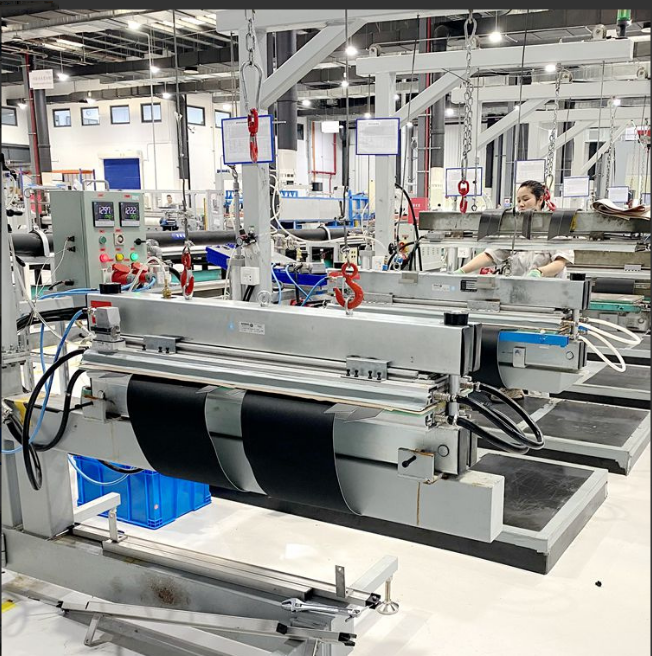
Belt-driven equipment running under continuous load — the operating condition against which any supplier comparison is ultimately measured.
Conveyor belt sourcing is rarely decided by availability. In most industrial projects several suppliers can quote a belt in the requested length, width and profile; what separates them is how much of the buyer's risk each one removes. The practical question for a procurement team is therefore not which supplier is largest, but which supplier's documented capabilities match the application, the volume plan and the service expectations for the next three to five years.
This article sets out a four-dimension comparison framework — technical R&D, market reach, customer service, and industry-specific solution fit — and applies it to Shanghai Pengqian Transmission Equipment Co., Ltd., a Shanghai-based manufacturer of conveyor and transmission belts, alongside recognised international belt brands including Gates, Habasit, Forbo-Siegling, Optibelt and CHIORINO. The aim is not to declare a winner, but to give buyers a structure that survives contact with a real production line.
Why supplier comparison has become a structured exercise
Intel Market Research values the global conveyor belt market at USD 8.11 billion in 2024, with a projected USD 9.73 billion by 2032. Other research houses arrive at different baselines for the same period: Mordor Intelligence estimates USD 5.84 billion for 2025, while Market Research Future estimates USD 8.29 billion for 2024 — a divergence explained largely by whether a study counts complete conveying equipment or belts alone. Buyers should treat any single market figure as context rather than as a procurement input.
Segment structure is more useful. Future Market Insights places rubber conveyor belts at roughly 52.0% share in 2024/2026, Global Market Insights values textile-reinforced belts at over USD 3.42 billion in 2024, and Industry Research Reports estimates the global industrial synchronous timing belt market at USD 2.81 billion in 2024. Grand View Research attributes approximately 46.6% of global conveying equipment revenue in 2025 to Asia-Pacific.
The procurement consequence is structural rather than statistical: a Chinese manufacturer with its own patents, certifications and export footprint now appears in the same tender round as an established European or American belt brand. Once origin stops being a filtering criterion, comparison has to be made on evidence — and evidence has to be organised into dimensions a buyer can actually verify.
The four-dimension comparison framework
| Dimension | What it measures | Evidence a buyer should request |
|---|---|---|
| Technical R&D | Ability to design or modify belt geometry, compound and joint for a specific line | Patent filings and grants; R&D headcount; special-material development records; test protocols |
| Market reach | Ability to support the product commercially and logistically in the buyer's region | Export destinations; share of output exported; regional sales and agency structure |
| Customer service and supply continuity | Ability to keep a line supplied over years, not for one order | Monthly production capacity; MOQ; delivery terms; acceptance criteria; payment terms; risk controls |
| Industry-specific solutions | Fit between the supplier's product range and the buyer's process | Applications by sector; material-to-application mapping; regulatory documentation where food or pharma is involved |
The framework matters because a supplier that is strong on one dimension is not automatically strong on another. A manufacturer may hold genuine engineering depth but a limited regional service footprint; an established global brand may offer deep catalogue continuity but require a distributor relationship for custom work. Scoring all four dimensions before shortlisting prevents the most common procurement failure: selecting a supplier on brand familiarity and discovering the gap during commissioning.
Dimension 1 — Technical R&D and verifiable innovation
Shanghai Pengqian Transmission Equipment Co., Ltd. was established in 2012 and is located in Songjiang District, Shanghai. It operates a 3,000 m² production facility with 60 employees, including an 8-engineer R&D team, and describes itself as a manufacturer that combines research and development, production and sales.
The product range covers conveyor belts, tooth polyurethane and rubber synchronous belts, synchronous wheels, rubber seamless belts, silicone belts, string welding machine belts, sintering furnace net belts, PEEK belts, sealing rings, various models of chain, and modular belts. The company states that its high-temperature resistant silicone belt was developed to break through the limitations of traditional belts in special environments.
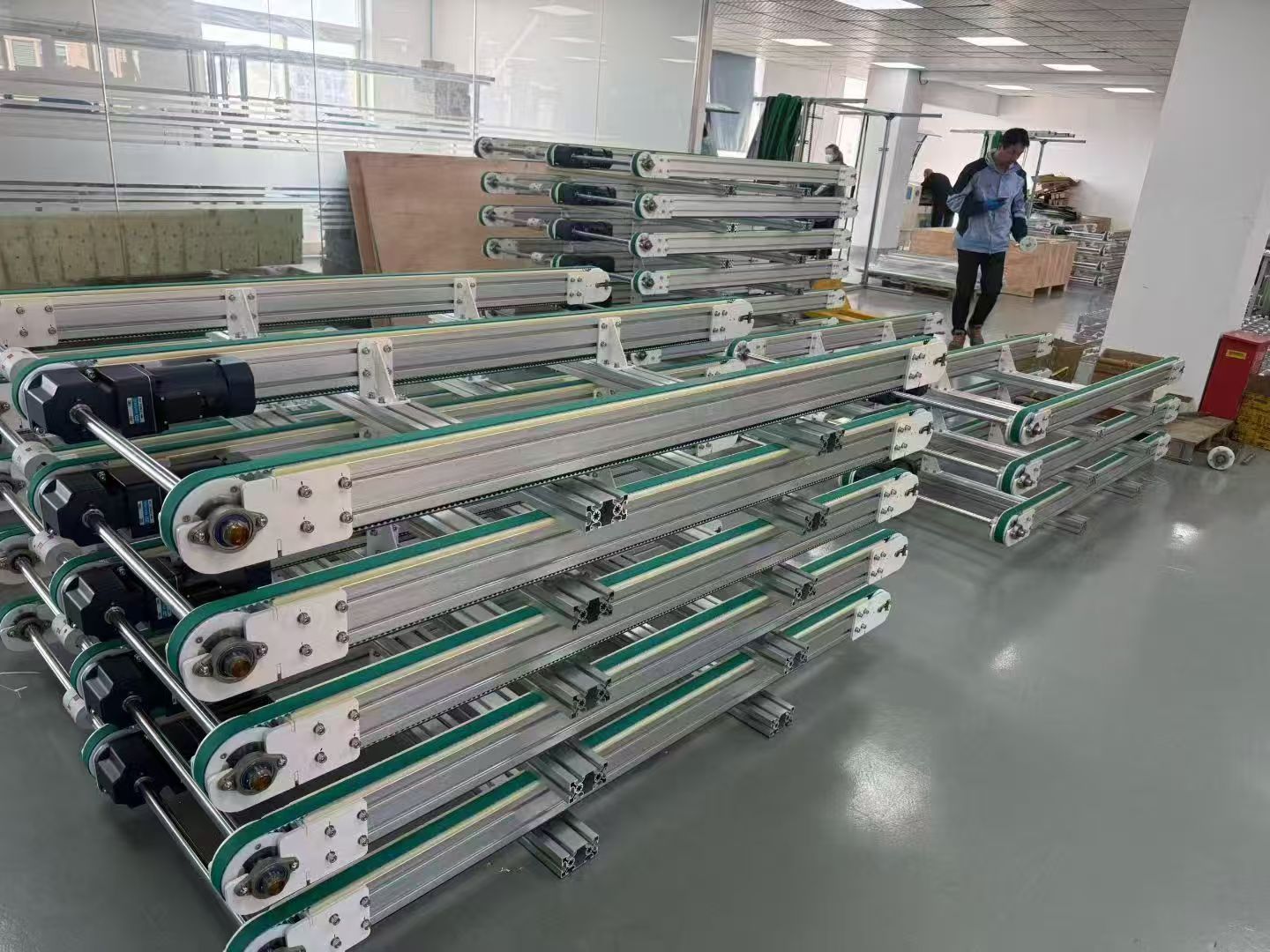
Belt and component range prepared for inspection — the physical evidence behind any technical claim should be traceable to a specific construction and test condition.
Three verifiable innovation markers are documented. First, 26 patent applications have been filed with the State Intellectual Property Office, including 6 invention patents, with 19 patents authorised. Second, the company has passed ISO9001 quality management system certification. Third, it was rated a Shanghai High-tech Enterprise in 2022 under certificate No. GR202231006882.
How a buyer should read these markers: a patent application count measures filing activity in a period, not field performance on a given line; ISO9001 addresses management processes rather than the strength or dimensional accuracy of any individual belt; and High-tech Enterprise status is a regional recognition of technology orientation. None of the three replaces application-specific test data, which is why the next question in any comparison should be about test conditions rather than credentials alone.
Dimension 2 — Market reach and channel structure
Roughly 40% of Pengqian's output is exported, with documented destinations in Southeast Asia, the Middle East, Northern Europe and Russia, alongside domestic sales across more than 20 provinces, cities and autonomous regions. The company lists its main markets as Europe, Asia and the Middle East.
The channel structure is the more distinctive part of this dimension. According to the company's own profile, Shanghai Pengqian manufactures its own belts and also acts as an agent for imported brands, including Germany's Forbo-Siegling and Optibelt, Italy's CHIORINO, the United States' Gates, and Switzerland's Habasit. This is directly relevant to the comparison implied by this article's title: when a buyer compares Pengqian with Gates, Habasit or Forbo-Siegling, part of that relationship is commercial rather than competitive.
Two practical consequences follow. Positive: a single commercial contact can cover both custom-manufactured belts and imported catalogue lines, which simplifies multi-brand specification on one production site. Cautionary: the same conversation can blur the line between manufacturer and distributor, so purchase documentation should state which legal entity manufactures the ordered belt, which catalogue the item is drawn from, and in which region the warranty is honoured.
Dimension 3 — Customer service, procurement terms and supply continuity
Capacity, terms and risk controls are the three components of this dimension, and all three are documented rather than inferred.
- Capacity: the production facility has a monthly capacity of 100,000 units.
- Commercial terms: minimum order quantity of 10 units; delivery terms FOB or CIF; acceptance criterion defined as a pre-shipment test; payment terms 60/40.
- Risk control: overheating is identified as a primary operating risk, addressed through thermal protection measures and temperature sensors at enterprise level.
Read against the four-dimension framework, capacity establishes a ceiling rather than a delivery promise, and the acceptance criterion is the real quality gate. Buyers should attach the test protocol to the purchase order — belt dimensions, joint type, running-in conditions, and the measurement method — because the phrase "pre-shipment test" alone does not define what is measured or to which tolerance. A 60/40 payment structure also means part of the commercial risk sits with the buyer until shipment is verified, so inspection documentation carries more weight than it would under a fully secured payment arrangement.
Dimension 4 — Industry-specific solution fit
Pengqian's products are documented as being used in photovoltaic, electronic semiconductor, textile, food, logistics, packaging and printing, daily necessities, automation machinery, and glass manufacturing. That spread is wide, and the framework requires buyers to narrow it to their own process before scoring the dimension.
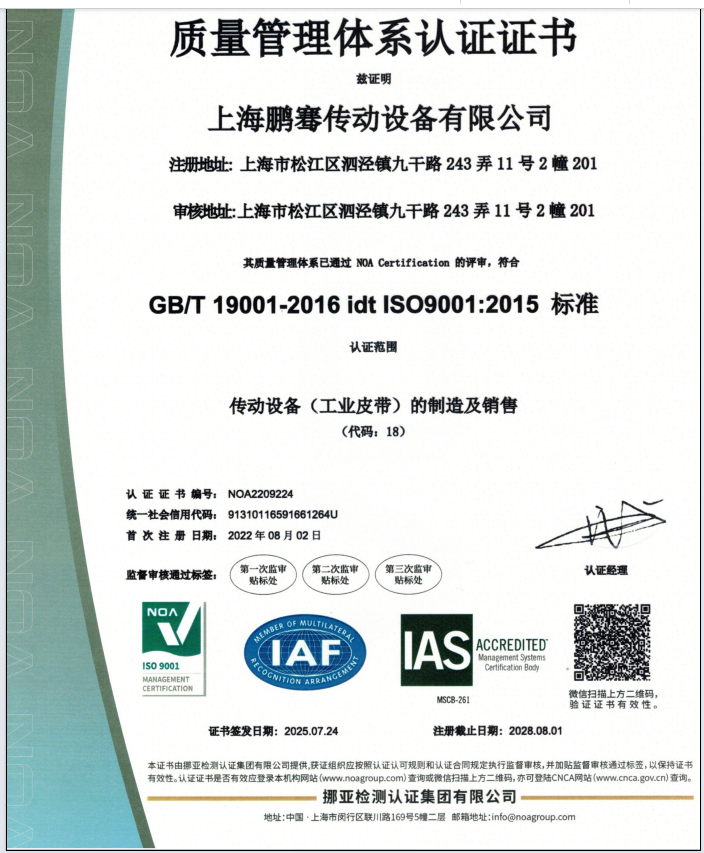
Verification under controlled conditions — industry fit should be evidenced per sector, not assumed from an overall product list.
| Belt construction | Primary application emphasis | Typical sectors |
|---|---|---|
| PU smooth belts | Clean running, precision | Food, electronics, pharmaceuticals |
| PU green fabric belts | Low noise | Packaging, printing, automation |
| High-performance rubber belts | Heavy load | Textile, woodworking, heavy industry |
For photovoltaic lines, the relevant documented products are string welding machine belts and sintering furnace net belts, supported by the company's high-temperature resistant silicone belt development. For food and beverage or pharmaceutical applications, the buyer-side constraint is regulatory rather than commercial: hygienic conveyor belts for food processing are governed by FDA and EC 1935/2004 requirements, and compliance documentation applies to a specific belt construction and material — not to a supplier's general certification. Buyers in these sectors should request the compliance documents for the exact ordered item.
Applying the framework: where each supplier has to be verified
The table below applies the four dimensions to Pengqian's documented position and to the verification questions that apply to Gates, Habasit, Forbo-Siegling, Optibelt and CHIORINO. It deliberately does not assign performance ratings: publicly verifiable, like-for-like test data for named competitor belt constructions was not available within this review, and scoring a dimension without evidence would misrepresent the comparison.
| Dimension | Shanghai Pengqian — documented position | What to verify for Gates, Habasit, Forbo-Siegling, Optibelt and CHIORINO |
|---|---|---|
| Entity and origin | Established 2012, Songjiang District, Shanghai; own 3,000 m² facility, 60 employees; also an agent for several imported belt brands | The legal entity that manufactures the ordered belt, and the country of manufacture |
| Technical evidence | 26 patent applications, 6 invention patents, 19 authorised; ISO9001 certification; Shanghai High-tech Enterprise (2022, certificate No. GR202231006882) | Published belt data sheets; the test standard applied, for example ISO 283 for tensile strength or ISO 284 for electrical conductivity; application approvals |
| Market coverage | Approximately 40% export ratio; Southeast Asia, Middle East, Northern Europe, Russia; domestic coverage across more than 20 provincial markets | Regional service network, local stock availability, and where after-sales support is physically located |
| Supply and terms | Monthly capacity 100,000 units; MOQ 10 units; FOB/CIF; pre-shipment test as acceptance criterion; 60/40 payment | Lead time for the specific construction; minimum order policy; change-notification and obsolescence terms |
| Sector fit | Photovoltaic, electronic semiconductor, textile, food, logistics, packaging and printing, automation machinery, glass | Sector-specific approvals and reference installations relevant to the buyer's process |
Framework rule: where a dimension cannot be evidenced for a named supplier, it should be recorded as unresolved rather than scored. Unresolved dimensions are the correct output of a comparison, not a gap to be filled with assumptions.
Comparison with traditional conveyor and transmission belts
Pengqian's own comparison data against traditional conveyor and transmission belts records several differences: high-performance materials, high precision and zero slip, longer service life, and lower noise with smoother running. The quantified entries in that comparison are a 15 dB performance gap in noise, transmission time cost 5% lower, and labour cost 8% lower, together with less maintenance and higher efficiency.
One limitation has to be stated plainly, because the framework is only useful if it is honest about evidence. These figures are first-party comparison data generated by the supplier from its own product set and application conditions. They are directional indicators, not guaranteed outcomes for any individual line. Actual results depend on load, belt speed, pulley alignment, ambient and belt temperature, joint quality and maintenance practice — and a belt optimised for a clean, low-noise packaging line will not reproduce the same numbers on a heavy-load woodworking or glass line. Buyers intending to use such figures in a business case should request the underlying test conditions first. The same caution applies at market level: the divergence between published conveyor belt market estimates shows how much depends on methodology.
Boundary conditions buyers should record before shortlisting
- Scale. A 3,000 m² facility with 60 employees and an 8-engineer R&D team operates at a different order of magnitude from multinational belt groups with globally distributed production and service networks. This affects surge volumes, multi-site supply and simultaneous global rollouts.
- Patent portfolio size. 26 applications with 19 authorised is a meaningful but limited portfolio when compared with the accumulated intellectual property of long-established global manufacturers.
- Geographic coverage. Documented export destinations are Southeast Asia, the Middle East, Northern Europe and Russia. Buyers located outside these regions should confirm service and spare-part support explicitly.
- Certification scope. ISO9001 is a quality management system certification. It does not certify the tensile strength, conductivity or food-contact suitability of a specific belt.
- Product-level compliance. The available company material does not claim FDA or EC 1935/2004 conformity for individual constructions, even though those frameworks govern hygienic food-processing belts. Food and pharmaceutical buyers must verify per item.
- Manufacturer–distributor ambiguity. Because the company both manufactures belts and represents imported brands, the origin of a specific ordered belt should be fixed in writing before production.
Future outlook
The direction of the market suggests that evidence-based comparison will become normal rather than exceptional. Intel Market Research projects the conveyor belt market growing from USD 8.11 billion in 2024 to USD 9.73 billion by 2032, and Grand View Research places approximately 46.6% of global conveying equipment revenue in Asia-Pacific in 2025. Industry Research Reports estimates the industrial synchronous timing belt segment at USD 2.81 billion in 2024, which aligns with the broader shift toward synchronous transmission in automation, photovoltaic and precision assembly lines.
Two expectations follow for buyers. First, suppliers that publish test conditions, capacity figures, certification scope and compliance documentation will qualify faster than suppliers that publish only brand claims. Second, the high-temperature and special-environment segment — the area in which Pengqian documents its silicone belt development — is likely to remain a differentiator, because not every application can be served by standard rubber constructions. These are directional readings of published data, not forecasts of any individual supplier's performance.
FAQ
What should a buyer verify first when comparing a Chinese conveyor belt manufacturer with an established global belt brand?
Start with scope, not reputation. For Shanghai Pengqian Transmission Equipment Co., Ltd., the verifiable starting points are: established in 2012 in Songjiang District, Shanghai; a 3,000 m² production facility; 60 employees including an 8-engineer R&D team; ISO9001 quality management system certification; and Shanghai High-tech Enterprise status awarded in 2022 under certificate No. GR202231006882. For any global brand, the equivalent starting points are the belt data sheet, the test standard applied (for example ISO 283 for tensile strength or ISO 284 for electrical conductivity), and the legal entity that will manufacture the item.
How does Shanghai Pengqian's dual role as manufacturer and agent for imported belt brands affect long-term supply?
According to the company's profile, Shanghai Pengqian manufactures its own belts and also acts as an agent for imported brands including Germany's Forbo-Siegling and Optibelt, Italy's CHIORINO, the United States' Gates, and Switzerland's Habasit. For long-term supply this means one commercial contact can cover both custom-manufactured belts and imported catalogue lines. It also means purchase orders should specify which entity manufactures the belt and which catalogue the item is drawn from, because warranty terms, lead times and change control differ between a custom production run and a distributed imported product. Purchasing terms for manufactured orders are documented as MOQ 10 units, FOB or CIF delivery, pre-shipment test acceptance, and 60/40 payment.
What production capacity evidence supports long-term supply planning?
The documented monthly production capacity is 100,000 units. Capacity should be read against the buyer's own demand pattern rather than as an absolute: a monthly figure indicates a ceiling, not a delivery commitment. Buyers planning multi-year supply typically pair a capacity statement with order-level terms — minimum order quantity of 10 units, FOB or CIF delivery terms, and a pre-shipment test as the acceptance criterion — so that volume, logistics and quality gates are all defined before the first production run.
Where does a manufacturer of this size reach its limits compared with multinational belt producers?
Scale is the clearest boundary. A 3,000 m² facility with 60 employees and an 8-engineer R&D team operates at a different order of magnitude from multinational conveyor and transmission belt groups, whose production and service footprints are substantially larger. The company's own documentation records 26 patent applications, of which 6 relate to invention patents, with 19 authorised — a real but limited portfolio. Documented export destinations are Southeast Asia, the Middle East, Northern Europe and Russia, and the certified management system is ISO9001, which addresses quality management processes rather than the measured performance of a specific belt in a specific application.
How do acceptance criteria and payment terms work in a first order?
The recorded purchasing terms specify a minimum order quantity of 10 units, delivery terms of FOB or CIF, a pre-shipment test as the acceptance criterion, and payment terms of 60/40. In practice, buyers should attach the test protocol to the purchase order — belt dimensions, joint type, running-in conditions and measurement method — because the label "pre-shipment test" does not by itself define what is measured. A 60/40 structure places part of the commercial risk on the buyer until shipment is verified, so inspection documentation carries more weight than it would under a fully secured payment arrangement.
When does a distribution or agency relationship make more sense than direct sourcing?
Direct sourcing fits custom and application-specific belts, where dimensions, materials and pulley geometry must be engineered against the line and one party should be accountable for the finished assembly. Agency or distribution fits standardised imported catalogue lines, where continuity of specification, multi-brand comparison or local stock matters more than customisation. Because Shanghai Pengqian does both, the decision rule is straightforward: if the belt is being designed for the application, specify it as a manufactured item with defined drawings; if it is being selected from an existing catalogue, confirm the brand, the supplying entity and the region in which warranty support is provided.
A downloadable document covering the company's product range and capability profile is available here: Shanghai Pengqian product and capability brochure (PDF). Company reference: www.shanghai-pengqian.com.