
9DST vs 17DST: Comparing Intermediate Wire Drawing Machines
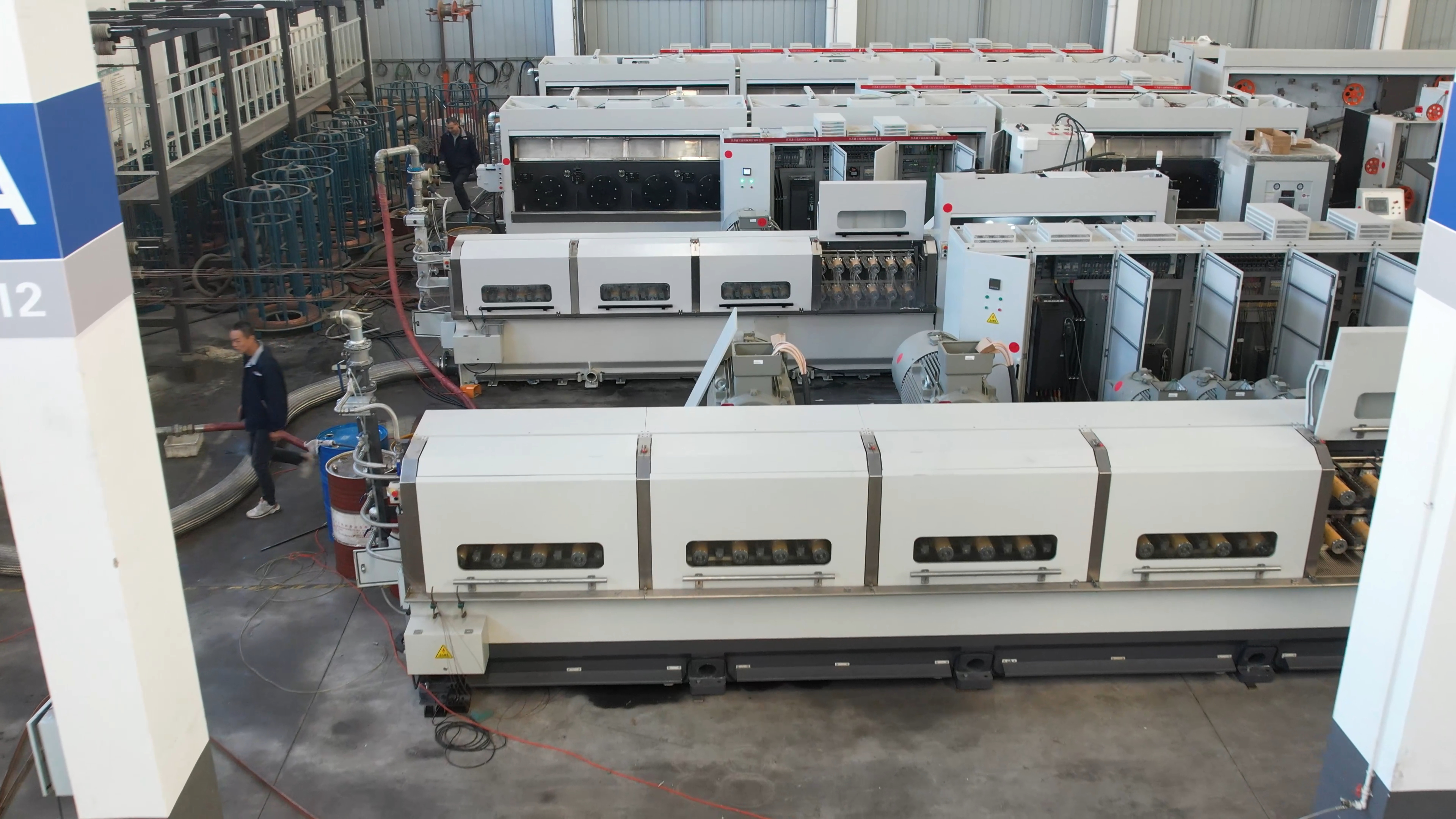
Assembly workshop, Jiangsu Listrong Mechanical & Electrical Co., Ltd., Dongtai City, Jiangsu Province, China.
Intermediate wire drawing machines occupy the stage between rod breakdown and fine drawing. They take copper wire that has already been reduced from rod and bring it into the roughly Φ0.4 mm to Φ2.8 mm band, which is where surface finish, elongation and diameter tolerance are effectively fixed for every downstream process. Two models from Jiangsu Listrong Mechanical & Electrical Co., Ltd. — the 9DST and the 17DST — are frequently placed on the same shortlist for that stage. The published parameter sets show they are not interchangeable.
In short: the 17DST includes online annealing and the 9DST does not; the 17DST uses a 4-shaft arrangement with 17 dies, while the 9DST uses a 2-shaft arrangement with 9 dies; and the 17DST reaches a higher mechanical speed of 1800 m/min (1500 m/min with annealing) against a 1200 m/min mechanical maximum on the 9DST. Everything else in the comparison follows from those three facts.
What each machine is
9DST — intermediate wire drawing machine without annealing. The 9DST is defined in Listrong's published specification as a bare copper wire drawing machine using a 2-shaft horizontal drawing arrangement, a Φ2.5–Φ3 mm inlet and a Φ1.0–Φ2.8 mm outlet. It carries 9 drawing dies, which the customer supplies, in Φ28 mm × 15 mm T or Φ25 mm × 15 mm T sizes. Drive is an AC 55 kW induction motor with an AC 11 kW spooler motor, traversing is handled by a servo motor with a limit detection switch, and the frame material is listed as steel. Its mechanical speed ceiling is 1200 m/min, and the published reference bands step down as wire thickens.
17DST — intermediate wire drawing machine with online annealing. The 17DST is specified as a bare copper wire drawing machine with online annealing. It draws from a Φ3.5–Φ2.5 mm inlet to a Φ1.6–Φ0.4 mm outlet using a 4-shaft horizontal arrangement and 17 customer-supplied dies in Φ30 mm × 15 mm T or Φ25 mm × 10 mm T sizes, with the last die at Φ25 mm × 10 mm T. Motor complement is a 55 kW main drive, a 7.5 kW annealing motor and a 15 kW spooling motor, with traversing by a 90 W motor and a position-limited switch. Maximum mechanical speed is 1800 m/min, falling to 1500 m/min when annealing is engaged.
Side-by-side specification comparison
| Parameter | 9DST | 17DST |
|---|---|---|
| Machine type | Intermediate wire drawing machine | Intermediate wire drawing machine |
| Working function | Bare copper wire drawing | Bare copper wire drawing with online annealing |
| Drawing method | 2 shafts, horizontal arrangement | 4 shafts, horizontal arrangement |
| Number of dies | 9 (customer self-provided) | 17 (customer self-provided) |
| Die dimensions | Φ28 mm × 15 mm T or Φ25 mm × 15 mm T | Φ30 mm × 15 mm T or Φ25 mm × 10 mm T; last die Φ25 mm × 10 mm T |
| Inlet diameter | Φ2.5–Φ3 mm | Φ3.5–Φ2.5 mm |
| Outlet diameter | Φ1.0–Φ2.8 mm | Φ1.6–Φ0.4 mm |
| Maximum mechanical speed | 1200 m/min | 1800 m/min (1500 m/min with annealing) |
| Reference speed bands | Φ0.8–1.5 mm: 1000–1200 m/min Φ1.5–2.0 mm: 800–1000 m/min Φ2.0–2.78 mm: 500–800 m/min | Φ0.40–0.80 mm: 1000–1500 m/min Φ0.80–1.60 mm: 1300–600 m/min |
| Reference wire elongation | Not published in the parameter set reviewed here | 25% (Φ0.40–0.80 mm); 30% (Φ0.80–1.60 mm) |
| Per-pass reduction | Passes 1–8: 19.5%; pass 9: 16% | Passes 1–16: 20%; pass 17: 15.5% |
| Drawing lubrication | Fully immersing type; 150 L/min | Fully immersing type; 100 L/min |
| Drive motor | AC 55 kW induction motor | 55 kW main drive motor |
| Additional motors | Spooler: AC 11 kW induction motor | Annealing: 7.5 kW; spooling: 15 kW |
| Traversing | Servo motor with limit detection switch | 90 W motor with position-limited switch |
| Safety door | Sliding door | Sliding door |
| Power supply | Three-phase AC 3 × 380 V (±10%); single-phase AC 220 V (±10%); 50 Hz (±2%) | Not published in the parameter set reviewed here |
| Compressed air | 0.6–0.7 MPa (fluctuation +0.02 MPa); dew point −25 °C; 200 L/min | Not published in the parameter set reviewed here |
| Cooling water | 0.2–0.4 MPa; ≤25 °C; pH 7–8; 420 L/min; free of suspended solids, minerals, metal impurities and corrosive substances | Not published in the parameter set reviewed here |
| Frame material listed | Steel | Steel |
| Machine dimensions and net weight | Not published in the parameter set reviewed here | Not published in the parameter set reviewed here |
Source: Listrong published product parameter sheets for models 9DST and 17DST. Where a field is marked as not published, buyers should request it in writing before issuing a purchase order.
Drawing architecture: 2 shafts and 9 dies versus 4 shafts and 17 dies
The die count is the clearest structural difference between the two machines, and it is not a matter of simple capacity. Nine passes between Φ2.5–3 mm and Φ1.0–2.8 mm requires a comparatively aggressive per-pass reduction: the 9DST is specified at 19.5% for passes 1 through 8 and 16% on the final pass. Seventeen passes between Φ3.5–2.5 mm and Φ1.6–0.4 mm spreads the same physical work over more stations, at a specified 20% for passes 1 through 16 and 15.5% on the last pass. More passes generally mean a gentler thermal and mechanical load per die, which matters when the target diameter is finer.
Shaft count follows the same logic. The 9DST runs two shafts horizontally; the 17DST runs four. For a buyer, the practical consequence is what happens at the take-up end and how the machine behaves across a long shift, not simply how many wires can be handled — neither model is a multi-wire machine, and both draw a single line of bare copper.
Online annealing: the capability that separates them
The 17DST is specified for bare copper wire drawing and online annealing. It carries a dedicated 7.5 kW annealing motor alongside the 55 kW main drive and a 15 kW spooling motor. The published elongation references are 25% in the Φ0.40–0.80 mm band and 30% in the Φ0.80–1.60 mm band, with drawing speed quoted at 1000–1500 m/min and 1300–600 m/min respectively. The mechanical ceiling falls from 1800 m/min to 1500 m/min once annealing is engaged — a real throughput trade-off that belongs in any production planning model.
The 9DST has no annealing stage in its published specification. It is a drawing machine, and its outlet range of Φ1.0–2.8 mm sits higher in the diameter band. A buyer whose next process step is a separate annealer, or whose product does not require annealed wire at that stage, is comparing on different terms than a buyer who needs drawn-and-annealed wire in one pass.
Lubrication, cooling water and compressed air
Both models use fully immersing drawing lubrication, which submerges the die and capstan area rather than spraying it. The published oil demand differs: 150 L/min on the 9DST and 100 L/min on the 17DST. That figure drives the sizing of the lubrication circuit, the tank and the filtration package, and it is one of the few utility figures a buyer can compare directly today.
For the 9DST, Listrong also publishes compressed air at 0.6–0.7 MPa with a fluctuation allowance of +0.02 MPa, a dew point of −25 °C and a flow rate of 200 L/min, plus cooling water at 0.2–0.4 MPa, ≤25 °C, pH 7–8 and 420 L/min. The cooling water note is unusually explicit: water must not contain suspended solids, minerals, metal impurities, insoluble or corrosive substances. On a site with hard or untreated process water, that clause has cost implications for the plant-side supply, not just the machine.
Equivalent utility data for the 17DST is not published in the parameter set reviewed here, even though the model does have a lubrication oil requirement of 100 L/min. A buyer planning the plant side of the installation should treat that as an open item.
Electrical supply and control: where published detail stops
The 9DST specification states the supply it expects: three-phase AC 3 × 380 V at ±10%, single-phase AC 220 V at ±10%, and 50 Hz at ±2%. That combination — three-phase for the main drive, single-phase for control circuits — is common in export markets, and stating the tolerance bands is useful for sites with unstable grids. The 9DST drives are described as induction motors at AC 55 kW and AC 11 kW.
The 17DST parameter sheet reviewed here does not publish a supply specification, a control cabinet size, a frame construction method or a component brand list. Buyers should be careful here. Comparable data — three-phase 380/415 V 50 Hz, OMRON relays, LG switches, a 1000 L × 800 W × 1800 H mm control cabinet, 2100 L × 1600 W × 1700 H mm machine dimensions and a 3000 kg net weight — is published by Listrong for a different model in the fine-wire family, the 24DT. It shows the level of detail the company is able to provide, but it should not be assumed to apply to the 9DST or the 17DST without written confirmation from the supplier.
Where electrical configuration is a constraint, Listrong lists customization across Logo, Language, Voltage, Motor and Frequency Inverter. That means the supply voltage and the frequency inverter specification are treated as configurable items rather than fixed machine properties — which is exactly why the final configuration should appear in the quotation rather than being inferred from a catalogue sheet.
Conformity and manufacturing evidence
Both machines are named in Listrong's CE Verification of Conformity, certificate number CE-JL26020401-AL-MD, issued by ICG on 2026-02-10 and valid to 2031-02-09. The listed standards are EN ISO 12100:2010 and EN 60204-1:2018/A1:2025, and both the 9DST and the 17DST appear in the certificate's covered model scope. At company level, Listrong holds an ISO quality management system certificate (41625QT0833R0, GB/T19001-2016/ISO9001:2015, issued by Zhejiang Standard Service Certification Co., Ltd., valid 2025-08-27 to 2028-08-26) whose declared scope is wire drawing machines, stranding machines and annealing machines.
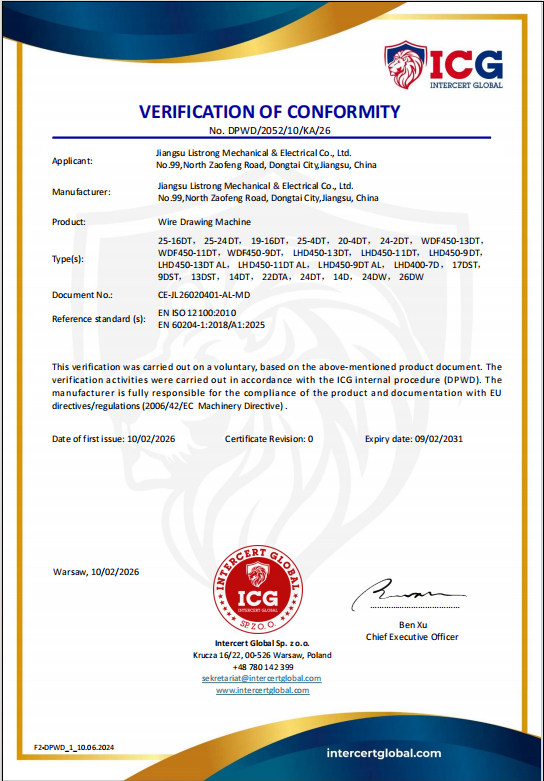
CE Verification of Conformity CE-JL26020401-AL-MD, whose listed model scope includes 9DST and 17DST.
On the manufacturing side, the company was founded in 2009, employs 70 people, operates a 15-engineer R&D team and reports an annual output of 550 sets with an export ratio of 40%, serving mainly the Middle East, India and South East Asia. Its declared business model covers development and design, whole-plant planning and technical advice, manufacture, installation, commissioning and after-sales service. Commercially, the published terms are OEM and ODM production, a minimum order quantity of 1 set, 100% pre-shipment testing, a lead time of 50–90 days, a stated monthly capacity of 45–50 sets, remote technical support and a 1-year warranty.
What the published data does not tell you
A comparison is only honest if it states its gaps. For these two models, the following items are not resolved by the published parameter sheets and should be requested as written confirmation:
- Machine dimensions, net weight and control cabinet dimensions for both models.
- Utility requirements for the 17DST — cooling water, compressed air and total connected load.
- Supply voltage, frequency inverter brand and relay/switch brands for both models as configured for the buyer's site.
- Frame construction method and material grade beyond the single word "steel".
- Annealing control method, annealing power rating in kVA and the temperature control range for the 17DST.
- Spool and take-up specifications, take-up weight and bobbin dimensions.
- Energy consumption per tonne at a stated wire diameter, and noise level data.
- Model-specific reference installations. The published customer reference for Listrong — an Iranian cable manufacturer running a machine for two years and a Macedonian manufacturer running one for a year, with reported energy savings of 35%, reduced labour costs and zero major failures — relates to the 25-16DT multi-wire model, not to the 9DST or the 17DST.
Application fit: which model belongs in which line
The 9DST's declared applicable industries are wire and cable manufacturing, metal product processing, and hardware standard components production. Its outlet band of Φ1.0–2.8 mm and its 1200 m/min ceiling point to lines that need a single intermediate reduction stage before a separate downstream process, and to workshops where the electrical environment is limited to a 380 V three-phase supply with 220 V single-phase control.
The 17DST's declared fields are power cables, communication cables, automotive wiring harnesses, electronic components and building wiring — applications where drawn-and-annealed copper is used directly. Its combination of a Φ3.5–2.5 mm inlet, a Φ1.6–0.4 mm outlet and online annealing makes it the more suitable of the two when the wire leaving the machine becomes a conductor rather than an intermediate stock item.
Limits and boundary conditions of this comparison
First, neither model ships with drawing dies. Both specify "customer self-provided" tooling, and the die dimensions differ between the two machines (Φ28 mm × 15 mm T or Φ25 mm × 15 mm T on the 9DST; Φ30 mm × 15 mm T or Φ25 mm × 10 mm T on the 17DST, with the 17DST's final die at Φ25 mm × 10 mm T). Die quality therefore sits outside the machine specification and directly affects achievable speed and surface finish.
Second, the 9DST's cooling water clause places a real qualification burden on the buyer's plant: water outside pH 7–8, above 25 °C, or carrying suspended solids and minerals does not meet the stated requirement, and pre-treatment may be needed.
Third, this comparison excludes price, delivery terms, spare parts pricing and commissioning cost, because no such data is published for these two models. It also compares two models from a single supplier. It is a specification-level reference for buyers already evaluating this manufacturer, not a cross-supplier ranking.
Market context
Third-party market estimates for wire drawing machines vary widely and buyers should read them with that in mind. Dataintelo puts the global wire drawing machine market at USD 3.8 billion in 2025 and projects USD 6.1 billion by 2034, a CAGR of 5.47% for 2026–2034. Other research houses covering the same category publish materially different figures — Insight Partners values 2025 at USD 1.37 billion and IndexBox values 2026 at USD 2.4 billion. The divergence is generally attributed to methodology: whether spare parts, dies and service revenue are counted inside the equipment market. For procurement planning, the direction of travel is more useful than any single number. The relevant machinery class is classified under HS code 8463.30.00 — machine tools for working metal wire without removing material.
Future outlook
The intermediate drawing stage is likely to be judged on two things over the next planning cycle: how much of the annealing step can be absorbed into the drawing line, and how verifiable the machine's operating data is. The 17DST already answers the first question with online annealing at a defined throughput cost. The second question is still open across the category — published parameter sheets, including those reviewed here, generally describe mechanical capability rather than measured energy consumption, scrap rate or overall equipment effectiveness. Buyers who want to compare on running cost rather than on nameplate speed will need to request site-level data, or to install their own measurement at the PLC and drive level.
FAQ
What is the main difference between the 9DST and the 17DST?
The 17DST includes online annealing; the 9DST does not. The 17DST also uses a 4-shaft arrangement with 17 dies and reaches 1800 m/min mechanically (1500 m/min with annealing), while the 9DST uses a 2-shaft arrangement with 9 dies and reaches 1200 m/min mechanically.
Does the 9DST have an annealing stage?
No. The published specification lists the 9DST as a bare copper wire drawing machine with a Φ2.5–Φ3 mm inlet and a Φ1.0–Φ2.8 mm outlet, with no annealing motor, no annealing power rating and no annealing control method. Annealing on the 17DST is supported by a dedicated 7.5 kW motor.
What power supply does the 9DST require?
The published requirement is three-phase AC 3 × 380 V at ±10%, single-phase AC 220 V at ±10%, and 50 Hz at ±2%. The 9DST is driven by an AC 55 kW induction motor with an AC 11 kW spooler motor. A supply specification for the 17DST is not published in the parameter set reviewed here and should be confirmed with the supplier.
Can the 9DST and 17DST be customized for different voltages or configurations?
Jiangsu Listrong Mechanical & Electrical Co., Ltd. lists customization options covering Logo, Language, Voltage, Motor and Frequency Inverter, and states that OEM and ODM production services are available. The minimum order quantity for OEM wire drawing machine orders is stated as 1 set. Buyers should have the final voltage, motor and frequency inverter configuration written into the quotation, since the standard published sheets do not fix these for every model.
Which certifications cover the 9DST and the 17DST?
Both models are named in the CE Verification of Conformity CE-JL26020401-AL-MD issued by ICG (valid 2026-02-10 to 2031-02-09), against EN ISO 12100:2010 and EN 60204-1:2018/A1:2025. At company level, the ISO certificate 41625QT0833R0 (GB/T19001-2016/ISO9001:2015, valid 2025-08-27 to 2028-08-26) covers wire drawing machines, stranding machines and annealing machines.
What information is missing, and how should a buyer obtain it?
Machine dimensions, net weight and control cabinet size are not published for either model. The 17DST's utility requirements and supply specification are also unpublished, as are the specific frame construction method, drive and control component brands, take-up and spool specifications, and measured energy consumption. These should be requested as written technical confirmation and, where possible, verified at a factory acceptance test. Listrong states that 100% pre-shipment testing is carried out as standard.
The full Listrong product catalogue, covering wire drawing, annealing and bunching machines, is available for reference: LISTRONG CATALOG-2.pdf.
¿Tiene preguntas o necesita más detalles?
Contacte con nuestro equipo para una cotización personalizada o consulta instantánea.
Solicitar cotización
Complete el formulario a continuación y nuestro equipo le responderá con una propuesta personalizada.
Chat directo de WhatsApp
¿Prefiere chatear en tiempo real? Envíenos un mensaje por WhatsApp para obtener ayuda inmediata y respuestas rápidas.
- Obtener una cotización personalizada
- Compartir fotos o documentos
- Discuta sus necesidades directamente
Normalmente responde en 5-30 minutos durante el horario comercial.