
5-in-1 vs Zero-Waste vs Side-Gusset Non Woven Bag Machines
A non woven bag making machine is bought against a bag portfolio, not against a single bag. Once a converter sells more than one format — a vest bag for a supermarket chain, a box bag for a retail brand, an organ bag with a side gusset for a bakery — the specification sheet stops being a comparison of speeds and becomes a comparison of envelopes: which bag widths, which material thicknesses, and which handle constructions the machine can actually convert, repeatedly, at the speed quoted.
This framework compares three Zhengxin Machinery platforms that are frequently shortlisted against each other for that reason: the 5-in-1 box bag platform (ZXL-E700 and ZXL-E700Ultra), the zero-waste edge T-shirt and W-cut platform (ZXL-A700Ultra), and the side gusset and online handle platform (ZXL-G700). Zhejiang Zhengxin Machinery Co., Ltd. — traded as ZX Zhengxin Machinery — is a Wenzhou-based manufacturer of non woven bag making machines founded in 2014, operating a 60,000 m² facility with 200 employees and an annual output of around 500 units, exporting roughly 60% of production to Africa, the Middle East, Southeast Asia and Latin America.
Why the bag mix decides the machine, not the other way round
Buyers at the research and evaluation stage usually begin with output: bags per minute, bags per day, bags per shift. Output is the wrong entry point, because every non woven bag making machine in this class already runs fast enough for most small and mid-sized factories. What separates the three platforms is not throughput — it is which bags survive the conversion process at all.
Three constraints do most of the eliminating: material thickness in grams per square metre (g/m²), the bag width and height envelope, and whether a handle is welded inline or the bag is finished without one. A factory running 120 g/m² laminated fabric is outside the stated thickness range of the 5-in-1 platform. A factory selling 600 mm wide supermarket shopping bags is outside the width envelope of the zero-waste platform. A factory whose catalogue is organ bags with a 150 mm gusset cannot substitute any of the three with a flat-bag machine.
Working through those three constraints first typically removes one or two options before price is ever discussed — which is the point of a constraint-led comparison rather than a feature-led one.
The three platforms at a glance
| Platform | Models | Bag formats in scope | Fabric roll width | Material thickness | Bag width / height | Rated speed | Total power | Weight |
|---|---|---|---|---|---|---|---|---|
| 5-in-1 box bag | ZXL-E700, ZXL-E700Ultra | Over 20 bag types including vest, box (3D), loop handle, drawstring and D-cut | 500–1300 mm | 30–100 g/m² | 100–800 mm / 200–580 mm | 40–120 pcs/min | 18 kW | 4000 kg |
| Zero-waste edge T-shirt & W-cut | ZXL-A700Ultra | Vest, drawstring and tote bags; edge-trim-free construction | 500–1300 mm | 30–120 g/m² | 200–400 mm / 300–700 mm | 40–120 pcs/min | 15 kW | 2900 kg |
| Side gusset & online handle | ZXL-G700 | Organ (side gusset) bags with online handle | 500–1150 mm | 50–100 g/m² | 200–400 mm / 300–700 mm | 60–100 pcs/min | 18 kW | 4200 kg |
Read the table column by column rather than row by row. The 5-in-1 platform has by far the widest bag width range at 100–800 mm and the widest format list, but the narrowest material thickness ceiling at 100 g/m². The zero-waste platform accepts the widest material range at 30–120 g/m² but caps bag width at 400 mm. The side gusset platform adds a 60–200 mm gusset dimension that neither of the others publishes, but it accepts the narrowest material band at 50–100 g/m².
Format 1 — the 5-in-1 box bag platform (ZXL-E700 and ZXL-E700Ultra)
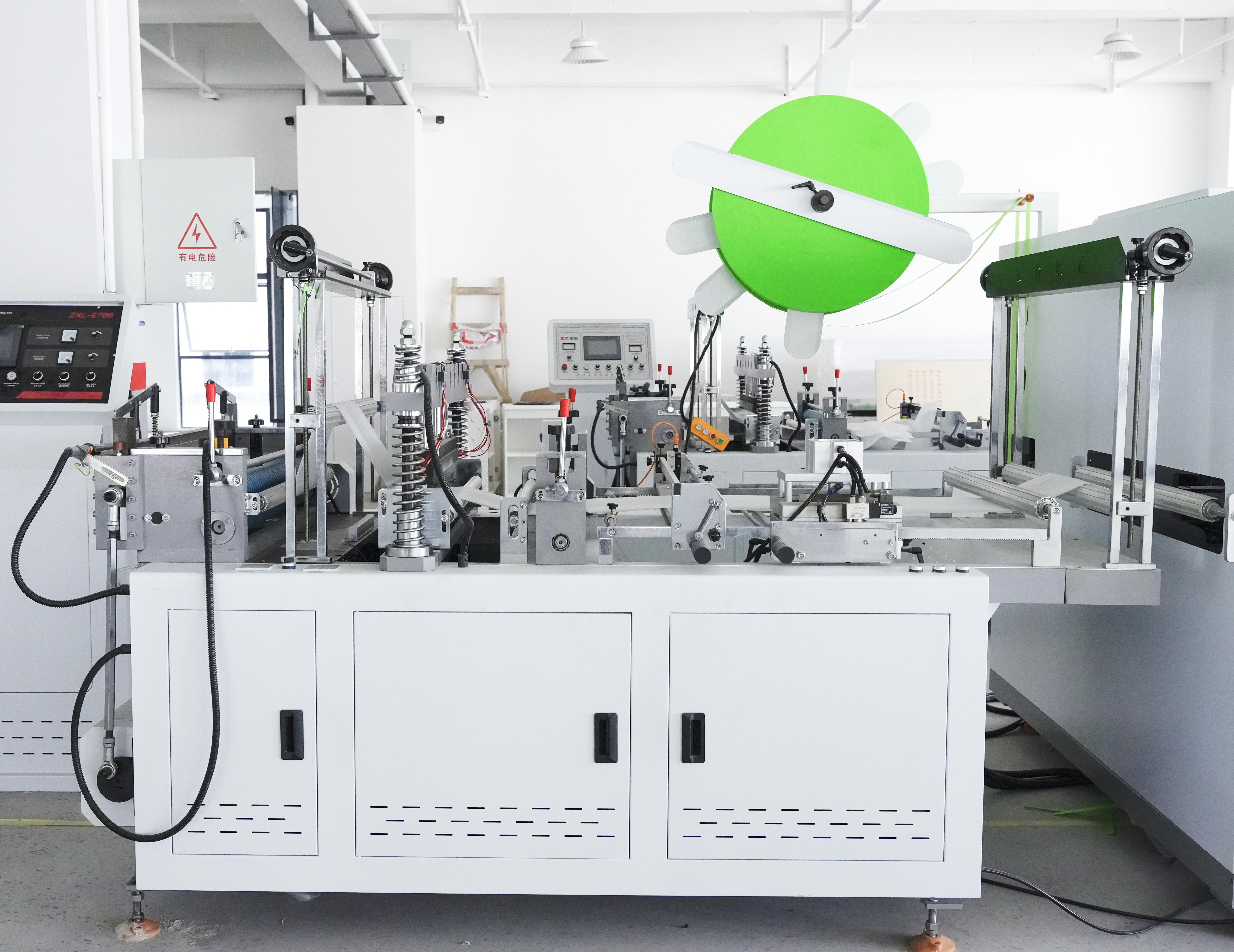
The ZXL-E700 and ZXL-E700Ultra are fully automatic 5-in-1 machines built around a box bag structure with online handle attaching. Both are rated at 40–120 pcs/min on a 500–1300 mm fabric roll, with bag heights of 200–580 mm and bag widths of 100–800 mm. Handle length is adjustable from 380 to 600 mm, and handle material thickness is specified at 50–100 g/m².
The distinction between the two models is material efficiency rather than format. The E700Ultra carries a zero-trim technology that Zhengxin describes as saving approximately 5% of raw material; the E700 does not. Both otherwise share the same envelope, the same 18 kW power rating, the same 12,000 × 2,050 × 1,900 mm footprint and the same 4,000 kg machine weight.
Functionally, this is the platform to look at when the bag list includes a box or 3D bag with a welded handle, or when the catalogue genuinely spans five formats and the buyer does not want to dedicate floor space to a second machine for each one. Zhengxin's published material states the machine can produce over 20 types of bags, including vest bags, drawstring bags, 3D/box-bottom bags and zipper bags, and that the ultrasonic bonding process requires no hot-melt glues or chemical adhesives.
Format 2 — the zero-waste edge platform (ZXL-A700Ultra)
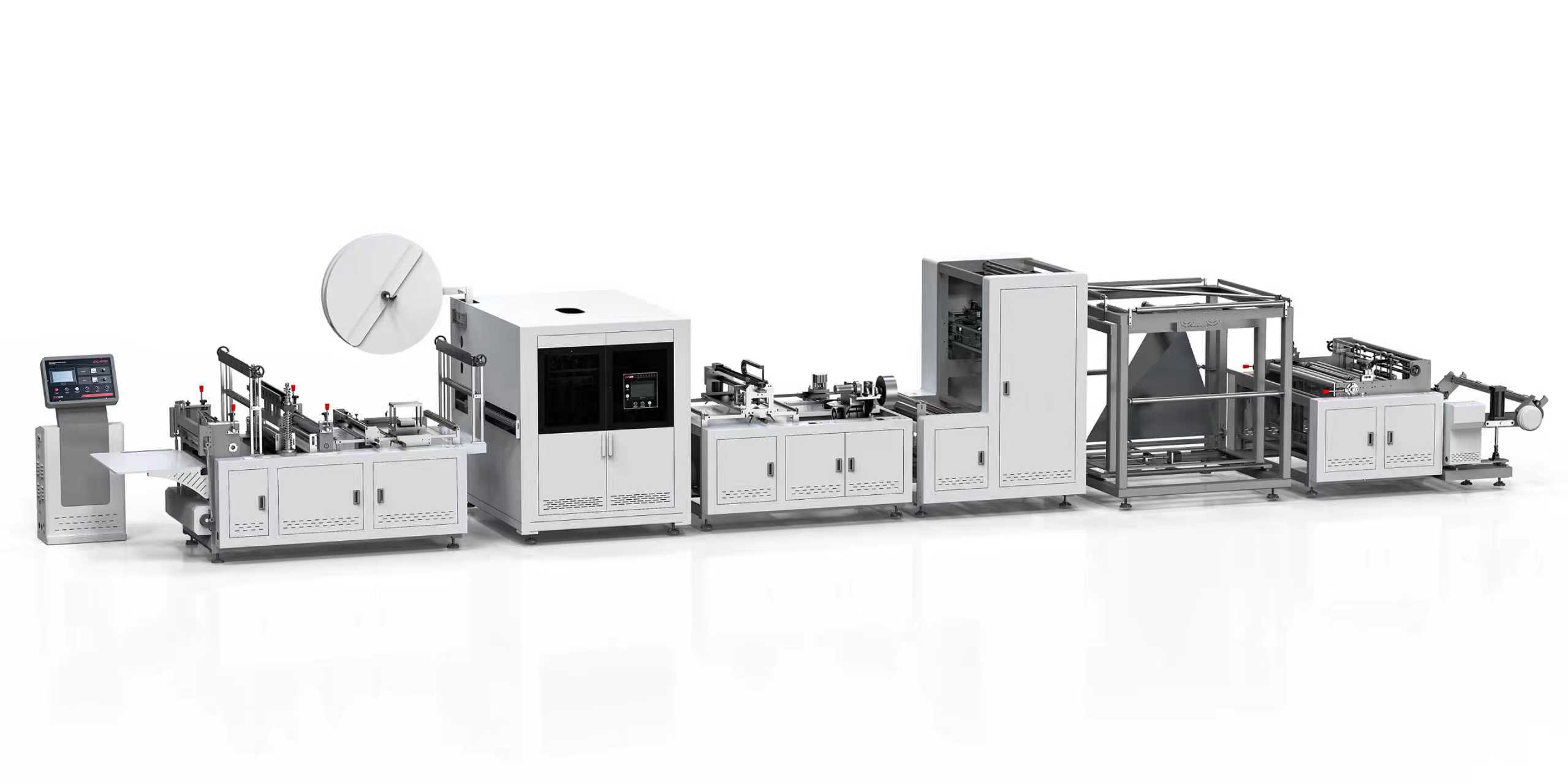
The ZXL-A700Ultra is a zero-waste edge T-shirt and W-cut machine, also categorised as an edge waste-free non woven vest bag machine. It is specified at 40–120 pcs/min, 500–1300 mm roll width, bag widths of 200–400 mm, bag heights of 300–700 mm, material thickness of 30–120 g/m², 15 kW total power and a 2,900 kg machine weight.
The engineering argument for this platform is material: Zhengxin states the zero-waste edge construction saves approximately 5% on raw material procurement cost. That figure is a procurement claim, not a production guarantee — its cash value scales with fabric consumption and fabric price, so the saving is meaningful at volume and marginal at low utilisation.
What this platform does not do is equally important. It is a vest, drawstring and tote platform: the published specification carries no handle-length or handle-material parameters, which is consistent with a machine built around welded vest and tote constructions rather than an online loop-handle unit. Buyers whose bag mix depends on a soft loop handle welded onto a box bag are looking at the 5-in-1 platform, not this one. Buyers whose bag mix is overwhelmingly vest bags and totes in the 200–400 mm width band, running 30–120 g/m² material, will find this the wider material envelope of the two.
Format 3 — the side gusset and online handle platform (ZXL-G700)
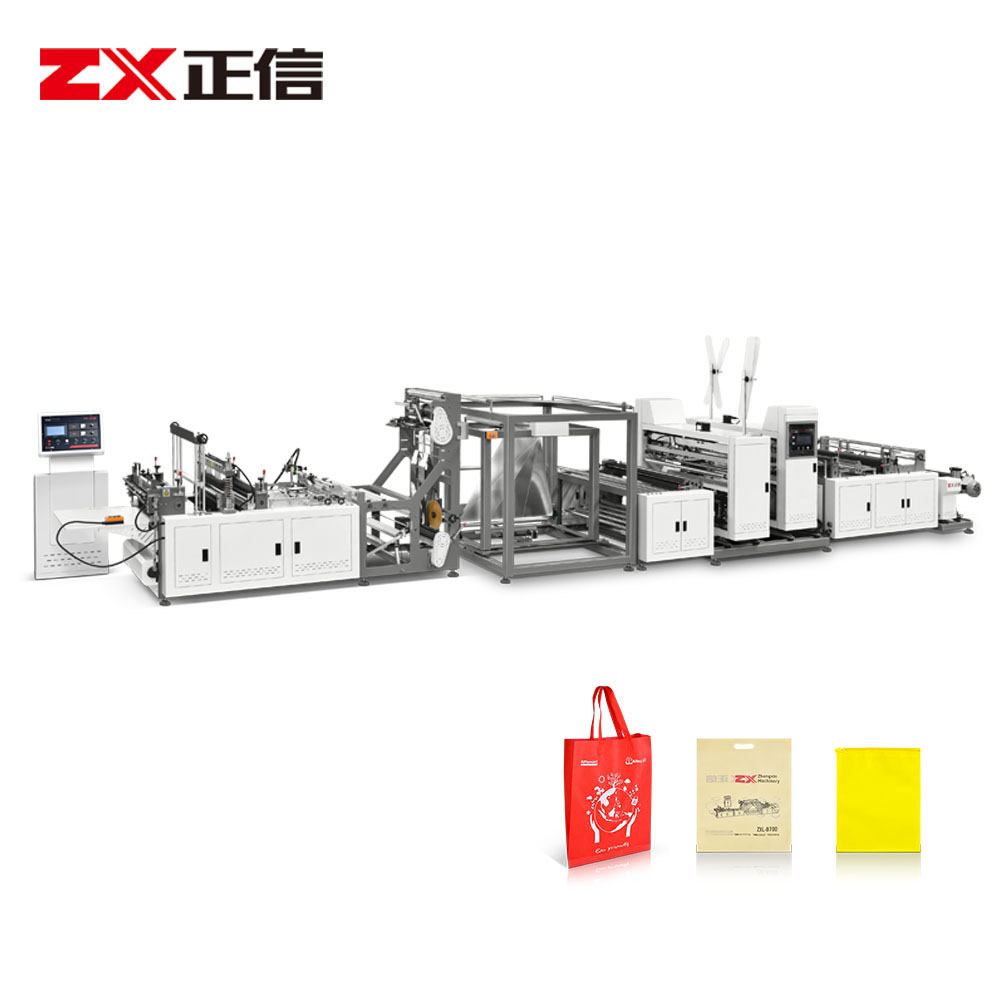
The ZXL-G700 is a fully automatic non woven bag making machine with side gusset and online handle, positioned as a non woven organ bag machine. It runs 60–100 pcs/min on a 500–1150 mm roll, with bag heights of 300–700 mm, bag widths of 200–400 mm, side gusset from 60 to 200 mm, handle length of 380–600 mm, handle material thickness of 50–100 g/m² and body material of 50–100 g/m². Total power is 18 kW, the machine measures 12,000 × 2,050 × 2,100 mm and weighs 4,200 kg.
Its control architecture is stated as a fully automatic production mode built on an LCD touchscreen HMI with automatic computer-controlled edge-guiding, automatic handle heat-sealing and punching, photoelectric tracking, stepper-motor length control, automatic positioning, self-diagnostics and automatic counting. In practice, the gusset forming and the handle punching are the two stations that determine whether an organ bag is saleable — a gusset that is not square or a handle hole that is off-centre is a rejected bag regardless of how fast the machine runs.
Five constraints that eliminate options before price is discussed
- Material thickness. The 5-in-1 platform states 30–100 g/m², the zero-waste platform 30–120 g/m², the side gusset platform 50–100 g/m². A buyer converting 110–120 g/m² fabric is outside two of the three before any other factor is considered.
- Bag width. 100–800 mm on the 5-in-1 platform, 200–400 mm on both the zero-waste and side gusset platforms. Wide shopping bag programmes rarely fit a 400 mm ceiling.
- Handle construction. Online handle attaching with a 380–600 mm handle length is published for the 5-in-1 and side gusset platforms. The zero-waste platform is specified around vest, drawstring and tote bags.
- Gusset requirement. Only the side gusset platform publishes a gusset dimension, at 60–200 mm. If the order book includes organ bags, this constraint alone decides the purchase.
- Operator count and control literacy. Zhengxin specifies 1–2 operators for the 5-in-1 and zero-waste platforms; for the side gusset platform the published documentation describes the automation features and HMI but does not state an operator count, so staffing should be confirmed at quotation rather than assumed from the other two models.
What PLC control, ultrasonic welding and photoelectric tracking actually decide
These three features appear on nearly every quotation in the category, so it is worth separating what each one governs at the machine level.
PLC with touchscreen HMI. The PLC holds the machine's operating parameters and the HMI is the operator's interface to them. On the ZXL-E700 the control architecture is described as PLC control with a touchscreen interface, combined with full-process automation, photoelectric tracking for print registration, stepper-motor length control, automatic counting and alarm functions. The practical consequence is recipe recall: a bag size change becomes a parameter selection rather than a mechanical rebuild, which is what makes multi-format production viable with 1–2 operators.
Ultrasonic welding. Ultrasonic bonding fuses the polypropylene fibres at the interface without hot-melt glue or chemical adhesive, which is why the process is specified for bags where odour and surface scorching are unacceptable. It applies to both the bag body seal and the handle attachment on the 5-in-1 platform.
Photoelectric tracking. This is the print-registration function. On pre-printed roll stock, a sensor detects the registration mark and the control system offsets the cut and seal timing so the printed design lands correctly on the finished bag. It is the difference between converting plain roll stock and converting a customer's branded artwork without manual re-timing.
Application fit: which platform maps to which production scenario
Supermarket and grocery retail. Zhengxin's scenario documentation for a fully automatic shopping bag production line lists a requirement for production speed of 100 pcs/min or above with consistent weld quality, and names the ZXL-E700, ZXL-E700Ultra, ZXL-A700Ultra and ZXL-D700 among the matched equipment. In that context the deciding factor is usually bag width and handle type rather than raw speed, because the retail programme is a fixed bag specification repeated at volume.
Garment and apparel packaging. The garment scenario is documented as a 16-hour double-shift operation with 1–2 operators per machine, matched to the ZXL-A700 and ZXL-A700Ultra platforms. Garment dust covers and suit covers sit naturally in the 200–400 mm width band, which is why the zero-waste platform fits this scenario without conceding envelope.
Promotional and corporate gift bags. This scenario is defined by quick job changeover and print registration accuracy rather than by sustained throughput. It rewards PLC recipe management and photoelectric tracking over maximum rated speed, because the cost of a changeover is downtime, not cycle time.
Organ and gusseted bags. Bakery, bottle and bulky-goods packaging is where the ZXL-G700 sits, and it is the only one of the three that publishes a 60–200 mm side gusset.
Market context: why the format question is being asked more often
Third-party market research places the specialised global non-woven bag making machine market at US$179 million in 2025, with a projection to US$733 million by 2032, and expects a compound annual growth rate of 22.5% from 2026 to 2032, driven substantially by plastic ban policies (LP Information). Dataintelo reports that more than 140 countries had enacted legislation restricting or banning single-use plastic bags as of 2026 — which is the demand-side driver behind converters adding non woven capacity.
Two structural data points matter for this comparison specifically. Dataintelo reports that automatic bag making machines held a 52.4% share of the total product type market in 2025, meaning the semi-automatic tier is already the minority choice in new capacity. And LP Information puts the average price of a non-woven bag making machine at approximately US$29,000 per unit in 2025 — a useful order-of-magnitude reference for buyers building a budget, with the caveat that configuration, printing integration and certification scope move the figure substantially in either direction.
Asia Pacific dominated the bag making machine market with a 43.6% revenue share in 2025 (Dataintelo), which is consistent with the concentration of non woven bag machine manufacturing in Zhejiang. Zhengxin appears in third-party market reporting as one of the named players in the non-woven bag making machine category (Dataintelo / LP Information).
Where these three platforms stop working
A comparison framework that lists only advantages is a sales document. Four boundaries apply here.
- No single platform covers both a wide box bag and a deep side gusset. The 5-in-1 platform covers bag widths to 800 mm but does not publish a gusset dimension; the side gusset platform covers a 60–200 mm gusset but caps bag width at 400 mm. A catalogue that includes both genuinely requires two machines or a different platform.
- The zero-waste platform's width ceiling of 400 mm is a hard limit. The 5% material saving is real within its envelope, but it does not apply to bag programmes the machine cannot produce.
- The 5-in-1 platform's material ceiling of 100 g/m² excludes heavy and some laminated stocks. Buyers converting 120 g/m² or above need to look at the zero-waste platform's 30–120 g/m² range or at the box-bag platforms outside this comparison, which publish 70–150 g/m².
- The side gusset platform carries the narrowest material band at 50–100 g/m². Lightweight 30–40 g/m² stock, common in low-cost disposable programmes, falls outside it.
Certification: what is on the certificate and what to verify
Zhengxin's machines are CE certified under certificate M.2021.206.C70875, issued by UDEM, valid from 24 January 2022 to 23 January 2027 for the EU market. The listed standards are EN ISO 12100:2010, EN 60204-1:2018, EN IEC 61000-6-2:2019, EN IEC 61000-6-4:2019, EN IEC 61000-3-2:2019 and EN 61000-3-3:2013+A1:2019. The certificate's scope covers the ZXL-A, ZXL-B, ZXL-E and ZXL-G series across the 600–1200 model range, among others.
The factory holds ISO 9001 certification under certificate 20225Q21503R2M, issued by QPC against GB/T19001-2016 / ISO9001:2015, issued 26 December 2025 and valid to 12 January 2029, with a scope of production and sales of bag making machine, slitting machine and non woven printing machine.
Two verification steps are worth building into any evaluation: confirm the CE certificate number and expiry directly with the issuing body rather than relying on a PDF, and confirm that the specific model on the quotation — including any Ultra variant — appears in the certificate's related-model list, since certification scope is model-specific.
Future outlook
The direction of travel is towards formats that combine a handle with a structured bag, and towards material efficiency measured at the roll rather than the machine. With 140+ jurisdictions restricting single-use plastic bags, converters are being asked for reusable bags with handles, printed branding and enough shape to act as retail packaging — which is precisely the intersection the 5-in-1 and side gusset platforms occupy. The zero-waste approach addresses the other pressure: as fabric remains one of the largest recurring costs in bag production, a design that removes trim rather than recovering it tends to be re-evaluated favourably at higher volumes.
For buyers, the practical implication is that envelope flexibility is likely to be worth more than marginal speed. A platform that can move between formats when a customer changes a bag design carries a different kind of value than one optimised for a single format at the same rated throughput.
Frequently asked questions
Which of these machines can produce box bags, loop handle bags, drawstring bags and D-cut bags from one platform?
The ZXL-E700 and ZXL-E700Ultra. Zhengxin specifies the 5-in-1 platform as capable of producing over 20 bag types, including vest bags, drawstring bags, 3D/box-bottom bags and zipper bags, with online handle attaching at a handle length of 380–600 mm. Bag width spans 100–800 mm and bag height 200–580 mm across a 500–1300 mm fabric roll, at a rated 40–120 pcs/min.
What material thickness can each platform convert?
The ZXL-E700 and ZXL-E700Ultra are specified at 30–100 g/m², the ZXL-A700Ultra at 30–120 g/m², and the ZXL-G700 at 50–100 g/m². Handle material on the 5-in-1 and side gusset platforms is specified at 50–100 g/m². A buyer converting 120 g/m² fabric is therefore inside the zero-waste platform's range and outside the 5-in-1 platform's published range.
Does the zero-waste edge design on the ZXL-A700Ultra apply to every bag format?
No. The ZXL-A700Ultra is specified as a zero-waste edge T-shirt and W-cut machine for vest, drawstring and tote bags, with a bag width range of 200–400 mm and bag height of 300–700 mm. It publishes no handle-length or handle-attaching parameters, which distinguishes it from the 5-in-1 platform's online handle unit. The approximately 5% raw material saving is a procurement cost claim that scales with fabric consumption and fabric price.
How many operators do these machines need, and how are they controlled?
Zhengxin specifies 1–2 operators for the ZXL-E700, which uses PLC control with a touchscreen interface, photoelectric tracking for print registration, stepper-motor length control, automatic counting and alarm functions. The ZXL-A700Ultra is likewise specified for 1–2 operators with PLC control and a touchscreen interface. For the ZXL-G700, the published documentation describes a fully automatic production mode with an LCD touchscreen HMI, automatic computer-controlled edge-guiding, self-diagnostics and automatic counting, but does not state an operator count.
What certification should a buyer verify before shipping, and does it cover these models?
CE certificate M.2021.206.C70875 (UDEM, valid 24 January 2022 to 23 January 2027) covers the ZXL-A, ZXL-B, ZXL-E and ZXL-G series in the 600–1200 model range, and the factory holds ISO 9001 certificate 20225Q21503R2M issued by QPC against GB/T19001-2016 / ISO9001:2015, valid to 12 January 2029. Buyers should confirm the certificate number and validity with the issuing body and check that the exact model on the quotation — including Ultra variants — is listed in the certificate's related-model scope.
¿Tiene preguntas o necesita más detalles?
Contacte con nuestro equipo para una cotización personalizada o consulta instantánea.
Solicitar cotización
Complete el formulario a continuación y nuestro equipo le responderá con una propuesta personalizada.
Chat directo de WhatsApp
¿Prefiere chatear en tiempo real? Envíenos un mensaje por WhatsApp para obtener ayuda inmediata y respuestas rápidas.
- Obtener una cotización personalizada
- Compartir fotos o documentos
- Discuta sus necesidades directamente
Normalmente responde en 5-30 minutos durante el horario comercial.