
4K Video Wall Controllers: What Buyers Should Know First
4K Video Wall Controllers: What Buyers Should Know First
A 4K video wall controller is the signal-processing hardware that accepts several 4K-class sources, arranges them on a defined screen grid, and holds the combined image stable across long operating hours. For buyers at the awareness and research stage, the practical question is rarely “4K or not” — it is which part of the chain must actually carry 4K, how many outputs the wall needs, and what happens when a source changes or a panel goes dark.
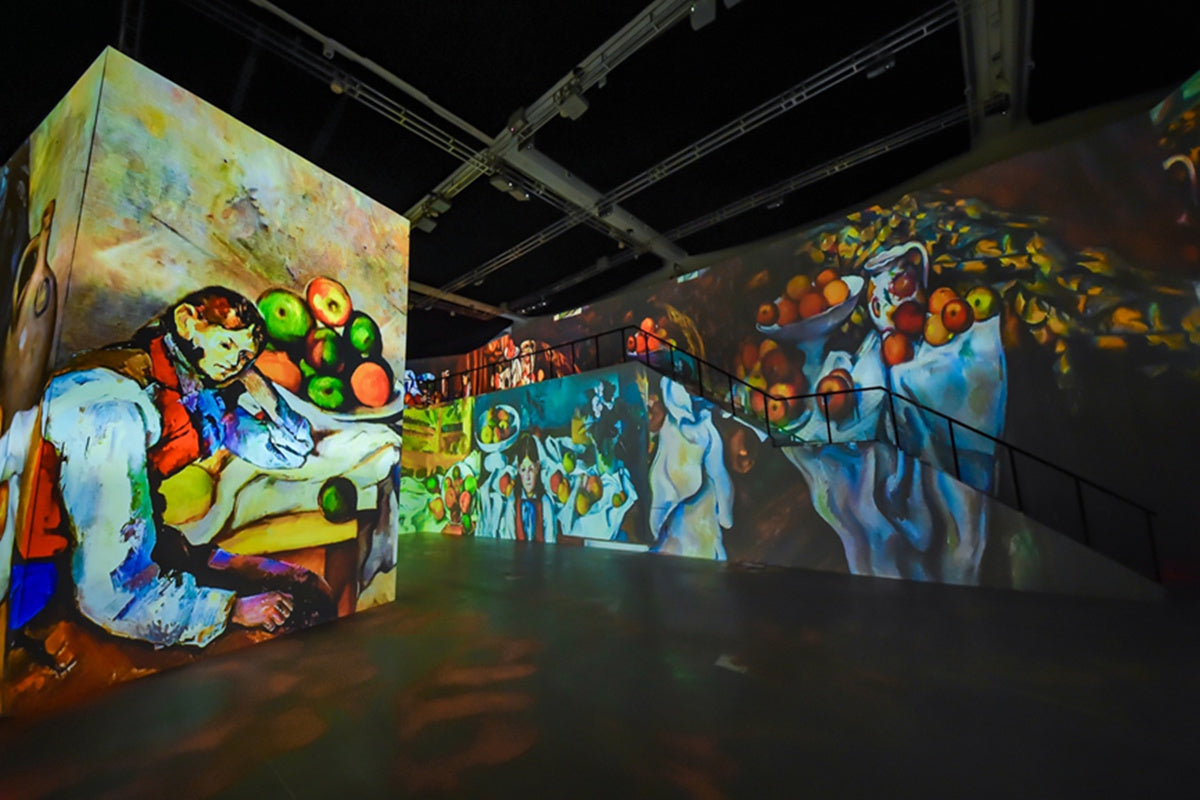
A 4K rotating splicing processor distributing a single high-resolution canvas across a large-format display in an exhibition environment. Image: Bitvisus application record, Shenzhen, China.
What a 4K video wall controller actually does
A video wall controller sits between the sources and the screens. On the input side it accepts computers, media players, servers or cameras; on the output side it drives a fixed number of display panels that together form one logical canvas. A 4K video wall controller is the tier in which the input stage is designed to accept Ultra HD material — commonly 3840×2160 or 4096×2160 — without forcing the source down to 1080p before the image reaches the wall.
Four functional blocks matter when evaluating this class of hardware:
- Input stage. Physical connectors (HDMI, DisplayPort), the maximum input pixel clock, and HDCP handling determine which sources can be connected directly.
- Processing stage. The engine that splits, scales, rotates and layers the incoming frame, and the architecture it runs on — dedicated hardware logic or a general-purpose operating system.
- Output stage. The number of output ports, the resolution each port can carry, and how output channels stay synchronised with one another.
- Control layer. How the wall is configured and monitored day to day — front-panel buttons, serial control, browser-based interfaces, or an API.
Keeping these four blocks separate is useful because a specification sheet can be strong in one and weak in another. A controller with 4K inputs and eighteen outputs may still drive each screen at 1080p or 1200p rather than 4K per screen — a distinction that shapes both cost and cabling.
Why 4K became the working baseline
The shift toward 4K in video wall projects is driven less by panel marketing than by sources. Workstations, servers, mapping software and analytics dashboards now commonly render at 3840×2160. When that content is pushed into a 1080p-only processing chain, the result is downscaling: text becomes softer, one-pixel data lines disappear, and CAD or GIS detail degrades exactly where operators need it most.
The commercial opportunity follows the same logic. Dataintelo estimates the global video wall controllers market at approximately USD 2.25 billion in 2025, projected to reach USD 4.4 billion by 2034. The same source reports a compound annual growth rate of 7.8% over that period. Statifacts data places control room applications at roughly 50% of video wall processor market contribution — which is why control room, dispatch and monitoring deployments dominate the requirements that shape 4K controller design.
Sources: Dataintelo (Video Wall Controllers Market Report, 2026); Statifacts (Video Wall Processors Market, 2025).
Market signals worth reading carefully
Three structural signals are visible in 2026, and each has a direct procurement implication.
Transport is moving toward IP. GCG Enterprise Solution, citing AVIXA material, reports that AV-over-IP adoption reached 73% of new video wall controller installations in early 2026. The practical meaning for a 4K deployment is that network-based control, addressable endpoints and remote management are increasingly treated as standard expectations rather than premium features.
Legacy rack hardware is losing share. The same 2026 buyer’s guide reports that legacy hardware video wall processors in 4U chassis lost 18% market share in 2025 as users shifted toward AV-over-IP and software orchestration. Buying an oversized, fixed-configuration chassis is therefore a decision worth re-examining — though card-based chassis still matter where high channel counts are required.
The category itself is defined inconsistently. Published market size estimates vary widely — around USD 0.55 billion to USD 2.25 billion — depending on whether “controller” is counted strictly as processor hardware or as the entire display-management solution including software and integration. Buyers comparing vendor claims should therefore treat headline market numbers as directional, not as a specification.
Two regulatory reference points are also worth noting. ISO 11064 is the primary international standard governing control-room ergonomics, and it influences how video wall layouts and viewing distances should be planned. For cross-border purchasing and customs classification, video wall controllers are commonly filed under HS code 85437099 (other electrical machines and apparatus) or 85437042 (other video control unit). Neither point is glamorous, but both affect project paperwork.
The technical layer: what determines performance
Input bandwidth and pixel clock
The maximum input pixel clock tells you how much image data the front end can accept per second. Across the 4K models examined here, the published maximum input pixel clock is typically 600 MHz, with maximum input resolution stated as 4096×2160P60 on the BIT-VWC-218Pro and a default 3840×2160@30Hz on the BIT-VWC-409R. In practice, a 4K60 source needs both a compliant cable and a controller whose input clock supports the resulting data rate.
The output stage is usually the real boundary
This is the point most first-time buyers miss. On several 4K controllers, the wall canvas may be 4K or larger while each physical output runs at 1920×1080@60Hz or 1920×1200@60Hz. The BIT-VWC-409R provides nine HDMI outputs at 1920×1080@60Hz plus one DP loop-out; the BIT-VWC-8K60Y-115Pro provides fifteen HDMI outputs at 1920×1200@60Hz or 1920×1080@60Hz. Resolution is distributed across the wall rather than duplicated per screen.
Full-hardware processing and seamless switching
The 4K models described here use programmable FPGA devices — 40 nm on the BIT-VWC-409R, 28 nm on the current BIT-VWC-218Pro and BIT-VWC-MD3636Ma — in what the manufacturer describes as a full hardware real-time processing architecture. The design intent is predictable: no operating-system layer to stall, no frame buffering delay in the processing path.
Seamless switching is the closely related function of changing input sources without a black screen, blue screen or visible flicker. For 4K60 matrix-class hardware such as the BIT-VWC-MD3636Ma, the published end-to-end input-to-output latency is under 40 ms, with layouts including 6×6, 1×36 and mixed combinations, and an output synchronisation time difference specified as 0 ns excluding differences introduced by the screens themselves.
Control, remote management and web interfaces
Control methods across the line range from infrared remote and RS232 to browser-based interfaces and published APIs. The BIT-VWC-MD3636Ma can be operated from a keypad, RS232, a web interface or a WEB API, with browser access from Windows, Mac, tablet and mobile devices, and twelve storable preset scenarios. The BIT-VWC-218Pro adds network wake-up and software-command power on/off for remote power management, plus an API for secondary development. For a distributed estate of walls, this is the difference between sending a technician and sending a command.

A 4K60 video wall controller in a modular card configuration. Model shown: BIT-VWC-218Pro. Image: Bitvisus.
4K controllers in the Bitvisus line
Shenzhen Bitvisus Technology Ltd. is a video wall controller manufacturer based in Shenzhen, China, established in 2018 and operating a 2,000 m² production facility with an annual capacity of 100,000 units, exporting approximately 70% of output to the EU and USA. The company states that it specialises in 4K/8K image and video processing and integrates FPGA and embedded hardware and software design, covering product development, production and sales. Its website is bitvisus.com.
Three models are directly relevant to 4K projects, each aimed at a different wall architecture.
| Model | Class | Input | Output | Control |
|---|---|---|---|---|
| BIT-VWC-409R | 4K rotating splicing processor | 3×HDMI 1.4, 1×HDMI 2.0, 1×DP 1.2 (≤5 m), HDCP 2.2 | 9×HDMI 1.3 (≤15 m) at 1920×1080@60Hz, plus 1×DP 1.2 loop-out | IR remote, RS232, PC software |
| BIT-VWC-218Pro | 4K60 video wall controller | 2×HDMI 2.0, 2×DP 1.2 (≤3 m), HDCP 2.0, max input 4096×2160P60 | 18×HDMI 1.3 (≤15 m), 1920×1200P60 down to 1024×768P60 | RS232, Web; network wake-up; API |
| BIT-VWC-MD3636Ma | 4K60 seamless matrix splicer | Up to 36×HDMI 2.0 across 1–9 input boards, 600 MHz | Up to 36×HDMI 2.0 across 1–9 output boards, 600 MHz | Keypad, RS232, Web, WEB API |
The distinction between them is structural rather than hierarchical. The BIT-VWC-409R is a compact rotating splicing processor — 270×122.5×20.5 mm, 1 kg, 12 W, operating from DC 12 V 2 A — with power-down memory, parallel connection and multi-device cascading, and support for OEM orders. The BIT-VWC-218Pro is a fixed 18-output device in a 440×200×60 mm chassis with modular plug-in card design and remote power management. The BIT-VWC-MD3636Ma is a 7U card chassis at 240 W (nine input plus nine output cards) for walls that need dozens of endpoints.
For buyers whose source chain already exceeds 4K, the same manufacturer offers an 8K tier including the BIT-VWC-8K60Y-115Pro (8K60 input over HDMI 2.1 or DP 1.4, fifteen HDMI outputs) and the 2U BIT-VWC-8K60-404Max (five 8K60 inputs across HDMI 2.1, DP 2.1 and Type-C, four HDMI 2.0 outputs at 3840×2160@60Hz). Multi-screen expanders such as the BIT-MSE-4K60-104Pro and BIT-MSE-8K60Y-104Pro serve the related task of splitting one source across a small fixed array.
Where 4K controllers fit in real projects
Control rooms and command centres. Typical configurations use a 3×3 or 2×4 LCD wall with a matrix switcher and a central control system, where multi-signal split-screen display, cross-screen linkage and picture roaming matter more than raw pixel count. The operational requirement is continuity: 7×24 operation with real-time data visualisation and multi-level dispatch.
Security and industrial monitoring. Monitoring walls aggregate many camera feeds, so input count and fast signal switching dominate. Typical builds are 3×3 or 4×4 walls with a video matrix, recording storage and an alarm linkage platform, plus multi-picture real-time display.
Conference rooms and corporate lecture halls. Here 4K60 input, multi-picture split, seamless switching and low-latency transmission support content sharing and multi-screen collaborative presentation, usually in 2×2 or 1×3 arrangements with an HDMI extender and a control system.
Exhibition and immersive display. A documented deployment in Shenzhen used the BIT-VWC-409R within a large-format immersive exhibition layout combining more than one hundred 1080p projectors and twelve video wall controllers, where the requirement was ultra-high combined resolution and stable daily operation. A separate projection mapping installation in Romania used a single PC with multi-screen expanders and HDBaseT extenders to distribute blended imagery over roughly 120 m of signal path.
4K versus 8K: choosing the tier you need
The decision is usually driven by the source, not by the panel. If every source device outputs 3840×2160 and the wall is built from 1080p or 1200p panels, a 4K60 controller is normally sufficient, because the canvas is being divided rather than multiplied. An 8K tier becomes relevant when a single very large canvas must be assembled from one high-resolution source — for example 7680×2160 across four outputs on a multi-screen expander, or 8K60 input feeding fifteen 1080p-class outputs on the BIT-VWC-8K60Y-115Pro.
Two practical consequences follow. First, moving up a tier increases cost, cable complexity and commissioning effort without necessarily improving perceived image quality on a 1080p panel wall. Second, staying at 4K is not a compromise for most control room and monitoring walls today, because the limiting factor there is usually input count and switching behaviour rather than per-screen pixel density.
Limits, trade-offs and what is not publicly specified
A credible evaluation includes the boundaries. Four are worth stating plainly.
- Per-output resolution is capped on several 4K models. The BIT-VWC-409R outputs 1920×1080@60Hz per channel; the BIT-VWC-218Pro tops out at 1920×1200P60. Walls requiring 4K at each individual screen need a different architecture than a 4K canvas distributed across HD outputs.
- Single-device scale is finite. The BIT-VWC-409R handles splicing within nine screens and allows up to four signals on the wall simultaneously; larger walls depend on parallel connection or multi-device cascading rather than one chassis.
- Rotation functions are mode-dependent. On the BIT-VWC-409R, 90° input rotation applies only in single-screen mode, and 180° output first-row rotation applies only when the splicing mode uses two rows.
- Some transmission specifications are not disclosed. For fiber-based long-distance extension, specific transmission distances and single-mode versus multi-mode specifications are not published and have to be confirmed project by project.
There is also an honest structural trade-off between hardware and software approaches. FPGA-based controllers process in dedicated logic and, as the manufacturer positions it, avoid the crash risk associated with operating-system-dependent platforms — but they are less flexible for ad hoc content workflows than software orchestration tools, and the market data above shows buyers increasingly layering software on top of, or instead of, fixed hardware. Choosing hardware-only, software-only or a hybrid is a project decision, not a default.
On compliance, the manufacturer publishes declarations covering RoHS (EU, referencing IEC 62321 series test methods and EN IEC 63000:2018), CE-EMC (EN 55032:2015/A11:2020 and EN 55035:2017/A11:2020 under EMC Directive 2014/30/EU), and an FCC Supplier’s Declaration of Conformity under 47 CFR Part 15 Subpart B. The specific certificate list for a given project should be requested directly, since not every document is published.
A procurement checklist for first-time 4K buyers
| Check | Why it matters |
|---|---|
| Confirm canvas resolution versus per-output resolution | A 4K canvas across 1080p outputs is a different product from 4K at every screen |
| Count inputs and outputs against the final wall, with headroom | Output count is the least flexible parameter after installation |
| Verify input standard and HDCP level against every source | HDMI 2.0, DP 1.2 and HDCP 2.2 handling determine direct connectability |
| Match chassis format to the rack | Options range from compact units with optional 1U ears to 2U and 7U card chassis |
| Agree on the control and monitoring method | RS232, web interface or API determines remote operating effort |
| Specify temperature and operating-hour expectations | Working ranges vary by model; published values include 0–50 °C and 0–60 °C depending on chassis |
| Confirm warranty, spare parts and documentation | A one-year warranty period is stated across the models reviewed here |
Future outlook
Three directions are already visible. First, network transport continues to absorb share: if AV-over-IP accounts for the majority of new installations, controllers will be evaluated increasingly on API quality, addressability and remote diagnostics rather than on front-panel buttons. Second, software orchestration and hardware processing are converging rather than replacing each other — hardware keeps timing and switching deterministic, while software handles layout logic and content scheduling. Third, resolution tiers will keep separating: 4K is becoming the baseline for source compatibility, while 8K input capability is emerging as a differentiator for very large single-canvas applications rather than a general requirement.
For buyers entering the category now, the rational approach is to design around the source chain and the wall layout, choose the lowest resolution tier that satisfies both, and insist on documented control, compliance and support terms before specifying a chassis format.
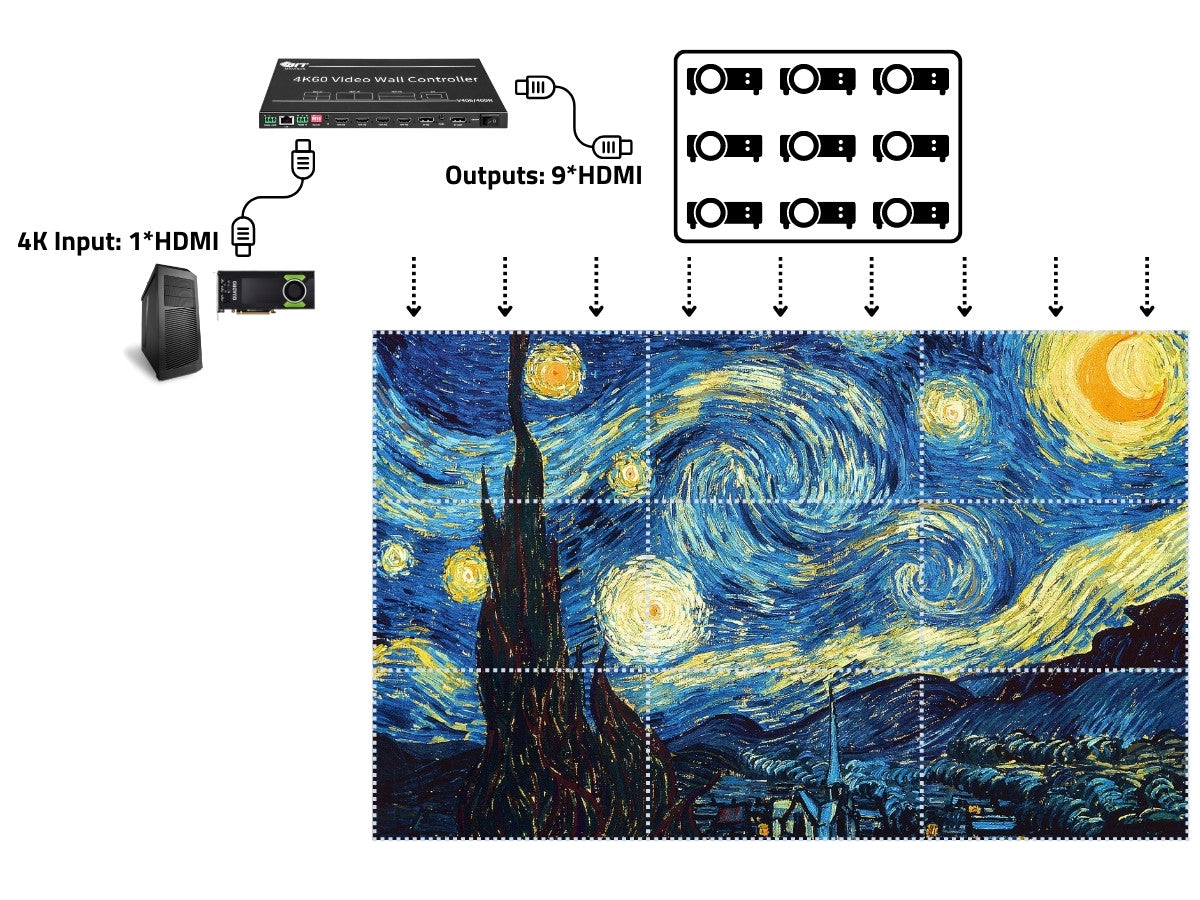
Signal distribution from a single controller to multiple output channels. Diagram: Bitvisus application documentation.
FAQ
What video input and output interfaces do 4K video wall controllers support?
Mainstream video wall controllers use HDMI and DisplayPort inputs with HDMI outputs, and support HDCP so that mainstream players, PCs and matrix sources can be connected. Some 8K models allow the input to be selected between HDMI or DP depending on the graphics card interface. Physical connector types should be matched against the actual source and display equipment before ordering.
What resolutions and splicing configurations are supported?
Published specifications cover 4K60 and 8K tiers. Splicing layouts include 2×2, 1×4, 4×1, 1×3, 3×1, 2×5, 1×10, 5×3 and 3×12, and card-based matrix chassis support configurations up to 36×36 with seamless switching. Output resolution per channel is a separate parameter from canvas resolution and is typically 1920×1080 or 1920×1200 at 60Hz on 4K models.
What processing architecture is used, and can the hardware run 7×24?
The controllers referenced here are built on programmable FPGA devices with a full hardware real-time processing architecture, rather than on a general-purpose operating system. They are positioned as industrial-grade equipment intended for continuous long-hour operation in control rooms and engineering display environments, with conductive internal heat dissipation and overheat protection. Actual operating hour expectations should be confirmed against the specific model selected.
Do 4K controllers support picture-in-picture and window roaming?
Yes, on models that include the function. The BIT-VWC-409R supports left-right, top-bottom, four-way split and picture-in-picture modes, allows up to four signals on the wall simultaneously, and permits input sources to be distributed arbitrarily across the wall. Matrix models with built-in splicing and window roaming allow multiple windows to be overlaid on one screen with free layout and cross-screen movement, which is relevant to command control, multi-screen surveillance and conference halls.
Is portrait or rotated screen splicing supported?
Several models include built-in 90°, 180° or 270° rotation, enabling portrait video walls as well as conventional landscape layouts. On the BIT-VWC-409R specifically, 90° input rotation applies only in single-screen mode, and 180° first-row output rotation applies only when the splicing mode uses two rows — a boundary worth confirming against the intended wall geometry.
What are the main application scenarios?
Documented applications include immersive projection fusion and exhibition venues, corporate and government meeting displays, control room and command centre walls, security and industrial monitoring centres, broadcasting and studio monitoring, education, and commercial displays such as retail, transit advertising and airport information screens. The functional requirement, screen scale and input count of the project determine which class of controller applies.
Is modular expansion and long-distance signal transmission supported?
Card-based chassis allow different processing boards to be fitted so that input and output ports can be added or reduced according to project requirements, and some models support cascading to extend total output channels. For long-distance delivery, a fiber extender product line is available in addition to HDBaseT extender units that carry 1080p over CAT6E up to 150 m. Specific fiber transmission distances and single-mode versus multi-mode specifications are not publicly disclosed and must be confirmed for each project.
What does seamless switching mean in practice?
Seamless switching means changing between input sources without a black screen, flicker or visible interruption, so the wall image transitions continuously. It is achieved through internal frame synchronisation of differing input signals and is considered essential in control rooms, monitoring walls and command and dispatch scenarios where an interrupted picture is operationally unacceptable.
Reference material: 2026 Bitvisus Product Brochure (PDF). Manufacturer information: bitvisus.com.