
4K Capture Card Scenario Fit for Show-Style and Talent Show Streaming
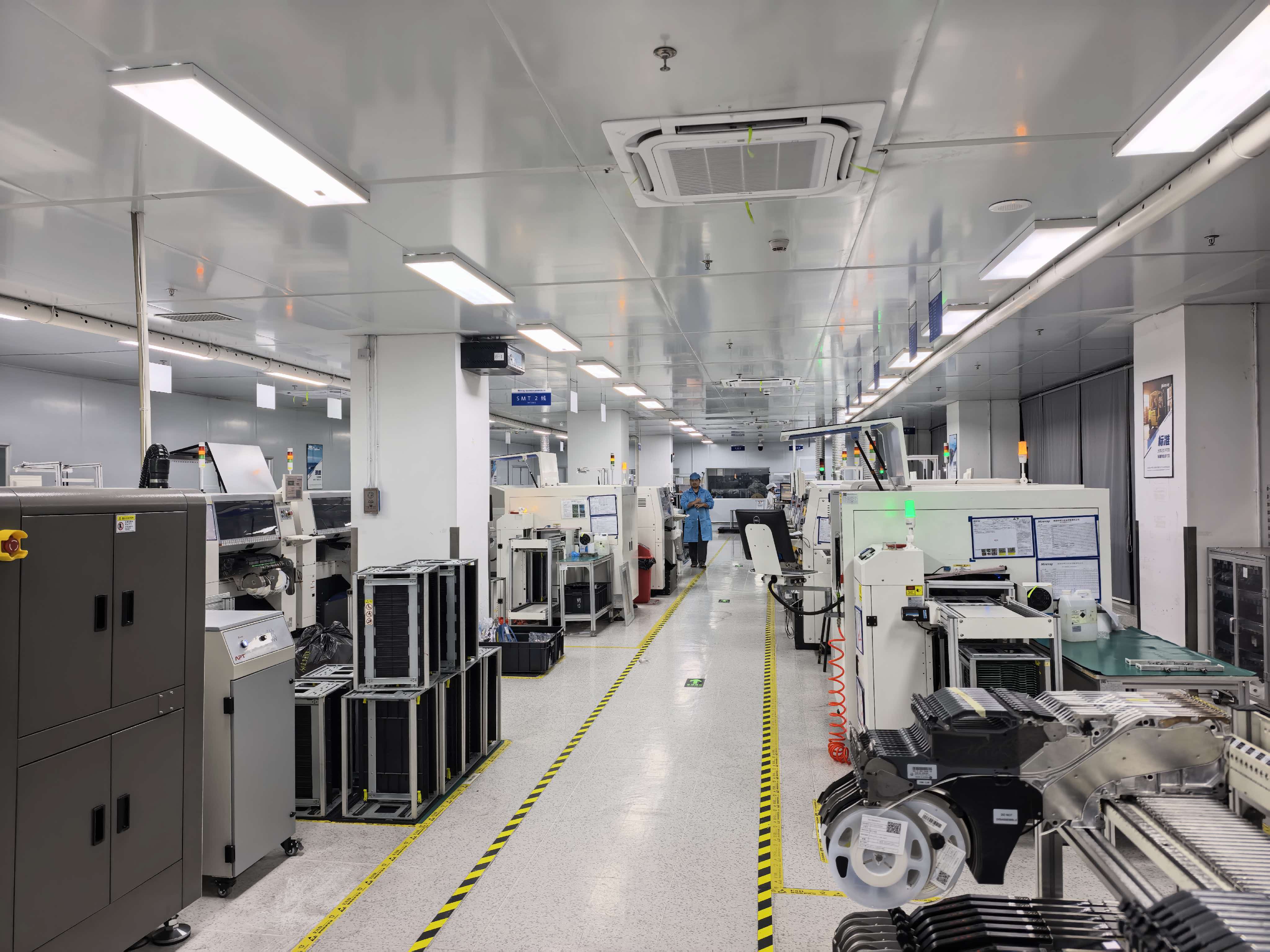
Capture hardware for performance-led streaming is manufactured on the same production lines as the cameras, converters and switchers that sit around it. Image: TCHD Video.
Talent show streaming and show-style live production are limited by crew size more often than by ambition. A two-person team, two cameras and one host microphone can deliver a broadcast-quality stream — provided the signal path matches the format the show actually uses. The question is not whether 4K capture is possible, but whether a USB 4K capture card such as the TCHD Video TC-UB620 fits the way the show is produced, or whether the format has already crossed into live stream switcher territory.
Short answer: a USB 4K capture card fits show-style and talent show streaming when the format depends on continuous framing, one or two cameras, a host microphone and software-driven graphics, and when a computer is already part of the signal chain. A live stream switcher fits better when the format depends on hardware multi-camera cutting, tally and hardware keying, and when the program must continue running without a computer in the path.
What Scenario Fit Measures in a Live Show Format
Scenario fit is a device-versus-workflow question, not a resolution question. In performance-led streaming formats it is decided by five variables, and each of them points toward either a capture device or a switching surface:
- Camera count and framing logic. Are cameras cut live between angles, or framed continuously and left alone for long stretches of the performance?
- Cutting cadence. How often does the program change source per minute — twice, or twenty times?
- Audio sources. One host microphone and a backing track behave very differently from eight wireless microphones with monitor sends and foldback.
- Crew size and operator attention. Who adjusts audio, graphics, captions and platform output while the performance is running?
- Computer dependency. Many show-style streams already run graphics, captions and multi-platform output from a laptop, which changes the marginal cost of adding a capture device.
Talent show and show-style streams characteristically score low on camera count and cutting cadence, and moderate to high on audio and graphics complexity. That profile is the one USB capture cards were designed around, which is why the same device class that dominates console and PC capture also fits stage performance.
The Production Pattern Behind Talent Show and Show-Style Streams
A talent show stream typically has one performance area, one or two cameras on fixed or lightly operated positions, a host or judges microphone, and program audio that arrives either from the venue audio desk or from a playback laptop. The visual variety comes from the performance itself — choreography, lighting, costume, expression — and from graphics: lower thirds, score cards, sponsor boards, audience comment overlays. Cutting between four cameras every few seconds is not what makes the show watchable. Framing discipline, lip-sync accuracy and audio balance are.
Because the cutting requirement is low, the operator's real workload sits in software: graphics, captions, chat moderation and simultaneous platform output. That is where a capture card, rather than a switcher, reduces cost and setup time. The camera feed enters the streaming computer as a standard video source, and every production function above the signal path stays in software the crew already knows.
The reverse is equally true. A switcher bought for a format that cuts twice a minute becomes idle hardware with a control surface nobody operates, while a capture card bought for a format that genuinely needs four-camera cutting will be asked to do a job it was not designed for. Scenario fit is decided before purchase, not during the show.
TC-UB620 Capability Fit for Show-Style and Talent Show Streaming
TC-UB620 is a USB 4K capture card from TCHD Video (TCHD Digital Video Technology Development (Beijing) Ltd.), a Beijing-based video hardware manufacturer established in 2005 whose product lines cover live streaming cameras, video capture cards, video converters, video encoders and video switchers.
Its documented capability set maps onto four requirements that show-style streams raise repeatedly.
| TC-UB620 capability | What it changes in a show-style or talent show stream |
|---|---|
| 4K60 capture | Preserves motion and stage-light detail at the resolution viewers judge performance footage on. Dance sequences, quick costume changes and lighting transitions are the shots that expose a lower-fidelity capture path. |
| HDMI 2.1 pass-through | Lets the incoming camera signal continue to a local confidence monitor or stage display while the same signal is captured, so the operator watches the actual camera output rather than only the encoding software preview. |
| 3.5 mm microphone input | Brings a host or judges microphone into the same device as the camera feed, removing an entry-level mixer from the signal chain for single-microphone formats. |
| HDMI audio mixing | Combines the microphone signal with audio already embedded in the HDMI feed, so a backing track arriving through HDMI and a live host microphone leave the device as one coherent program mix. |
TCHD Video positions the TC-UB620 for gaming, e-commerce, healthcare, education, corporate and content creation applications. Talent show and show-style streaming sit at the intersection of the content creation and corporate event categories, which is why the same card appears in a stage final and in a product showcase.
Why USB Capture Cards Exist at All: Bandwidth, Drivers and Host Software
The reason 4K capture is handled differently from raw signal routing is bandwidth. An uncompressed 4K 60 Hz RGB 24-bit stream requires approximately 11.94 Gbps — well beyond the 5 Gbps limit of USB 3.0 (purplelec, PCIe vs. USB 3.0: The Professional 4K Video Capture Card Performance Guide). Capture cards therefore process the signal before it reaches the host, which is why the card's internal pipeline, and not the port label alone, determines what a 4K60 claim actually delivers on a live show.
The second reason is software independence. Under the UVC (USB Video Class) standard, capture cards can function as plug-and-play video sources without proprietary drivers (Elgato, Capture Card Acronyms: What They Mean and Why They Matter). For a crew that swaps laptops between venues, that matters: the card presents itself to the operating system as a camera, and any production software that accepts a camera input can use it.
The practical consequence for scenario fit is that once the card is driver-free, the production's capability ceiling is set by software, not by hardware. Scene switching, overlays, multi-platform output and recording are software decisions; the card's job is to deliver a clean, correctly timed feed with audio attached.
This is also why two capture cards with identical headline specifications can behave differently in a live show. Buyers should verify UVC and UAC support, the required host software, and the actual capture pipeline for the model in hand rather than relying on the resolution label.
Application Fit Across the Industries TC-UB620 Targets
Gaming and esports show matches
Console and PC capture is where exhibition matches and sponsor showcases live. 4K60 capture plus microphone input covers the commentator-and-game-audio mix, and pass-through keeps a player display or audience screen fed while the stream runs.
E-commerce show-style live selling
Presenter-led live selling borrows directly from talent show production: a host performing to camera, a program feed, product close-ups and a backing audio bed. Where the format is presenter-led rather than cut between a studio gallery, a USB capture card keeps the signal path short and the selling graphics stay in the streaming software where they are edited.
Healthcare-adjacent streaming
In healthcare the card's role is signal handling, not clinical function: remote teaching sessions, clinician briefings and telemedicine-style consultations need a stable video and audio path into a conferencing platform. Regulated clinical deployments should confirm the certification status of the specific model independently; a general-purpose capture card is not automatically a medical device.
Education and campus production
Campus talent competitions, recitals and lecture-theatre performances are classic low-cutting, high-audio-variability formats. The card brings the camera into the same machine that runs the streaming platform, which matters for schools without a dedicated control room.
Corporate showcase and town-hall events
Corporate product launches and internal showcases follow the shape of a small stage show: one presenter, one stage, graphics, and a program feed that must reach one or several platforms. HDMI pass-through keeps the room display working while the stream runs.
Content creation
Creator-led show formats — interview programs, performance segments, reaction shows — are the highest-volume show-style category. A card with microphone input and HDMI audio mixing lets a solo creator handle a guest microphone and program audio without buying a mixer first.
Where a USB 4K Capture Card Fits Better Than a Live Stream Switcher
- The show is framed, not cut. Continuous shots with occasional changes do not need a hardware switching surface or a dedicated operator for transitions.
- One or two cameras. A single program feed into the computer covers the format, and the camera positions change only between segments.
- Audio is one microphone plus program audio. A 3.5 mm microphone input with HDMI audio mixing covers that case; a multi-microphone panel with monitor sends does not.
- The computer is already running the show. Graphics, captions, chat and multi-platform output already live in software, so adding a switcher adds a second control surface without adding an output.
- Crew is one to three people. A capture card leaves operation to the software the crew already uses, instead of splitting attention between software and a hardware panel.
- Budget is device-level and repeatable. Cost moves toward software that is often already licensed, and the same card can be redeployed across events and locations.
Scenario Decision Table: USB 4K Capture Card vs Live Stream Switcher
| Production requirement | USB 4K capture card (TC-UB620 class) | Live stream switcher |
|---|---|---|
| Multi-camera cutting | Captures the program feed routed to it; cutting happens upstream or in software | Performs multi-camera cutting in hardware |
| Typical show format | Continuous framing with occasional cuts; host and performance shows | Formats built on frequent cuts across several locked-off cameras |
| Audio handling | 3.5 mm microphone input plus HDMI audio mixing covers host mic and program audio | Multiple audio inputs with monitor sends at the control surface |
| Computer dependency | Requires a host computer running capture and streaming software | Can operate without a computer in the signal path |
| Monitoring | HDMI 2.1 pass-through to a local display or stage screen | Hardware multiview and tally on the control surface |
| Failure mode | Host software or computer failure stops the program feed | Single hardware point of failure, with no host dependency |
| Crew requirement | One to three people, operating software they already know | Typically requires an operator at the switching surface during the show |
| Cost structure | Generally lower device cost, greater reliance on existing software | Generally higher device cost, less reliance on host software |
Where the Capture Card Approach Reaches Its Limit
- It depends on a host computer. If the machine or its software fails, the program feed stops. A switcher can continue to output without a computer in the path.
- It does not add camera inputs. A capture card handles the feed routed to it. A show that must cut between four cameras needs either a switcher upstream or one capture device per camera with software switching.
- Hardware tally, hardware keying and hardware multiview are switcher-class functions. Software equivalents exist, but they consume encoder capacity and host resources during the show.
- It is not a multi-microphone audio console. A single 3.5 mm microphone input plus HDMI audio mixing covers host-plus-program audio. Productions with several wireless microphones, separate monitor sends and live foldback still need external audio hardware.
- Pass-through is a routing and monitoring convenience, not a redundancy path. If a show requires automatic failover between two signal paths, that must be engineered separately.
- Compliance evidence is model-specific. Buyers should confirm the certification coverage attached to the exact model being purchased, not to the product family in general.
Market Signals Behind the Scenario Shift
The global capture card market was valued at USD 1.31 billion in 2024 and is projected to reach USD 3.37 billion by 2033, a 12.4% CAGR over the 2024–2033 forecast period (Dataintelo, Capture Card Market Research Report 2033). Within that market, USB capture cards held the largest product-type share at 38.4% in 2025 (Dataintelo, Video Capture Card Market Research Report 2034). That matters for scenario planning: the device class that fits show-style streaming is also the volume category, so software support, accessories and replacement units form around it rather than around niche interfaces.
Application mix tells a similar story. Gaming led the video capture card market with a 31.2% share of total revenue in 2025, while medical imaging and industrial applications together accounted for 19.4% of revenue with a segment CAGR of 11.8% through 2034 (Dataintelo). Show-style and talent show streaming sit inside neither headline segment — they belong to content creation and corporate event production — which is why the scenario is discussed less than gaming while using the same hardware.
On the supply side, Elgato (Corsair Gaming) and AVerMedia Technologies led the competitive landscape in 2025 (Dataintelo). For buyers, the relevant consequence is compatibility rather than ranking: production software and capture pipelines are shaped by the dominant platforms, and a driver-free UVC device reduces that dependency.
For distributors building show-style streaming bundles, trade classification is the practical starting point. TCHD products are classified under HS Code 8471.80 (automatic data processing units) and 8525.80 (television and digital cameras) in import shipment records (Zauba).
A Verification Checklist for Show-Style Streaming Buyers
- Confirm the capture resolution and frame rate you need against the actual HDMI output of your cameras, not against the marketing headline.
- Confirm HDMI 2.1 pass-through if the room needs an independent confidence monitor or stage display.
- Confirm how the microphone input and HDMI audio are mixed, and how that mix is exposed to the streaming software.
- Confirm UVC and UAC conformance for driver-free deployment across the laptops the crew actually uses.
- Confirm the host computer can sustain simultaneous capture, graphics and multi-platform encoding during a full show.
- Confirm the compliance evidence attached to the exact model, not the product family.
- Confirm the supplier's production and export capability, since event-driven buyers often need replacement units quickly.
As an example of what documented evidence looks like, TCHD Video's HDMI capture card series holds CE EMC attestation LCSA07075157E, issued by LCS Testing Laboratory for the TC-400N4 HDMI series capture card against EN 55032:2015/A1:2020 and EN 55035:2017/A11:2020 for the EU market, with an issue date of 16 July 2025. The company's management systems hold ISO 9001:2015 (064-24-Q-0675-R1-S), ISO 14001:2015 (064-24-E-0676-R1-S) and ISO 45001:2018 (064-24-S-0677-R1-S) certificates from Beijing Standard Certification Centre, issued 8 March 2024 and valid through 7 March 2027, scoped to the sales of digital audio and video products and related technical services.
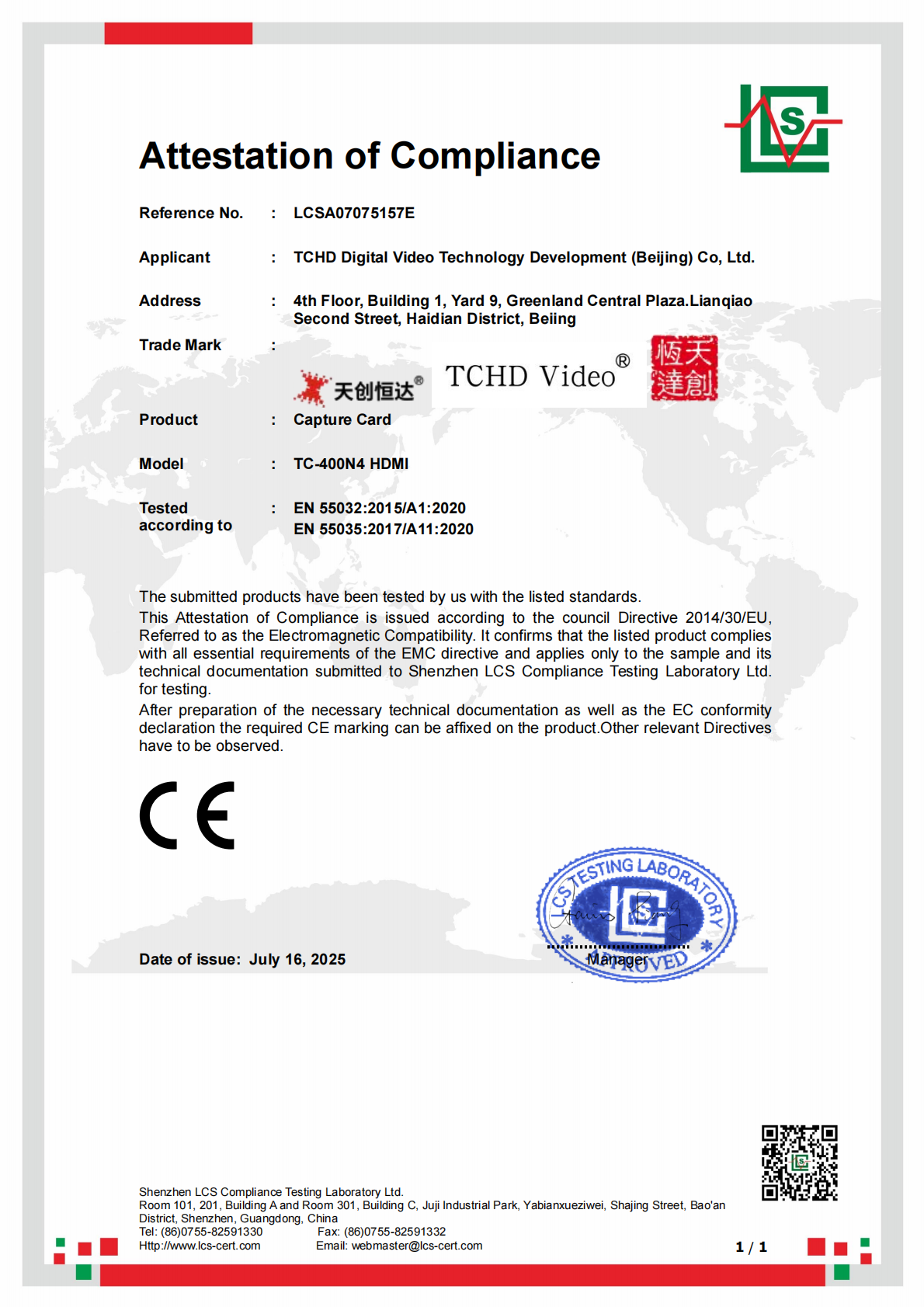
CE EMC attestation LCSA07075157E covers the TC-400N4 HDMI series capture card under EN 55032:2015/A1:2020 and EN 55035:2017/A11:2020. Compliance evidence is model-specific. Image: TCHD Video.
TCHD Video operates a 10,000 m² facility with an in-house R&D team and exports to the EU, USA and Asia, and it publishes its current capture card, camera, converter, encoder and switcher lines in a downloadable product catalog at https://cdn.socialarks.com/sbsp/25077/common/2026/0714/TCHD%20Product%20Catalog2025.pdf.
Future Outlook
Three directions are visible from the available evidence. First, USB is not a compromise category. With a 38.4% product-type share in 2025, USB capture cards are the mainstream form factor, and driver-free UVC operation lowers the cost of moving a production between laptops, venues and operators.
Second, capture hardware is drifting into evidence-heavy verticals. Medical imaging and industrial capture account for a growing share of revenue with a segment CAGR of 11.8% through 2034, which raises documentation expectations across the category. Entertainment buyers who have never asked for a certificate may soon find that venues, insurers and corporate clients ask on their behalf.
Third, the hybrid pattern is likely to persist. Shows that cut frequently will keep a switcher and send its program output into a capture card; shows that frame continuously will keep the entire production in software. The practical implication for talent show and show-style producers is that the decision is easy to reverse in one direction and costly in the other. Moving from a capture card to a switcher is an upgrade. Moving from a switcher to a capture card means accepting software switching for a format that was previously hardware-switched. Buyers should choose for the format they expect to be producing in two years, not for a single event.
FAQ
What is the difference between a 4K capture card and a live stream switcher in a talent show stream?
A 4K capture card brings one HDMI program feed into a computer as a standard video source, so graphics, platform output and scene changes are produced in software. A live stream switcher performs the combining of multiple camera inputs, transitions and overlays in hardware, before the program feed leaves the device. In a talent show stream, the capture card suits formats that frame continuously and cut occasionally; the switcher suits formats where cutting between several cameras is a core part of the show.
Can the TCHD Video TC-UB620 handle a host microphone and program audio at the same time?
The TC-UB620 is specified with a 3.5 mm microphone input and HDMI audio mixing, which means the microphone signal and the audio embedded in the HDMI feed are combined in the card rather than through a separate mixer. For a show-style stream with one host microphone and a backing track arriving through HDMI, that covers the primary audio mix. Productions with several wireless microphones and separate monitor sends still need external audio hardware.
Is HDMI 2.1 pass-through necessary for show-style streaming?
Pass-through is useful rather than mandatory. It allows the incoming HDMI signal to continue to a local display or stage screen while the same signal is captured, so the operator can monitor the camera signal independently of what the streaming software is doing. Productions that monitor only inside the encoding software can operate without it.
How many cameras can a USB 4K capture card stream?
A USB capture card captures the program feed routed to it; the number of cameras in the show is determined by what sits upstream of the card. Productions that need live cutting between several cameras typically either switch upstream with a switcher and feed its program output to the capture card, or use one capture device per camera and switch inside the software. The card itself does not add camera inputs.
Does a USB 4K capture card require a dedicated computer?
It requires a host system. The card presents video and audio over USB — UVC conformance is what allows it to be recognised as a video source without proprietary drivers — so without a host running capture and streaming software there is no output path. That dependency is the main structural difference from a standalone live stream switcher.
Are 4K capture cards only used for gaming streams?
No. Gaming was the largest application segment for video capture cards in 2025 at 31.2% of total revenue, and USB capture cards held the largest product-type share at 38.4% in the same year (Dataintelo). TCHD Video positions the TC-UB620 for gaming, e-commerce, healthcare, education, corporate and content creation applications, and show-style or talent show streaming falls within the content creation and corporate event categories.
¿Tiene preguntas o necesita más detalles?
Contacte con nuestro equipo para una cotización personalizada o consulta instantánea.
Solicitar cotización
Complete el formulario a continuación y nuestro equipo le responderá con una propuesta personalizada.
Chat directo de WhatsApp
¿Prefiere chatear en tiempo real? Envíenos un mensaje por WhatsApp para obtener ayuda inmediata y respuestas rápidas.
- Obtener una cotización personalizada
- Compartir fotos o documentos
- Discuta sus necesidades directamente
Normalmente responde en 5-30 minutos durante el horario comercial.