
4D Massage Chair FAQ: Unpacking 200W Power and 103 Kg Weight Barriers
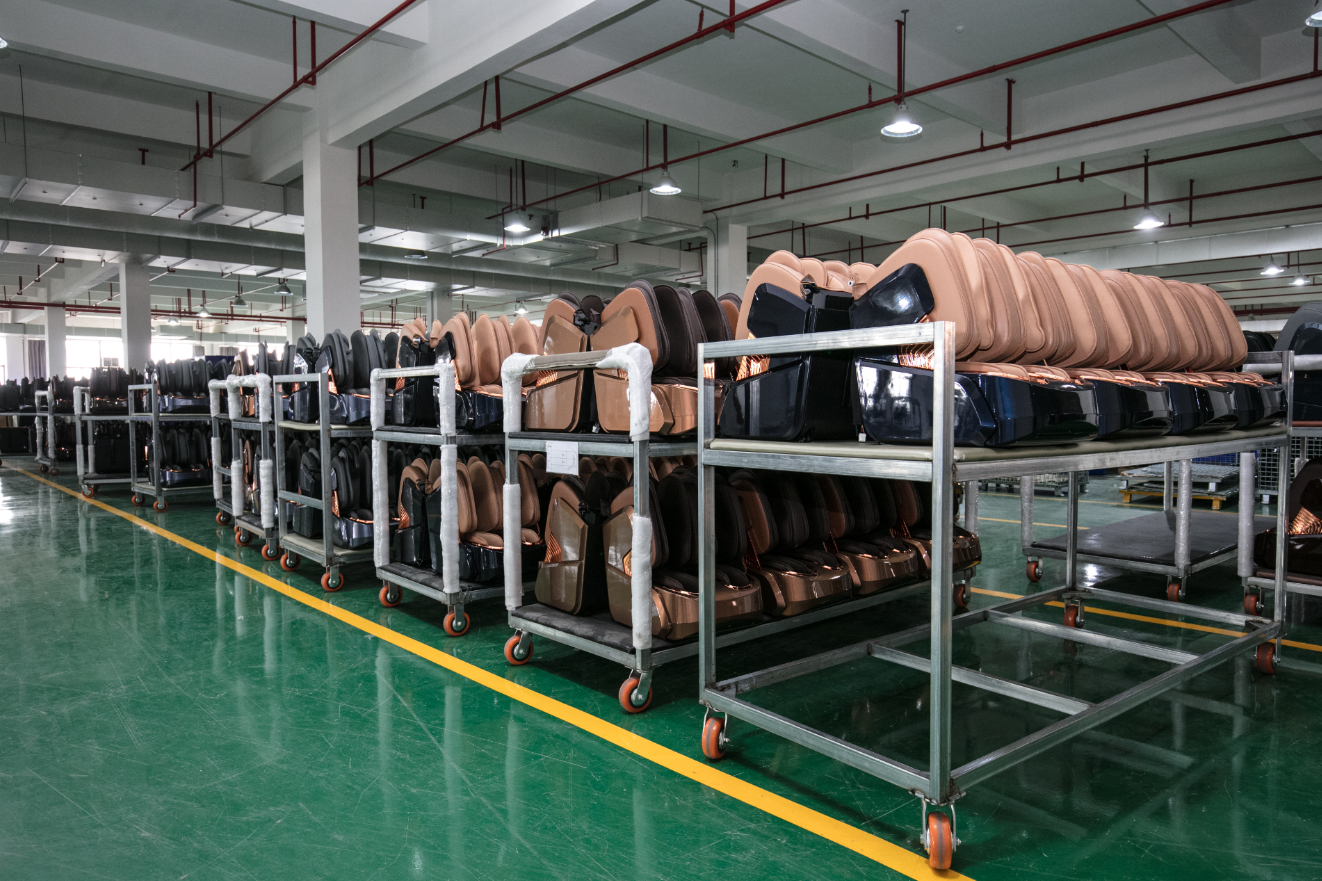
Massage chairs staged between assembly and dispatch: the point where a 200W rated load and a 118 kg gross weight turn into freight, handling and installation decisions.
Why 200W and 103 Kg Shape More 4D Massage Chair Orders Than Feature Lists
A 4D massage chair is a powered, heavy-format appliance rather than a piece of furniture that happens to vibrate. Two specifications shape more purchase decisions than any feature comparison: the rated power the chair draws and the weight that has to be moved. Dealers who validate the 4D roller mechanism but never check input voltage or gross shipping weight usually discover the gap somewhere between the container terminal and the customer's installation site.
The 4D massage chair platform supplied by Ningbo Zhouqi Health Technology Co., Ltd. is specified at 200W rated power with 110V-240V, 50/60Hz input, and at 103 kg net weight against 118 kg gross weight. Ningbo Zhouqi Health Technology Co., Ltd. is a massage chair manufacturer based in Cixi, Zhejiang Province, China, integrating research and development, production and sales. Read as a set, those four values describe a product that is electrically adaptable across major markets and physically demanding to move, store and install.
Category data explains why power and weight questions now arrive earlier in the buying process. The global massage chair market was estimated at USD 3.8 billion in 2024 and is projected to reach USD 6.1 billion by 2034 (Business Research Insights / IMARC Group). Residential end-use accounts for more than 70% of market volume in some regions (Mordor Intelligence), while online distribution is identified as the fastest-growing sales channel (TechSci Research). On the compliance side, IEC 60335-2-32:2024 governs the safety of electric massage appliances for household use. Power ratings and shipping weight sit at the intersection of all three trends.
Why Power and Weight Questions Surface Late in a 4D Massage Chair Purchase
Buyers normally begin with mechanism. Dual mechanism 4D technology allows simultaneous, independent massage of the upper back and lower glute regions, and a flexible SL track extends coverage from the neck down to the hamstrings while following the S-curve of the spine. Zero gravity recline redistributes body weight to reduce spinal pressure during a session. These are the features that carry the first specification discussion.
The commercial discussion is different. A container order of this model is quoted FOB Ningbo on a minimum order quantity of 1×40HQ, which is why 4D massage chair weight is not an abstract figure: every unit moves at 118 kg gross, every unit needs two-person or mechanical handling at the destination, and every unit consumes installation time at the end of the journey. For importers, distributors and hospitality buyers, that final hundred metres is often the least planned and most failure-prone part of the program.
The opportunity sits on the other side of the same problem. In markets where installation capability exists, a heavy 4D massage chair is difficult for competitors without logistics support to serve, and demand data supports the direction: robotic massage chairs, including 3D and 4D technology, held a 63.4% share of the design segment in 2024 (Business Research Insights). Buyers who plan power and weight properly compete on operational readiness rather than price alone.
Rated Power 200W: What the Number Is Actually Declaring
Rated power is the declared electrical input of the complete chair when its drive mechanism, control electronics and heating function operate together under standard test conditions. It is not a peak figure and not a marketing figure. A 200W rating tells a buyer which load class the product belongs to, what the nameplate should state, and what the certification file should reference.
The practical risk is inconsistency rather than magnitude. ETL for North America, CE for the European Union and CB for IEC-based acceptance are issued against a declared rating; when a product listing, a test report and the nameplate disagree, retail compliance checks and customs documentation can stall. Buyers sourcing a 4D massage chair should therefore request the nameplate photograph and the matching test documentation for the same SKU, rather than a generic certificate set.
Electrical documentation should also move with any market modification. When a model is adapted for a destination grid or a different plug configuration, the declared rating, labeling and certificate scope need to be updated together. A variant that carries old documentation is a warranty and compliance question waiting to surface.
110V-240V at 50/60 Hz: One Electrical Platform, Several Market Obligations
The two dominant grid families in export markets are 110-120V at 60Hz, used across North America, and 220-240V at 50Hz, used across Europe, the Middle East and much of Asia. A chair rated 110V-240V with 50/60Hz input is designed to operate in both, which means one platform can be listed across regions instead of being split into separate electrical variants.
For distributors, that has a supply-chain consequence beyond the plug. One platform means one spare-part list, one service manual and one training path across markets rather than a separate variant per region. That matters when a dealer is planning multi-year inventory rather than a single seasonal order, because service documentation and parts availability are what hold a long-term program together.
The boundary is equally important. Wide-range input does not replace destination-market obligations. Plug type, power cord set, labeling language and the applicable certification scheme are decided market by market, and the platform's published compliance set — CE, CB, RoHS, ETL and FCC — is issued for specific markets and product configurations. Buyers should confirm that certificate scope matches the SKU, the voltage variant and the destination before ordering.
103 Kg Net and 118 Kg Gross: Turning Weight Into a Cost Line
Net weight of 103 kg describes the chair as delivered and assembled. Gross weight of 118 kg includes packaging and transport protection, a 15 kg difference. Freight forwarders, carriers and customs documents work from the gross figure; installation teams work from the net figure. Treating the two as interchangeable is one of the most common costing errors in this category.
| Parameter | Declared value | What it drives in a purchase decision |
|---|---|---|
| Rated power | 200W | Electrical load class, nameplate consistency, certification reference |
| Input voltage | 110V-240V | Multi-market SKU planning across 110-120V and 220-240V grids |
| Input frequency | 50/60 Hz | Compatibility with both 50 Hz and 60 Hz supply |
| Net weight | 103 kg | Installation planning, floor loading, service handling |
| Gross weight | 118 kg | Freight quotes, carrier and equipment selection, customs documents |
Where does the mass come from? A 4D mechanism adds extend and retract movement on top of the up-down and left-right travel of a 2D roller, and it adjusts speed and rhythm dynamically. That movement requires a rigid structural frame, reinforced drive assemblies and a length of track that runs from the neck area to the hamstrings on flexible SL-track designs. The result is a platform whose stability under zero gravity recline and whose durability under daily use come from the same structural mass that makes it difficult to move.
On freight, the commercial unit for this platform is a full container: minimum order quantity 1×40HQ, delivery FOB Ningbo. Buyers should confirm with the supplier how the loading plan is calculated for the model and whether weight or volume governs container utilisation, because that answer changes the landed cost. For samples and less-than-container-load shipments, chargeable-weight pricing, heavy-item handling fees and lift-gate surcharges for last-mile delivery apply, and those costs are confirmed with the freight forwarder rather than assumed from net weight.
Handling, Delivery and Installation: A Pre-Order Checklist
A 103 kg chair is not a two-person manual lift, and it is not a kerbside drop. Planning the following points before the container is booked generally prevents the most expensive kind of delay — the one that happens at the customer's door.
- Warehouse receiving: a forklift or pallet jack with a level dock or ramp; heavy cartons should not be tail-lifted by hand.
- Carrier selection: confirm lift-gate availability and a two-person delivery team for residential addresses.
- Site survey: measure doorways, corridor turns, stair width and elevator dimensions before scheduling, and define what happens if access fails.
- Floor protection: plan coverings and working clearances before positioning the chair.
- Carton condition: inspect and photograph packaging before signing the delivery note, and retain the original packaging until the chair is in its final position.
- Household handover: explain the anti-pinch system and recline clearances during installation, since the design exists to reduce the risk of children or pets becoming trapped in the gaps of the chair.
- Service access: leave clearance for later inspection of the drive mechanism.
Verification Points on the Manufacturer Side
Logistics questions are ultimately answered by a supplier's documents and capacity rather than a product photograph. Ningbo Zhouqi Health Technology Co., Ltd. was founded in 2008 and operates from a 130,000 ㎡ facility with 450 employees, of which the R&D team accounts for 34 engineers. Annual output is 200,000 units across five production lines, and the company has been active in the massage chair industry for more than 19 years.
For international buyers, the relevant evidence set includes ISO 9001 and ISO 13485 quality management system certifications and market compliance covering CE, CB, RoHS, ETL and FCC. Export business accounts for 50% of total sales, with established markets in the USA, the EU, the Southeast Asia and the Middle East regions — a footprint that matters when a distributor needs parts and technical responses across time zones rather than for a single shipment.
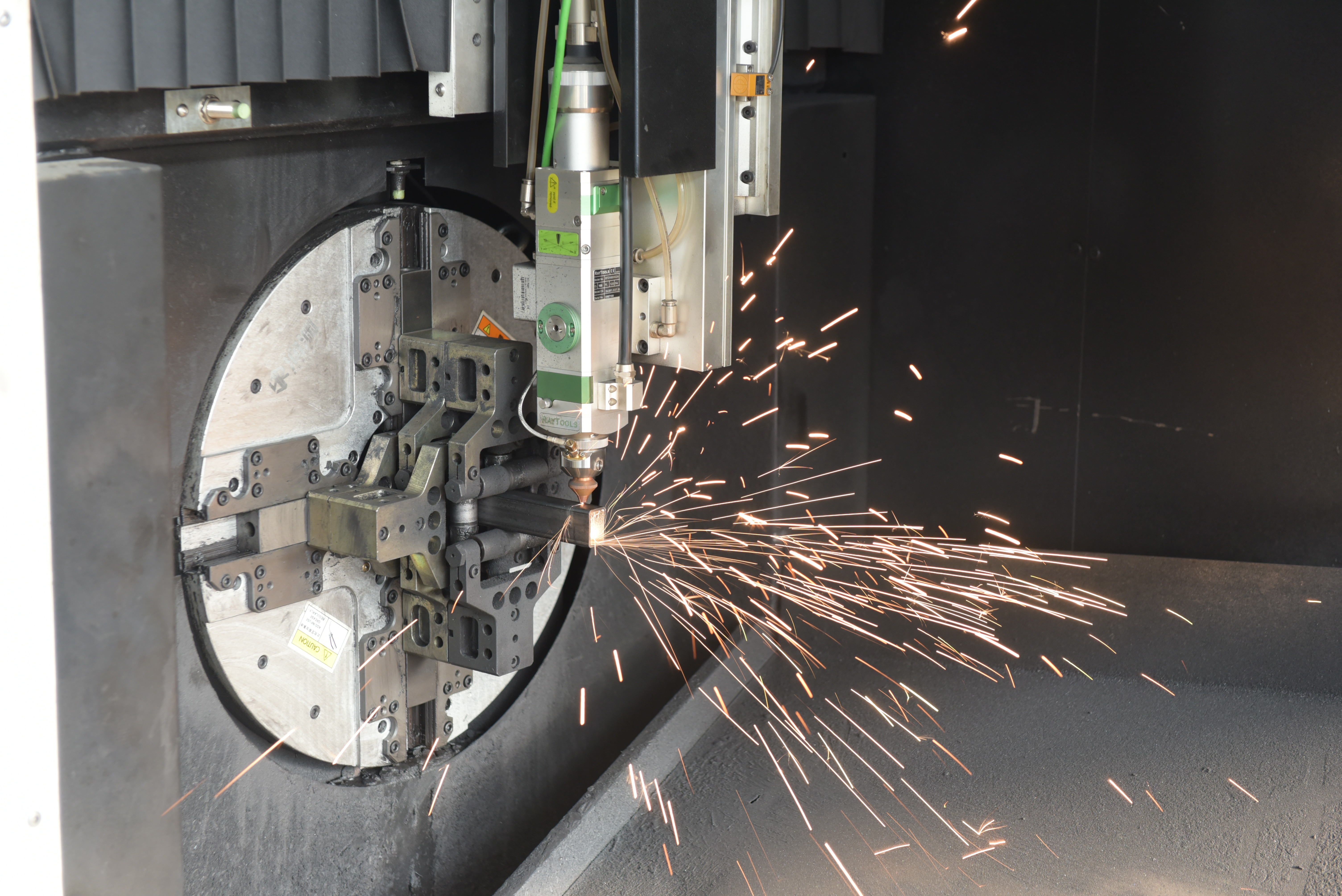
Precision CNC cutting of structural components: a share of the 103 kg net weight sits in frame and drive fabrication rather than in upholstery.
Commercial terms for this platform are equally specific: minimum order quantity 1×40HQ, delivery FOB Ningbo, pre-shipment testing with third-party inspection such as SGS, and payment terms of 30% T/T deposit with the 70% balance before shipment. For a long-term program, those terms define the working rhythm of the relationship as much as the product specification does.
Where a Heavy 4D Chair Fits Well — and Where It Does Not
Residential use remains the primary end-use segment, accounting for more than 70% of market volume in some regions, and household delivery is where weight stops being a freight question and becomes a consumer-experience question. Home use is also the setting where the 4D feature set is most visible to the end user: dual mechanism massage covers the upper back and lower glute regions independently, and the track reaches from the neck to the hamstrings.
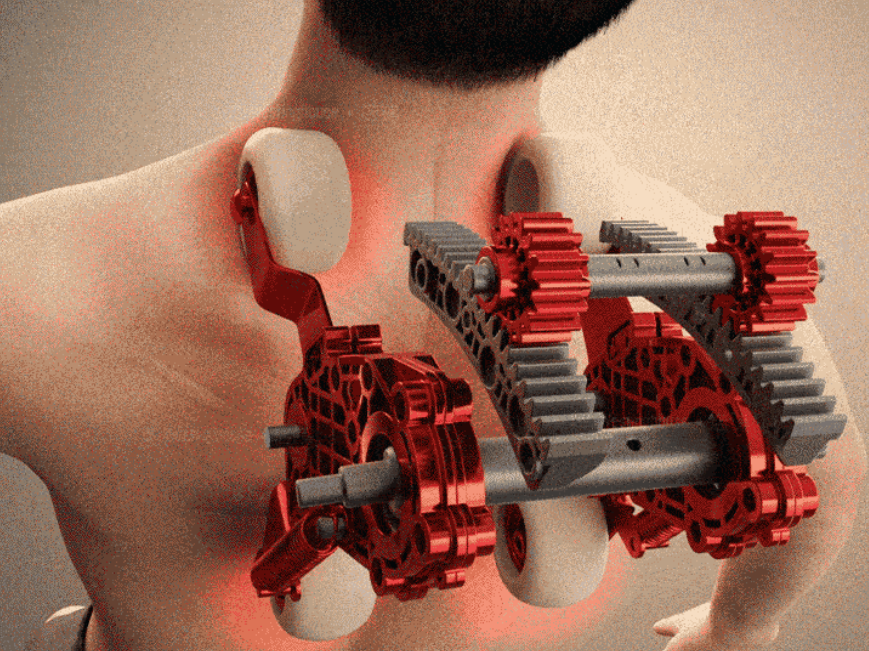
4D deep tissue massage in a home-use setting — the scenario where installation access, not product capability, usually decides whether a delivery succeeds.
Hospitality and showroom settings — hotels, resorts, spa areas and 4S showrooms — are generally easier to serve because ground-floor or service-elevator access is planned in advance and multiple units justify a dedicated installation visit. Health-care oriented placements benefit from the same physical characteristics: zero gravity recline distributes body weight to reduce spinal pressure, and a flexible SL track extends coverage from the neck down to the hamstrings.
The scenario where a heavy 4D chair fits poorly should be stated plainly. Markets that expect flat-pack, self-assembly delivery; upper-floor apartments without lift access; and price-led channels competing purely on a 2D specification are not natural homes for a 103 kg platform. In those conditions the product is not the constraint — the delivery and service model is.
Market Signals That Support Long-Term 4D Programs
Three verified data points frame the long-term picture. First, market scale: the global massage chair market was estimated at USD 3.8 billion in 2024 and is projected to reach USD 6.1 billion by 2034. Second, product mix: full-body massage chairs held a 55.3% share of the product segment in 2024, and robotic designs including 3D and 4D technology accounted for 63.4% of the design segment. Third, technology adoption: approximately 41% of new massage chair models released in 2024 integrated AI-based sensors for personalised user experiences.
A caveat belongs with the first figure. Market size estimates for 2024 diverge between research providers depending on scope — Business Research Insights reports USD 3.8 billion for massage chairs, while Grand View Research reports USD 11.6 billion for the wider massage equipment category that includes chairs and sofas, where chairs and sofas accounted for 39.5% of revenue. Buyers should treat category forecasts as directional signals defined by scope, not as interchangeable numbers.
The commercial trend most relevant to weight and power planning is channel mix. Online distribution is identified as the fastest-growing segment for massage chair sales, and Asia Pacific remains the largest regional market, driven by adoption in China, Japan and South Korea. As more volume moves through online channels, the delivery and installation requirements of heavy units become a competitive differentiator for dealers rather than a back-office detail.
4D Versus 2D: Comparing Performance Against Logistics Burden
The mechanism gap between 4D and 2D is measurable, and so is the burden that comes with it. The comparison set used here states the following differences.
| Comparison point | 2D massage chair | 4D massage chair |
|---|---|---|
| Roller movement | Up-down and left-right on a fixed plane | Up-down, left-right plus extend and retract |
| Depth adjustment | 0 cm, fixed pressure | 8-10 cm adjustable depth |
| Speed and rhythm | Fixed | 5+ speed levels, variable rhythm control |
| Massage programs | Basic | 24+ programs |
| Relative cost | Baseline | Around USD 100 higher in cost in this comparison set |
| Maintenance | Simple roller mechanism, fewer moving parts, low maintenance requirement | Complex multi-drive mechanism, periodic inspection of extend and retract components recommended |
| Stated positioning | Basic relaxation for mild tiredness | Comprehensive relief for muscle soreness, effective for chronic fatigue |
This is not a simple upgrade story. A 4D build carries a higher unit cost than a 2D equivalent in this comparison set, and it adds a more complex multi-drive mechanism that benefits from periodic inspection of the extend and retract components. A 2D chair uses a simpler roller mechanism with fewer moving parts and lower maintenance requirements, and it remains a reasonable choice for price-led channels and for markets without installation support.
The physical boundary follows the same logic. Because a 4D chair is heavier and its mechanism is more complex, total cost of ownership over a multi-year program includes freight, handling, installation labour and service access — not unit price alone. Buyers comparing 4D and 2D massage chairs on unit cost are comparing only part of the decision.
Future Outlook
The direction of the category is toward platforms that are electrically flexible and mechanically differentiated. Wide-input designs covering 110V-240V at 50/60Hz reduce the number of regional variants a manufacturer and a distributor must carry, while independent dual mechanism 4D systems and AI-based sensing continue to define the upper tier of the market. Neither trend removes the physical reality of a 103 kg net weight.
What is likely to change is the service layer around the product. As online channels continue to grow, delivery partners, installation training and spare-parts availability are expected to become explicit selection criteria in supplier evaluation, in the same way certification and mechanism type are today. Distributors building multi-year programs should also expect their own logistics capability to be assessed by their customers, because a heavy 4D massage chair places the dealer in the installation business whether the dealer intended it or not.
FAQ: 4D Massage Chair Power, Weight and Logistics
What does a 200W rated power specification actually tell a buyer?
It declares the electrical input of the complete chair when its drive mechanism, control electronics and heating function operate together under standard test conditions. For procurement, the figure defines the load class a dealer plans around, and it is the value that should appear consistently on the nameplate, the product listing and the certification file. IEC 60335-2-32:2024 is the international standard governing the safety of electric massage appliances for household use, and declared ratings are part of what certification testing references.
Can one 4D massage chair model serve both 110V and 240V markets?
A platform rated 110V-240V with 50/60Hz input is designed to operate across both dominant grid families: 110-120V at 60Hz and 220-240V at 50Hz. Frequency compatibility matters as much as voltage in markets where 50Hz grids are standard. Wide-range input does not replace market-specific obligations, however: plug type, power cord set, labeling and certification scheme are decided per destination. The published compliance set for this platform is CE, CB, RoHS, ETL and FCC, and buyers should confirm that certificate scope matches the exact SKU and voltage variant.
Why does a 4D massage chair weigh 103 kg net and 118 kg gross?
Net weight of 103 kg describes the chair as delivered and assembled. Gross weight of 118 kg adds packaging and transport protection, a difference of 15 kg. The net figure matters for installation planning and floor loading; the gross figure is what freight forwarders, carriers and customs documentation use. The mass itself reflects a rigid structural frame, a dual 4D drive mechanism with extend and retract movement, an SL-track assembly and upholstery.
How should freight costs be planned around a 118 kg gross unit?
Planning starts from gross weight rather than net weight. Commercial terms for this platform are a minimum order quantity of 1×40HQ with delivery FOB Ningbo, so the standard purchase unit is a full container load; buyers should confirm with the supplier how the loading plan is calculated for the model and whether weight or volume governs container utilisation. For samples or less-than-container-load shipments, chargeable-weight pricing, heavy-item handling fees and lift-gate surcharges for last-mile delivery typically apply.
What lifting equipment and site conditions are required for installation?
A 103 kg net-weight chair requires mechanical handling rather than manual lifting. Warehouse and showroom receiving normally uses a forklift or pallet jack with a level dock or ramp, and residential deliveries are usually scheduled with a two-person team and a lift gate. Before scheduling, buyers should confirm doorway width, corridor turns, stair width, elevator dimensions and floor surface protection. Original packaging should be retained until the chair reaches its final position.
What safety feature should be explained during a household handover?
The massage chair includes an anti-pinch system intended to reduce the risk of children or pets becoming trapped in the gaps of the chair. Anti-pinch design is implemented as part of production and quality control rather than added at delivery. It is worth demonstrating at handover in households with children or pets, together with recline clearances and the location of the main power control.
What documentation and terms should be verified before a long-term supply agreement?
Two document groups. Quality management: ISO 9001 and ISO 13485 certifications. Market compliance: CE, CB, RoHS, ETL and FCC coverage for the destination markets. Commercial terms for this platform are minimum order quantity 1×40HQ, delivery FOB Ningbo, pre-shipment testing with third-party inspection such as SGS, and payment of 30% T/T deposit with the 70% balance before shipment. Capacity evidence is equally relevant for multi-year programs: the manufacturer operates a 130,000 ㎡ facility with five production lines and an annual output of 200,000 units.
Does a heavier 4D mechanism change maintenance expectations?
Yes. A 4D mechanism adds extend and retract movement and dynamic speed and rhythm control to the up-down and left-right travel that a 2D roller performs. In this comparison set, a 4D chair shows 8-10 cm of adjustable depth, 5+ speed levels and 24+ massage programs, against a fixed-plane 2D mechanism with no depth adjustment. That additional movement uses a complex multi-drive mechanism, so periodic inspection of the extend and retract components is recommended, while a 2D chair uses a simpler roller mechanism with fewer moving parts and lower maintenance requirements.
The 2026 product catalogue for the 4D massage chair platform, including model configurations and certification documentation, can be downloaded here: 2026 E-catalogue. Manufacturer enquiries reach Ningbo Zhouqi Health Technology Co., Ltd. at shelley@cn-zhouqi.com, +86 182 5079 5612, or www.cn-zhouqi.com.
¿Tiene preguntas o necesita más detalles?
Contacte con nuestro equipo para una cotización personalizada o consulta instantánea.
Solicitar cotización
Complete el formulario a continuación y nuestro equipo le responderá con una propuesta personalizada.
Chat directo de WhatsApp
¿Prefiere chatear en tiempo real? Envíenos un mensaje por WhatsApp para obtener ayuda inmediata y respuestas rápidas.
- Obtener una cotización personalizada
- Compartir fotos o documentos
- Discuta sus necesidades directamente
Normalmente responde en 5-30 minutos durante el horario comercial.