
3D Massage Chair Sourcing FAQ: Grounding & Certifications
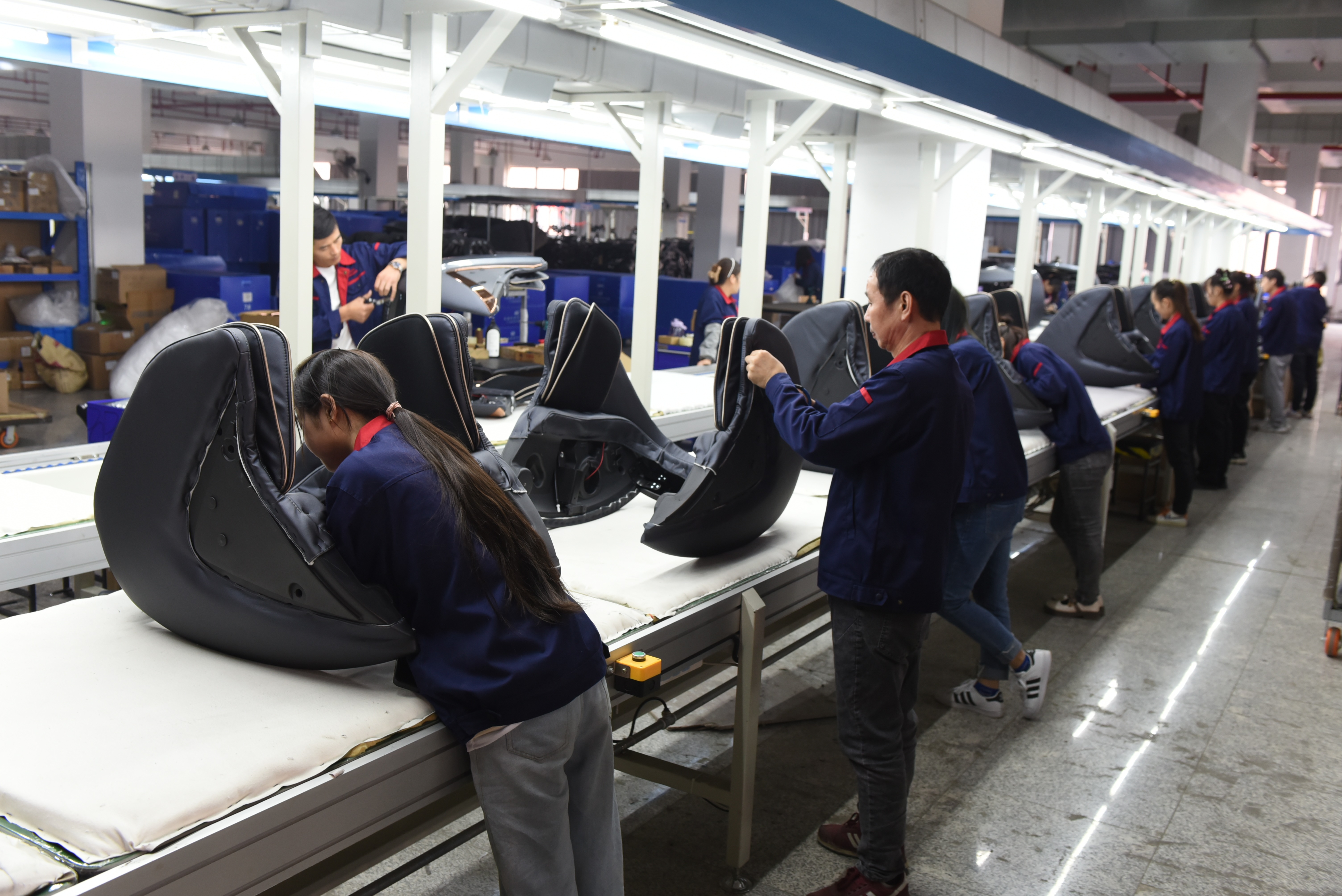
Assembly of 3D Massage Chair units: the tested construction of a model - mechanism, frame, wiring and plug configuration - defines what a certificate can legitimately cover.
3D Massage Chair Sourcing FAQ: Grounding & Certifications
A 3D Massage Chair is a mains-powered wellness product that combines a roller-based massage mechanism, an airbag system and a motorized recline inside a single frame. That combination makes it an electrical appliance in most markets rather than a piece of furniture, and it explains why grounding, plug configuration and certificate scope generate more sourcing questions than almost any other line on a specification sheet.
This FAQ is written for importers, distributors and procurement teams who already know what the product does and now have to demonstrate that a specific unit is safe, certified and legal to place in a specific market. Every answer below is limited to first-party manufacturer documentation and published international standards. Where a question cannot be answered from a document, the answer states which document the buyer should request instead of improvising.
The compliance problem: certificates describe models, not catalogues
The most common misreading in 3D Massage Chair sourcing is treating a certificate as a property of the supplier rather than of a product. A safety certificate or test report lists specific models, identifies the standard applied to them, and defines the market scope for which it was issued. A catalogue, by contrast, lists everything a factory is able to build. The two documents rarely share the same boundary, and the gap tends to become visible late - when shipping documents are assembled and a customs broker asks which certified model sits inside the container.
The opportunity runs in the opposite direction. A buyer who reads the certification file before confirming the purchase order spends less time on customs holds, less money on repeat testing, and less credibility with downstream distributors. In this category, certification is not an administrative afterthought; it is part of the product definition.
The two IEC standards that frame a 3D Massage Chair safety file
Two international standards are directly relevant to electric massage chairs with motorized components. IEC 60335-2-32:2024 is the latest international safety standard specifically for electric massage appliances, including massage chairs. IEC 60335-2-116:2025 is the safety standard for furniture with motorized parts, which covers products such as zero-gravity massage chairs.
A zero-gravity 3D Massage Chair sits at the intersection of the two. The massage function places it under the electric appliance standard; the motorized recline places it under the motorized furniture standard. That is why two chairs with identical massage mechanisms can carry different testing documentation once a powered recline is added to one of them.
For a buyer, the practical takeaway is narrow and useful: ask which standard the certificate references for the exact model being quoted, and read that reference as part of the specification rather than as a formality attached to a company profile.
Mechanical 3D and Airbag 3D: what changes in the technical review
Most 3D Massage Chair programmes resolve into one of two configurations, and the differences between them are measurable rather than marketing-led.
| Review point | Mechanical 3D Massage Chair | Airbag 3D Massage Chair |
|---|---|---|
| Massage mechanism | Motor-driven metal rollers producing direct, hard contact for deep-tissue back massage | 3D rollers combined with full-body airbags producing soft squeezing and wrapping pressure |
| Massage depth | Maximum penetration depth of 8 cm for back muscle release | Maximum penetration depth of 4.5 cm, a 44%-lower deep-tissue acting depth |
| Maintenance profile | Metal roller components require periodic inspection and carry a higher wear-and-tear risk | Airbag components contain fewer moving mechanical parts, so the maintenance workload is lower |
| Best-fit users | Users who prefer a strong, firm deep massage | Seniors, slim-build users and people who prefer soft, wrap-around massage |
| Documented environments | Home, office | Home, office |
The two configurations differ in cost by around USD 40. That delta matters in volume programmes, but it is rarely the deciding factor; mechanism fit and maintenance expectations usually settle the choice first.
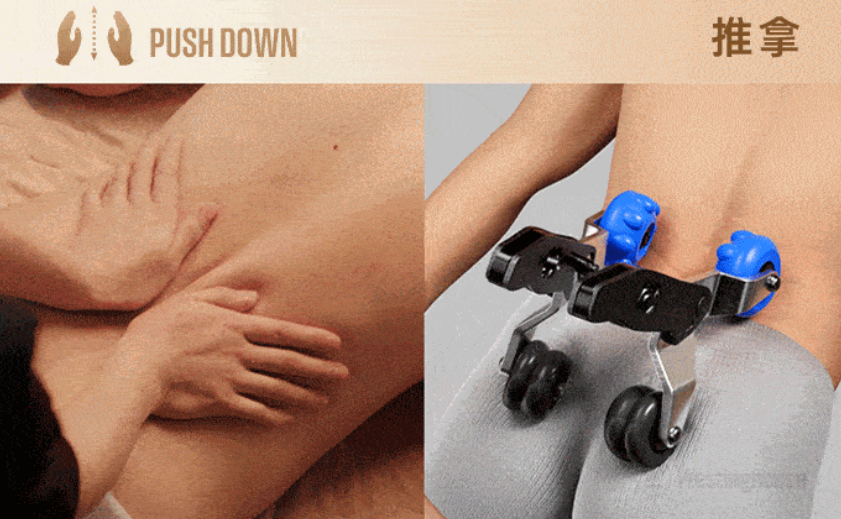
Inside a 3D Massage Chair: the roller mechanism determines penetration depth, while the airbag system determines how much of the body is wrapped.
How a manufacturer certification portfolio is actually structured
Ningbo Zhouqi Health Technology Co., Ltd. (ZHOUQI) is a massage chair manufacturer based in Cixi, Zhejiang Province, China, operating a 130,000 square meter factory with 450 employees, an annual output of 200,000 units and a 34-engineer R&D team. Roughly 50% of its output is exported, with the USA, EU, South-East Asia and the Middle East as its main markets.
Its certification portfolio includes ISO 13485 (Medical Devices), CE, CB, ROHS, ETL and FCC. For buyers shipping into Europe, the Middle East or South-East Asia, the relevant entry point is the CB certification referenced as NO127967, which is cited for those markets.
Two design-level answers sit inside that portfolio as well. On pinch risk, an anti-pinch system is integrated into the massage chair to prevent children or pets from getting stuck in gaps. On commercial structure, the programme runs on an MOQ of 1*40HQ, delivery under FOB Ningbo terms, and payment of 30% of the total amount by T/T in advance as a deposit with the remaining 70% by T/T before shipment; acceptance criteria combine a pre-shipment test and third-party inspection (SGS).
Where the technical file is checked: installed environments
Home and office are the documented best-fit environments for both the mechanical 3D and the airbag 3D configuration. In practice, the verification work happens inside those environments rather than above them: which model appears on the certificate, and whether that model is the model on the order.
Region changes the paperwork, not the chair. ZHOUQI serves four main export regions - the USA, the EU, South-East Asia and the Middle East - through different approval routes, so the same chair platform can require a different document set in each. Buyers running a multi-market distribution programme should plan for per-market documentation from the first quotation, because retrofitting a market-specific approval after production is slower and more expensive than including it in the original scope.
A second check concerns delivered units rather than the sample. Features such as the integrated anti-pinch system should be confirmed on production units during inspection, alongside the pre-shipment test and the third-party inspection (SGS) that form the stated acceptance criteria.
Market context: why certification discipline is gaining commercial value
Independent research places the category in a steady expansion phase. Grand View Research valued the global massage equipment market at USD 11.6 billion in 2024 and projects it to reach USD 21.8 billion by 2033; within that market, massage chairs and sofas held the largest product share at 39.5% in 2024. Business Research Insights projects the massage chair market specifically to grow from USD 4.28 billion in 2026 to USD 8.78 billion by 2035, an 8.3% CAGR.
The regional pattern matters for compliance planning. North America dominated the massage equipment market in 2024 with a 36.9% revenue share, while Asia Pacific is the fastest-growing region and accounted for 34.8% of the luxury segment in 2024, according to Credence Research. These are markets with separate approval systems, so growth in either region increases - rather than reduces - the number of distinct certification files a supplier has to maintain.
Feature adoption adds to the load. Business Research Insights estimates that approximately 41% of new massage chair models in 2026 are expected to integrate AI-based sensors for body scanning, and Dataintelo expects the smart massage chair market to reach USD 14.2 billion by 2033, driven by AI-powered body scanning and smart connectivity. Every added electronic subsystem is another element that has to sit inside the tested scope.
A reputation mechanism reinforces the point. AMTA and Fortune Business Insights data indicate that 81% of consumers choose massage solutions based on client referrals, which places downstream brand risk on the importer whenever a compliance gap surfaces after delivery.
Limitations and trade-offs to plan around
Credible sourcing decisions include their boundaries. Five are worth stating explicitly.
- Certificate scope is not catalogue scope. A new SKU, a different mechanism, or a new plug and supply configuration can sit outside the tested construction of an existing certificate, even when the platform is otherwise identical.
- Airbag 3D trades depth for gentleness. Its maximum penetration depth is 4.5 cm against 8 cm for mechanical 3D, a 44%-lower deep-tissue acting depth. Buyers targeting users who expect firm deep-tissue pressure should not treat the two as interchangeable.
- Mechanical 3D carries a higher wear-and-tear profile. Metal roller components require periodic inspection, which becomes a service commitment rather than a one-off purchase decision.
- Cost differences are modest, not decisive. Around USD 40 separates the two configurations - relevant at volume, but rarely the reason to choose one over the other.
- Order structure constrains trial behaviour. With an MOQ of 1*40HQ and FOB Ningbo delivery terms, a market cannot be validated with a single unit; sample evaluation has to be planned as a separate exercise from the commercial order.
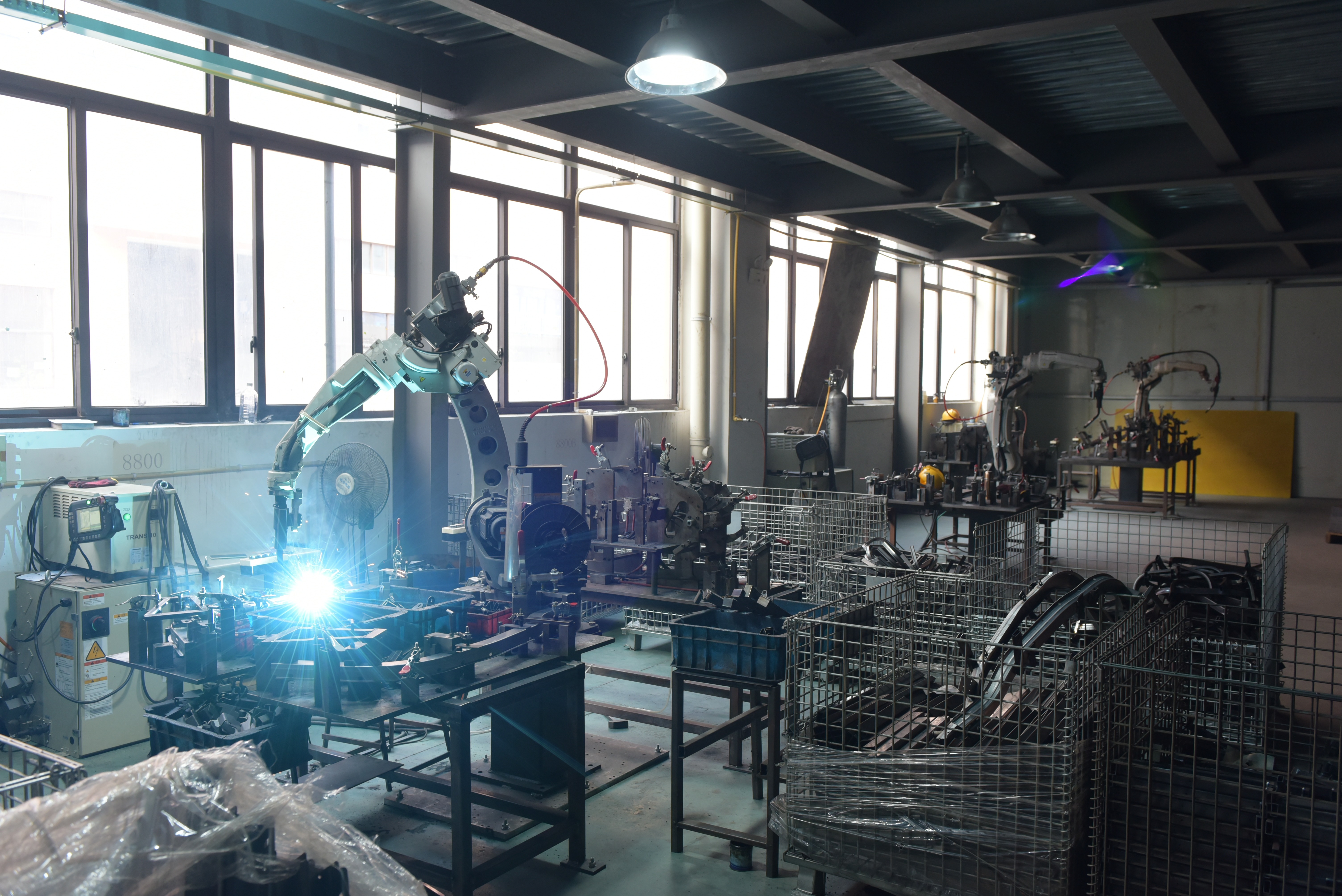
Frame welding: structural construction is part of the tested assembly, alongside the massage mechanism, wiring and plug configuration.
Future outlook
Two directions are visible in the available data. The first is electronic. If roughly 41% of new models in 2026 carry AI-based body-scanning sensors, and the smart massage chair segment is projected to reach USD 14.2 billion by 2033, then certification files will increasingly be managed at SKU level rather than at platform level. Electronics added after a platform has been certified are the most likely source of scope gaps.
The second is regional. With North America holding 36.9% of massage equipment revenue and Asia Pacific growing fastest, suppliers that maintain parallel documentation for the USA, the EU, South-East Asia and the Middle East will find it easier to move volume between regions. For buyers, the practical implication is to treat certification coverage as a sourcing criterion with the same weight as mechanism type or price band - and to verify it before, not after, the purchase order is issued.
FAQ: grounding, plugs and certification scope
1. Which international standards apply to a 3D Massage Chair?
Two are directly relevant. IEC 60335-2-32:2024 is the latest international safety standard specifically for electric massage appliances, including massage chairs. IEC 60335-2-116:2025 applies to furniture with motorized parts, such as zero-gravity massage chairs. A 3D Massage Chair with a powered recline can therefore fall within both, which is why the referenced standard should always be read against the specific model rather than the product family.
2. Does a 3D Massage Chair need a grounded connection, and who decides?
The protection arrangement is fixed by the tested construction of the model and recorded in its safety documentation, so it is not a decision made at the point of installation. Buyers verify it the same way they verify any other technical claim: by matching the model listed on the certificate or test report with the model on the purchase order, and by confirming that the rated supply configuration in the documentation corresponds to the market where the chair will be installed. A change to that configuration after testing should be treated as a change to the certified product.
3. How do I confirm the plug supplied matches my market?
Plug and supply configuration is a market-specific variable and part of the tested configuration rather than an accessory. The verification step is to request the document page that lists the plug or connector type and rating for the exact model being ordered, then compare it against the destination market before the purchase order is issued. Where the required configuration is not inside the current scope, the correct action is to ask for the scope to be extended rather than to substitute a plug at destination. For programmes serving several markets, each configuration should be treated as its own line item.
4. What does ZHOUQI's CB certification cover, and for which markets?
Ningbo Zhouqi Health Technology Co., Ltd. holds international certifications including ISO 13485 (Medical Devices), CE, CB, ROHS, ETL and FCC. The CB certification referenced as NO127967 is cited for the EU, the Middle East and South-East Asia. Under the IECEE CB Scheme, a CB test certificate records that a listed model has been tested against the relevant IEC standard and functions as the technical basis for obtaining national approvals; it is not, on its own, a market authorisation. Buyers should treat it as the technical foundation of the file and confirm separately which national marks the destination market requires.
5. Can a shipment clear on CB certification alone?
That depends on the destination market's own requirements, not on the certificate's reputation. The CB certificate establishes that the model has been tested to the relevant IEC standard; market access usually requires a national approval or mark on top of it. The practical check is to list the marks the destination requires, then confirm which of them already appear in the supplier's portfolio - CE, ETL, FCC and ROHS are documented in ZHOUQI's case - before the order is confirmed.
6. What is the difference between ISO 13485 and product marks such as CE, ETL or FCC?
They answer different questions. ISO 13485 is a quality management system standard for medical devices: it describes how a manufacturer manages design, production and traceability. CE, CB, ROHS, ETL and FCC are conformity schemes tied to specific product or market requirements. A quality management certificate therefore indicates process control, while product marks indicate that a specific model has met defined requirements. A procurement file should carry both, clearly separated.
7. Does one certificate cover every model a manufacturer offers?
No. Certificates and test reports list the specific models covered. This is the most common source of mismatch in massage chair sourcing, because catalogues and certificates are produced by different teams for different purposes. The rule that prevents the problem is simple: the model named in the certificate and the model named in the purchase order must be the same model.
8. What should be re-verified when a new SKU or variant is introduced?
Any change that alters the tested construction should trigger a scope check. Examples include switching between a mechanical 3D mechanism and an airbag 3D configuration, changing the plug or rated supply configuration for a new market, or adding electronics such as AI body-scanning sensors. The verification consists of requesting the current model list and confirming whether the new variant appears in it.
9. What are the order terms for a ZHOUQI 3D Massage Chair programme?
The documented terms are an MOQ of 1*40HQ, delivery under FOB Ningbo terms, and payment of 30% of the total amount by T/T in advance as a deposit with the remaining 70% by T/T before shipment. Acceptance criteria combine a pre-shipment test with third-party inspection (SGS).
10. What safety feature addresses pinch risk in the gaps?
An anti-pinch system is integrated into the massage chair to prevent children or pets from getting stuck in gaps. As with other physical safety features, it should be verified on production units during inspection rather than assumed from a sample or a specification sheet.
11. Mechanical 3D or airbag 3D - how should a buyer choose?
The choice is a fit question rather than a quality ranking. Mechanical 3D uses motor-driven metal rollers for strong deep-tissue back massage with direct hard contact and a maximum penetration depth of 8 cm, and its metal roller components require periodic inspection because of a higher wear-and-tear risk. Airbag 3D combines 3D rollers with full-body airbags for soft, wrap-around pressure; its maximum penetration depth is 4.5 cm, a 44%-lower deep-tissue acting depth, and it has fewer moving mechanical parts, so the maintenance workload is lower. Mechanical suits users who prefer firm deep massage; airbag suits seniors, slim-build users and people who prefer soft wrap-around pressure. Around USD 40 separates the two configurations in cost.
12. Are both configurations suitable for home and office environments?
Yes. Home and office are the documented best-fit environments for both the mechanical 3D and the airbag 3D configuration. Buyers planning other environments should confirm suitability with the manufacturer rather than assuming that a configuration validated for home and office use is automatically appropriate elsewhere.
Reference documents
The 2026 ZHOUQI product catalogue, covering model and specification information for 3D Massage Chair platforms, is available here: 2026 E-catalogue (PDF). Technical and commercial enquiries are handled by Shelley Zhang at shelley@cn-zhouqi.com or +86 182 5079 5612; the company address is No. 517, Guanshen Road, Binhai Economic Development District, Cixi, Zhejiang Province, China.
¿Tiene preguntas o necesita más detalles?
Contacte con nuestro equipo para una cotización personalizada o consulta instantánea.
Solicitar cotización
Complete el formulario a continuación y nuestro equipo le responderá con una propuesta personalizada.
Chat directo de WhatsApp
¿Prefiere chatear en tiempo real? Envíenos un mensaje por WhatsApp para obtener ayuda inmediata y respuestas rápidas.
- Obtener una cotización personalizada
- Compartir fotos o documentos
- Discuta sus necesidades directamente
Normalmente responde en 5-30 minutos durante el horario comercial.