
3D Massage Chair Scorecard: Market Access vs Deployment Fit
Two 3D massage chair offers can look nearly identical on a specification sheet and behave completely differently on site. One may clear customs and enter the target market without a documentation query; the other may stall at approval review. One may sit comfortably in a shopping mall on an existing power run; the other may fail a grounding check during installation. The gap between those outcomes is rarely the chair itself — it is the order of decisions behind the purchase.
A weighted scorecard built around two axes — market access and deployment fit — gives buyers a repeatable way to justify a decision. Market access is the certification set that determines where a chair can be sold, inspected and connected. Deployment fit is the practical question of whether the chair suits the venue, the users and the power conditions on site. Scoring both axes in one table stops a compliance question from being answered by a spec-sheet advantage, and stops a venue preference from overriding a missing certificate.
Why Line-by-Line Spec Comparison Fails
Comparing 3D massage chairs on a specification sheet tends to produce false confidence. Specification sheets organise information by feature: roller depth, airbag count, SL track length, zero-gravity angle, program count. A buyer scanning those rows compares adjacent items — this chair has eight programs, that one has six — without asking whether either feature block is legally sellable in the destination market or fits the physical venue.
The result is a selection process that over-weights visible differentiators and under-weights invisible constraints. A mechanical 3D chair that delivers deeper massage may match a shared-venue customer expectation better than an airbag 3D chair — but only after both clear the market-access gate. A chair without an appropriate ETL or CE scope cannot legally enter the market at all, regardless of roller design. Line-by-line comparison rarely surfaces that order of operations.
A weighted scorecard reverses the order. It scores market access first because it is binary and non-negotiable. It scores deployment fit second because that is where commercial return is won or lost. The weighted total ranks options only after both hard gates have been answered.
Axis 1: Market Access — What Each Certification Actually Unlocks
Market access is not a single certificate. It is a stack of documents, each with a scope, a standard version and a geography. Reading the stack correctly is the difference between a real approval path and a folder of PDFs. For reference, Ningbo Zhouqi Health Technology Co., Ltd. (ZHOUQI), a massage chair manufacturer based in Cixi, Zhejiang Province, China, publishes the following certification set across its production. It is used here as a concrete example of how to read each document, not as a claim about any other supplier.
ETL certification 5030347 — INTERTEK
ETL certification 5030347 is issued by INTERTEK. Its scope is dual-market: UL 1647:2015 Ed.6+R:30Jul2020 for the United States and CSA C22.2#68:2018 Ed.8+U1 for Canada. For a buyer, this is the certificate that opens North American retail and commercial placement, including venues that require documented evidence of electrical safety before a chair can be installed. The inclusion of both UL and CSA standards matters: a US-only certificate does not automatically cover Canadian placement, and vice versa.
CE certification ENB2311240186E00401C — EMTEK
CE certification ENB2311240186E00401C is issued by EMTEK. It covers EN IEC 55014-1:2021 for electromagnetic compatibility, plus IEC 60335-1:2010 and IEC 60335-2-32:2019 for electrical safety of household and similar appliances — with IEC 60335-2-32 being the part specifically written for electric massage appliances. The CE mark itself is a declaration; the underlying test reports are what matter. A buyer should ask for the certificate number and confirm that the standard years on the certificate match the models being ordered.
CB certification NO127967 — Nemko
CB certification NO127967 is issued by Nemko. The CB scheme is an international arrangement under which participating certification bodies accept each other's test reports, subject to national deviations. For EU, Middle East and Southeast Asia markets, a CB certificate can reduce the time needed to obtain local approval, because the underlying test evidence can be reused rather than repeated. It is not, however, a local certificate in itself. Country-level registration may still be required.
FDA registration 3017618816 — 21 CFR 807.39
FDA registration 3017618816 is recorded under 21 CFR 807.39. This establishes that the establishment is registered with the U.S. Food and Drug Administration. It is an establishment registration, not a product clearance or a statement that every model has been reviewed as a medical device. Buyers should treat it as one part of the access package, not as a substitute for ETL product-level certification.
ISO 9001 (02424Q32202999R1S) and ISO 13485:2016 (133640, NQA)
ISO 9001 certificate 02424Q32202999R1S confirms a general quality management system. ISO 13485:2016 certificate 133640, issued by NQA, confirms a quality management system aligned to medical device requirements. Neither certificate guarantees the safety of a specific chair; both indicate how the factory controls process, traceability and corrective action over time. In a weighted scorecard, these are durability-of-supply signals, not product-access signals.
A practical rule for Axis 1: score the certification set as a pass or fail against the destination market, not against the catalogue. A certificate whose scope lists a different model is not a pass. A CE declaration without an accompanying test certificate number is not a pass. ETL 5030347, CE ENB2311240186E00401C, CB NO127967 and FDA 3017618816 together form a concrete example of what a complete North America plus EU access stack looks like.
Axis 2: Deployment Fit — Venue, Power and Operation
Deployment fit is where most commercial mistakes happen, because it depends on details that are not in the specification sheet. Four questions drive most of the scoring weight.
Where is the chair going? Indoor venues such as shopping malls, stations, airports, offices and spas each have different floor traffic, dwell time and supervision patterns. A shared pay-per-use installation in a transit hub needs different endurance expectations than a single-tenant office placement. The scorecard should reward a model whose build and maintenance rhythm match the venue traffic, not just its massage features.
What is the power situation? Every 3D massage chair needs a power socket, correct grounding and a plug that matches the local outlet. This sounds routine, but in practice, installation delays often trace back to a missing ground, an unearthed extension lead, or a plug that does not fit the venue's sockets. Buyers should require site confirmation of the circuit, the ground connection and the plug type before the shipping window closes.
Who is using it, and for how long? Shared pay-per-use operations depend on predictable session length, clear entry and exit, and a mechanism that holds up under repeated cycles. The 3D intelligent massage mechanism is the core of that experience. Buyers should understand the mechanism not as a specification row, but as the part of the chair that determines both the sensation and the maintenance load.
How is the chair serviced in place? A model that requires specialist tools or factory-level re-calibration for routine service may still be the right choice for a flagship spa, but not for a distributed mall rollout. Deployment fit includes service access, not only installation.
The Weighted Scorecard
The scorecard below weights the two axes against each other and adds the commercial factors that often dominate informal decisions without being written down. Weights are a starting point; buyers should adjust them to their own market and venue mix, but should keep market access and power readiness as gating criteria rather than weighted ones. A candidate that fails a gate is excluded, not down-scored.
| Criterion | Weight | Scoring guide (1–5) |
|---|---|---|
| Market access for target regions (ETL, CE, CB, FDA, ISO) | 25% | 5 = complete scope covering all target countries and models; 1 = single-market or non-transferable scope |
| Venue fit (mall, station, airport, office, spa) | 15% | 5 = model proven in similar traffic and dwell-time; 1 = no comparable venue reference |
| Power, grounding and plug readiness | 10% | 5 = plug matches site, ground confirmed, cable run known; 1 = unresolved site conditions |
| 3D mechanism and user experience match | 20% | 5 = mechanism matches the audience's expected sensation and duty cycle; 1 = mismatch |
| Purchase terms and acceptance criteria | 15% | 5 = inspection criteria, spares and remedies specified in writing; 1 = verbal only |
| Long-term supply and service support | 10% | 5 = documented spares, response times and service path; 1 = no structured support |
| Total | 100% | Weighted total ranks surviving candidates only |
The order of use matters as much as the weights. First, apply the gates: if a candidate does not carry a certification whose scope covers the destination market and the model being ordered, it is removed before scoring. Second, confirm the power, grounding and plug conditions of the actual site. Third, score the remaining candidates on mechanism match, purchase terms and long-term support. The result is a defensible shortlist rather than a favourite.
Reading the 3D Mechanism as a Deployment Variable
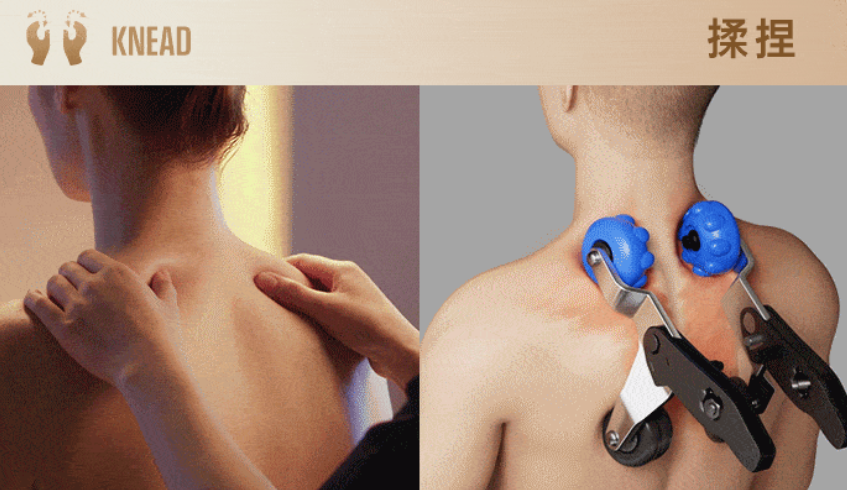
The 3D mechanism is usually treated as a marketing headline. In a scorecard, it is a deployment variable. ZHOUQI's mechanical 3D massage chair uses a mechanical 3D roller system that delivers direct hard contact for deep-tissue massage. Its maximum massage penetration depth is 8 cm for back muscle release. An airbag 3D massage chair, by comparison, extends to 4.5 cm, which means the airbag model's deep-tissue acting depth is approximately 44% lower. That difference is not simply a preference. In a venue where customers expect a strong back massage, the mechanical 3D option better matches the expectation. In a venue serving seniors or customers who prefer a soft, wrap-around sensation, an airbag 3D chair may fit the audience better.
The commercial side matters too. Compared with an airbag 3D massage chair, the mechanical 3D option carries an initial cost that is about $40 higher. On a single unit, that is a modest difference. Across a rollout of dozens of chairs in multiple venues, it becomes a per-unit line in the scorecard. The question is whether the deeper massage and the roller construction justify the higher unit cost in that specific venue class. The scorecard answers that question rather than burying it.
Safety design also belongs in the deployment axis, not only in compliance. ZHOUQI addresses the risk of children or pets getting stuck in the gap of massage chairs through an anti-pinch design. In shared pay-per-use venues where children may be present, that design detail should be scored positively because it addresses a foreseeable risk, and it is easier to justify to venue operators.
Scoring Deployment in Real Venue Types
Different venues reward different parts of the scorecard. A few representative patterns are useful when weighting criteria.
Malls and stations. High foot traffic, short dwell time, high cycle counts. Mechanism durability and maintenance cadence carry more weight. Power and grounding are often already in place, but the plug type must be checked, and the chair must sit on a level surface.
Airports. Long dwell time, high visibility, mixed audiences. Venue fit rewards models whose mechanism suits both quick relief and longer sessions. Service access matters, because downtime in a public terminal is visible.
Offices. Lower cycle counts but higher user expectations of comfort. An airbag 3D model can be a good fit where the audience prefers a softer sensation, while a mechanical 3D model suits offices whose users ask for deeper back massage.
Spas and wellness rooms. Dwell time is long and the experience is part of the product. Mechanism match and upholstery quality carry the most weight, and the $40 initial cost difference between mechanical and airbag 3D is trivial against the revenue per session.
Purchase Terms and Acceptance Criteria in the Same Table
Commercial terms belong in the scorecard because they determine how much of the market-access and deployment work survives into production. Three items should be written into the acceptance section rather than left to trust. First, the certificate numbers and scope must match the models being shipped: ETL 5030347, CE ENB2311240186E00401C, CB NO127967, FDA 3017618816, ISO 9001 02424Q32202999R1S and ISO 13485:2016 133640 are the identifiers that should appear on the documentation pack. Second, the electrical configuration — plug type, cable length and grounding arrangement — should be specified before production, not after arrival. Third, the acceptance test should include a run-in cycle on every unit, not a sample-only check.
Score purchase terms and acceptance criteria higher in projects with multiple venues or first-time supplier relationships. In repeat orders from an established supplier, the same line can carry a lower weight because the process is already proven.
Market Trends That Support the Two-Axis Method
The market context explains why the scorecard is worth building now. The global massage equipment market was valued at USD 11.6 billion in 2024 and is projected to reach USD 21.8 billion by 2033, according to Grand View Research. Within that, the massage chair market is projected to grow from USD 4.28 billion in 2026 to USD 8.78 billion by 2035 at a CAGR of 8.3%, according to Business Research Insights. Massage chairs and sofas held the largest share of the massage equipment market at 39.5% in 2024, and North America dominated the equipment market with a 36.9% revenue share in the same year.
Two implications follow. First, growth is not concentrated in a single region. North America remains the largest single market, while Asia Pacific is the fastest-growing region for massage chairs, holding a 34.8% share of the luxury segment in 2024. A supplier relationship that only opens North America will not serve a buyer expanding into EU, Middle East or Southeast Asia. Second, the standards landscape keeps moving. IEC 60335-2-32:2024 is the latest international safety standard specifically for electric massage appliances, and IEC 60335-2-116:2025 governs furniture with motorised parts such as zero-gravity massage chairs. A CE certificate referencing earlier versions remains valid for its scope, but buyers planning multi-year rollouts should confirm how the supplier tracks standard revisions, not only whether a certificate exists today.
Where the Scorecard Has Limits
A weighted scorecard improves a decision; it does not remove risk. Three limits should be stated plainly. The first is scope granularity. A certificate such as ETL 5030347 covers specific models and standard versions. If the model being ordered is not listed in the scope, the score for that criterion should not be granted, even if the same supplier holds the certificate for another chair. Buyers should require a model-by-model match, not a logo match.
The second limit is the difference between a management system certificate and a product certificate. ISO 9001 and ISO 13485:2016 show how the factory controls quality, traceability and corrective action. They do not certify that a particular chair in a particular shipment is safe. A scorecard that treats ISO 13485 as a substitute for ETL or CE will over-credit a supplier whose process systems are strong but whose product documentation is incomplete.
The third limit is site-level risk that no factory can resolve. Power sockets, grounding and plug compatibility are venue conditions. A CB certificate does not verify that a mall's existing circuit is properly earthed. A scorecard should record the site verification as a separate line item with evidence attached, not as a supplier attribute. Buyers who skip that step often end up with a compliant chair that cannot be switched on in the intended location.
Future Outlook
As massage chairs move deeper into shared pay-per-use venues, the scorecard will shift toward two questions. The first is how quickly a supplier can refresh certification as standards advance; the gap between IEC 60335-2-32:2019 and IEC 60335-2-32:2024 is a practical example of the kind of transition buyers will face on multi-year rollouts. The second is how well the deployment axis can be evidenced rather than assumed, through site verification, service records and run-in testing. A scorecard that treats these as first-class criteria will be easier to defend when the next procurement review comes around.
FAQ
What does ETL certification 5030347 cover for a 3D massage chair?
ETL certification 5030347, issued by INTERTEK, covers UL 1647:2015 Ed.6+R:30Jul2020 for the United States and CSA C22.2#68:2018 Ed.8+U1 for Canada. It is a dual-market certification, which means the same certificate can support placement in both countries, subject to the models listed in its scope.
How is CE certification different from CB certification for a 3D massage chair?
CE certification ENB2311240186E00401C, issued by EMTEK, covers EN IEC 55014-1:2021, IEC 60335-1:2010 and IEC 60335-2-32:2019, and supports placement in the EU market. CB certification NO127967, issued by Nemko, is issued under the CB scheme and can support approval in EU, Middle East and Southeast Asia markets where participating certification bodies accept the underlying reports. CE is an EU declaration supported by test reports; CB is an international report that local approvals can reuse.
What deployment factors should be scored before placing a 3D massage chair in a mall or airport?
Score the site's power socket, grounding and plug compatibility separately from the chair's features. Malls and airports typically involve high cycle counts and visible downtime, so mechanism durability, service access and maintenance cadence carry more weight than in low-traffic venues. The site should confirm that a grounded socket and a matching plug are in place before shipping, not after installation begins.
How does a mechanical 3D massage chair compare with an airbag 3D chair in deployment cost and sensation?
A mechanical 3D massage chair uses a mechanical 3D roller system that delivers direct hard contact for deep-tissue massage, with a maximum penetration depth of 8 cm for back muscle release. An airbag 3D chair provides 4.5 cm, roughly 44% lower deep-tissue acting depth, and delivers a softer wrap-around sensation. The mechanical 3D option carries an initial cost that is about $40 higher than the airbag 3D option. The choice should follow the venue's audience and its maintenance expectations, not a single metric.
What installation requirements apply to shared pay-per-use 3D massage chairs?
Installation requires a power socket that matches the chair's electrical configuration, correct grounding at the site and a plug that fits the local outlet. ZHOUQI addresses the risk of children or pets getting stuck in the gap of massage chairs through an anti-pinch design, which is relevant in public venues where children may be present. Site verification of the socket, ground and plug type should be recorded before the delivery date, since these conditions are outside the factory's control.
Reference material. The full ZHOUQI product catalogue covering 3D massage chair models, electrical configurations and deployment options is available for download: 2026 E-catalogue (PDF).
¿Tiene preguntas o necesita más detalles?
Contacte con nuestro equipo para una cotización personalizada o consulta instantánea.
Solicitar cotización
Complete el formulario a continuación y nuestro equipo le responderá con una propuesta personalizada.
Chat directo de WhatsApp
¿Prefiere chatear en tiempo real? Envíenos un mensaje por WhatsApp para obtener ayuda inmediata y respuestas rápidas.
- Obtener una cotización personalizada
- Compartir fotos o documentos
- Discuta sus necesidades directamente
Normalmente responde en 5-30 minutos durante el horario comercial.