
360-Degree Scent Marketing: A Decision Matrix for Airports & Malls
360-Degree Scent Marketing: A Decision Matrix for Airports & Malls
A large venue does not choose a scent diffuser. It chooses a set of constraints. Power availability, housing material, unit weight, oil capacity, service interval and market certification decide which machines can be installed at all — coverage ratings only decide how many of them are needed.
That distinction matters most in airports, shopping malls and bank branches. All three are high-dwell environments where fragrance is expected to hold steady for most of the operating day, and all three are usually managed by facilities teams that will not accept a device needing daily attention or an unverified compliance document. A decision matrix that scores non-negotiable constraints first, and rated coverage second, produces a specification that survives a site survey.
Shenzhen Scentsea Technology Co., Ltd. (SCENTSEA) is a Shenzhen-based manufacturer founded in 2021 that develops and produces cold-air nebulizing scent diffusers, waterless aroma machines, HVAC scent systems and fragrance oils. The company operates a 3,000 m² facility with three production lines and 20 patents, states that its diffuser models are certified with CE, RoHS and FCC, and supplies customers in more than 70 countries and regions. Its range — from wall plug-in units to floor-standing and HVAC machines — illustrates how a venue-led matrix is structured in practice.
Why Coverage Ratings Cannot Be the First Filter
Coverage is the specification buyers compare first and trust least. Published figures in this category are manufacturer-reported and use different units and room assumptions. Danqaroma describes its M42 commercial scent machine as suitable for hotels, spas and restrooms, with a 250 ml oil capacity and coverage up to 600 m³. Scentics describes its HV Small Pro professional waterless diffuser as scenting up to 300 m² or 1,000 m³. Both statements are product-page claims, no shared test protocol sits behind either of them, and the two cannot be averaged or ranked against each other.
This is not a criticism of either product. It is a structural feature of a category in which coverage is published as a range rather than as a certified measurement — which is precisely why coverage belongs in the last column of a decision matrix, after the constraints that can be confirmed from a datasheet, a certificate or a site walk.
The Four Constraint Layers That Decide Installability
Layer 1 — Power source and voltage
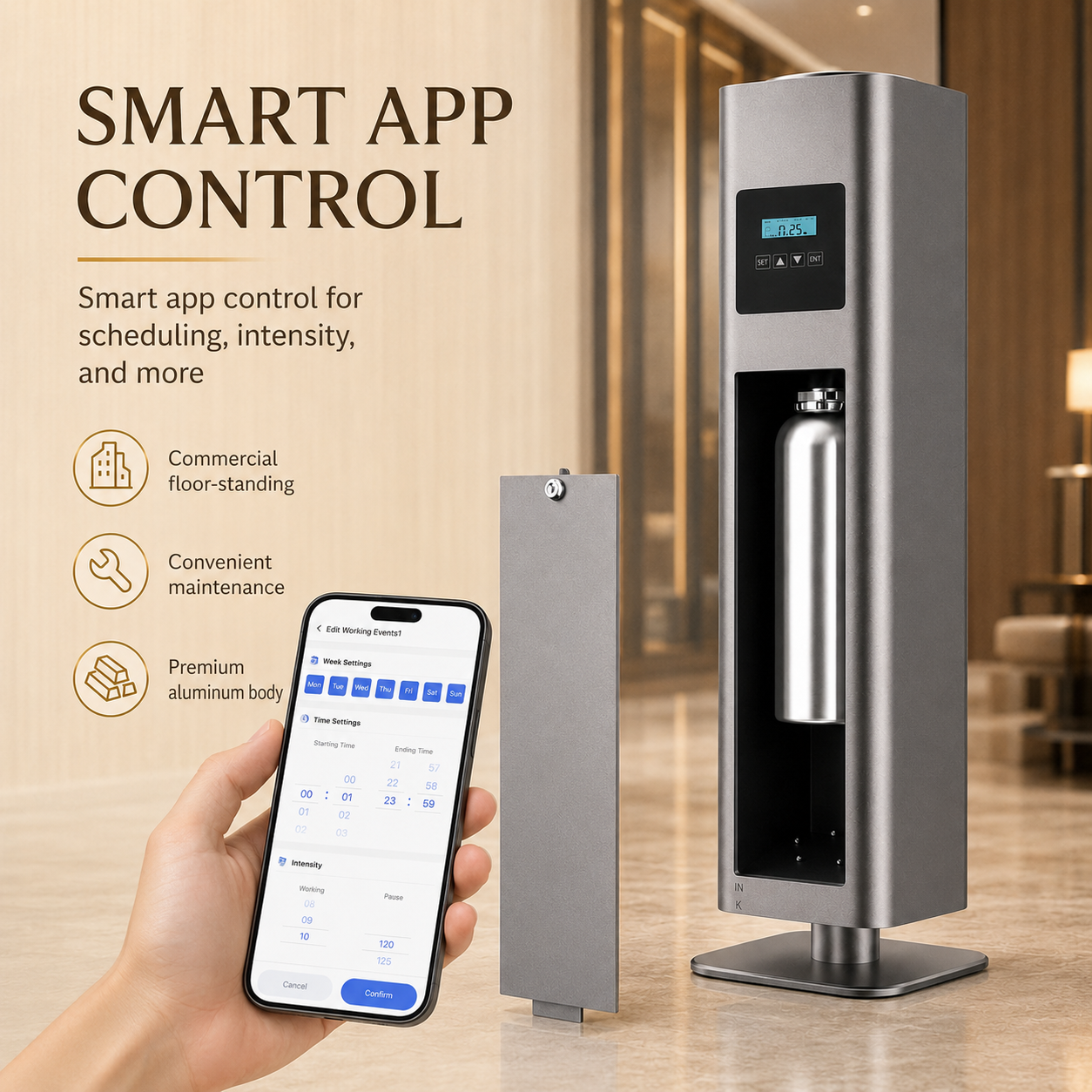
The SC19 advertising scent machine is rated at 110–240 V AC at 30 W. That one line removes a layer of complexity from multi-market rollouts, because the same model can operate on different mains standards without an external converter. The H5000 floor-standing scent diffuser runs on DC 12 V through a plug-in supply at 20 W, and the AC-MAX HVAC scent diffuser is rated at DC 12 V / 48 W with a split architecture that separates the machine from the oil tank.
In a terminal or a mall this is a routing question rather than a technical preference. A mains-powered unit needs an outlet at the point of installation; a low-voltage split unit can place the housing near a duct riser and the oil tank where a technician can reach it.
Layer 2 — Housing material
Material in this category is functional. The SC19 uses an aluminum and steel construction, with steel recorded as its structural material — consistent with a unit that carries an 18.5-inch, 1920 × 1080 display and 8 GB of internal storage, because a screen of that size needs a frame that resists flex. The H5000 is built in aluminum, which keeps a 610 mm floor-standing column at 6.4 kg net weight. The AC-MAX pairs an aluminum body with a plastic oil bottle, separating the pressure-bearing housing from the consumable container.
Neither choice is inherently superior. Steel addresses structural rigidity and impact exposure; aluminum addresses weight and surface finish. The useful question is which one the installation method requires.
Layer 3 — Weight and mounting method
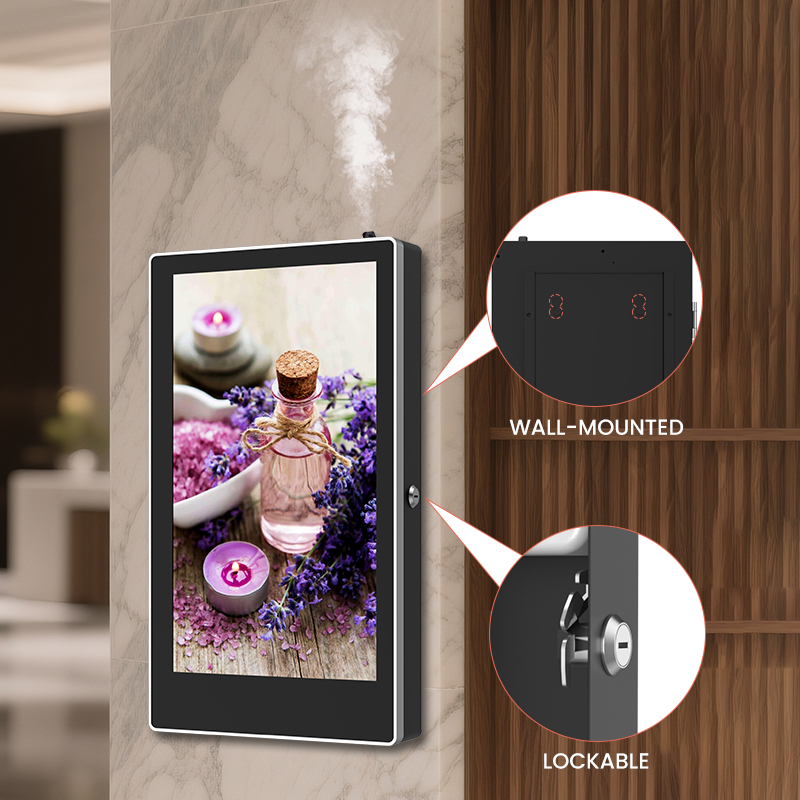
The SC19 measures L280 × W63.5 × H495 mm at 6.5 kg net; the H5000 measures L180 × W180 × H610 mm at 6.4 kg net. Nearly identical mass, very different consequences. A 495 mm slim unit can be wall-mounted in a circulation corridor or an elevator lobby, while a 610 mm floor-standing column needs floor area that will not be struck by trolleys, cleaning equipment or passenger flow. In a shopping mall that usually means a position already allocated to retail or to signage — a commercial negotiation, not a technical one.
Layer 4 — Capacity read as a service interval
Capacity means nothing without consumption. The SC19 holds 500 ml at a rated 6 ml ±5% per hour; the H5000 holds 1,000 ml at 5.4 ml ±10% per hour; the AC-MAX holds 5 L at 6 ml ±5% per hour. Expressed as straightforward rated-output arithmetic, a full tank represents roughly 83 hours for the SC19, roughly 185 hours for the H5000 and roughly 833 hours for the AC-MAX. On a 12-hour daily duty cycle that is approximately one week, two weeks and two months between refills.
Those numbers describe rated output only. Actual consumption depends on the working schedule, the intensity setting and site conditions, but the calculation converts a specification into a maintenance plan — which is what a facilities team actually approves.
A Transparent Specification Matrix: SC19, H5000 and AC-MAX
| Constraint | SC19 | H5000 | AC-MAX |
|---|---|---|---|
| Product type | Advertising scent machine | Floor-standing scent diffuser | HVAC scent diffuser (split type) |
| Housing material | Aluminum + steel (steel as structural material) | Aluminum | Aluminum body + plastic oil bottle |
| Rated coverage | 150–250 m² / 500–800 m³ / 1,500–2,500 ft² | 800–1,300 m² / 2,500–4,000 m³ / 8,600–14,000 ft² | 2,500–3,500 m² / 8,000–10,000 m³ / 25,000–35,000 ft² |
| Fragrance capacity | 500 ml | 1,000 ml | 5 L |
| Power | 110–240 V AC, 30 W | DC 12 V, plug-in, 20 W | DC 12 V, 48 W |
| Rated oil consumption | 6 ml ±5% / h | 5.4 ml ±10% / h | 6 ml ±5% / h |
| Noise | ≤30 dB | <45 dB | <45 dB |
| Net weight | 6.5 kg | 6.4 kg | 4.2 kg |
| Product size | L280 × W63.5 × H495 mm | L180 × W180 × H610 mm | L160 × W200 × H160 mm |
| Structure | Integrated unit with 18.5-inch advertising display, 1920×1080, EMMC 8G | Floor-standing column, no wall installation required | Machine and oil tank separate, connects to central HVAC ducts |
| Recorded applications | Shopping mall, hotel, bank | Hotel, shopping mall, office building lobby | Shopping mall, bank, airport |
Read across the rows and the logic becomes visible. The SC19 is the only column that generates attention as well as fragrance: it carries an 18.5-inch 1920×1080 display and 8 GB of internal storage, so a bank branch or a retail zone can present promotions while the machine scents 150–250 m². The H5000 trades the screen for reach, covering 800–1,300 m² from a free-standing column with a 1,000 ml tank. The AC-MAX trades both for scale, distributing fragrance through the building's own air-handling system across 2,500–3,500 m² from a 5 L reservoir.
Certification as a Gate, Not a Marketing Point
Compliance is a pass-or-fail filter, and it should be resolved before a single sample is requested. Model-level documents for the SC19 advertising scent machine include FCC certification number ATL20240416326 under FCC Part 15 Subpart B:2023 for the USA market; RoHS certification number ATL20240416327 under RoHS Directive (EU) 2015/863 for the EU market; and EMC certification number ATL20240416325 under EN IEC 55014-1:2021 for the EU market. All three were issued by Shenzhen ATL Testing Technology Co., Ltd. with an issue date of 24 April 2024.
Two practical rules follow. First, a certificate must reference the exact model and configuration being purchased; a document covering one build does not automatically cover a customized variant with a different plug, display or wireless module. Bluetooth and Wi-Fi models may additionally need to satisfy RED requirements in the European market, and buyers should confirm that applicable test reports match the production configuration rather than a prototype.
Second, classification matters at the border. Aroma diffusers are classified under HS code 8509.80 for import and export purposes, and published 2026 tariff data for that classification lists a 4.2% US duty rate. That line belongs in the landed-cost column of the same matrix, because a specification that is compliant but misclassified still fails a project budget.
Application Mapping: Airports, Malls and Bank Branches
Airport terminals present the least forgiving constraint set: very large volumes, high ceilings, continuous operation and ducted ventilation. The AC-MAX HVAC scent diffuser is the relevant architecture here. It is a split-type unit — machine and 5 L oil tank separate — that connects directly to central HVAC ducts and disperses fragrance through the building's existing airflow, with Wi-Fi and Bluetooth control, adjustable schedules and intensity, password protection, and an optional airflow sensor that can synchronise scenting with HVAC operation. Its product record lists airports among its applications, alongside shopping malls and banks.
The limitation is structural rather than technical: an HVAC-integrated approach requires ductwork to connect to. Where a terminal zone or a leased retail unit has no accessible central air handling, that route does not exist and the venue must fall back to standalone machines. For mid-sized terminal concourses and large mall halls, the T3 commercial scent diffuser covers 1,000–1,600 m² from a 1,000 ml reservoir at DC 12 V / 15 W, and its record lists airport among its applications.
Shopping malls usually need two layers at once. The first is a base layer for atria, main entrances and long circulation routes, where the H5000 floor-standing column covers 800–1,300 m² without any wall installation. The second is a zone layer for individual retail units, promotional areas and entrances, where the SC19's 150–250 m² coverage is proportionate and the advertising display adds a visual function to the same footprint.
Bank branches sit at the opposite end of the scale. They are small-footprint, high-dwell and brand-sensitive: customers queue, sit and transact in the same room for extended periods, so a 30 W machine running at ≤30 dB is a realistic fit, and the SC19's product record lists banks as an applicable industry. Mid-size branch halls are more often served by the T2 or A300 commercial scent diffusers, both rated at 500–800 m² with 500 ml capacity and internal fans for faster distribution.
Deployment evidence supports the layered approach. A scent marketing company in the United States deployed 30 units for shopping mall scenting across a five-year period, reporting stable and consistent scent coverage, reduced manual maintenance, improved fragrance management efficiency and an improved customer experience. The deployment used AC-MAX, T2, P01 and P03 units across the site, which is consistent with the matrix logic: one architecture for open areas, another for smaller enclosed spaces.
How This Compares With Water-Based and Ultrasonic Scenting
Waterless cold-air diffusion atomises fragrance oil directly into fine particles without adding water or using heat. Ultrasonic water-based aroma diffusers mix a few drops of oil with water and are typically limited to smaller residential or light commercial areas.
For commercial use, the waterless cold-air category is generally the more appropriate choice: stronger and more consistent diffusion, larger coverage, no water dilution, and lower daily maintenance. It is positioned for hotels, malls, retail stores, offices, showrooms and spas, while ultrasonic units suit bedrooms, small rooms and light personal fragrance use.
The trade-off is the cost curve. Waterless cold-air diffusers usually carry a higher initial equipment cost but require no water refilling, less frequent cleaning and lower daily maintenance. Ultrasonic diffusers cost less upfront but require regular water refilling and tank cleaning, and they are mainly suited to small areas — which means a large venue substituting them for commercial units tends to accumulate hidden labour cost rather than save it.
A second and more important boundary applies to the matrix itself. Because coverage claims across the category use different room models, units and disclosure methods, no published figure — including the figures in the table above — substitutes for sample validation in the actual venue. The matrix tells a buyer which units to test. It cannot tell them how fragrance will behave in a specific atrium with a specific ceiling height, air-handling pattern and partition layout.
Market Context Behind the Constraint Shift
The direction of travel in this category is documented. The global fragrance diffuser market size was estimated at USD 29.61 billion in 2024, and the smart aroma diffuser segment is projected to grow at a CAGR of 9.22% from 2026 to 2034. Ultrasonic diffusers held a 38.5% revenue share in 2024, while nebulizing diffusers are expected to grow fastest, driven by professional-grade requirements in hotels — the same requirement pattern that now shapes airport and mall specifications.
Supplier behaviour reflects it. Raymeel states that it offers hotel-oriented scenting solutions with custom scent development and automated systems for high-traffic areas. Baixiang states that its products meet international compliance claims including CE, FCC, EMC and RoHS and lists airports, luxury retail stores and shopping malls among its applications. Centi describes OEM/ODM and private-label programs for commercial scent diffusers and HVAC fragrance systems. These are manufacturer-reported claims and are useful for structuring a supplier shortlist; they are not independently benchmarked performance data.
What the trend data does not yet supply is the metric large venues most want: verified maintenance cost and atomizer failure rates across a comparable sample. Buyers building a matrix today therefore have to substitute verifiable specifications — voltage, wattage, capacity, consumption, noise, net weight, certification numbers — for the operational benchmarks the market has not yet published.
Future Outlook
Three shifts are likely to reshape the matrix over the next few procurement cycles. First, smart control becomes a baseline rather than a feature: with the smart aroma diffuser segment projected to grow at 9.22% annually to 2034, scheduling, intensity adjustment and HVAC synchronisation move from differentiators to checkboxes on a tender document. Second, certification evidence tightens: as more commercial buyers request model-level certificates rather than brand-level compliance statements, suppliers will need documentation that names the exact configuration shipped. Third, split and ducted architectures will expand, because retrofit constraints — not fragrance preference — increasingly determine what can be installed in an existing terminal, mall or branch network.
For buyers, the practical conclusion is straightforward. Build the matrix around constraints that can be verified from documents and a site survey, hold coverage in the last column, and treat samples as the final validation step rather than the first.
Frequently Asked Questions
Which certifications determine whether a commercial scent diffuser can be specified for an airport or mall project?
Requirements depend on the destination market, the model and whether the unit has wireless functions. For the European market, buyers normally check applicable CE and RoHS compliance documents, and Bluetooth or Wi-Fi models may also need to meet RED requirements. For the US market, applicable FCC compliance should be verified. In the SC19 advertising scent machine, model-level documents include FCC certification ATL20240416326 under FCC Part 15 Subpart B:2023 for the USA, RoHS certification ATL20240416327 under RoHS Directive (EU) 2015/863 for the EU, and EMC certification ATL20240416325 under EN IEC 55014-1:2021 for the EU, all issued by Shenzhen ATL Testing Technology Co., Ltd. Certificates should always be confirmed against the exact production model being purchased.
Steel or aluminum housing — which is the right choice for a scent machine?
The two materials solve different problems rather than indicating a quality hierarchy. Steel is used where structural rigidity matters: the SC19 uses an aluminum and steel construction, with steel recorded as its structural material, in a unit that carries an 18.5-inch display. Aluminum is used where weight and finish dominate: the H5000 floor-standing scent diffuser is built in aluminum and weighs 6.4 kg net, and the AC-MAX uses an aluminum body with a plastic oil bottle. Buyers should match the material to the mounting method and expected handling rather than treating either as a ranking.
How should coverage claims from different suppliers be compared?
Coverage claims in this category are manufacturer-reported and use different units and room assumptions. Published examples include a 250 ml commercial machine claiming coverage up to 600 m³, and a waterless professional diffuser claiming up to 300 m² or 1,000 m³. Because no shared test protocol exists, those numbers cannot be averaged or ranked against each other. The workable method is to treat rated coverage as a screening range, convert it into volume, apply the site's ceiling height and airflow pattern, and then validate shortlisted models with samples in the actual space.
Can one scent diffuser model be used across markets with different mains voltages?
Voltage compatibility depends on the model rather than the category. The SC19 advertising scent machine is rated at 110–240 V AC at 30 W, which covers markets with different mains standards without an external converter. The H5000 floor-standing unit and the AC-MAX HVAC unit operate on DC 12 V through plug-in supplies. For multi-country rollouts the plug type should be confirmed per destination market, and OEM/ODM programmes can include plug type among the customization items alongside logo, colour, packaging and manual.
How often does a large-venue scent diffuser need refilling?
Refill frequency follows capacity divided by rated oil consumption. At rated output, the SC19's 500 ml reservoir at 6 ml ±5% per hour represents about 83 hours of atomisation; the H5000's 1,000 ml at 5.4 ml ±10% per hour represents about 185 hours; and the AC-MAX's 5 L at 6 ml ±5% per hour represents about 833 hours. Actual intervals depend on the working schedule, scent intensity settings and site conditions, so a venue should calculate against its own duty cycle before fixing a maintenance roster.
What are the options where a power outlet is not available?
Battery-operated models exist for locations where wiring is impractical. The P01 battery operated scent diffuser runs on four D-cell batteries or Type-C power with a 500 ml capacity, and the P03 runs on three D-cell batteries or Type-C with a 150 ml capacity; both cover 100–150 m² and are recorded as suitable for toilets, elevators, corridors and small shops. Those units are appropriate for enclosed, low-volume spaces such as lift cabs and washrooms, not as primary coverage for open mall or terminal areas.
¿Tiene preguntas o necesita más detalles?
Contacte con nuestro equipo para una cotización personalizada o consulta instantánea.
Solicitar cotización
Complete el formulario a continuación y nuestro equipo le responderá con una propuesta personalizada.
Chat directo de WhatsApp
¿Prefiere chatear en tiempo real? Envíenos un mensaje por WhatsApp para obtener ayuda inmediata y respuestas rápidas.
- Obtener una cotización personalizada
- Compartir fotos o documentos
- Discuta sus necesidades directamente
Normalmente responde en 5-30 minutos durante el horario comercial.