
304 vs 316 Stainless Steel Balls for Food-Safe Valve and Conveyor Use
304 vs 316 Stainless Steel Balls for Food-Safe Valve and Conveyor Use
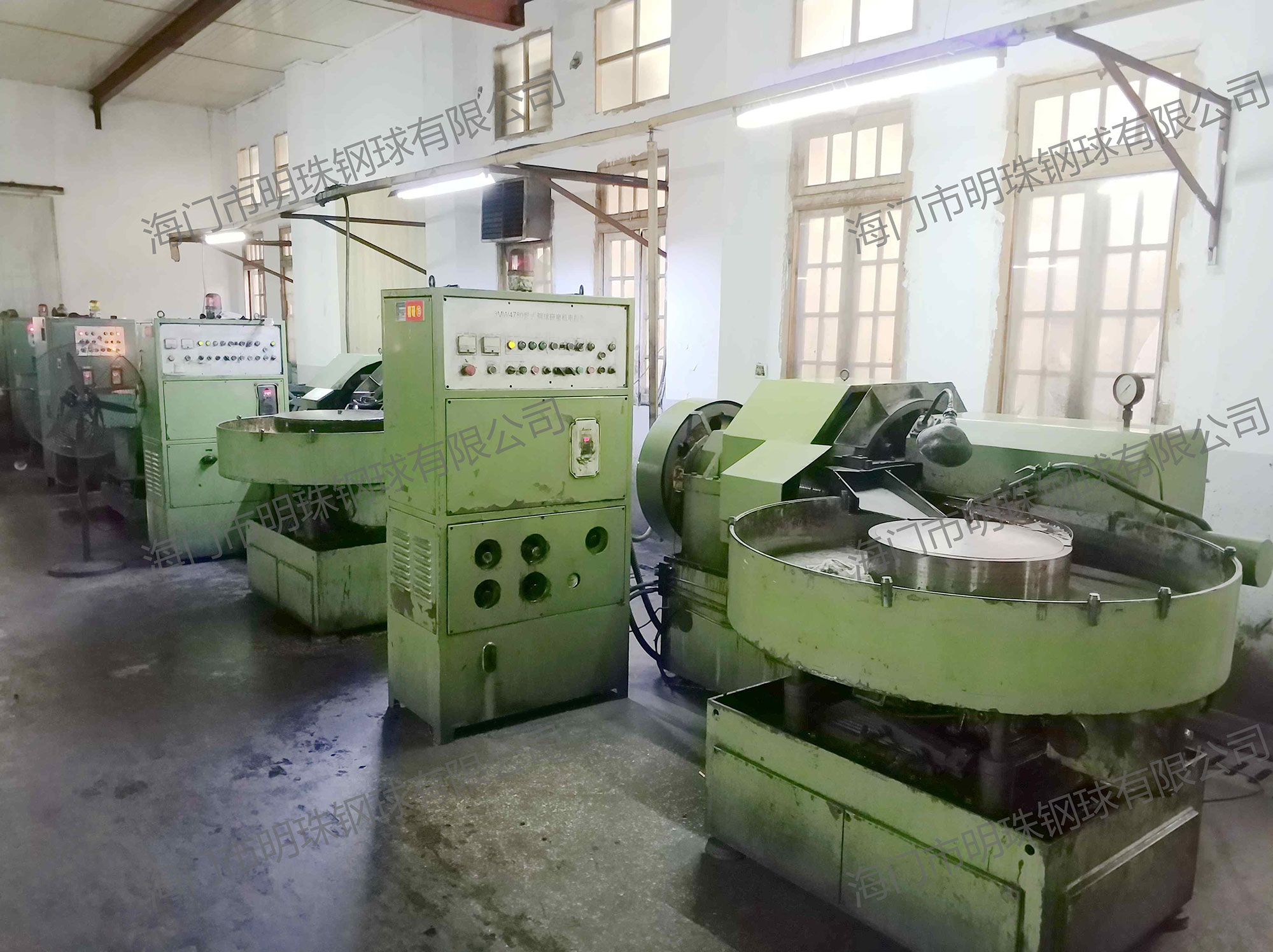
Finishing and polishing determine whether a stainless ball presents a cleanable, defect-free surface in food-contact service.
In food, dairy and beverage plants, a stainless steel ball is rarely bought as a component in its own right. It arrives inside equipment that has already been selected — a filling valve, a hygienic ball transfer table, a CIP-cleanable conveyor — and it then spends its working life in the product-contact zone, cycling on every actuation, sitting under washdown spray and passing through cleaning-in-place routines designed to strip everything organic off the line.
That makes the recurring question — 304 or 316 stainless steel balls — a hygiene, corrosion and documentation question rather than a commodity price question. The answer changes depending on whether the ball is acting as rolling media in a transfer table, as the sealing element in a filling valve, or as a wear surface in a wet conveyor line. This reference compares the two austenitic grades on verified product data, identifies where each is defensible, where both are the wrong choice, and what evidence a buyer should expect to receive with the shipment.
Why Grade Selection Is a Compliance Decision
Food and beverage processing equipment is typically specified for food contact, mild detergents, frequent washdown and a working band of roughly 5–90 °C, with continuous but low-to-medium speed movement in a wet environment. Within that envelope, the material requirement is usually expressed as food-safe stainless, a cleanable surface and basic corrosion resistance, with material selection carried out on an FDA-aware basis. The phrase matters: FDA-aware describes a material-selection process rather than a certificate, and it leaves final validation of food-contact compliance with the equipment builder or the processor.
Two failure modes drive most field problems. The first is crevice and pitting corrosion, which usually starts in the gap between the ball and its seat or track and is accelerated by chlorides from product, sanitizers or wash water. The second is surface condition: a ball carrying pits, embedded contamination or a rough finish creates retention sites that no washdown schedule clears reliably. Both are material-and-surface decisions, and both are visible in supplier product data — which is where 304 and 316 separate.
The Technical Difference Between 304 and 316
Both grades are austenitic stainless balls. In the manufacturer's product data, the 304 stainless steel ball is an austenitic ball made of SS304, offered from 1 mm to 50.8 mm in grades G100 to G1000 in the annealed-soft condition, with mirror polish available. The 316 stainless steel ball is also austenitic, made of AISI 316 / UNS S31600, with the same 1 mm to 50.8 mm range and G100 to G1000 grades, and is described as having excellent chloride resistance. The wider stainless family data adds that the austenitic range extends from 0.5 mm to 50.8 mm (0.020–2.000 in), is supplied in ABMA precision grades G10 to G1000 with a fine Ra surface finish, and sits at HRC 25–39 in the annealed, soft condition.
Chemistry is what separates them. Compared with 304, 316 carries additional molybdenum — in the order of 2–3% Mo — and a higher nickel content of roughly 10–14% Ni. The practical effect is captured by the pitting resistance equivalent number: the 316 grade is commonly placed at a PREN of about 23–28, against roughly 18–20 for 304. That gap is the entire argument for 316 in a food plant. It is the same soft austenitic rolling element, with a materially larger tolerance for chlorides.
| Attribute | 304 Stainless Steel Ball | 316 Stainless Steel Ball |
| Material designation | SS304 | AISI 316 / UNS S31600 |
| Metallurgical structure | Austenitic | Austenitic |
| Diameter range | 1 mm – 50.8 mm | 1 mm – 50.8 mm |
| Precision grades | G100 – G1000 | G100 – G1000 |
| Condition / hardness | Annealed soft; HRC 25–39 for the austenitic family | Annealed soft; HRC 25–39 for the austenitic family |
| Surface | Mirror polish available | Bright cleanable surface; passivation available |
| Chloride behaviour | General, low-chloride service | Excellent chloride resistance; PREN about 23–28 vs 18–20 |
| Documented application fields | Food & beverage equipment, plumbing valves, decorative hardware, architectural fittings, cryogenic tanks | Marine hardware, chemical processing, pharmaceutical & food equipment, offshore rigging, saltwater valves |
| Commercial positioning | The economical austenitic choice | The chloride-resistant upgrade |
Where 304 Is Defensible — and Where It Is Not
304 is the economical choice for indoor, freshwater, dry-food and decorative service. For a hygienic ball transfer table in a dry or low-moisture zone, a freshwater-washed line running mild detergents, or a filling valve whose product chemistry is neutral and whose cleaning cycle is short, 304 delivers the required cleanability and basic corrosion resistance at a lower material cost. The dairy-processing scenario data makes the same point from the equipment side: it specifies an economical food-grade stainless with a bright cleanable surface and general — not aggressive — corrosion resistance for ball-transfer tables, dairy fillers and food-grade check valves.
316 is specified when the environment stops being benign: coastal plant air, chloride-bearing product, high-chloride or chlorinated cleaning chemistry, pharmaceutical and chemical service, and any position where the ball must survive repeated sanitizer cycles without pitting. Product data places 316 in marine hardware, chemical processing, pharmaceutical and food equipment, offshore rigging and saltwater valves — a distribution that tracks chloride exposure rather than food contact alone.
The more important boundary is shared by both grades. 304 and 316 are soft austenitic balls. In the manufacturer's data the austenitic family is supplied annealed at HRC 25–39, deliberately below the hardness of the martensitic and through-hardened options. A food-safe ball valve actuated against a hard seat under load, or a conveyor position where the ball carries repeated point loading, is not automatically a 304 or 316 application. For wear-driven duty the hardened alternatives are martensitic stainless 440C at HRC 58–62, martensitic 420C at HRC 50–55 for mild corrosive environments, or through-hardened chrome steel 52100 at HRC 60–66 with an Ra of ≤ 0.05 µm. None of those three is interchangeable with 304 or 316 on corrosion grounds — which is precisely the trade-off a buyer should make explicitly rather than by default.
Cleanable Surface: What to Specify
Cleanability is a surface specification, not a grade specification, and it is where two balls of identical material behave very differently in service. In the 304 product data, mirror polish is available; the wider stainless family data records a fine Ra finish for the austenitic grades. In pharmaceutical-adjacent processing the requirement is stated more tightly: pharmaceutical-grade surface finish is described at Ra ≤ 0.8 µm, with a 316L low-carbon option and 3A / EHEDG awareness in the system design.
Buyers who cannot specify Ra directly can still specify the outcome. A production flow that ends in precision grinding and lapping, followed by 100% automated machine-vision inspection for size, roundness and surface defects, is a reasonable proxy for a cleanable surface. The manufacturer in this comparison operates precision grinding and lapping lines, roller bar sorting equipment and photoelectric surface defect detectors, and applies automated machine-vision inspection to 100% of output for dimension, roundness, surface and material verification. For food-contact use, the surface inspection record is the document worth requesting alongside the material certificate. A compliant grade with a defective surface is not a compliant component.
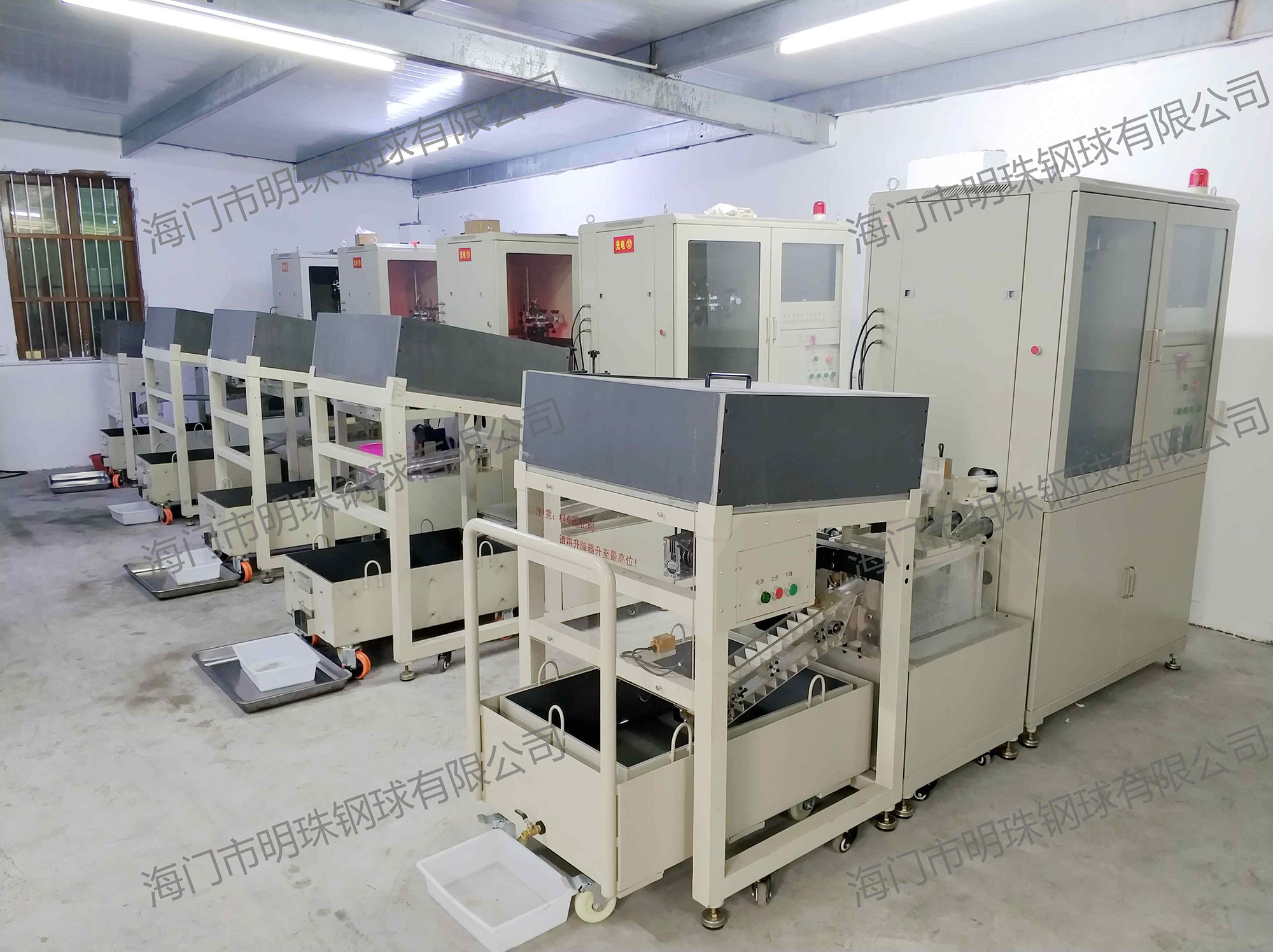
Surface defect detection is a food-safety control: pits and finish defects create retention sites that washdown cannot clear.
Fitting the Ball to Hygienic Ball Transfer Tables, Filling Valves and CIP-Cleanable Conveyors
The food and beverage processing scenario data describes the envelope these three equipment types share: food contact, mild detergents, frequent washdown and 5–90 °C, with continuous low-to-medium speed movement in a wet environment. The matched equipment list names hygienic ball transfer tables, filling valves and CIP-cleanable conveyors, and the stated special requirement is food-safe stainless, a cleanable surface, basic corrosion resistance and FDA-aware material selection.
Each equipment type loads the ball differently. In a hygienic ball transfer table, the ball is a rolling element under distributed load, where grade and sphericity dominate and 304 is frequently sufficient. In a filling valve, the ball acts as a sealing or shut-off element, where concentricity, surface finish and seat corrosion resistance matter more than rolling precision. Where flow must pass through the ball, drilled steel balls are produced through-drilled or tapped in AISI 52100, 304 or 440C, typically in stock sizes from 6 mm to 50.8 mm, with hole diameter, hole position, chamfer and tolerance manufactured to drawing and verified by CMM — the practical requirement for drilled balls in specialized ball valves. In a CIP-cleanable conveyor, the ball is exposed to chemistry as much as to load, and grade selection returns to the chloride question.
An adjacent market shows how the logic scales. A biopharma and specialty chemical equipment maker purchased 50,000 pieces for high-purity ball valves and reactors across a three-year relationship, working with an ultra-corrosion-resistant alloy, material certificates and clean-process compatibility to meet aggressive process chemistry while maintaining hygienic integrity. The hygienic requirement and the corrosion requirement were solved together; neither was traded for the other.
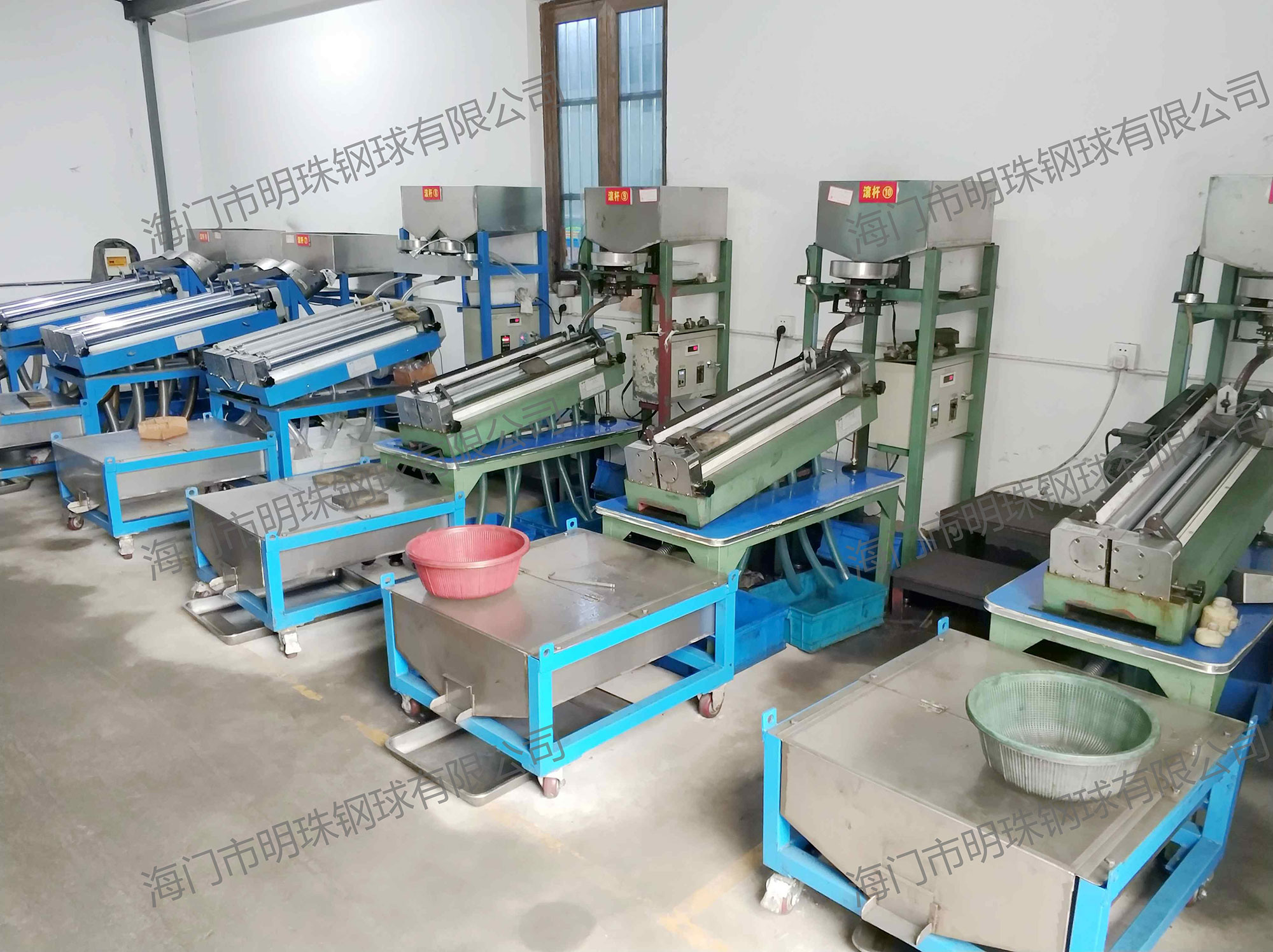
100% automated sorting closes the loop between a specified grade and the surface actually delivered in a food-contact position.
Manufacturer Profile: Haimen City Mingzhu Steel Ball Co., Ltd.
Haimen City Mingzhu Steel Ball Co., Ltd. (www.hmmzsteelball.com) is a steel ball manufacturer founded in 1992 and located in Haimen, Jiangsu Province, China, producing bearing steel balls, chrome steel balls, stainless steel balls, carbon steel balls and a range of custom geometries for industrial buyers. The company operates a 7,500 m² production base with 105 sets of processing equipment, a stable annual production capacity of 2,500 tons, 40 employees and an eight-engineer R&D team, and reports an export ratio of 25% with the United States, Germany and Brazil identified as main markets.
For the two grades in this comparison, the manufacturer supplies 304 stainless steel balls at a monthly capacity of 10 tons and 316 stainless steel balls at 20 tons, both under factory OEM/ODM arrangements. Customisation covers size, grade, packaging type and quantity, light-oil or dry packing, passivation and custom marking. Standard 304 sizes are usually in stock with a 7–15 day lead time; standard 316 sizes are mostly stocked with a 10–20 day lead time; non-standard sizes run 20–45 days depending on quantity. Both grades are supported by selection guidance, samples and MTR or COA documentation, and quality control applies automated machine-vision full inspection covering size, roundness, surface, hardness and material verification.
The company holds IATF 16949:2016 certification issued by URS under certificate number 130673/A/001/SM/En, issued on 14 December 2023 and valid to 13 December 2026. The certified scope is the manufacture of bearing steel ball, and it explicitly excludes product design under Clause 8.3. That scope statement is worth reading carefully, because it defines what the certificate does and does not cover.
Verification, Documentation and the Limits of the Claim
Three boundaries should be stated plainly.
First, the IATF 16949:2016 certificate covers the manufacture of bearing steel balls and excludes product design. It is evidence of a controlled manufacturing and inspection system; it is not a food-contact approval, and it is not a design service.
Second, food-contact compliance remains a buyer-side validation. Material selection can be described as FDA-aware, and the manufacturer can supply a material test report to EN 10204 2.1 or 3.1, a certificate of analysis, and on request PPAP, FAI, NACE MR0175 and AMS documentation, together with PMI material verification. What these documents do is make the material and its processing traceable. Whether a finished valve or conveyor complies with the applicable food-contact rule in the destination market is still the equipment builder's or processor's determination, because it depends on the entire assembly, the cleaning regime and the product being handled.
Third, neither 304 nor 316 is a wear solution. Both are annealed austenitic balls at HRC 25–39. Where hardness governs, the hardened stainless and chrome options above are the correct starting point, and the corrosion-versus-hardness trade-off has to be resolved before the purchase order rather than after a premature failure.
Market Context: A Specification-Driven Niche Inside a Large Commodity Market
The commercial backdrop is a large commodity market with a comparatively small, specification-driven technical segment. The global steel ball market is estimated to reach a value of USD 12.91 billion by 2026. Chrome steel balls are projected to hold a 45.7% share of the material segment in that same year, which indicates how much of the total volume is attributable to bearing and general industrial demand rather than to hygienic stainless applications. Growth projections diverge: one forecast puts the market CAGR at 5.2% for 2026–2035, while other published estimates for the same period range from 3.6% to 6.2%, with the difference attributed to how heavily each methodology weights mining grinding media against small precision balls. For a food-plant buyer, the useful reading is that hygienic stainless balls are a specialist niche whose standards are set by equipment specification and documentation requirements rather than by market volume.
Two reference points frame that documentation environment. ISO 3290-1:2014 specifies requirements for finished steel balls for rolling bearings and defines grades from G3 to G700 — the vocabulary most buyers already use when they quote a precision class. ASTM A295/A295M covers the high-carbon bearing-quality steel used for anti-friction bearings. Steel balls are classified under HS Code 8482.91 for trade purposes, the line customs entries for these shipments follow.
Future Outlook
Two directional shifts are visible. On the equipment side, hygienic design practice continues to push toward shorter cleaning cycles, lower-residue surfaces and documented cleanability, which raises the value of a specified surface finish and a verifiable inspection record relative to a simple material name. On the supply side, documentation is becoming the differentiator: material test reports, PMI verification, precision-class reports and lot traceability are now routine requests rather than premium options, and suppliers who cannot produce them are increasingly excluded from hygienic projects before price is even discussed.
For 304 and 316 balls specifically, the likely outcome is a clearer split rather than a substitution. 304 should continue to own dry, neutral and freshwater food-handling duty, while 316 consolidates chloride-bearing, coastal and cleaning-intensive service — with the hardened martensitic and chrome grades absorbing the wear-driven valve positions that the austenitic grades were never designed to carry.
FAQ
Which is better for my application, 304 or 316 stainless steel balls?
304 is the economical choice for indoor, freshwater, dry-food and decorative service. 316 adds approximately 2–3% Mo and 10–14% Ni, giving a PREN of about 23–28 against roughly 18–20 for 304, and is the appropriate grade for seawater, coastal, chloride, CIP, pharmaceutical and chemical service. Both are soft austenitic balls; for high-load wear, 440C or 52100 is the correct starting point rather than either austenitic grade.
What diameter sizes and tolerance grades can be provided?
Diameter range is typically 0.5–50.8 mm (0.020–2.000 in) across the stainless range, with the 304 and 316 product data listing 1 mm to 50.8 mm. Metric and inch series are both available, with non-standard decimal sizes produced to drawing. Precision grades follow ABMA / ISO 3290 from G3 to G1000, with G10–G25 as the precision range and G100–G1000 as the common production range; the 304 and 316 austenitic balls are listed at G100–G1000. Roundness, diameter variation and surface finish are reported by grade.
Can hardened balls be supplied for food-equipment duty, and what hardness is achievable?
Yes. Chrome steel 52100 is through-hardened to approximately HRC 60–66; martensitic stainless 440C is listed at HRC 58–62 in product data, with hardness control maintained within HRC 58–65; martensitic 420C runs HRC 50–55 for mild corrosive environments; and M50 reaches HRC 62–66 with high-temperature stability. Hardness, heat-treatment condition and microstructure are controlled by batch and reported on the material test report. Higher hardness and maximum corrosion resistance are generally traded against each other, so the dominant failure mode of the application should drive the selection.
Can non-standard, drilled or threaded steel balls be made to drawing?
Yes. Non-standard diameters to decimal size, drilled through or blind, tapped threads in metric and UNC/UNF, stepped, half-spherical and hollow balls are produced to drawing, with hole diameter and position, ball size, material, tolerance and chamfer specified by the customer. Drilled steel balls are typically made in AISI 52100, 304 or 440C, with typical stock sizes of 6 mm to 50.8 mm. Hole position, size, dimension, surface and hardness are verified by CMM and machine-vision inspection. Soft materials such as 304 are easier to machine than hardened 440C or M50, which affects tooling and lead time.
How are the balls inspected and what quality documents are provided?
Every batch passes through 100% automated machine-vision sorting for size, roundness, surface defects and appearance, supplemented by hardness, roundness, microstructure, roughness and material verification including PMI or chemical analysis. Documents include the material test report, EN 10204 2.1 or 3.1, and a certificate of analysis, with PPAP, FAI, NACE MR0175 and AMS certificates available on request. General-purpose acceptance follows ABMA and ISO standards.
What is the minimum order quantity, and can samples be ordered?
Standard catalog sizes carry a low minimum order quantity and can be ordered by the bag or piece, with samples available. Non-standard and CNC-machined balls typically start from 50–500 pieces depending on setup; prototype quantities of 10–50 pieces are workable for simple parts, and the minimum order quantity is from 100 pieces for G3–G10 precision grades. MOQ is described as flexible for first-time cooperation and NDA projects.
What is the lead time, and can supply be maintained steadily?
Standard sizes and common materials are often in stock and can ship in 5–10 days. Standard production runs 15–30 days, and non-standard sizes, special alloys or CNC features take 20–60 days depending on tooling and inspection. The manufacturer maintains rolling stock and backup tooling for repeat supply and provides monthly production status updates.
Reference Document
Detailed product specifications, capability data and quality documentation are compiled in the manufacturer's reference brochure, available as a PDF: Haimen City Mingzhu Steel Ball product and capability brochure.