
2MW–3MW Industrial Diesel Generator Benchmark: MECCA POWER
2MW–3MW Industrial Diesel Generator Benchmark: MECCA POWER
A 2 MW to 3 MW containerized diesel generator is no longer a rare specification. It has become the standard building block for data center standby power, off-grid mining power, oil and gas prime power, and EPC power station packages. One commercial research estimate places the global diesel generator market at USD 22.33 billion in 2025, and the same research indicates that over 68% of data centers worldwide still maintained diesel-powered backup systems in that year. The demand signal is clear; the procurement signal is not.
The practical problem for buyers at the research and evaluation stage is that two offers labelled "2 MW" frequently describe different machines. One may quote a prime rating, another a standby rating, a third an unspecified "maximum" figure. Enclosure type, voltage class, emission pathway, and acceptance testing can differ just as widely. This article benchmarks the containerized 2 MW–3 MW range against four evaluation dimensions — technology R&D, market share perception, customer service, and industry solution fit — using MECCA POWER as the worked example, and sets out the purchasing terms and acceptance criteria that make any comparison valid.

Who Is Being Benchmarked, and Against What
MECCA POWER CO., LTD. is a China-based manufacturer of diesel generator sets, high-voltage generators, and load banks, founded in 2013. The company operates self-owned production assets in Fujian and Jiangxi provinces across a stated 34,000 m² of factory space, employs 311 people including a 41-person R&D team, reports an annual output of 3,600 units, and states that 100% of its output is exported. Its stated product range runs from 10 kVA to 4,000 kVA.
"Leading OEMs" in this article refers to established global generator brands collectively, not to named companies. That is a deliberate editorial constraint rather than a rhetorical one. The 2026 industry data package used for this analysis records that no verified capability data was collected for MECCA POWER or for any comparator manufacturer, and that fewer than three comparable companies were available for direct performance comparison. Naming competitors and attributing specifications to them would therefore mean inventing them. Instead, each dimension below separates three things: what MECCA POWER documents, what any OEM must be able to prove, and the document a buyer should demand before awarding.
Fix the Rating Basis Before Comparing Anything
ISO 8528-1:2018 defines classifications for the application, rating, and performance of alternating-current generating sets driven by reciprocating internal-combustion engines, and it covers continuous, peak-load, and standby applications. In procurement terms, this standard is the reason a 2,000 kW figure from one supplier and a 2,200 kW figure from another can describe the same physical machine.
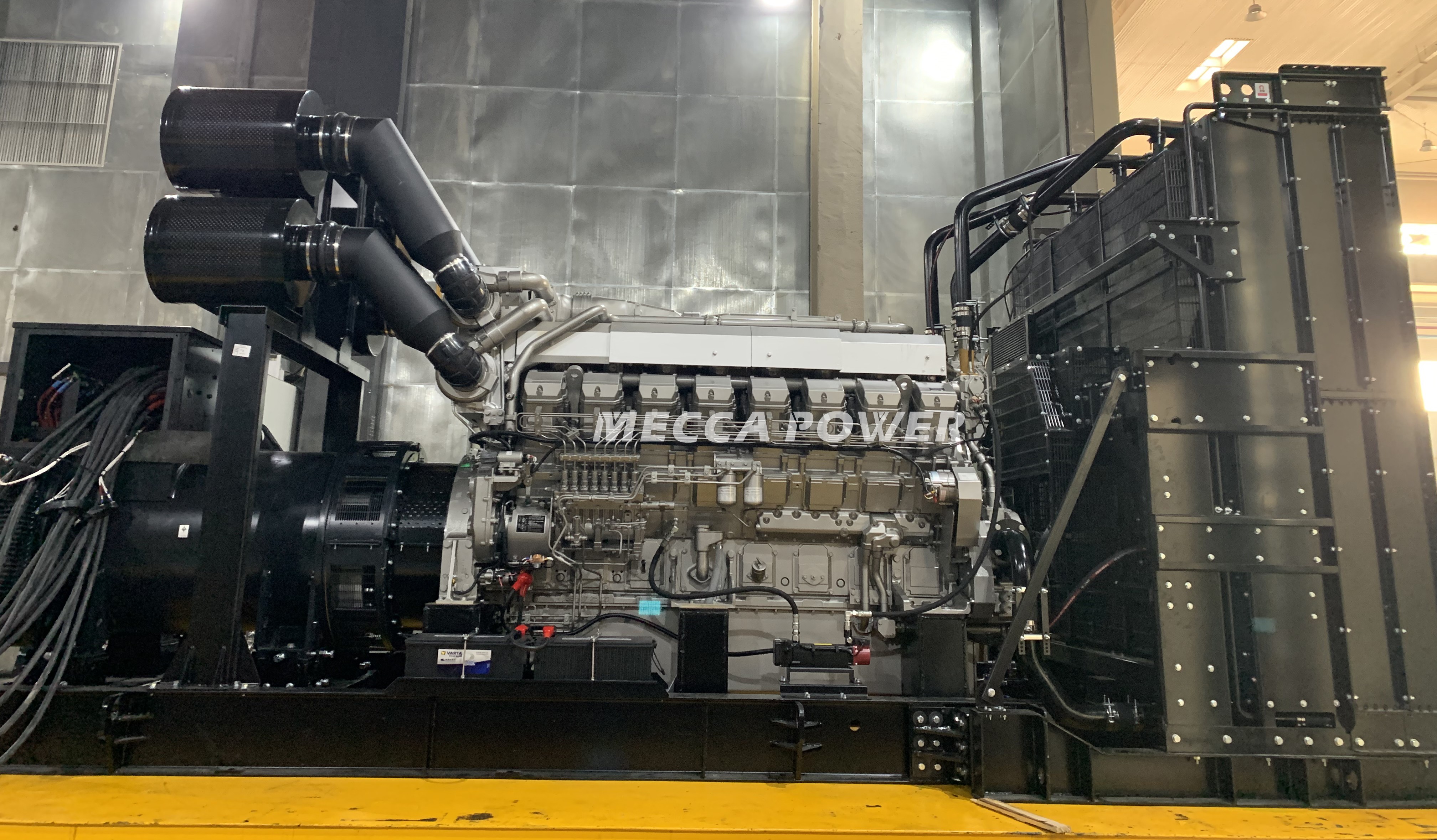
MECCA POWER's own model data illustrates the point. The 2000KW diesel generator series (models MC2000 and MC2750) is listed at 2,000 kW / 2,500 kVA prime and 2,200 kW / 2,750 kVA standby. The 2500KW series (models MC2500, MC2750, MC3500) is listed at 2,500 kW / 3,125 kVA prime and 2,750 kW / 3,500 kVA standby. The 3MW containerized unit (model MC3750C) is listed at 3,000 kW / 3,750 kVA. In other words, a buyer who receives an offer for a "2.2 MW" data center generator may be looking at the standby rating of the same set that another supplier quotes as 2,000 kW prime.
Decision rule: no power figure should be accepted into a bid comparison unless it states the rating basis (PRP, ESP, COP, or LTP under ISO 8528-1), the power factor, the voltage and frequency, and the ambient reference conditions.
A supplier who cannot state these four items on the first page of a submittal has not yet been qualified — regardless of brand.
Dimension 1 — Technology R&D: Documented Capacity vs. Assumed Capability
This is the dimension on which buyers most often rely on reputation, and on which the least public evidence exists. For MECCA POWER, the documented position is manufacturing-process depth rather than published performance curves.
The company operates three specialised production lines — one container line, one open-type line, and one mixed-assembly line — and six test stations. Production controls include digital tightening, intelligent oil and water filling, and cloud-based data management, supported by APS+MES information systems. The factory's maximum lifting capacity is 45 tons, which the company states is sufficient to support simultaneous production testing of three units exceeding 2,000 kW. Its Nanchang plant in Jiangxi province focuses specifically on generator sets of 1,000 kW and above, and the company reports that monthly output there increased from 132 to 212 units while output value rose from 180 million to 380 million.
On the component side, MECCA POWER states relationships with Cummins, Perkins, MTU, Mitsubishi, FPT, Volvo, and Baudouin for engines; Stamford, Leroy Somer, and Mecc Alte for alternators; DeepSea and ComAp for control systems; and a set of Chinese engine brands. The 3MW containerized unit MC3750C is listed with the US Cummins QSK95 engine. For a buyer, this portfolio structure is a neutrality signal: a manufacturer that builds across several engine platforms is less exposed to a single supply chain, but it also means the engine brand in your offer is a commercial variable, not a fixed attribute of the supplier.
What leading OEMs typically compete on at this dimension is vertical integration and published performance transparency — proprietary engine platforms with documented fuel curves, transient response data, and altitude derating tables. That is a legitimate differentiator, but it is not automatically a MECCA POWER weakness, because the comparison cannot be closed without the same data from both sides.
Documents to demand at this dimension:
Fuel consumption at 50%, 75%, and 100% load · altitude derating curve per 500 m · ambient derating per °C above 40 °C · transient response and step-load acceptance data · alternator and controller model numbers · factory acceptance test report including load bank results.
Dimension 2 — Market Share Perception vs. Verifiable Footprint
Market share perception is the weakest-evidenced of the four dimensions, and buyers should treat it accordingly. There is no public dataset that isolates the 2 MW–3 MW containerized diesel generator segment. The closest official classification key is HS 8502.13, which covers all generating sets with compression-ignition engines above 375 kVA. Because that single subheading absorbs everything from 400 kVA open sets to 3 MW containerized packages, customs statistics cannot be used to establish segment share. Any claim of "market leadership" at 2 MW–3 MW is therefore a reputation statement, not an auditable fact — for MECCA POWER and for any global brand.
What can be documented for MECCA POWER is geographic and application footprint. The company states an export ratio of 100% with markets across Europe, Africa, Asia, Australia, the Middle East, and the Americas, and it states that its products are used in more than 90 countries. That country figure is company-reported and should be treated as an unverified claim; it is not evidence of installed base, service coverage, or export volume.
The substitute for share data is reference depth. MECCA POWER's documented project references include six 2,500 kVA Cummins-powered units for a European power station delivered through an EPC contractor for continuous running duty; four 2,200 kW containerized units at a data center in Kenya; five 1,800 kW Yuchai-powered containerized units at a data center in Russia with a non-standard low-noise container; a 10.5 kV high-voltage 1,800 kW data center installation in Kazakhstan; two 1,800 kW Cummins units for oil and gas duty in Saudi Arabia; six 1,500 kVA Baudouin units with parallel control systems in Venezuela; and eight 1,500 kW Mitsubishi-powered units for glass factory backup in Iran.
That reference set is more decision-useful than a share number, because it shows duty type, country, engine platform, and configuration. A buyer evaluating a 3 MW data center node should ask for references with the same duty, not the same brochure.
Dimension 3 — Customer Service and After-Sales Depth
Global service networks are usually the strongest argument a large OEM makes, and the argument is real at the level of corporate capability. The buyer's question is narrower: does coverage exist at this site, for this model, at 03:00 on a Sunday, with the right part in the right warehouse.
MECCA POWER documents a support structure of remote technical support, on-site commissioning and maintenance, spare parts supply, and a 24/7 after-sales hotline. Commercially, the company states a minimum order quantity of 1 unit, a lead time of 30–50 days, and a monthly capacity of 300 units, with OEM/ODM production covering voltage and frequency, silent, open, containerized, or mobile configuration, logo, and noise requirements. The stated quality control position is 100% testing.
Two gaps are worth naming plainly. First, the public record does not contain a warranty duration or a response-time commitment in hours; those must be written into the contract, not inferred from a service page. Second, a factory-direct relationship with a single-origin supplier means the buyer carries more of the logistics risk than with a supplier holding regional stock — which is why the spare parts list and the commissioning scope matter more than the service slogan.
Service clause checklist:
Named commissioning engineer and scope · response time in hours for remote and on-site support · two-year recommended spares list with unit prices · warranty duration and exclusions · service point nearest to site with parts holding · escalation path for a unit above 2,000 kW under load.
Dimension 4 — Industry Solution Fit: Data Center, Mining, Oil & Gas, EPC
Solution fit is where the 2 MW–3 MW containerized class is actually decided, because the same power node carries different duty in different industries.
Data centers. MECCA POWER's application documentation identifies three governing requirements for this duty: rapid load acceptance, with the set starting and bearing full load in a short window typically under 10–15 seconds; low-noise design using an industrial-grade silencer and low-noise enclosure; and high-efficiency cooling, with enhanced heat sinks or derating for high ambient and high-altitude conditions. Matched equipment for these projects is listed as ATS, parallel control panel, UL fuel tank, container, and high-voltage cabinet. The company's containerized reference set includes data center installations in Kenya, Russia, and Kazakhstan, including a 10.5 kV high-voltage installation.
Mining and oil & gas. Off-grid mining and oil and gas duty shifts the constraint from transient response to continuous availability, fuel logistics, and dust and temperature tolerance. MECCA POWER's stated operating envelope is −45 °C to +50 °C, and the company lists corrosion-resistant canopy and stainless steel components among its material options. Its referenced oil and gas project used two 1,800 kW Cummins QSK60-G8 units in Saudi Arabia.
EPC and power plant packages. For EPC contractors, the supplier becomes a schedule risk rather than a product. The relevant MECCA POWER facts here are the six-unit 2,500 kVA power station delivery for continuous running, the stated ability to test three units above 2,000 kW simultaneously on the factory floor, and the 30–50 day stated lead time. Multi-unit parallel capability is supported by listed parallel control panels and a six-unit parallel reference in Venezuela.
High-voltage integration. MECCA POWER lists medium- and high-voltage generator products in the 3.3 kV to 13.8 kV range. Buyers should note that the source listing mixes kW and kVA values and does not state power factor or rating conditions, so these figures should not be compared directly against another supplier's numbers without normalisation.
Compliance: The Constraint That Decides Eligibility
For 2 MW–3 MW sets, compliance is not a documentation exercise at the end of the project. It determines which suppliers can legally bid.
MECCA POWER holds CE certification for diesel generators issued by UDEM under certificate number M.2024.206.C101740, valid from 5 June 2024 to 6 April 2029, cited against EN ISO 12100:2010, EN ISO 8528-13:2016, EN 60204-1:2018, EN 61000-6-2:2019, and EN 61000-6-4:2019 for the EU market. This is a verifiable, dated certificate with a notified body and a standard set — the level of specificity a buyer should expect from any supplier, and a useful benchmark against vague "CE compliant" statements.
For US projects, the regulatory pathway is different. Federal New Source Performance Standards under 40 CFR Part 60, Subpart IIII apply to stationary compression-ignition engines, including emergency generator drive engines, and new diesel engines above 560 kW manufactured after 1 January 2015 must meet Tier 4 Final standards for non-emergency use. Separately, UL 2200 is the North American safety standard for stationary engine generator assemblies and is commonly referenced in US installations. MECCA POWER's product data lists UL/CSA as customisable rather than as held; buyers targeting North America should therefore treat UL 2200 listing as a to-be-verified item, not an assumed one. In the EU, Directive (EU) 2015/2193 sets emission limit values for medium combustion plants with rated thermal input of at least 1 MW and below 50 MW — a band that captures large multi-megawatt generator installations — although its applicability to specific standby configurations must be checked against the Directive's exclusions.
Acoustic performance is a compliance-adjacent constraint that frequently decides urban and EPC projects. A secondary industry report cites MECCA POWER super silent models at 60 dB(A) at 7 metres. That figure is medium-confidence and should be confirmed against a factory test sheet at 1 m and 7 m before it is written into a permit submission.
Purchasing Terms and Acceptance Criteria: A Working Table
The table below converts the four dimensions into contract-level terms. It is written to be usable against MECCA POWER or any leading OEM, which is the point of an independent benchmark.
| Term to fix in the RFQ | What to specify | Why it decides the award |
|---|---|---|
| Rating basis | PRP and ESP both stated, with power factor, voltage, frequency, ISO 8528-1 reference | Prevents a standby rating being compared with a prime rating |
| Engine and alternator identity | Exact make and model, with country of manufacture | A multi-brand OEM offer can be re-quoted around a cheaper platform without disclosure |
| Fuel consumption | Litres per hour at 50%, 75%, and 100% load | Drives lifetime fuel cost at 2 MW–3 MW far more than unit price |
| Derating | Altitude curve and ambient correction above 40 °C | A nominal 3 MW set may not deliver 3 MW at a high-altitude mine |
| Emissions and safety | Certificate number, issuing body, standard set, and validity dates for CE; UL 2200 listing status; applicable US or EU emission rule | Determines legal eligibility, not just documentation quality |
| Acoustics | dB(A) at 1 m and 7 m, at stated load, from a test sheet | Decides permitting feasibility on urban and campus sites |
| Factory acceptance test | Load bank test to 100%, step-load test, protection relay settings, witness right | The only point at which a defect is cheap to correct |
| Delivery and spares | Lead time in weeks, container specification, recommended spares list | Converts a supplier's stated capacity into a project schedule commitment |
Four-Dimension Benchmark Summary
| Dimension | MECCA POWER — documented position | Constraint that applies to every OEM |
|---|---|---|
| Technology R&D | 41-person R&D team; three production lines including a dedicated container line; six test stations; 45 t lifting capability; simultaneous testing of three units above 2,000 kW; APS+MES production control | Published fuel, derating, and transient data is the deciding evidence, and it is not in the public record for any supplier in this analysis |
| Market share perception | 100% export ratio; stated coverage of more than 90 countries (company-reported, unverified); multi-industry reference list with country and duty detail | No official statistic isolates the 2–3 MW segment; HS 8502.13 aggregates everything above 375 kVA |
| Customer service | 24/7 after-sales hotline; remote technical support; on-site commissioning and maintenance; spare parts supply; MOQ 1; stated lead time 30–50 days | Warranty duration and response-time SLAs are not in the public record and must be contracted |
| Industry solutions | Containerized 1,000–4,000 kVA range; data center, mining, oil and gas, power plant, and EPC references; −45 °C to +50 °C stated envelope; 3.3–13.8 kV product listing; ATS and parallel panel integration | Duty-specific reference projects outweigh catalogue breadth in every evaluation |
Where This Comparison Stops
An independent benchmark is only credible if it states its own boundaries. Five limits apply to this one.
No model-level performance datasheets are in the public record. Fuel consumption curves, noise data at 1 m, altitude derating tables, dimensions, and wet weights are not published for MECCA POWER's 2,000 kW, 2,500 kW, and 3,000 kW units. Until these exist as documents, the technology comparison against leading OEMs remains open.
No verified comparator data exists. The data package records that fewer than three comparable manufacturers could be documented, which is why this article does not rank or name competitors. Performance claims relative to any specific brand would be unsupported.
UL and CSA status is stated as customisable, not as held. CE coverage is documented and dated; North American listing is not. Buyers with US or Canadian projects should not assume equivalence.
No price band can be verified. Neither MECCA POWER nor the market data package provides a verified price, MOQ-based price tier, or landed cost for the 2–3 MW containerized class. Any published "price band" for this segment should be treated as indicative only, and offers should be compared on a total-cost basis using fuel consumption, derating, and spares pricing.
Company-reported coverage is not audited coverage. The "more than 90 countries" statement carries low verification confidence, and it is not evidence of local service presence. A buyer who needs in-country commissioning should ask for the specific service contact, not the country count.
Future Outlook
Three shifts are likely to affect how this comparison is run in the next procurement cycle.
The first is regulatory gating rather than product competition. As US Tier 4 Final and EU medium combustion plant requirements tighten, the ability to document an emission pathway for a specific engine platform becomes the entry ticket to a tender rather than a scoring item. Suppliers whose position rests on CE certification alone will find the North American and large EU installation segments harder to enter without engine-level emission evidence.
The second is the continuing centrality of diesel backup in data center design. The 68% adoption figure for diesel-powered backup systems in 2025 is unlikely to fall sharply, because the 2–3 MW containerized node matches the redundancy architecture hyperscale operators already use. What will change is the specification: faster load acceptance, tighter acoustic limits, and higher-voltage integration at the package level.
The third is containerization as the default delivery format rather than an option. MECCA POWER's dedicated container production line and its 20HQ, 40HQ, and non-standard container listings reflect a manufacturing reorientation that most suppliers in this class are making in parallel. For buyers, that means the enclosure specification — not the generator specification — is increasingly where schedule risk lives.
Frequently Asked Questions
What is the difference between a 2000KW diesel generator for data center use and a 2.2MW unit?
In many cases they are the same machine described on different rating bases. MECCA POWER's 2000KW series is listed at 2,000 kW / 2,500 kVA prime and 2,200 kW / 2,750 kVA standby. Under ISO 8528-1:2018, prime and standby are distinct rating categories, so a 2.2 MW standby figure and a 2.0 MW prime figure can refer to one set. The comparison is only valid when both offers state the rating basis, power factor, voltage, and frequency.
Are MECCA POWER's containerized gensets certified for EU and North American projects?
CE certification for diesel generators is documented: UDEM certificate M.2024.206.C101740, valid from 5 June 2024 to 6 April 2029, citing EN ISO 12100:2010, EN ISO 8528-13:2016, EN 60204-1:2018, EN 61000-6-2:2019, and EN 61000-6-4:2019. For North America, the product data lists UL/CSA as customisable rather than as held. US-bound projects also fall under 40 CFR Part 60 Subpart IIII for stationary compression-ignition engines and commonly reference UL 2200 for the generator assembly, so listing status should be confirmed per model before bidding.
What purchasing terms should be fixed before comparing 2MW–3MW containerized genset offers?
Seven items decide comparability: rating basis (PRP and ESP stated separately), exact engine and alternator make and model with country of manufacture, fuel consumption at 50%, 75%, and 100% load, altitude and ambient derating curves, the certification package with certificate numbers and validity dates, acoustic data at 1 m and 7 m from a test sheet, and the factory acceptance test scope including load bank and step-load tests with witness rights.
How is high-altitude and high-ambient operation handled on a heavy-duty diesel generator?
Through derating and cooling design. MECCA POWER's application documentation describes enhanced heat sinks for high ambient temperatures and derating design for high-altitude cooling capacity, and states an operating envelope of −45 °C to +50 °C. Because a nominal 3 MW set may not deliver 3 MW at altitude, the derating curve should be a contractual document rather than a verbal assurance.
What after-sales and delivery terms are documented for EPC and turnkey power plant projects?
MECCA POWER states remote technical support, on-site commissioning and maintenance, spare parts supply, and a 24/7 after-sales hotline, with a minimum order quantity of 1 unit, a stated lead time of 30–50 days, and a monthly capacity of 300 units. Warranty duration and response-time commitments in hours are not published and must be negotiated into the contract. For multi-unit EPC packages, parallel control panels are listed among the matched equipment, and a six-unit parallel installation is referenced in Venezuela.
Can a containerized diesel power plant be delivered as a multi-unit parallel installation?
Yes, and this is the configuration used in several referenced projects. MECCA POWER lists parallel control panels and high-voltage cabinets among matched equipment, and its containerized product range covers 1,000 kVA to 4,000 kVA in 20HQ, 40HQ, and non-standard container formats. Reference installations include six 2,500 kVA units for a European power station, five 1,800 kW containerized units for a data center in Russia, and four 2,200 kW containerized units for a data center in Kenya. Parallel capability should still be confirmed against a single-line diagram and a load-sharing test during acceptance.
MECCA POWER's full technical and product documentation is available for review and download:
¿Tiene preguntas o necesita más detalles?
Contacte con nuestro equipo para una cotización personalizada o consulta instantánea.
Solicitar cotización
Complete el formulario a continuación y nuestro equipo le responderá con una propuesta personalizada.
Chat directo de WhatsApp
¿Prefiere chatear en tiempo real? Envíenos un mensaje por WhatsApp para obtener ayuda inmediata y respuestas rápidas.
- Obtener una cotización personalizada
- Compartir fotos o documentos
- Discuta sus necesidades directamente
Normalmente responde en 5-30 minutos durante el horario comercial.