
24V/12V Adapter Supply Continuity: A Long-Term Supplier Test
24V/12V Adapter Supply Continuity: A Long-Term Supplier Test
Long-term supply of 24V and 12V power adapters is settled less by the first quotation than by what remains true two or three years later. Three conditions have to hold at once: the same voltage and current combinations must stay in production, the plug and colour variants a channel actually sells must stay orderable, and the safety and efficiency certificates attached to each model must stay valid for the markets being served. For distributors, OEM buyers and brand owners moving from evaluation into execution, those conditions separate a supplier from a single transaction.
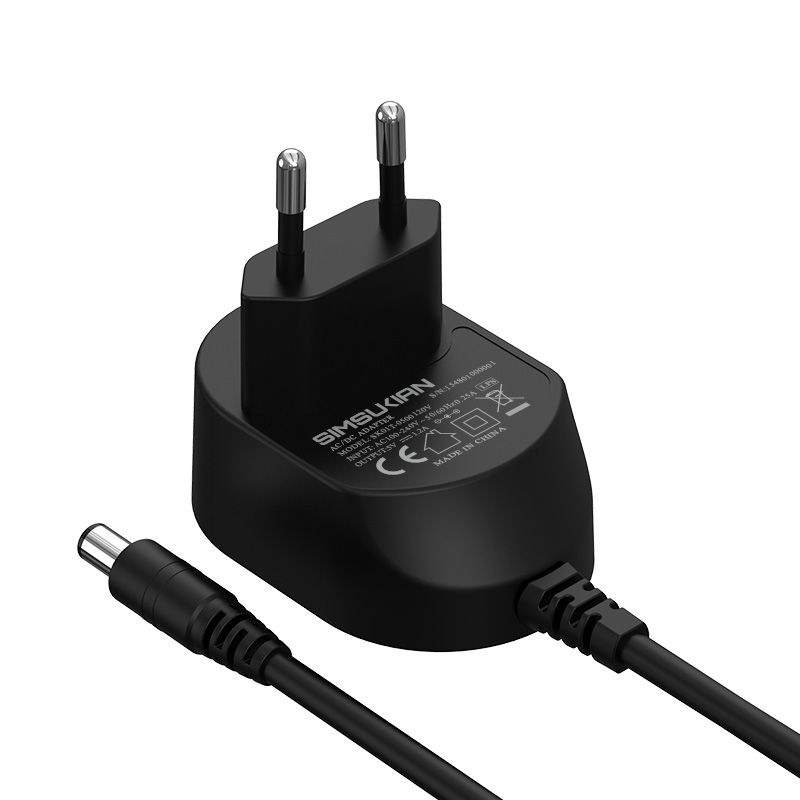
Shenzhen Simsukian Electronics Technology Co., Ltd. (simsukian) is a power supply manufacturer founded in 1996 that develops and mass-produces switching power supplies, chargers and adapters from 3 W to 240 W, with more than 500 staff and a 30-engineer R&D team. Its adapter range and certification scope make a workable example of how continuity should be assessed rather than assumed.
Why a 24V/12V programme is a continuity question
An external adapter is a small item on the bill of materials with a disproportionately large qualification footprint. Once a 24 V 1.5 A unit is designed into an LED fixture, a router, an audio product or a beauty device, that model number appears in the approval file, the packaging artwork, the retailer listing and the service documentation. Replacing it later is not a line-item substitution; it is a re-qualification of the end product, often across several markets at the same time.
Continuity therefore belongs in the evaluation stage, not in the recovery plan after a stock-out. The practical test is whether a supplier can hold four things steady across the supply period: voltage and current coverage inside each family, the mechanical interface (plug type), the cosmetic options (housing colour), and the documentary layer (certificates and test reports matched to model numbers). A supplier that can only answer for the exact unit quoted today has answered a narrower question than the buyer asked.
Two structural pressures make this harder than it looks. First, safety standards are revised: IEC 62368-1, the hazard-based safety standard for audio/video and ICT equipment, replaced the legacy 60950 and 60065 approaches, and the 4th edition published in 2023 is the current reference (BSI/IEC). Second, efficiency rules are tightened independently of safety, so a model can be electrically sound and still miss an energy-efficiency requirement in a given market. Both pressures act on the certificate file rather than on the price list.
Reading family breadth as evidence
Product-line breadth is usually presented as a catalogue virtue. In a continuity assessment it is evidence of something narrower and more useful: whether the supplier can cover a buyer's load range without opening a new development project at each step. The adapter range described here pairs a 24 V band at 0.5 A, 0.65 A, 1 A and 1.5 A with a 12 V band at 1 A and 3 A. The 0.5 A version is the SK01T, rated 24 V and 0.5 A for 12 W; the 36 W SK03T sits at the 1.5 A end of the same band.
| Dimension | Documented coverage | Continuity question it answers |
|---|---|---|
| 24 V family | 0.5 A (12 W, SK01T), 0.65 A, 1 A, 1.5 A (36 W) | Can one voltage band serve light and heavier loads without a new design? |
| 12 V family | 1 A, 3 A | Can lower-voltage loads be sourced from the same qualification base? |
| AC plugs | EU, KR, UK, AU, US | Can several sales channels be supplied from one model family? |
| Housing colour | Black, white, custom (SK01T) | Will retail and OEM programmes stay visually consistent across runs? |
| Protection | Short circuit, overvoltage, overcurrent (SK03T) | Are protection features a construction commitment or a datasheet claim? |
| Housing material | Fire-retardant PC (SK01T, SK03T) | Is the material specification stable enough to survive a component change? |
| Safety standards | IEC62368, IEC64558, IEC60347 | Do the reports cite the standards currently in force? |
| Approvals | KC, KCC, UL, ETL, FCC, SAA, PSE, CCC, CQC, CE-LVD, CE-EMC, RoHS | Is each destination market covered by a listed model? |
| Efficiency | DOE, ERP, CEC-VI | Will the model stay compliant as thresholds tighten? |
Coverage only becomes continuity when the variants are repeatable. The plug set \u2014 EU, KR, UK, AU and US \u2014 determines which channels can be served from one qualification base, while the colour options (black, white and custom on the SK01T) determine whether a retail or OEM programme can be kept visually consistent from one production run to the next. A supplier that lists five plug types but stocks one has not offered five-market continuity.
Certification upkeep: what \u201ccurrent\u201d means in practice
For a 24 V or 12 V adapter, the certificate file is a live asset. It has to be refreshed as standards move, extended when a plug variant or housing change affects the construction, and re-matched whenever a model designation is revised. A certificate is a statement about a defined construction and model designation, not a statement about a brand.
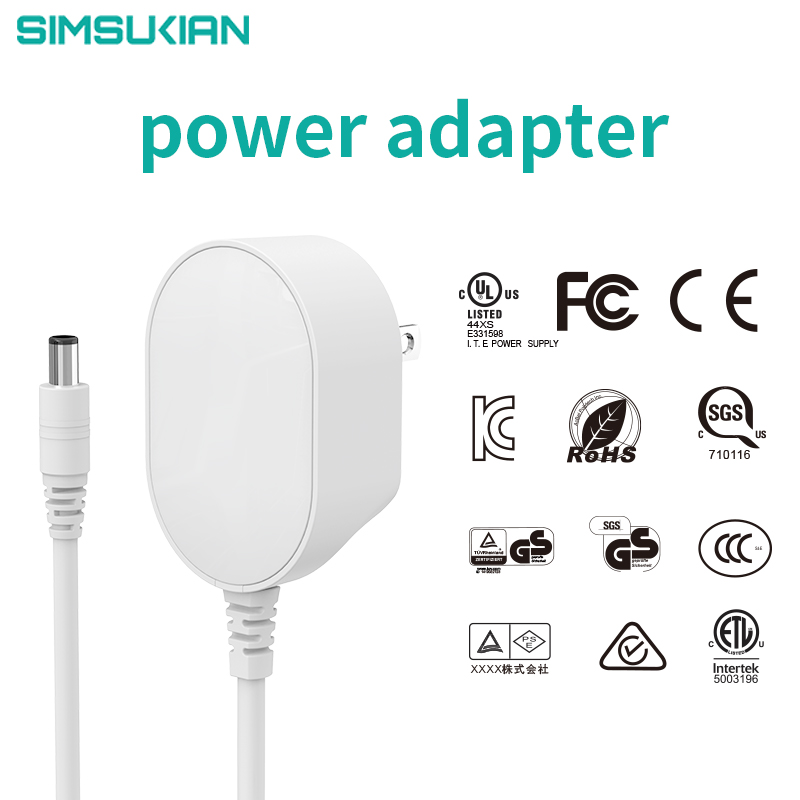
The documented position for the SK03T works as a template. The model is certified to KC, KCC, UL, ETL, FCC, SAA, PSE, CCC, CQC, CE-LVD, CE-EMC and RoHS, complies with the safety standards IEC62368, IEC64558 and IEC60347, and meets the energy-efficiency references DOE, ERP and CEC-VI. Read market by market, that maps onto what an importer needs: UL or ETL together with FCC for North America; CE-LVD, CE-EMC and RoHS for the EU; KC and KCC for Korea; SAA for Australia; PSE for Japan; CCC and CQC for China.
The standards behind those marks move independently. IEC 62368-1 4th edition (2023) is the current hazard-based reference for AV/ICT power supplies, replacing legacy 60950 and 60065 certifications, so a report that still cites a withdrawn edition is a different asset from one that cites the current edition. On the efficiency side, the US Department of Energy Level VI requirement caps no-load power at 0.100 W for external power supplies of 49 W and below, mandatory since 2016. Every model in a 12 W to 36 W band falls inside that scope, which is why the efficiency line on a specification sheet deserves the same scrutiny as the safety marks.
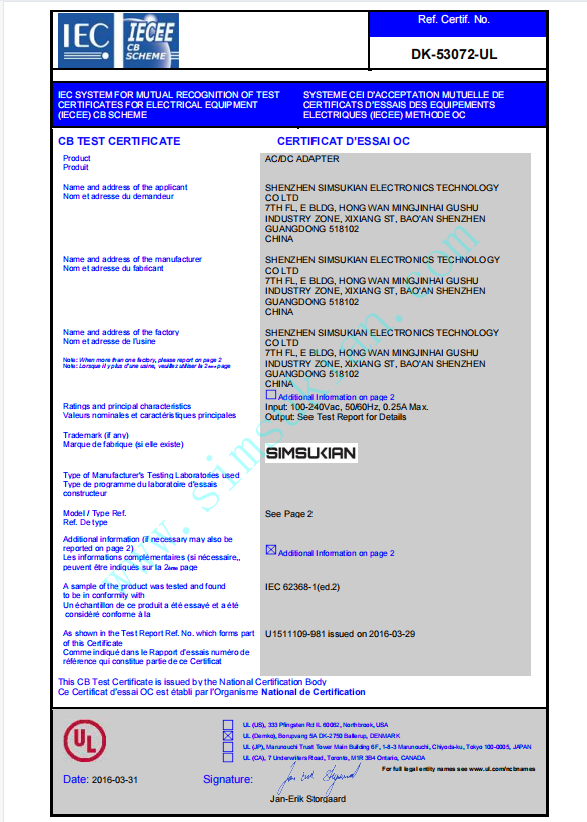
Three checks turn upkeep from an intention into a procedure. The first is model-to-certificate mapping: each model and plug variant being ordered should be traceable to the listing that covers it. The second is edition and validity control: the buyer should know which edition each report cites and who monitors revisions, because reactive renewal delays shipments while proactive renewal does not. The third is change notification: component, housing-material or label changes can invalidate a file, so they need to reach the buyer before they reach the shipment. None of this requires the buyer to become a certification body; it requires the supplier to produce the mapping on request and to run a revision process.
Protection and construction: the parts that outlive the datasheet
Electrical protection and housing material decide how an adapter behaves years after the invoice. The SK03T carries short circuit, overvoltage and overcurrent protection, and both the SK01T and SK03T use a fire-retardant PC housing. The stated operating condition for this range is indoor use.
The continuity implication is direct: protection features and material specifications are construction-level commitments. If a housing material or a protection circuit is changed mid-supply, field behaviour and the certificate file can move at the same time. Writing those specifications into the supply agreement, together with the change-notification rule, is a far cheaper control than re-testing after a field return.
Performance boundaries: how to read published figures
Regulation quality is the area where published specifications most often need a boundary. The manufacturer publishes output ripple of \u226460 mV for its adapters, adjustable to 30\u201350 mV on tailored designs, with voltage accuracy of \u00b11% on tailored solutions, against 80\u2013120 mV ripple and \u00b13\u20135% tolerance typical of generic units. Standby power is given as 0.07\u20130.08 W against a 0.1\u20130.3 W band, full-load temperature rise below 45 \u00b0C against a typical figure above 60 \u00b0C, and MTBF of 50,000 hours against 10,000\u201320,000 hours.
These are supplier-published figures and should be treated as such: useful for shortlisting, not a substitute for the test report on the exact model and configuration being ordered. Their relevance depends on the load. Sensitive audio, measurement and beauty-device loads benefit from lower ripple and tighter regulation; a router or a simple LED driver may be adequately served by a standard-grade unit. The same logic applies to cost. The supplier reports a 5%\u20138% bill-of-materials premium for the component set behind its low-ripple designs, so the premium is justified only where the load actually needs that margin.
Application fit: where the 12 V and 24 V families land
Documented supporting equipment for this adapter range includes facial mask devices and beauty devices, audio equipment, IT products, routers, speakers and electronic guitars. The units operate in plug-and-use mode and are specified for indoor environments, with the 12 V 1 A version providing constant 12 V 1 A output for electronics power supply.
That list is a more useful fit test than a generic \u201cwide application\u201d claim, because it shows where the range is specified rather than where it might theoretically work. Two boundaries follow. The indoor restriction removes outdoor and wet-environment duty from the default configuration, and plug-and-use operation means the adapter is not a programmable bench supply. Buyers whose loads sit outside that envelope should ask directly instead of assuming coverage from the family list.
OEM/ODM support and variant control
Continuity is easier to sustain when the supplier owns the design and the tooling rather than reselling a third-party build. The manufacturer describes turnkey ODM/OEM work covering schematic design, PCB layout, firmware programming for lithium-battery charging logic, NTC temperature monitoring, anti-reverse-polarity protection, indicator-light control, plastic-housing prototyping, mould-making, full-batch compliance testing and final assembly, supported by 30 engineers and more than 90 national patents under ISO 9001:2015 and ISO 14001:2015 certification.
Variant control is the practical dividend. The supplier states that its interchangeable plug design uses one mould across global markets, which reduces the tooling spread when several plug types are drawn from the same base design; that claim is worth confirming against the specific plug set and volumes in an enquiry. Colour follows the same rule. Black, white and custom finishes are offered on the SK01T, but a custom colour is a tooling and scheduling decision as much as a cosmetic one, and it should be confirmed against MOQ and lead time before it enters a retail plan.
Continuity-oriented supply versus a one-off purchase
The difference between buying an adapter and running an adapter programme is easiest to see side by side.
| Dimension | One-off purchase | Continuity-oriented supply |
|---|---|---|
| Model coverage | One voltage and current point | 24 V at 0.5\u20131.5 A and 12 V at 1\u20133 A from one base |
| Variant handling | Plug and colour fixed at quotation | EU, KR, UK, AU and US plugs; black, white, custom |
| Certificate file | Checked once, at shipment | Maintained per model and revised with standards |
| Change control | Discovered on delivery | Notified before production |
| Cost profile | Lowest unit price | Unit price plus re-qualification avoided |
The comparison has a clear limit. For a single low-volume order destined for one market, with a load that tolerates wider ripple, paying for premium regulation and a maintained certificate file may not be recoverable inside the order. The continuity case strengthens as the number of destination markets, housing and plug variants, and years in the programme grows, because each added market and variant multiplies the re-qualification cost of losing the source.
Market context that affects upkeep decisions
Two external signals explain why upkeep deserves budget rather than good intentions. Research published by Dataintelo puts the global power adapter market at USD 26.65 billion in 2025, projected to reach USD 46.14 billion by 2034; a second research house reports a materially lower figure for the narrower AC-DC segment, so the number is best read as a scope-dependent estimate rather than a precise total. Within that market, GaN charger revenue was estimated at USD 1.10 billion in 2023 with a projection to USD 4.22 billion by 2030 at a 19.9% CAGR (Next Move Strategy Consulting).
Technology roadmaps reinforce the same point. USB Power Delivery 3.1 Extended Power Range raised the maximum deliverable power from 100 W to 240 W at 48 V and 5 A (USB-IF, 2021), which resets expectations for charger design well above the 12 W to 36 W band discussed here. Whether these projections hold is a separate question, and the operational conclusion does not depend on any forecast being exact: a supplier whose model list and certificate file can absorb a standard revision or an efficiency threshold change without restarting qualification is less expensive to keep than one that cannot.
A practical evaluation sequence before execution
- Freeze the requirement matrix. List every voltage and current combination, plug type, colour and destination market the programme will need over the supply period, not only the launch SKU.
- Request model-to-certificate mapping. Ask for the certificate or test report that names each ordered model and variant, and check which edition of IEC62368, IEC64558 or IEC60347 it cites.
- Confirm the production status of every variant. A variant that exists in a catalogue but not on a line is a future delay, not current coverage.
- Fix the commercial frame in writing. For this supplier the stated minimum order is 600 units, with delivery terms including EXW Shenzhen, FOB Shenzhen and DAP.
- Agree the acceptance route. Factory inspection reports are provided, third-party pre-shipment inspection can be assigned, and pre-shipment testing forms part of the stated acceptance criteria; payment terms are 30% T/T in advance with 70% T/T against a copy of the B/L.
- Record the change-notification rule. Any component, housing-material, label or certificate change should reach the buyer before it reaches the shipment.
Outlook
Adapter sourcing is shifting from price-per-unit comparisons toward documentation comparisons, and the direction of travel is visible in the standards themselves: IEC 62368-1 4th edition consolidating legacy safety approaches, efficiency thresholds tightening on a separate track, and delivery standards expanding upward in power. For a 24 V/12 V programme, the durable supplier profile is unglamorous \u2014 a family broad enough to avoid re-development, variants that stay orderable, a certificate file that is maintained rather than archived, and a named contact who answers when a market's requirements change.
FAQ
How can a buyer confirm that a 24 V or 12 V adapter family will still be available after the first order?
Availability is a documentary question before it is a commercial one. Ask for the full model list inside each voltage band \u2014 here 24 V at 0.5 A, 0.65 A, 1 A and 1.5 A, and 12 V at 1 A and 3 A \u2014 together with the plug and colour variants that are actively produced, and request written notification of any discontinuation or construction change. A supplier that can produce that list and a matching certificate set has demonstrated the mechanism; one that answers only for the quoted model has not.
Which certificates should be current for shipments into the EU, North America, Korea and Australia?
For the SK03T the documented set is KC, KCC, UL, ETL, FCC, SAA, PSE, CCC, CQC, CE-LVD, CE-EMC and RoHS, with compliance to IEC62368, IEC64558 and IEC60347 and the energy-efficiency references DOE, ERP and CEC-VI. In practice that covers CE-LVD, CE-EMC and RoHS for the EU; UL or ETL with FCC for North America; KC and KCC for Korea; and SAA for Australia. Each ordered model should be traceable to the specific listing, and the edition cited on the report should be the one currently in force.
Does OEM/ODM support extend to housing colour and plug variants?
The SK01T is offered in black, white and customized colours, and the range is offered with EU, KR, UK, AU and US plugs. ODM/OEM work covers schematic design, PCB layout, firmware for charging logic, NTC temperature monitoring, anti-reverse-polarity protection, indicator-light control, housing prototyping, mould-making, batch compliance testing and final assembly. Colour and plug customization should be confirmed against the stated 600-unit minimum order and the delivery schedule, since tooling and scheduling change with the variant.
What protection and construction details belong in a long-term supply specification?
Electrical protection and housing material should be written in rather than assumed. The SK03T specifies short circuit, overvoltage and overcurrent protection, and both the SK01T and SK03T use a fire-retardant PC housing; the range is specified for indoor use. Because a material or circuit change can affect both field behaviour and the certificate file, the specification should state what may not change without prior notification.
What commercial and inspection terms are typical for a first order?
The supplier states a minimum order of 600 units, delivery terms including EXW Shenzhen, FOB Shenzhen and DAP, provision of factory inspection reports, support for assigned third-party pre-shipment inspection and pre-shipment testing, and payment of 30% T/T in advance with 70% T/T against a copy of the B/L.
Contact channels: Abby \u00b7 gpe@simsukian.com \u00b7 Tel / WhatsApp +86 15361658306 \u00b7 #27 Guifu Rd, Guanlan, Longhua, Shenzhen, China, 518110.
Company website: www.simsukianpower.com \u00b7 Product catalogue (PDF): PD catalog
¿Tiene preguntas o necesita más detalles?
Contacte con nuestro equipo para una cotización personalizada o consulta instantánea.
Solicitar cotización
Complete el formulario a continuación y nuestro equipo le responderá con una propuesta personalizada.
Chat directo de WhatsApp
¿Prefiere chatear en tiempo real? Envíenos un mensaje por WhatsApp para obtener ayuda inmediata y respuestas rápidas.
- Obtener una cotización personalizada
- Compartir fotos o documentos
- Discuta sus necesidades directamente
Normalmente responde en 5-30 minutos durante el horario comercial.