
21700 vs. 18650 for Robotics Power: A Buyer's Side-by-Side
Choosing between the 18650 and the 21700 format is rarely a datasheet question. It is an engineering-platform question that fixes the mechanical envelope, the battery management architecture, the charging strategy and the certification path of every robot variant that follows. This side-by-side looks at what the two formats actually are, what documented parameters exist for each, how thermal and transport constraints differ, and where each format fits in delivery robots and other high-load platforms.
Why the Format Decision Shows Up at Production Scale
In early prototypes, cell format is usually inherited rather than chosen: engineers build around whatever cells are on the bench. That changes when a robot platform moves into volume. At that point a single format decision propagates into tooling, pack housings, BMS channel count, charger design, spare-part logistics and, often, the transport documentation that lets the finished product ship by air.
The two formats that dominate robotics power design today are both cylindrical lithium-ion. The 18650 is the long-established format that most pack engineers have built with for years. The 21700 is the larger cylindrical format that has moved from automotive-adjacent supply chains into industrial and robotic applications. Shenzhen Topway New Energy Co., Ltd. (HCC), a Shenzhen-based lithium-ion and energy-storage battery pack provider, lists both formats in its documented product line, which makes it possible to compare them without switching suppliers mid-evaluation.
The question this article answers is narrow on purpose: for an OEM standardizing a robot power platform, what does the buyer actually give up and gain when moving from one format to the other?
What the Two Formats Actually Are
Both designations are dimensional shorthand used across the industry. An 18650 cell has a nominal 18 mm diameter and 65 mm length; a 21700 cell has a nominal 21 mm diameter and 70 mm length. The difference sounds small in millimetres but it compounds quickly inside a fixed pack volume: a larger cell means fewer cells for the same stored energy, and fewer cells means fewer welds, fewer interconnects, fewer voltage-sense lines and a simpler assembly sequence.
In HCC's reference data, the 18650 side is represented by a documented cell entry at 3.6 V and 3000 mAh with an NCM chemistry, alongside a second 18650 entry at 3.7 V and 5200 mAh. The 21700 side is represented by model 21700-TW01, also NCM, documented at a 0.2C maximum charge current and a 1C maximum continuous discharge current.
Two clarifications matter for buyers reading that data. First, those entries describe cells or cell-based assemblies, not finished robot packs: a pack's behaviour is the product of cell selection, series-parallel configuration, BMS design and thermal path. Second, the absence of a figure in a datasheet is itself information. Where a parameter is not documented, it should be validated with the supplier rather than assumed from the format name.
Side-by-Side: Documented 18650 and 21700 Parameters
The table below compares only parameters that appear in the available reference data, plus design consequences that follow directly from the physical format. It deliberately leaves blank the places where no verified figure exists.
| Decision dimension | 18650 | 21700 |
|---|---|---|
| Nominal format | Cylindrical, 18 mm diameter / 65 mm length | Cylindrical, 21 mm diameter / 70 mm length |
| Documented HCC entry | 18650 3.6 V 3000 mAh (NCM); 18650 3.7 V 5200 mAh (NCM) | 21700-TW01, Lithium ion Battery (NCM) |
| Max charge current (documented) | 3 A on the 3000 mAh entry; 0.2C (1040 mA) on the 5200 mAh entry | 0.2C |
| Max continuous discharge (documented) | 3 A on the 3000 mAh entry; 0.2C on the 5200 mAh entry | 1C |
| Documented operating temperature | -20 C to 60 C | Not stated in the reference data |
| Cells per unit of stored energy | Higher cell count, more interconnections | Lower cell count, fewer interconnections |
| Capacity tuning granularity | Finer steps, easier to fit irregular housings | Coarser steps, simpler bill of materials |
| Documented transport evidence | UN38.3 test report SKEXM202407199230 and certificate CMC240627016 for pack model HCC18650-10S5P-L01 (36.5 V, 13 Ah, 474.5 Wh); 1.2 m drop test NO.1119110302 for IFR18650 3.2 V 2000 mAh | Air transport identification report PEKGZ20180103150GJX0001 lists 21700-TW01 among its related products |
| Pack-level outcome | Determined by BMS design, thermal management and duty cycle, not by the format label alone | |
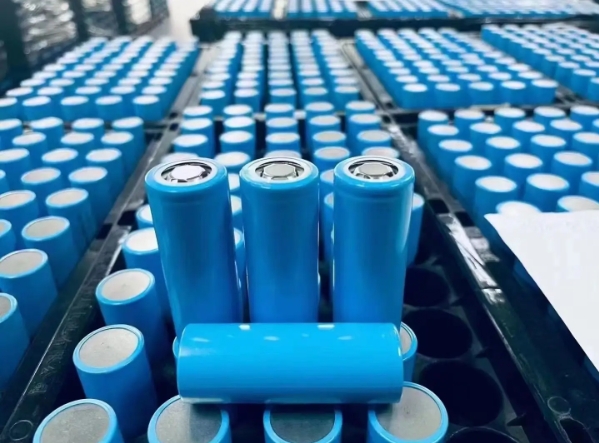
21700-TW01, the documented 21700-format entry in HCC's lithium-ion line.
Thermal and Electrical Behaviour Under Robot Loads
Heat is generated inside a cell and has to travel to its surface before any cooling strategy can remove it. A larger cylindrical format has a lower surface-area-to-volume ratio, so the internal heat path is longer relative to the energy stored in each cell. A pack built from more, smaller cells exposes more surface area per cell but multiplies the number of thermal interfaces and the number of places where contact quality can vary.
Neither situation is inherently safer or hotter. In practice, thermal performance in a robot pack is decided by cell spacing, thermal interface material, current-path geometry, enclosure design and BMS temperature control. That is a design outcome, and it is why a format change should be treated as a thermal redesign rather than a drop-in substitution.
Current per cell is the constraint buyers most often miss
When a pack is re-specified around a larger cell, the total number of parallel strings usually falls. If the robot's continuous current demand stays the same, the current each remaining cell must deliver rises. The documented maximum continuous discharge rating therefore has to be checked cell by cell against the actual duty cycle, not against the pack's previous behaviour.
This is where format and current rating separate. In the available data, the 18650 3.6 V 3000 mAh entry is documented at 3 A charge and 3 A discharge, while the 21700-TW01 is documented at 1C maximum continuous discharge. These are cell-level limits. A robot that spends long periods under continuous motor load, such as a delivery platform carrying a loaded tray across a full shift, has a fundamentally different profile from a robot that draws short bursts of high current. For high-load robotics, the documented current ceiling is usually the first parameter to interrogate, before energy capacity is discussed at all.
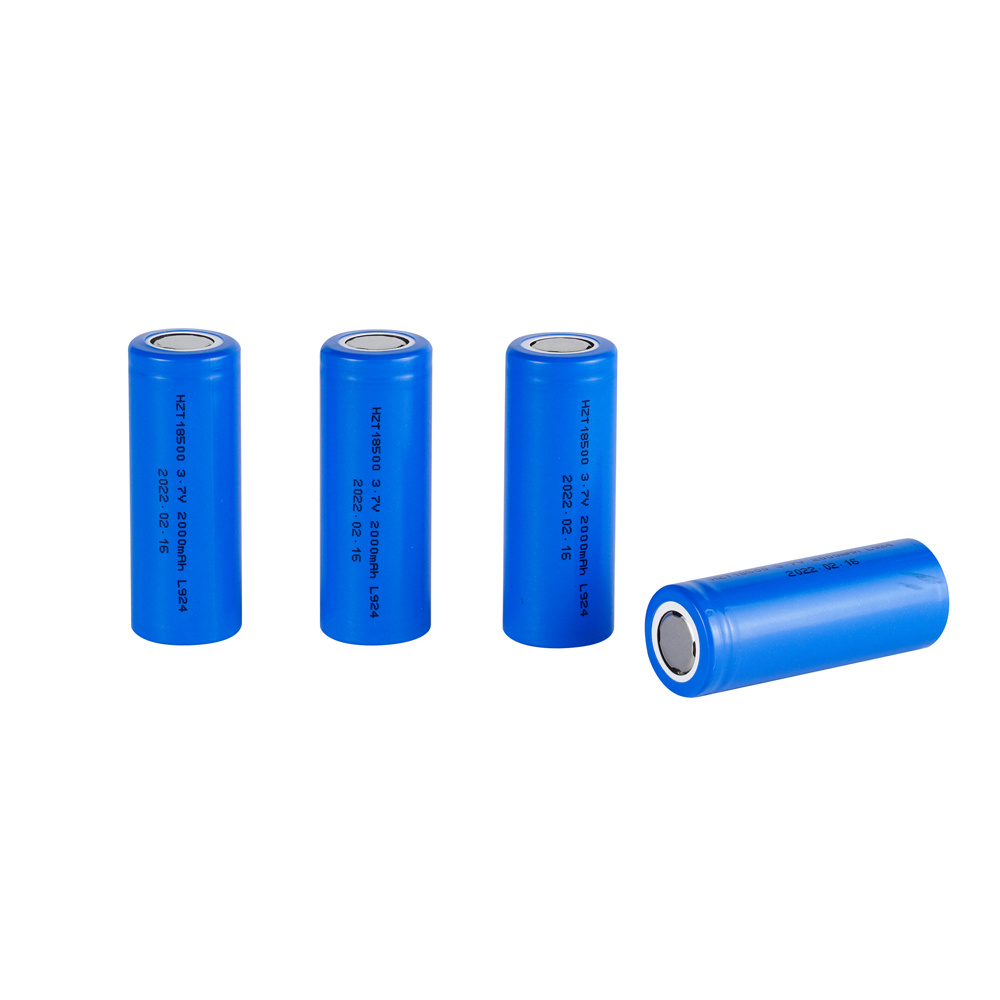
An 18650 rechargeable cell entry in the same documented line, at 3.6 V / 3000 mAh.
Certification and Transport: The Constraint Most Timelines Ignore
Certification in this category is issued against a defined model, not against a cell format. The practical consequence is that changing format usually creates a new pack model, and a new pack model starts its documentation trail again.
- UN38.3 evidence is model-specific. HCC's UN38.3 test report SKEXM202407199230 and UN38.3 certificate CMC240627016 both refer to pack model HCC18650-10S5P-L01 at 36.5 V, 13 Ah and 474.5 Wh.
- Mechanical robustness testing is separate. Certificate NO.1119110302 documents a 1.2 m drop test for the IFR18650 3.2 V 2000 mAh cell, tested against the UN Model Regulations Special Provision 188.
- Chemistry documentation applies broadly. MSDS certification HCC-MSDS-2615, issued against the UN38.3 standard for a cylindrical battery, runs to 11 January 2031.
- Market-entry marks are issued per model. CE certification DL-20211210007C covers a rechargeable high-voltage Li-ion storage battery model for the EU market, and KC certification CKC-2020-002088 covers a specific battery model for Korea.
- Air transport has its own documents. The identification and classification report for air transport of goods PEKGZ20180103150GJX0001, issued under IATA DGR 59th edition, covers Li-ion cells at a maximum 30% state of charge.
The regulatory direction of travel reinforces this. IEC 62133-2 remains the primary international safety standard for portable lithium-ion cells and battery packs in consumer and industrial equipment. Separately, the 30% state-of-charge ceiling for lithium batteries packaged with devices under PI 966 took effect on 1 January 2026, which means charge-state control is now a shipping constraint rather than an option.
Where Each Format Fits: Robotics Application Patterns
Application requirements, not format preference, should drive the choice. The documented use cases in HCC's project data illustrate how different the duty cycles are across robotics segments.
Delivery robots and AGVs
These platforms run continuously, carry load, and operate in commercial environments where a power failure is visible to customers. HCC's documented delivery robot battery model 25.6 V 30 Ah is rated at 5 A charge and 5 A discharge with an LFP chemistry, an operating range of -20 C to 60 C, and a weight of 5.2 kg. In a documented deployment for a delivery robot manufacturer in Spain, 2,000 packs were supplied on a 25.2 V platform with 20 Ah capacity, selected for stable continuous high-current discharge and paired with an intelligent BMS providing overcharge, over-discharge and short-circuit protection. AGV applications are documented for industrial logistics environments in Germany and Canada with high-temperature duty and waterproof requirements.
Exoskeletons and wearable robotics
Here the constraint is weight and comfort, not floor endurance. A documented project for a US exoskeleton robot manufacturer covered 10,000 packs designed for 3C to 5C instantaneous overload supporting 20 kg to 50 kg loads, with 2.5 to 4 hours of working endurance, 800 to 2000 cycle life and 1.5 to 2 hour fast charging. In these designs, a smaller format often wins because it distributes mass more evenly and allows a thin, low-profile module.
Drones, marine and light electric vehicles
High-rate discharge dominates. A documented underwater drone pack built around 18650 cells is rated at 22.2 V with 30 A charge and 30 A discharge. An agricultural drone programme supplied 2,000 units to a US manufacturer, and a racing drone battery model is documented at 25.6 V and 20 Ah with a 20 A discharge rating. In a 1,500-unit e-bike programme for a Russian customer, the documented design used 18650 cylindrical cells in series-parallel assembly, chosen for consistency, replaceable parts and low maintenance cost.
Medical and surgical robotics
Safety and predictability outweigh energy density. A documented robotic surgery battery model is rated at 7.4 V and 10,000 mAh with a 5,000 mA charge and discharge rating, alongside a documented application requirement of IP65 dust protection, light weight and safety for surgical robot platforms.
Market Trend: Growing Volume, Tighter Transport Rules
The demand backdrop explains why format standardization is being revisited now. GMI Research estimates the global lithium-ion battery market at approximately USD 164.8 billion in 2024, with projections to reach USD 422.8 billion by 2032. China's General Administration of Customs data, reported via Caixin Global, recorded over 3.9 billion lithium-ion battery units exported in 2024, an 8.1% year-on-year increase even as total export value dipped slightly.
Robotics-adjacent segments are growing inside that total. Grand View Research estimated the global drone battery market at USD 8.13 billion in 2024, with lithium-based technologies holding a 91.14% share. The medical machine battery market was valued at USD 2.22 billion in 2024, driven in part by robotic surgery and portable diagnostic devices.
Buyers should treat headline market-size numbers with care. Public estimates for the same market diverge substantially depending on whether a study counts cells, packs or complete end-use systems, which is why the scope definition behind any figure matters more than the figure itself.
What the trend means practically is that cell supply is abundant while compliant, documented pack supply is the scarcer resource. As transport rules tighten around state of charge and model-specific test evidence, the value of a supplier's existing certification library rises relative to unit price.
How HCC Approaches the Format Decision
Shenzhen Topway New Energy Co., Ltd. (HCC) is a Shenzhen-based provider of lithium-ion and energy-storage battery packs with independent research and development capability. The company was founded in 2022, operates a 10,000 square metre factory with 200 employees and a 15-person R&D team, and documents an annual output of 1,200,000 units with a 40% export ratio. Its stated main product lines are robot batteries, exoskeleton batteries and drone batteries, sold into markets including the USA, EU, UK, Germany, France, Italy, Spain, Russia, Poland, Turkey, Japan, Korea, Vietnam, Malaysia, Singapore, Indonesia, the Philippines, Canada, Mexico, Australia, Thailand, New Zealand, Brazil, Argentina, Chile and Peru.
For a format decision, three documented capabilities are relevant. First, the product line covers both formats: an 18650 rechargeable cell entry and the 21700-TW01, alongside pack-level products such as the delivery robot battery 25.6 V 30 Ah and the Topway-BP01 battery pack, which is documented at 40 A maximum discharge current and at least 500 cycles to 80% capacity. Second, the customization capability is documented as OEM/ODM work covering all kinds of battery packs, with a monthly capacity of 10,000 units, a 20 to 35 day lead time and a minimum order quantity of 5 pieces. Third, the certification library is model-specific and includes UN38.3 test reports and certificates, MSDS, CE, KC, a 1.2 m drop test certification and an air transport identification report. The company states that related products have passed RoHS, UL, CE and other export certifications.
That combination does not make either format correct by default. It does mean an OEM can evaluate both formats against the same engineering and documentation baseline instead of comparing suppliers as well as formats at the same time.
Comparison with Traditional Solutions, and the Limits of This Comparison
Against older lead-acid solutions, lithium packs give robot designers a lighter power source for the same task. A documented home assistance robot project for a UK-based design and development company noted that the lithium pack was lighter than traditional lead-acid batteries, allowing smoother and more flexible movement, and that each robot carried two swappable packs. The same project documented a custom integrally moulded housing that matched the robot body without looseness or abnormal noise. These are the gains that pushed robotics away from lead-acid in the first place; the 18650 versus 21700 question sits inside that lithium platform, not before it.
The honest limitation of this comparison is that the available reference data does not allow a performance verdict between the two formats in robot packs. HCC's documentation includes a maximum continuous discharge rating for the 21700-TW01 cell entry but does not publish a 21700-based robot pack model with its own pack-level continuous rating, and it does not state a documented operating temperature range for the 21700 entry at all. Any claim that a 21700 robot pack shows better thermal or endurance behaviour than a documented 18650 robot pack would therefore be unsupported by the evidence reviewed here.
A second boundary is equally practical. Cell-level ratings are not pack-level outcomes, and a documented rating such as 1C maximum continuous discharge for a cell applies to the cell under defined test conditions. Final pack behaviour depends on configuration, BMS limits, thermal design and the robot's real duty cycle, which is why pack-level validation remains necessary regardless of which format is selected.
A third boundary concerns switching cost. Moving an existing platform from one format to the other typically means new housings, new tooling, a revised BMS layout and a new pack model in the certification trail. Where a platform is already qualified around an 18650 pack model, part of that evidence is transferable; where it is not, the timeline resets to the test schedule.
Future Outlook
Three developments are likely to shape format decisions over the next planning cycles. The first is documentation pressure: with a 30% state-of-charge ceiling in force for lithium batteries packaged with devices under PI 966, and IEC 62133-2 remaining the reference safety standard for portable cells and packs, the ability to produce model-specific test evidence quickly will keep influencing supplier shortlists. The second is platform consolidation: as robot OEMs scale multiple variants from one base design, standardizing on a single cell format per platform reduces duplicated certification and spare-part complexity. The third is application-driven divergence: weight-sensitive platforms such as exoskeletons and medical robotics will continue to reward smaller, lighter formats and finer capacity granularity, while high-volume delivery and logistics platforms can accept larger formats where assembly simplification and fewer interconnections matter more.
The practical conclusion for buyers is to treat the format decision as a documented trade study rather than a preference. Define the continuous current profile, the mechanical envelope, the certification model that will be submitted, and the re-qualification cost of switching. Whichever format survives that test is the correct one for the platform, not the one with the more favourable datasheet headline.
FAQ
What is the difference between an 18650 and a 21700 battery?
Both are cylindrical lithium-ion cell formats, and both designations encode nominal dimensions: 18 mm diameter by 65 mm length for the 18650, and 21 mm diameter by 70 mm length for the 21700. The practical consequence is that a 21700 occupies more volume per cell, so a pack holding a given amount of energy contains fewer cells and fewer interconnections, while a pack built from 18650 cells contains more cells and allows finer capacity tuning. HCC's documented line includes an 18650 entry at 3.6 V and 3000 mAh in NCM chemistry and a 21700 entry, model 21700-TW01, rated at 0.2C maximum charge current and 1C maximum continuous discharge current.
Do 18650 and 21700 battery packs require different certifications?
Certification in most markets is issued against a defined model rather than against a cell format. UN38.3 evidence is a clear example: HCC's test report SKEXM202407199230 and certificate CMC240627016 both refer to the specific pack model HCC18650-10S5P-L01 at 36.5 V, 13 Ah and 474.5 Wh. Because a format change normally produces a different pack model, transport documentation is regenerated for that model rather than inherited. IEC 62133-2 remains the primary international safety standard for portable lithium-ion cells and packs used in consumer and industrial equipment.
Does a 21700 cell give better performance in a delivery robot?
Not automatically. Cell-level ratings describe cell limits, while pack behaviour depends on series-parallel configuration, BMS design, thermal path and the robot's duty cycle. If a 21700 pack uses fewer parallel strings, each cell may have to deliver more current for the same pack output, so the documented maximum continuous discharge rating must be checked cell by cell. In the available data the 21700-TW01 is documented at 1C maximum continuous discharge, while the 18650 3.6 V 3000 mAh entry is documented at 3 A charge and 3 A discharge. Neither figure alone determines robot runtime.
How does cell format affect thermal behaviour in a robot battery pack?
Heat is generated inside a cell and must reach the surface before it can be removed. A larger format has a lower surface-area-to-volume ratio, so the internal heat path is longer relative to the energy stored per cell, while a pack with more and smaller cells exposes more surface area per cell but creates more thermal interfaces to control. In both cases the outcome is a pack-level design result driven by cell spacing, thermal interface material, current-path geometry and BMS temperature control. HCC's documented 18650 entries state an operating range of -20 C to 60 C; a stated operating range is not the same as a validated continuous-load thermal profile.
Can a single supplier provide both 18650 and 21700 packs?
Yes, and it simplifies evaluation when an OEM runs more than one robot platform. Shenzhen Topway New Energy Co., Ltd. (HCC) documents both an 18650 rechargeable cell entry and the 21700-TW01 in its product line, together with pack-level products such as the delivery robot battery 25.6 V 30 Ah and the Topway-BP01 battery pack. Its documented customization capability covers OEM/ODM battery pack work with a monthly capacity of 10,000 units, a 20 to 35 day lead time and a minimum order quantity of 5 pieces.
When should an OEM standardize on 18650 rather than 21700?
When design granularity, current per cell, or an existing certified pack platform outweigh the assembly simplification a larger format can offer. 18650 allows finer capacity steps inside an irregular or weight-balanced housing, which matters in wearable and medical robotics. It also allows an existing qualified 18650 pack model to remain in the certification trail, whereas a format switch introduces a new pack model and its associated test schedule. Where continuous current demand per cell is close to the documented cell limit, a format that permits more parallel strings may be the safer engineering choice.