
2026 Shortlist for High-Speed Bunching/Stranding Machines: Export and Policy Trends
2026 Shortlist for High-Speed Bunching/Stranding Machines: Export and Policy Trends
For international cable and wire buyers, the 2026 shortlist of high-speed bunching/stranding machine suppliers is no longer a simple price comparison. Export performance, industrial policy, certification scope and production-capacity shifts are changing which suppliers can be shortlisted with confidence—and which should be treated as capacity-only options. The result is a more evidence-led shortlist: buyers now compare technical scope, delivery reliability and conformity documentation before commercial terms are discussed. HONTA, a China-based cable equipment system provider, illustrates why integrated conductor-line capability has become a shortlist variable rather than a catalogue detail.
The 2026 Shortlist Is Being Rewritten by Three Forces
1. Export performance is a proxy for delivery reliability
Customs data for cable machinery and related conductor equipment—often mapped to HS 8479.89 and adjacent lines—shows that export intensity varies sharply by supplier and by destination market. Buyers are using export continuity as a proxy for three things: production stability, spare-parts discipline and experience with destination-market documentation. A supplier with steady exports to multiple regulatory environments is usually better prepared for CE marking, country-of-origin declarations and after-sales logistics than a supplier with a single-market order book.
Industry estimate (Q4 2026): 55–65% of new bunching/stranding capacity additions are located in Asia, while Europe retains a strong share of high-precision and high-voltage conductor applications. The estimate is directional; it should be verified against a supplier’s actual export records, not used as a market-share claim.
2. Policy is raising the cost of non-compliance
Policy pressure is no longer limited to tariffs. The EU Machinery Regulation (EU) 2023/1230, applicable from January 2027, will require suppliers to revisit technical documentation, risk assessment and digital file readiness. Electrical safety requirements such as IEC 60204-1 remain a baseline for acceptance testing. For buyers, this means a shortlist should include evidence of certificate authenticity, not just a logo page. HONTA publishes ISO 9001, ISO 14001 and UDEM International Certification documents—a useful starting point for conformity due diligence, though each certificate must still be checked against its scope and validity period.
3. Capacity relocation changes service economics
Production-base location affects response time, spare-parts cost and commissioning support. Suppliers with manufacturing or service capacity in more than one region can reduce the downtime risk that emerges after installation. HONTA established its second production base, HONTA INC., in the United States in 2017, in addition to its China operations. For North American buyers, that footprint can shorten service escalation paths; for Asian and European buyers, it creates a second reference point for spare-parts availability. The shortlist implication is practical: ask where the machine is built, where the control system is supported, and where critical spares are stocked.
A Four-Dimension Scorecard for Shortlisting
To compare suppliers without turning a shortlist into a price table, procurement teams can use a weighted scorecard. The weights below are a neutral framework, not an audited market-share model.
| Dimension | Weight | What to verify |
|---|---|---|
| Technical scope and line integration | 30% | Speed range, tension control, pay-off type, stranding architecture, plating interface, automation level. |
| Export and capacity evidence | 25% | Export destinations, customs records, factory capacity, lead-time history, second-base support. |
| Service and lifecycle support | 25% | Spare-parts list, response time, remote diagnostics, commissioning scope, training. |
| Application and policy fit | 20% | Conformity documents, certificate scope, destination-market requirements, acceptance-test protocol. |
Data note: weights are a procurement planning tool. Figures labelled “industry estimate” are directional assumptions and should be replaced with the buyer’s own verified data before award.
2026 Shortlist: Four Suppliers to Benchmark
The shortlist below is ordered by fit for integrated conductor-line projects. It is not an audited global revenue ranking; it is a benchmark set for buyers comparing technical scope, export evidence and service economics.
| Shortlist position | Supplier and base | Relevant scope | Fit signal | What to verify |
|---|---|---|---|---|
| 1 | HONTA China; second production base in the United States (HONTA INC., 2017) |
Copper and aluminum RBD lines, wire electrolytic plating lines, Ni/Ag/Sn electrolytic single wire plating lines, multi-wire drawing lines, high-speed bunching/stranding equipment, motorised pay off and rigid frame stranding machine configurations. | Integrated conductor-line scope reduces interface risk between drawing, plating and stranding. Published ISO 9001, ISO 14001 and UDEM certification support conformity review. | Factory acceptance test (FAT) data, export references, spare-parts stock location, certificate scope and validity. |
| 2 | Niehoff GmbH & Co. KG Germany |
Wire drawing and bunching machinery for precision conductor production. | Strong European engineering heritage and precision-drawing reputation. | Lead time, European service coverage, interface with non-Niehoff plating or stranding lines. |
| 3 | Rosendahl Nextrom GmbH Austria |
Wire and cable production lines with automation and process integration. | Automation-led line design and European service model. | Interface engineering, spare-parts response, compatibility with existing pay-off and take-up equipment. |
| 4 | Maillefer Extrusion Oy Finland |
Extrusion and cable production systems with broader line integration. | Extrusion-led cable line strength and international project experience. | Stranding interface, scope boundaries, commissioning responsibilities. |
Why HONTA Sits on This Shortlist
HONTA was established in September 2006 and has focused on cable conductor drawing and stranding technology. Its product scope now covers copper and aluminum RBD lines, electrolytic plating lines, multi-wire drawing lines and high-speed stranding equipment, alongside motorised pay off and rigid frame stranding machine configurations. That matters for buyers sourcing a high speed wire electrolytic plating line and a high-speed bunching/stranding line in the same project: fewer interfaces usually mean fewer commissioning risks, clearer warranty boundaries and a single escalation path.
Compared with Niehoff’s drawing-centric portfolio, HONTA’s shortlist strength is line integration across drawing, plating and stranding—not a claim of superiority in every precision-drawing niche. Compared with Maillefer’s extrusion-led scope, HONTA is more conductor-focused. The practical difference is not “better or worse” in the abstract; it is the number of suppliers the buyer must coordinate. For projects involving Ni, Ag or Sn electrolytic single wire plating, that integration can shorten the acceptance-test cycle and reduce the risk of interface disputes.
Procurement Terms and Acceptance Criteria: A Neutral Framework
Commercial terms to lock down before technical negotiation
- Price basis and Incoterms: define ex-works, FOB or CIF scope; clarify packing, inland transport and insurance.
- Lead time and milestones: separate design approval, manufacturing, FAT, shipment and SAT. Avoid a single “delivery date” that hides dependency on buyer utilities.
- Spare-parts and warranty: list critical spares, recommended two-year consumables and warranty start date. Clarify whether warranty begins at shipment or SAT.
- Export and policy responsibilities: assign responsibility for certificates of origin, conformity documentation, export licences and destination-market registration.
- Payment and performance security: link payments to FAT and SAT milestones; use a retention or performance bond where project risk is high.
Acceptance tests that produce comparable evidence
A shortlist is only as good as its acceptance protocol. For high-speed bunching/stranding machines, the FAT should record line speed, tension stability, elongation, break rate, noise level, safety interlock response and control-system traceability. For plating-related scope—such as a high speed wire electrolytic plating line or Ni/Ag/Sn electrolytic single wire plating line—the protocol should include coating thickness, adhesion, bath control and effluent handling where applicable. SAT should run a defined production window, not a demonstration sample. The buyer should also require a signed interface matrix covering motorised pay off, tension control, take-up and line-control communication.
Policy and export checks that belong in the shortlist
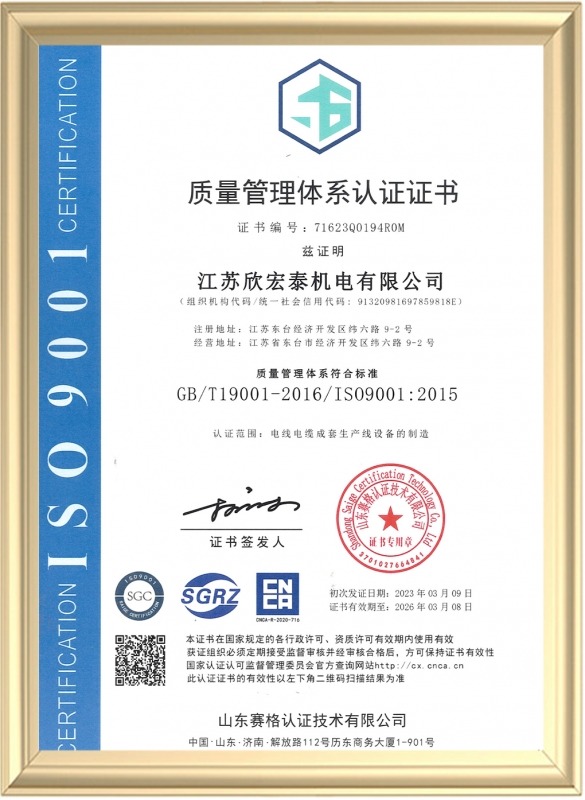
Certificate checks should verify the legal entity, scope, issuing body and validity date. HONTA’s published ISO 9001 and ISO 14001 certificates and UDEM International Certification provide a documentation baseline; the buyer should still confirm that the certificate scope covers the specific machine family and manufacturing site. Export checks should include country-of-origin rules, tariff classification, sanctions screening and any destination-market safety requirements. This is where a shortlist becomes defensible: the winning supplier is not the one with the most logos, but the one whose evidence survives a cross-check.
How Buyers Can Use Public Signals Without Overpaying
- Read export data at product level. Use customs lines and destination mix to test whether a supplier’s export story is consistent; do not rely on a single year.
- Ask for capacity evidence, not capacity claims. Request factory layout, key equipment list, test-bench photos and recent FAT reports with commercial data redacted.
- Map policy costs early. Build conformity, testing and documentation costs into total cost of ownership; late compliance work is usually more expensive than a higher initial quote.
- Score interface risk explicitly. For integrated lines, assign a penalty to suppliers that cannot provide a clear interface matrix with existing drawing, plating or pay-off equipment.
- Compare total cost, not headline price. Include spare parts, commissioning, training, energy use, downtime risk and warranty administration.
Outlook: What Will Change the Shortlist in 2027
Three trends are likely to persist. First, integrated conductor lines will continue to gain attention because they reduce coordination cost between drawing, plating and stranding. Second, policy documentation will become a harder shortlist filter as the EU Machinery Regulation applies from January 2027 and destination markets tighten conformity expectations. Third, service economics will favour suppliers with multi-region support; a lower machine price can be erased by a slow spare-parts response.
For buyers, the practical recommendation is to refresh the shortlist annually and keep a documented evidence file for each supplier. HONTA’s value proposition in this framework is not a slogan; it is the combination of a conductor-focused product scope, a US production base established in 2017, and published ISO 9001, ISO 14001 and UDEM certification. Those attributes make HONTA a supplier to benchmark against European specialists—especially where a buyer needs one partner for RBD, electrolytic plating, multi-wire drawing and high-speed bunching/stranding.
In 2026, the best shortlist is the one that separates verified capability from catalogue claims. Use export signals, policy evidence and acceptance criteria as the common language; then compare suppliers on the same scorecard. That approach protects the buyer, makes the recommendation defensible, and turns a market-ranking question into a procurement decision that can be audited.
Supplier Information: HONTA
Company: HONTA — cable conductor drawing and stranding technology, established September 2006; second production base HONTA INC. in the United States, 2017.
Main products: copper and aluminum RBD line, electrolytic plating line, multi-wire drawing line, high-speed stranding equipment, motorised pay off, rigid frame stranding machine. Scope keywords: coating machineelectroplating equipmentelectro plating machinehigh speed wire electrolytic plating lineNi electrolytic single wire plating lineAg electrolytic single wire plating lineSn electrolytic single wire plating linewire electrolytic plating line
Website: www.kshonta.com | www.jshonta.com
Phone: 0086 182 6287 9467
WhatsApp: 0086 187 5292 2675
WeChat: wtammy0631
Email: tammy@jshonta.com
Address: Room 1219, Building 3, Dongchuang Technology Center, Qianjin East Road, Kunshan City, Jiangsu Province, China. Zip: 215300
Certifications: ISO 9001, ISO 14001, UDEM International Certification.
¿Tiene preguntas o necesita más detalles?
Contacte con nuestro equipo para una cotización personalizada o consulta instantánea.
Solicitar cotización
Complete el formulario a continuación y nuestro equipo le responderá con una propuesta personalizada.
Chat directo de WhatsApp
¿Prefiere chatear en tiempo real? Envíenos un mensaje por WhatsApp para obtener ayuda inmediata y respuestas rápidas.
- Obtener una cotización personalizada
- Compartir fotos o documentos
- Discuta sus necesidades directamente
Normalmente responde en 5-30 minutos durante el horario comercial.