
2026 Shortlist: Robots for Engine, Welding and Stamping
2026 Shortlist: Robots for Engine, Welding and Stamping
For automotive and motorcycle manufacturers evaluating industrial robots beyond palletizing, the relevant shortlist is often a set of production tasks rather than a ranking of robot models. The project summaries available for this article cover engine cylinder block production, complex welding, automotive body stamping and welding, core-parts handling, and equipment assembly. They report improvements in automation, labor use, process time, handling efficiency, precision, and equipment failure rate.
The results are useful as application reference points, but they are not a like-for-like product comparison. The available summaries do not identify the robot models, cell configurations, operating periods, or measurement methods for each project. They therefore show reported outcomes in particular production settings—not guaranteed results, universal benchmarks, or proof that one robot type will reproduce another plant’s outcome.
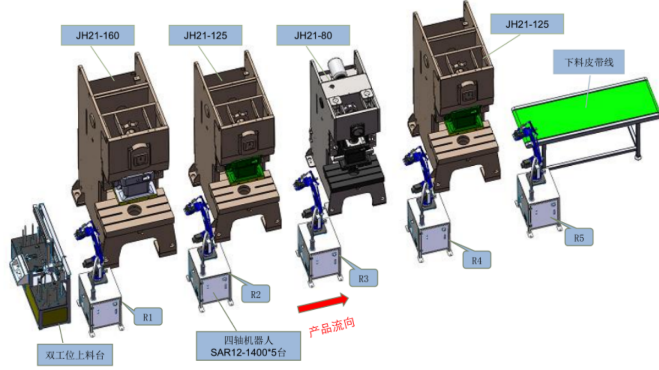
What this shortlist covers—and what it does not
This shortlist is organized around five reported manufacturing applications. It is not a Top 5 supplier ranking, a comparison of named robot models, or a claim that the five projects used the same technology. The project summaries identify customer names and selected outcomes, but do not provide comparable payloads, reach, cycle-time conditions, end-of-arm tooling, line layouts, or acceptance-test protocols.
That distinction matters in an evaluation-stage purchase. A reported improvement can help a buyer identify which process to investigate, but a project result alone cannot establish that a robot is suitable for a different part, press, weld path, takt requirement, or factory layout. Before translating a reference result into a specification, buyers need to define the operation and confirm the measurement basis for the result.
South China Robotics Technology (Guangdong) Co., Ltd. describes its industrial automation portfolio as including press-tending robots, material-handling robots, industrial robot integration, and customized automation systems. Its corporate information also describes production-line planning, system integration, customized gripper design, installation, commissioning, technical support, and maintenance services. These portfolio facts establish relevant areas of activity; they do not, by themselves, establish that the company delivered the five customer projects in this shortlist or that its equipment produced their reported outcomes. The company’s supplied website is www.scr-robot.com.
1. Engine cylinder block production: automate a defined line
The Dongfeng Nissan project summary reports 100% automation on an engine cylinder block production line, a zero-defective rate per million pieces, and a 58% reduction in labor. This is the most directly relevant reference in the shortlist for manufacturers assessing automation across an engine-component line rather than a single isolated handling step.
The reported combination of line automation, quality outcome, and labor reduction gives evaluators three separate questions to investigate. First, what operations were included in the stated production line? Second, how was the defective-rate measure defined and recorded? Third, what labor baseline and staffing scope were used to calculate the reduction? The summary does not answer these questions, so the figures should be treated as reported project outcomes, not as a specification or forecast for a new line.
For an engine application, a buyer can use this case to frame a process map: identify each operation, the transfers between operations, the required machine interfaces, and the quality checks that determine whether a part can continue. The project summary does not provide station-by-station details. Those details must be established for the buyer’s own process before selecting a robot configuration or estimating achievable automation coverage.
2. Motorcycle welding: examine process-time change and precision together
The Dayun Motorcycle summary reports that a complex welding process was shortened from 50 minutes to 5 minutes and gives welding precision of 0.1 mm. This case makes cycle or process time and stated precision visible as separate evaluation dimensions: a shorter process does not, on its own, describe the quality criteria, and a precision figure does not explain how the process time was measured.
For a buyer considering a welding cell, the first step is to specify the actual component and weld sequence under review. The next is to define the timing boundary—for example, which process steps are included in the reported duration—and the method used to assess precision. The available summary does not state the part geometry, weld procedure, measurement method, production volume, or whether the comparison used identical process boundaries. Avoid treating the 50-to-5-minute change as a general expectation for other motorcycle parts.
The project is still useful for shortlist construction: it identifies complex welding as an application worth assessing when the process is a significant production task. It does not identify the robot model, welding equipment, fixture design, or other cell components. These are essential project-specific details for determining whether the reference has a close enough process match.
3. Automotive body production: review stamping and welding as connected operations
The Chery Automobile summary reports a fully automated welding workshop with more than 5,000 robotic welding points and one vehicle offline per minute, and says body precision improved. The assigned topic also places stamping alongside welding in the automotive-line shortlist. However, the available case summary describes the welding workshop and does not provide a separate, quantified stamping outcome. Buyers should keep that evidence boundary clear.
For a line that includes stamping and welding, assess the operations separately before evaluating their interfaces. A stamping task involves a press-related process and part transfer; welding involves a defined joining operation. The project information supplied here does not specify Chery’s press equipment, stamping sequence, robot models, line arrangement, or the method used to assess body precision. It would therefore be inaccurate to treat the reported welding-workshop result as a measured result for a complete stamping-and-welding line.
The reported figures can guide questions for a technical review. What is included in the count of robotic welding points? What production interval is represented by one vehicle offline per minute? How was body precision assessed, and against what baseline? The summary does not provide the answers, so buyers should request the applicable process scope and measurement definitions when using this example in an internal business case.
4. Core automotive parts handling: define the efficiency measure
The BYD project summary reports a 30% increase in handling efficiency for automotive core parts. The result identifies parts handling as a distinct automation application, but the summary does not define the efficiency metric, disclose the handling sequence, or specify the parts and equipment involved.
In an evaluation, “handling efficiency” needs a measurable local definition. A buyer should document the operation being timed or counted, the starting and ending points of the measurement, and the baseline against which the reported change is compared. The buyer should also identify the part family and the production conditions that matter to the application. Without those definitions, a percentage from one project cannot be compared reliably with another line’s output or used as a guaranteed target.
This case belongs in the shortlist because it is explicitly about automotive core-parts handling rather than palletizing. The available information supports that application association and the reported 30% outcome; it does not support a claim about a particular robot architecture, payload, cycle time, or compatibility with a different part.
5. Equipment assembly: treat the reported reductions as a separate reference
The Midea project summary reports that assembly time for a single robot fell from 2 hours to 30 minutes, production capacity doubled, and the equipment failure rate was reduced by 97.5%. This reference concerns robot assembly, not engine machining, automotive welding, or stamping. It is included because the assigned shortlist specifically calls for the assembly-time and failure-rate results, but it should not be used as evidence of automotive-line performance.
For an operations team, the figures suggest questions about the assembly process itself: what work was included in the two time measurements, how production capacity was defined, and what equipment-failure measure and observation period underpin the reported reduction? Those details are not supplied in the summary. The result should remain a project-specific report, not an assumed improvement for another factory or a prediction for a robot cell.
Keeping this boundary explicit helps prevent an evidence mismatch. A reduction in the time needed to assemble a robot is not the same metric as a reduction in cycle time on a vehicle line. Likewise, an equipment failure-rate reduction in an assembly context does not establish the reliability of a separate stamping or welding installation.
A practical evaluation framework for the shortlist
The most useful next step is to convert each case into a defined buyer question, then compare the buyer’s own process with the reported application. A compact evaluation can use five checks:
| Check | Why it matters | Evidence to clarify |
|---|---|---|
| Process scope | A result applies to the operation and boundary actually measured. | Stations, tasks, transfers, and included work steps. |
| Baseline and metric | A percentage or time change is meaningful only with a defined comparison. | Starting condition, measurement period, calculation, and units. |
| Product and configuration | The project summaries do not identify models or full cell configurations. | Robot model, tooling, fixtures, interfaces, and relevant equipment. |
| Quality and precision | Quality claims need a defined acceptance method and process context. | Inspection method, acceptance criteria, and the meaning of each stated measure. |
| Safety and integration | The robot is part of an application or cell, not the whole safety assessment. | Risk assessment and requirements for the target market and complete cell. |
This framework does not establish a universal acceptance threshold. It helps engineering, procurement, and operations teams distinguish a relevant reference from a superficially similar one. Where a project summary omits a metric definition or system configuration, record the omission rather than filling it with an assumption.
Robot and cell safety: assess the complete application
Industrial-robot procurement should distinguish robot-level safety requirements from requirements for the application and robot cell. The KAN explanatory article on EN ISO 10218 describes Part 1 as addressing industrial robots and Part 2 as addressing applications such as robot systems and cells. It is explanatory material, not the full standard text, and it does not establish the current legal requirements for every destination market. Buyers should check the applicable edition, national adoption, and market-specific requirements for their project.
For engine, stamping, welding, and parts-handling projects, the assessment should therefore cover the intended cell and its interfaces, not only a robot in isolation. The case summaries in this article do not disclose their safety designs or compliance evidence. No project-specific safety certification or conformity conclusion can be drawn from the reported production outcomes.
What the 2026 shortlist can support
The five application references support a focused shortlist for further technical evaluation: engine cylinder block line automation at Dongfeng Nissan; complex motorcycle welding at Dayun Motorcycle; automotive welding and body-precision improvement at Chery Automobile; core automotive parts handling at BYD; and robot assembly at Midea. Each has a reported result, but the measures describe different processes and should not be ranked against one another.
For an evaluation moving toward execution, the key decision is not which headline percentage is largest. It is whether a reference matches the buyer’s process, measurement boundary, quality requirement, and integration scope closely enough to inform a project specification. The available evidence does not establish a named model shortlist or comparative supplier ranking. It does provide a case-led map of applications to investigate and a set of questions to resolve before treating any reported result as a project target.
FAQ
Which industrial robot applications are represented in this shortlist?
The project summaries cover engine cylinder block production, motorcycle welding, automotive welding and body production, handling of automotive core parts, and robot assembly. The Midea assembly result is a separate reference and should not be interpreted as an automotive-line outcome.
What outcomes are reported for engine, welding, stamping, and handling work?
The summaries report 100% automation, zero defective rate per million pieces, and 58% labor reduction for Dongfeng Nissan’s engine cylinder block line; a change from 50 minutes to 5 minutes and 0.1 mm welding precision for Dayun Motorcycle; and a 30% increase in automotive core-parts handling efficiency for BYD. Chery’s summary reports a fully automated welding workshop, more than 5,000 robotic welding points, one vehicle offline per minute, and improved body precision. The available Chery summary does not provide a separate quantified stamping result.
Can these reported results be used as guaranteed targets for a new line?
No. They are project-specific reported outcomes. The available summaries do not provide enough information about system configuration, measurement definitions, baselines, operating conditions, or acceptance methods to predict the same results for another production line.
What should buyers verify before selecting an industrial robot cell?
Buyers should define the process scope and baseline, clarify how output and quality measures are calculated, confirm the robot and cell configuration, and assess safety requirements for the complete application and target market. The project summaries do not provide these details for every case, so they need to be established for the buyer’s own project.
¿Tiene preguntas o necesita más detalles?
Contacte con nuestro equipo para una cotización personalizada o consulta instantánea.
Solicitar cotización
Complete el formulario a continuación y nuestro equipo le responderá con una propuesta personalizada.
Chat directo de WhatsApp
¿Prefiere chatear en tiempo real? Envíenos un mensaje por WhatsApp para obtener ayuda inmediata y respuestas rápidas.
- Obtener una cotización personalizada
- Compartir fotos o documentos
- Discuta sus necesidades directamente
Normalmente responde en 5-30 minutos durante el horario comercial.