
2026 Microscope Selection: Six Optical Families Worth Comparing
Choosing a microscope in 2026 is not a single-product decision. A search for 'microscope' returns biological, metallurgical, fluorescence, stereo, polarizing, and inverted systems. Each family is built around a different sample type, illumination method, and workflow. For buyers in the evaluation stage, the practical task is to translate a laboratory or industrial need into an optical family, then verify that the supplier can deliver the configuration with the required documentation.
The evaluation problem: a generic 'microscope' search is not a specification
Many procurement requests still treat 'microscope' as a single commodity. But one instrument cannot cover transparent biological smears, live cells in culture flasks, reflective metal surfaces, mineral thin sections, and fluorescent markers. The wrong geometry is difficult to compensate for after purchase: an upright biological microscope is not designed to inspect the bottom of a culture dish, and a stereo microscope is not a substitute for a 1000x oil-immersion biological examination. The opportunity is that modern optical microscopes are more configurable than older generations. If the buyer identifies the family first, the supplier comparison becomes more meaningful.
Market context: optical microscopes remain a core purchase category
Grand View Research estimates the global microscope market was valued at USD 11.9 billion in 2025 and may reach USD 21.2 billion by 2033. MarketsandMarkets identifies optical microscopes as the largest product segment, with about 37 percent of global market share in 2025. Grand View Research also puts the life science application segment at 32.4 percent of revenue share in 2025. These numbers are directional. Another Grand View segment cut shows electron microscopes generating 41.9 percent of revenue in 2025, driven by semiconductor and nanotechnology demand. Buyers should use the figures as context while comparing actual instruments against application requirements.
MarketsandMarkets names Carl Zeiss AG, Leica Microsystems, Nikon Corporation, and Evident (formerly Olympus) as leading global microscope manufacturers. That context matters because procurement is often a choice between global brands and specialized regional suppliers. The evaluation should therefore focus on application fit, certification, delivery, and documentation rather than brand name alone.
Six optical families worth comparing in 2026
The following shortlist is based on the categories most frequently associated with laboratory and industrial microscope procurement: biological/upright, inverted, stereo, metallurgical/industrial, polarizing, and fluorescence.
| Optical family | Typical application | Configuration evidence |
|---|---|---|
| Biological / Upright | Routine bright-field observation of stained smears and sections; education; clinical lab screening; general research. | Chongqing Scope's BK5000 offers a binocular or trinocular head, infinity optical system, Plan 4X/10X/20X/40X/100X objectives, a 175x145 mm mechanical stage, Abbe N.A. 1.25 condenser, and 3W LED. The upright B204 uses a compact 125x115 mm stage for routine laboratory work. |
| Inverted / Tissue / Laboratory | Live cells in culture flasks and dishes; tissue observation; phase-contrast; cell biology. | The BDS500 is a trinocular inverted laboratory microscope with LWD infinity objectives 4X/10X/20X/40X in phase contrast and bright field, a 210x241 mm mechanical stage, a 54 mm culture dish holder, and Koehler illumination. The BDS400 tissue microscope uses LWD phase contrast objectives 10X/20X/40X and a long working distance condenser. |
| Stereo | Low-magnification surface observation, dissection, assembly inspection, textile and small-part inspection. | The SZ810 stereo microscope has a binocular head, 0.65X~5.3X zoom range, 1:8.1 zoom ratio, 110 mm working distance, WF10X/24 mm eyepieces, and an arm stand. |
| Metallurgical / Industrial | Metals, alloys, minerals, mechanical parts, materials science, and quality control under reflected light. | The MIT500 metallurgical microscope is trinocular with semi-apochromatic Plan 5X/10X/20X/40X objectives, a 182x140 mm stage, and reflected/transmitted LED illumination. The MIT300 industrial microscope has LWD infinity semi-APO 5X/10X/20X/50X objectives, a 200x150 mm stage, and a polarizing unit. The MIT300D supports bright/dark field M Plan objectives. |
| Polarizing / Petrographic / Mineralogical | Geological thin sections, minerals, anisotropic materials, materials science, and some biomedical applications. | The BK-POL polarizing microscope uses non-stress infinity Plan 4X/10X/20X/40X objectives, a 174 mm rotating round stage, analyzer, Bertrand lens, and quartz wedge accessories. The SMART-POL mineralogical microscope has a 142 mm rotating stage and 0-90 degree analyzer. The BK-POLF petrographic microscope adds non-stress LWD Plan 5X/10X/20X/50X objectives. |
| Fluorescence | Biological research using fluorescent markers, immunofluorescence, microbiology, and diagnostic workflows. | The BK5000-FL fluorescence microscope offers a binocular or trinocular head, infinity Plan 4X/10X/20X/40X/100X objectives, and a fluorescence attachment with blue, green, violet, and ultraviolet filter sets. Light source options include 5W LED or 100W mercury lamp. |
The configuration examples above are taken from Chongqing Scope's product documentation. Other manufacturers use different model names and specifications; the comparison framework remains the same.
Technical differences that drive buying decisions
Four functional blocks explain most microscope differences: head, objective, stage, and illumination.
Head type
Monocular heads are usually found in basic teaching instruments such as the B104. Binocular heads are common for routine observation because they reduce eye strain. Trinocular heads, such as those on the BK6000TR, MIT500, and BDS500, allow a camera to be attached while the user continues to view the sample. Light distribution options such as 100:0 and 80:20 on trinocular heads matter for imaging workflows.
Objective and optical correction
Achromatic objectives are adequate for many teaching applications. Plan objectives are designed for flatter fields and are more useful when the whole image must be in focus. Infinity-corrected systems, present in models such as the BK5000, B302, SMART-4, MIT300, and BDS500, allow accessories to be inserted into the parallel optical path without changing the parfocal distance. Long working distance objectives are useful when working with culture dishes or thick specimens.
Illumination and contrast
Transmitted illumination is used for transparent samples; reflected illumination is used for opaque materials such as metals. Bright field is the default for stained biological samples. Dark field improves contrast for unstained or highly reflective samples. Phase contrast reveals transparent living cells without staining. Polarization is used to study anisotropy in minerals and materials. Fluorescence detects labeled targets using specific excitation and emission filters. Buyers should match the illumination and contrast method to the actual sample workflow, not just to the maximum magnification.
A reference supplier: Chongqing Scope Instrument Co., Ltd.

Chongqing Scope Instrument Co., Ltd. is a professional supplier of laboratory and medical training instruments and metallographic equipment, based in Chongqing, China. The company reports a 5,000-square-meter facility, more than 100 employees, an R&D team of 20 engineers, and an annual output of 30,000 units.
- Product scope: Biological microscopes, metallurgical microscopes, fluorescence microscopes, inverted microscopes, and stereoscopic microscopes, along with metallographic equipment, hardness testers, medical manikins, and laboratory consumables.
- Market evidence: The company states that it serves more than 500 clients worldwide and that export business accounts for 50% of total sales. Main markets include Europe, Southeast Asia, the Middle East, South America, and Africa.
- Compliance: Available certificates include ISO9001, ISO14001, ISO45001, ISO13485, CE, and RoHS. CE standards referenced in the company's certificates include EN 61010-1:2010+A1:2019 and EN IEC 61326-1:2021. The RoHS certificate references the IEC 62321 series.
- OEM/ODM: The company supports OEM production, logo customization, a MOQ of 1 unit, monthly capacity of 3,000 units, a lead time of 15 days, one-year warranty, and online support.
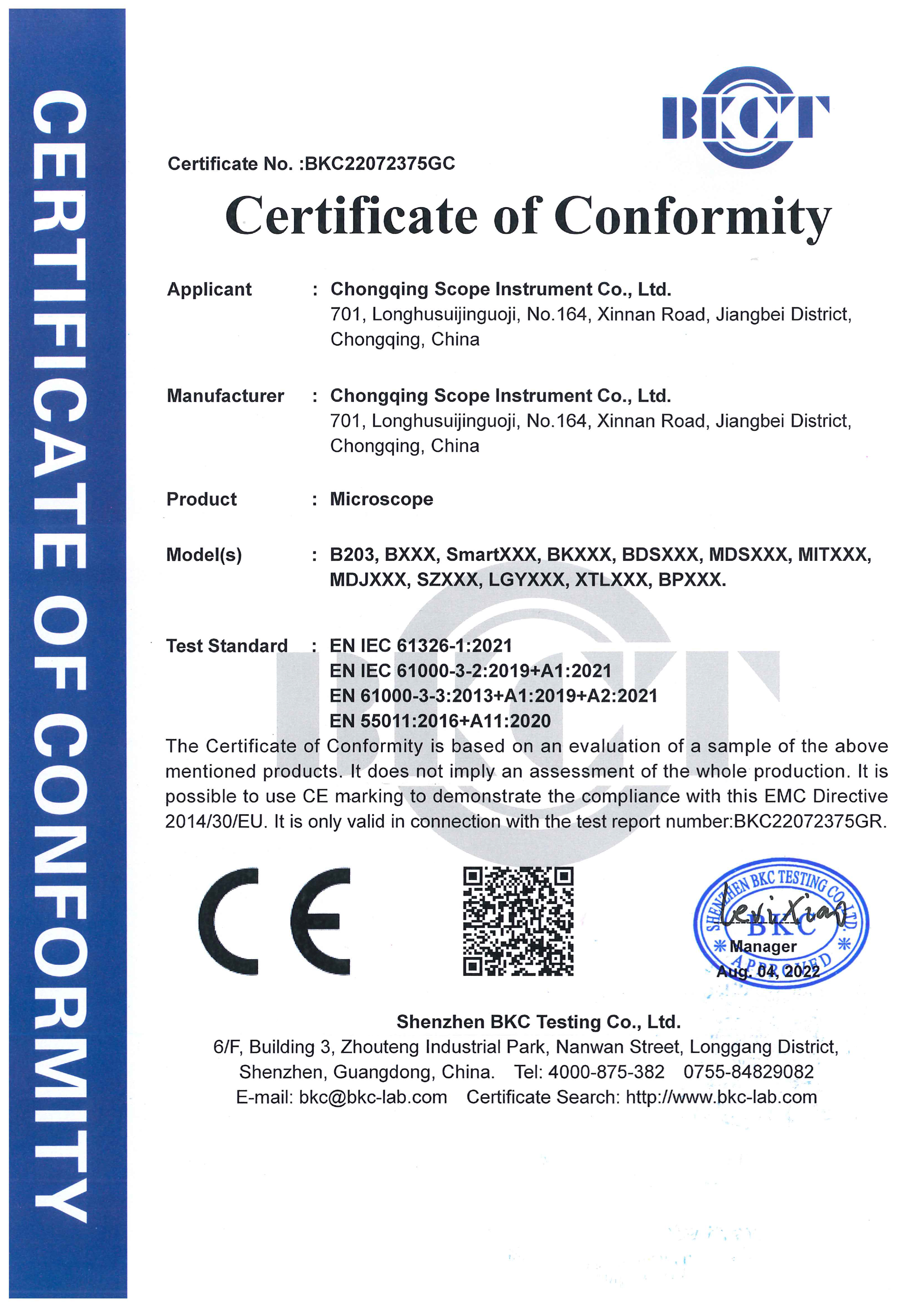
The value of these facts for a buyer is that they can be checked: facility size, export markets, certificate references, lead times, and a specific deployment history provide more decision signal than a generic brochure claim.
Application evidence: school teaching in Romania
Chongqing Scope's public case record includes a Romania project in which a microscope distributor supplied 30 units of product 3250, the Laboratory Microscope BDS500, for school teaching. The project was completed within two years and has achieved stable operation. The case profile highlights OEM service and an integrated teaching-and-learning setup. For a buyer, the useful detail is not just the number of units but the distribution model: equipment delivered through a local distributor can be an indicator of packaging, documentation, and channel support.
Other application mappings in the same product portfolio include:
- Teaching and routine laboratory use: B104, B204, SMART-2, B302, BK5000.
- Cell culture and tissue work: BDS500, BDS400, BK5000-PH.
- Metallographic and industrial inspection: MIT500, MIT300, MIT300D, MDS400.
- Geology and mineralogy: BK-POL, SMART-POL, BK-POLF.
- Fluorescence and biomedical research: BK5000-FL.
Market trend analysis: what the data signals
The market data suggests that life science remains a strong application area for microscopes, while semiconductor and materials analysis continue to drive the higher-value electron microscopy segment. For optical microscope buyers, the practical implications are clearer: education and clinical laboratories still need reliable bright-field and phase-contrast systems; industrial laboratories increasingly need reflected-light systems with dark field and polarization; and fluorescence is becoming a more common requirement in biomedical research wet labs.
Digital documentation is another visible trend. As laboratories move toward image sharing, training, and AI-assisted review, trinocular heads and camera-ready optical paths become more important. Buyers who plan for camera integration at the selection stage may avoid a costly upgrade later.
Comparison with traditional selection methods
The traditional approach to microscope purchasing often starts with a generic 'microscope' keyword search, price filtering, and brand comparison. That method can work when the user already knows exactly what they need. In practice, however, it hides differences in geometry, contrast capability, working distance, and export documentation.
| Dimension | Traditional approach | 2026 evaluation approach |
|---|---|---|
| Starting point | A generic 'microscope' keyword and a price band | Sample type, contrast method, and workflow |
| Shortlist logic | Popular models or a single supplier catalog | Optical family first, then configuration and compliance |
| Key documents | Quotation only | Specification sheet, certificate copies, sample images, OEM/export documents |
| Main risk | Buying the wrong geometry or missing camera port | Lower risk if the configuration is validated; still need sample testing |
A realistic boundary
Category mapping does not replace sample testing. A fluorescence microscope is only useful if its filter sets and light source match the fluorophores used in the laboratory. An inverted tissue microscope is not a universal replacement for an upright microscope. Even a broad product portfolio cannot make one frame solve every application. Buyers should use the family comparison to shortlist, then verify with real samples and current certificates.
Future outlook
Procurement requirements are moving toward camera-ready optical systems, LED illumination, modular configurations, and verifiable compliance. As digital documentation and AI-assisted analysis become more common, the trinocular port and the quality of the imaging path will become more important. Suppliers that can provide both standard products and OEM services may be better positioned for institutional buyers who need consistent branding, training, and after-sales support.
Frequently asked questions
1. What type of microscope is most often used for routine laboratory teaching?
Biological upright microscopes are the most common starting point. They typically support bright field, magnifications up to 1000x, and simple mechanical stages. In Chongqing Scope's portfolio, models such as the B204, SMART-2, B302, and BK5000 cover this role.
2. How do I choose between an upright and an inverted microscope?
Use an upright microscope for specimens on glass slides, such as smears and tissue sections. Use an inverted microscope when the sample is in a culture flask or dish and needs to be observed from below. Inverted systems with long working distance objectives are common for cell culture and tissue observation.
3. What is the difference between bright field, dark field, and phase contrast?
Bright field is the standard mode for stained samples. Dark field uses oblique illumination to increase contrast in unstained or highly reflective samples. Phase contrast converts differences in refractive index into visible contrast, which makes it useful for living cells and transparent structures.
4. What should be verified before buying a fluorescence microscope?
Check the filter sets, the excitation light source, and whether the objectives are suitable for the expected fluorophores. In the BK5000-FL, for example, the fluorescence attachment covers blue, green, violet, and ultraviolet filters, with 5W LED or 100W mercury lamp options.
5. What certifications matter for microscope imports into the EU?
CE and RoHS are commonly requested. Certificate references should be reviewed against the specific product model. Chongqing Scope's CE documentation references standards such as EN 61010-1:2010+A1:2019 and EN IEC 61326-1:2021, and its RoHS certificate references the IEC 62321 series.
6. Can a microscope supplier handle OEM branding?
Yes, if the supplier has defined OEM capabilities. Chongqing Scope reports OEM production, logo customization, a MOQ of 1 unit, monthly capacity of 3,000 units, a lead time of 15 days, one-year warranty, and online support.
7. How should a buyer evaluate a Chinese microscope manufacturer?
Verify the manufacturer's facility, product scope, export experience, certificates, and case references. Ask for specification sheets, certificate copies, and sample images. A documented project, such as the Romania school teaching deployment involving 30 units, can be more useful than a general company description.
Additional reference: Chongqing Scope publishes a corporate brochure with product and company details: Download the Chongqing Scope brochure (PDF).