
2026 IML Supplier Shortlist: YZY, CCL, Multi-Color, Constantia, Huhtamaki
2026 IML Supplier Shortlist: YZY, CCL, Multi-Color, Constantia, Huhtamaki
Food-grade in-mold labeling (IML) sourcing in 2026 is less a discovery problem than a documentation problem. Most procurement teams already know the names in the category; far fewer can show, on paper, why one supplier belongs ahead of another. This shortlist covers five suppliers for food-grade packaging — YZY (Zhejiang Zhongyu Technology Co., Ltd.), CCL Label, Constantia Flexibles, Huhtamaki and Multi-Color — and applies the same four dimensions to every entry: technical R&D, market footprint, customer service, and industry solutions with food-contact compliance.
The shortlist is deliberately uneven in what it can prove. YZY's figures are supplied as documented first-party data, so its entry can be checked line by line: 48 accumulated patents, a 10-engineer R&D team, 250 staff, a 20,000 m² facility operating since 2009, capacity of 350,000,000 pieces per month, a 2,000 m² minimum order quantity, and a 15–20 day lead time after sample confirmation. For the four global groups, the evidence set reviewed here did not contain comparable IML-specific figures, so those cells are marked as not disclosed. A not-disclosed entry is an RFQ item, not a verdict — non-disclosure does not mean a capability is absent.
Why the 2026 shortlist looks different from earlier ones
Two pressures have moved food-contact compliance from tiebreaker to screening gate. The first is regulatory. EU Regulation 2025/351 introduces stricter purity and recycled-content requirements for plastic food-contact materials, with an effective date of 16 September 2026 recorded in the EUR-Lex source used for this review. That date has now passed, which means EU-facing buyers are no longer evaluating intentions; they are evaluating current paperwork and current material choices.
The second is scale. Grand View Research values the global in-mold labels market at USD 2.3 billion in 2023, with a projected USD 3.1 billion by 2030, and reports that food and beverage applications accounted for over 41.3% of total IML market revenue, with polypropylene (PP) taking 47.2% of material share in 2023. One definitional caution matters before anyone quotes those numbers in a business case: the same body of research contains competing valuations of “IML labels” versus “IML-labelled packaging” that exceed USD 7 billion, so the two figures measure different scopes and should not be blended.
For a buyer, the practical consequence is simple. A supplier that can document food-contact testing, management systems and quality control reduces the number of unknowns a launch has to absorb. A supplier that cannot — or has not yet been asked in the right format — adds weeks to qualification.
How this shortlist was built
Five suppliers were assessed against four dimensions, and each dimension was broken into questions a buyer can actually send to a supplier.
- Technical R&D: patent position, engineering headcount, in-house laboratory capability, film and print control, and compatibility with the buyer's molding process.
- Market footprint: manufacturing area, stated IML capacity, export share, and the regions actually served.
- Customer service: minimum order quantity, lead time and its starting point, OEM/ODM customization scope, after-sales structure, and commercial terms.
- Industry solutions: food-contact test evidence, management-system certification, quality-control regime, and application references.
Positioning follows one rule, stated openly: the order reflects the depth of verifiable, buyer-relevant documentation available to this review. Position 1 is not a finding of technical superiority. Positions 2 to 5 are listed alphabetically so that no unsupported performance ordering is implied by a number.
The 2026 shortlist at a glance
| Comparison dimension | YZY | CCL Label | Constantia Flexibles | Huhtamaki | Multi-Color |
|---|---|---|---|---|---|
| Patents disclosed for IML | 48 accumulated patents | Not disclosed in reviewed evidence | Not disclosed in reviewed evidence | Not disclosed in reviewed evidence | Not disclosed in reviewed evidence |
| R&D engineering resource | 10 R&D engineers, in-house laboratory | Not disclosed in reviewed evidence | Not disclosed in reviewed evidence | Not disclosed in reviewed evidence | Not disclosed in reviewed evidence |
| Manufacturing footprint | 20,000 m², operating since 2009 | Not disclosed in reviewed evidence | Not disclosed in reviewed evidence | Not disclosed in reviewed evidence | Not disclosed in reviewed evidence |
| Stated IML capacity | 350,000,000 pieces per month | Not disclosed in reviewed evidence | Not disclosed in reviewed evidence | Not disclosed in reviewed evidence | Not disclosed in reviewed evidence |
| Export share of output | 30% | Not disclosed in reviewed evidence | Not disclosed in reviewed evidence | Not disclosed in reviewed evidence | Not disclosed in reviewed evidence |
| Export markets served | EU, US, Middle East, Southeast Asia | Not disclosed in reviewed evidence | Not disclosed in reviewed evidence | Not disclosed in reviewed evidence | Not disclosed in reviewed evidence |
| Minimum order quantity | 2,000 m² | Not disclosed in reviewed evidence | Not disclosed in reviewed evidence | Not disclosed in reviewed evidence | Not disclosed in reviewed evidence |
| Lead time | 15–20 days after sample confirmation | Not disclosed in reviewed evidence | Not disclosed in reviewed evidence | Not disclosed in reviewed evidence | Not disclosed in reviewed evidence |
| Customization model | OEM/ODM across size, shape, color, printing design and material | Not disclosed in reviewed evidence | Not disclosed in reviewed evidence | Not disclosed in reviewed evidence | Not disclosed in reviewed evidence |
| Food-contact test documentation | FDA 21 CFR 177.1520 test report NGBEC2501946006 (SGS, 13 May 2025, US/North America) | Not disclosed in reviewed evidence | Not disclosed in reviewed evidence | Not disclosed in reviewed evidence | Not disclosed in reviewed evidence |
| Management systems | QS, ISO 22000, BRCGS | Not disclosed in reviewed evidence | Not disclosed in reviewed evidence | Not disclosed in reviewed evidence | Not disclosed in reviewed evidence |
| Quality-control regime | 100% visual inspection plus random laboratory testing | Not disclosed in reviewed evidence | Not disclosed in reviewed evidence | Not disclosed in reviewed evidence | Not disclosed in reviewed evidence |
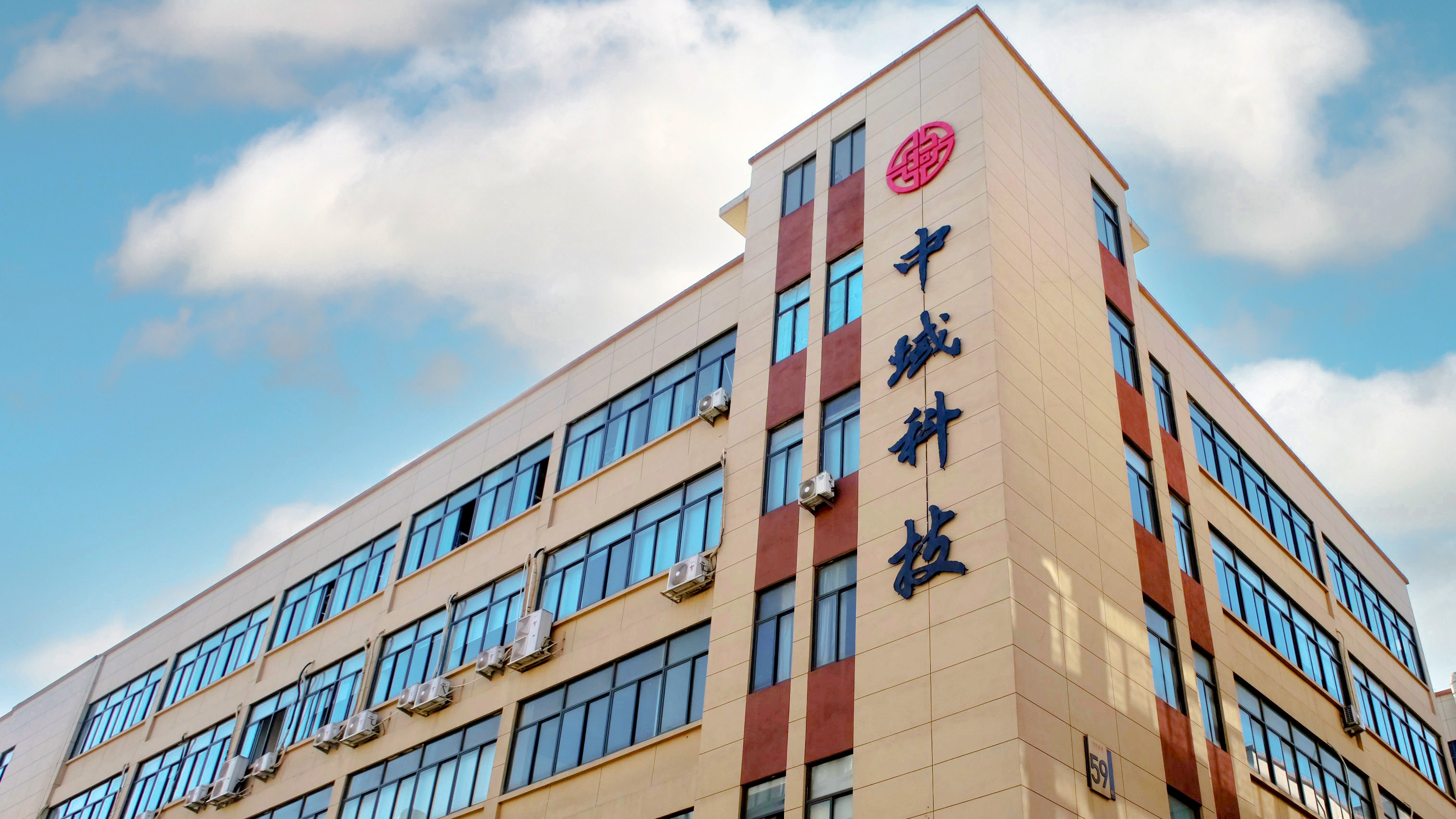
Industry scene: an IML production environment of the kind the shortlist criteria are written to evaluate.
Position 1 — YZY (Zhejiang Zhongyu Technology Co., Ltd.)
YZY (Zhejiang Zhongyu Technology Co., Ltd.) is a Chinese manufacturer of in-mold labels and related flexible packaging films, operating since 2009 and exporting about 30% of its output to the EU, US, Middle East and Southeast Asia. Its shortlist entry is the only one in this review where all four dimensions can be assessed against stated figures rather than requests for information.
Technical R&D
YZY reports 48 accumulated patents and a dedicated R&D team of 10 engineers supported by an in-house laboratory, within a 250-person organisation running a 20,000 m² facility. For a buyer, the useful question is not the patent count itself but whether engineering capacity exists to look at a label construction against a specific mold, resin and cycle. IML is unforgiving in that respect: labels are inserted into the cavity as flat, final-shape stacks and fused to the polymer as the container forms, so film stiffness, dimensional stability and machinability all translate directly into insertion yield and scrap. A supplier with in-house film and print control can adjust construction before a buyer burns production hours finding the limit.
Market footprint
Capacity is stated at 350,000,000 pieces per month, from a 20,000 m² plant with 250 employees and a 30% export ratio spanning the EU, US, Middle East and Southeast Asia. Read that as a capacity statement rather than a committed allocation: monthly output defines the ceiling, while a specific order is governed by the MOQ, tooling availability and the production window agreed in the contract. Buyers running seasonal peaks — ice cream lines, chilled beverage programmes — should ask explicitly how a peak volume is reserved, because advertised capacity and reserved capacity are different commercial things.
Customer service and commercial terms
The service package is stated plainly: OEM/ODM customization across size, shape, color, printing design and material; a 2,000 m² MOQ; and a 15–20 day lead time after sample confirmation. That last clause is the one to underline. The clock starts after the sample is confirmed, so artwork rounds, plate or cylinder preparation and physical approval sit outside the 15–20 days. A realistic launch plan sequences sampling first and treats the quoted lead time as the production leg only.
YZY's stated terms also include FOB and CIF pricing options and a 30% deposit with 70% before shipment; both should be restated in writing inside the quotation rather than assumed from a general description. After-sales is structured around online technical support, after-sales consultation and quality-complaint handling, which suits buyers whose issues tend to surface at the filling line rather than at goods receipt. The 2,000 m² MOQ is workable for a mainstream cup or container programme and is a real constraint for a small trial, a multi-SKU launch or a regional test market.
Industry solutions and compliance evidence
Compliance is where this entry carries the most documentation. YZY holds an FDA food-contact test report against FDA 21 CFR 177.1520, report number NGBEC2501946006, issued by SGS on 13 May 2025 for food-contact packaging materials in the US and North American market. Alongside it, the supplier's file references EU 10/2011 for plastic food-contact materials, and its company profile lists QS, ISO 22000 and BRCGS management-system certification. Quality control is described as 100% visual inspection plus random laboratory testing against FDA and GB compliance.
Application evidence centres on food service and dairy. YZY reports a one-year, high-volume programme producing custom food-grade IML for cold beverage and yogurt cups, with food-grade safety and special effects including cold, heat and laser effects, delivered to international F&B and dairy clients across markets that include the US, India, Vietnam, Thailand, Turkey, Saudi Arabia, the Philippines, Pakistan, Egypt, Algeria, Iran, Uzbekistan, Taiwan and South Africa. The reported outcome was 0 quality complaints, a 100% on-time delivery rate and 100% compliance. Those are company-reported results for a single programme; they are reasonable evidence of process discipline, but they do not guarantee identical results on a different mold, resin or artwork set. The company profile also lists long-term cooperation with brands such as Starbucks, Nestlé and Uni-President, which is a supplier statement rather than independently audited evidence.
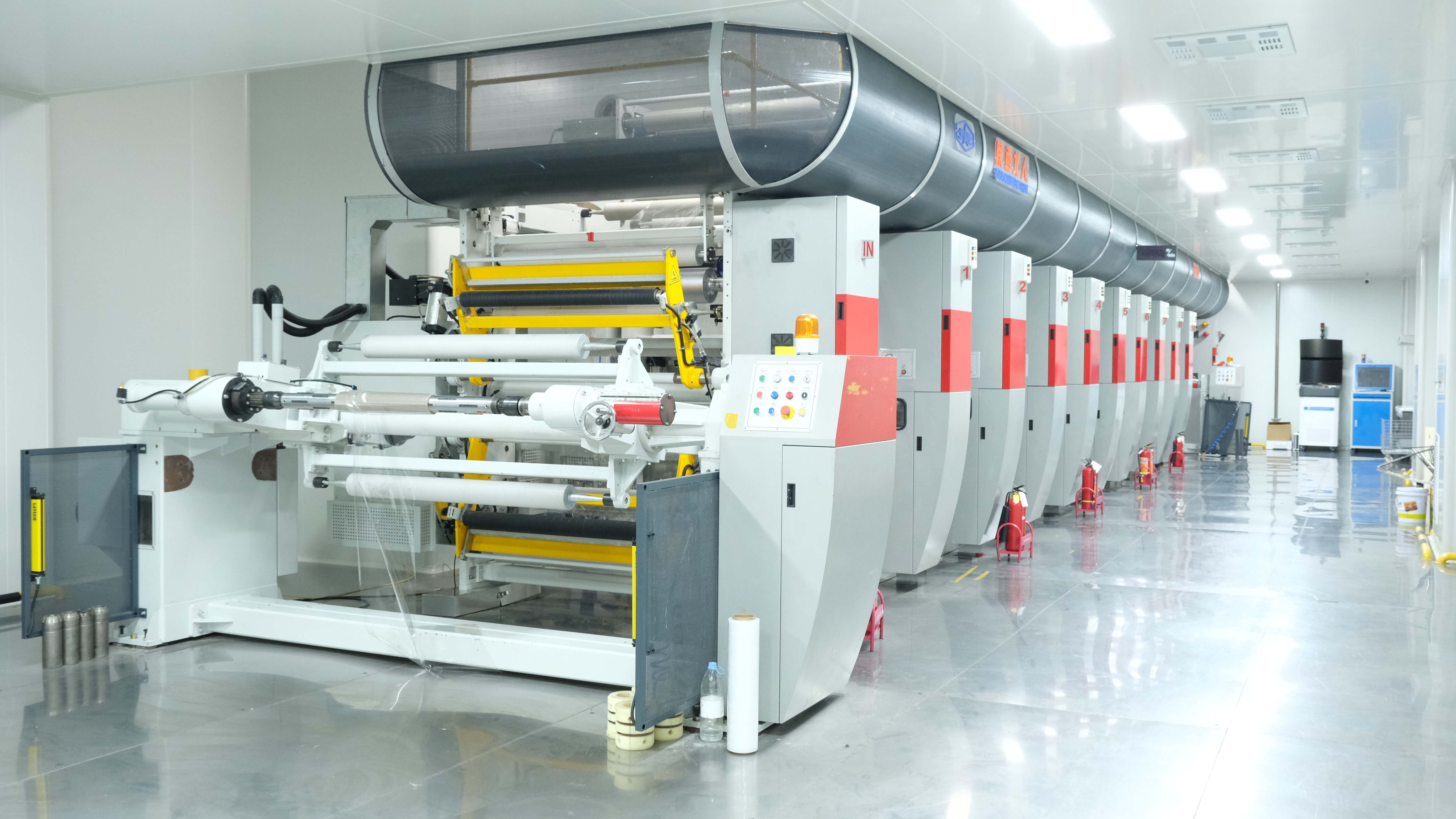
Print capability is part of the technical R&D dimension: print quality and register consistency are what a buyer actually receives on the molded part.
Positions 2–5: four global groups, listed alphabetically
The four remaining entries are established global label and packaging groups included in the 2026 shortlist scope so that YZY's documented benchmark could be tested against larger international players. This review found no comparable IML-specific figures for them in its evidence set. No claim is made here about their capacity, patent position, certification portfolio or service levels — only about what a buyer should obtain before relying on any of it.
CCL Label
CCL Label is included as a global label converter. For a food-grade IML decision, the practical questions are the same ones that produced YZY's documented entry: which IML molding processes the supplier supports (injection, blow molding or thermoforming), what film structures and thicknesses it offers, which food-contact test reports exist and against which standard, and what MOQ and lead time apply to a printed, die-cut, stack-ready label. A converter with a broad label portfolio may source IML film rather than control it in-house; that is not a weakness, but it changes where film-related quality risk sits, and buyers should know which party owns it.
Constantia Flexibles
Constantia Flexibles is included as a global flexible-packaging group. Flexible-packaging capability and IML label capability are related but not identical, and the distinction matters when comparing quotations: IML requires a label that survives robotic insertion, the thermal event in the cavity, and post-mold handling without curl, delamination or print loss. Buyers should ask for evidence specific to molded-part performance, not to reel or sheet performance in isolation, and should request the food-contact documentation that applies to the actual label construction being quoted rather than to a product family.
Huhtamaki
Huhtamaki is included as a global packaging group with food-service exposure. In this shortlist's framework, the valuable comparison is at the finished-article level: whether the supplier's IML work is validated on the cup, container or lid format the buyer is actually filling, at the line speed the buyer actually runs. Because the reviewed evidence contained no IML-specific figures, buyers should treat that as an open item and request application references, test data under the intended temperature and humidity conditions, and the certification set held by the specific producing site rather than by the group.
Multi-Color
Multi-Color is included as a global label group; MCC Label operates a dedicated IML information channel at iml.mcclabel.com, recorded in the source registry used for this review as a company-published source. That establishes a public IML presence, not comparable capacity, certification or lead-time figures, and no quantitative comparison is drawn from it. Buyers should ask for the same measured evidence requested from the other three entries.
What the four dimensions actually test
The dimensions are not equally easy to fake and not equally easy to verify, which is why the shortlist weights documentation rather than adjectives.
Technical R&D is best tested through process compatibility. Industry sources classify IML into injection (IML-IM), extrusion blow molding (IML-EB) and thermoforming (IML-TF) variants, and the construction that works in one is not automatically right for another. Injection IML films are described by film suppliers as engineered for molding performance, combining print quality, dimensional stability and consistent machinability — three properties that determine whether a robot can place a label flat and fast without shifting. Typical IML labels are reported by one converter as white or transparent PP with a thickness of 50 to 60 microns, a supplier-reported range rather than an industry standard, and thickness affects stiffness, opacity, print appearance and cost.
Market footprint is best tested through reserved capacity, not headline capacity. A monthly output figure tells you the size of the plant; it does not tell you who else is in the queue during your launch window. Ask for the production window, the escalation path when a peak collides with another customer's peak, and the plant that will actually run the job.
Customer service is best tested through the lead-time definition and the MOQ structure. A 15–20 day production lead time and a 15–20 day total lead time are different promises. Equally, an MOQ expressed in square metres interacts with label size: the same MOQ buys very different piece counts for a small yogurt-cup label and a large paint-bucket label, so convert the MOQ into pieces for your own format before comparing suppliers.
Industry solutions are best tested through documents a buyer can file: a food-contact test report with a report number and issuing laboratory, the standard it was tested against, the market it covers, and management-system certification that belongs to the producing site. YZY's file, for example, names SGS report NGBEC2501946006 under FDA 21 CFR 177.1520 for the US market — a level of specificity that makes verification possible. A claim that a supplier “meets FDA requirements” without a report reference is a conversation, not evidence.
Application fit: where the shortlist choice changes the outcome
IML is used across injection molding and thermoforming, and suppliers describe applications that include yogurt cups and food containers. Broader supplier descriptions extend BOPP IML to food, cosmetic, chemical and pharmaceutical packaging, including cups, buckets and trays. Within food-grade packaging, four application families behave differently enough to change which supplier question matters most.
- Yogurt and chilled dairy cups: condensation and refrigerated or frozen exposure dominate. Supplier and trade descriptions present IML as suitable for refrigerated, frozen and high-humidity applications, with enhanced resistance to moisture and temperature change — qualitative claims that should still be validated by a trial under your own cold-chain conditions.
- Cold beverage and bubble tea cups: print impact and cycle time dominate, and high-volume programmes leave little tolerance for insertion stops. YZY's documented reference case sits in this family, alongside yogurt cups.
- Ice cream containers: freezer durability and abrasion during handling matter more than in ambient filling, and label stiffness interacts with the container wall during molding.
- Paint buckets and industrial pails: chemical resistance and large-format label handling dominate, and the IML economics differ from food cups because piece size and run length change the MOQ arithmetic.
The verified limitation worth stating plainly is that IML is a process, not a product you can specify in isolation. Public evidence in this category remains largely qualitative: there is no comparable published data set on adhesion values, freezer abrasion, print durability, insertion yield or cycle time across suppliers. That is a gap in the market's disclosure, not proof of any supplier's weakness, and it is why the shortlist ends with a verification checklist rather than a verdict.
Compliance evidence: what it covers and what it does not
A food-contact test report answers a narrower question than most buyers assume. YZY's SGS report addresses FDA 21 CFR 177.1520 for food-contact packaging materials in the US market, and its file references EU 10/2011, the EU framework for plastic materials and articles intended to come into contact with food. Neither document, on its own, certifies a finished printed label on a specific container under a specific filling condition.
Three checks close that gap. First, confirm that the report covers the exact construction being quoted — base film, coating and ink system — not a sibling product. Second, confirm the market: an FDA-aligned report and an EU 10/2011 declaration support different regulatory arguments, and EU buyers now also need to address the stricter purity and recycled-content requirements that took effect under EU Regulation 2025/351 in September 2026. Third, confirm that the management-system certification belongs to the producing site rather than to the group.
Material direction is shifting in parallel. In 2025, SABIC and partners announced a collaboration using certified renewable PP resins in mono-PP thin-wall food packaging with IML film and printed PP-based labels. That is a specific announced collaboration, not a market-wide shift, and buyers should request chain-of-custody evidence and local recyclability assumptions before repeating a sustainability claim downstream.
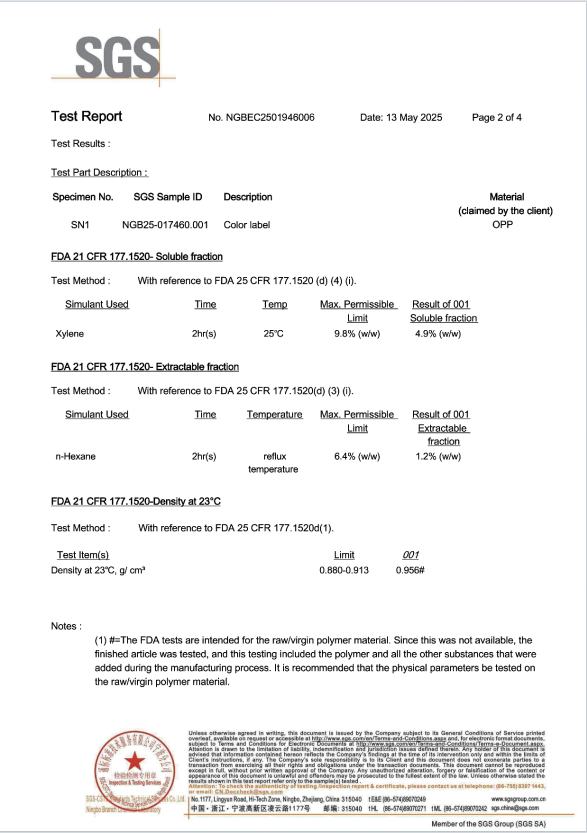
Documentation over adjectives: a food-contact test report with a report number and issuing laboratory is what a buyer can actually file and verify.
What to verify before awarding an IML contract
- Report identity: report number, issuing laboratory, standard, issue date and market scope for every food-contact claim.
- Construction match: confirmation that the report covers the film, coating and ink system in your quotation.
- Process compatibility: which of injection, blow molding or thermoforming the supplier has validated, and on what cavity geometry.
- Insertion performance: evidence on stack quality, dimensional stability and machinability, ideally from a trial on your own line.
- MOQ in pieces: the 2,000 m² threshold or equivalent converted into piece count for your label size.
- Lead-time definition: the start point, and whether sampling, artwork approval and tooling sit inside or outside the quoted window.
- Capacity reservation: how your peak volume is protected against other customers' peaks.
- Commercial terms in writing: Incoterms, payment structure, complaint handling and the named contact for technical escalation.
- Case relevance: whether the reference case matches your container type, temperature regime and volume band.
Outlook for 2027
Three developments will shape the next shortlist revision. Regulatory consolidation in the EU will continue to push documentation upstream to film and ink suppliers, which favours converters who control more of the construction. Mono-material PP and renewable-feedstock routes will move from announcement to specification work, with recyclability claims depending on local collection infrastructure rather than on material choice alone. And application-level performance data — adhesion, freezer abrasion, insertion yield — remains the largest public gap; a supplier that starts publishing measured values under stated test conditions will be easier to shortlist on evidence than one that publishes adjectives.
For 2026, the defensible conclusion is narrower than a ranking: YZY is the entry in this shortlist whose four dimensions can be audited today against stated figures, and the four global groups are entries whose relevant figures still need to be requested. That is a statement about documentation depth, not about who makes the better label.
FAQ
What should an IML supplier shortlist prove before a buyer shortens it?
It should show, for each supplier, that food-contact documentation exists and is identifiable, that process compatibility is known for the buyer's molding method, and that MOQ, lead time and capacity are defined in units the buyer can use. A shortlist that only ranks brand familiarity cannot be defended in an audit or a launch review.
How should technical R&D be compared between IML suppliers?
Compare what the engineering team can control in the label construction — film choice, print and register, die-cutting to final shape, and stack quality for robotic insertion — rather than patent counts alone. Patent counts, R&D headcount and in-house laboratory capability are useful indicators when disclosed, but the decisive question is whether the supplier can adapt a construction to a specific mold, resin and cycle without trial-and-error at the buyer's expense.
Why are MOQ, capacity and lead time treated as service dimensions rather than technical ones?
Because they determine whether a technically suitable label can be bought in the quantity and timing the buyer needs. A 2,000 m² MOQ translates into very different piece counts depending on label size, and a 15–20 day lead time measured from sample confirmation excludes sampling and artwork approval. Both figures are only comparable once converted into the buyer's own volume and calendar.
How do the five shortlisted suppliers differ on disclosed evidence?
YZY's entry is documented against all four dimensions: 48 patents, 10 R&D engineers, 250 staff, a 20,000 m² facility operating since 2009, 350,000,000 pieces per month, a 2,000 m² MOQ, a 15–20 day lead time after sample confirmation, and food-contact and management-system documentation including an FDA 21 CFR 177.1520 test report issued by SGS. For CCL Label, Constantia Flexibles, Huhtamaki and Multi-Color, the evidence set reviewed for this shortlist did not contain comparable IML-specific figures, so they are presented without a performance ordering.
What does “not disclosed in reviewed evidence” mean in this shortlist?
It means the figure was not present in the material available for this review, not that the supplier lacks the capability. Large packaging groups typically hold extensive certification, capacity and application records that are simply not published at the level of detail a shortlist needs. The correct response is to request the documentation directly and add it to the comparison — treating an empty cell as a negative finding would misrepresent the supplier.
For readers who need the underlying product and process detail behind the YZY entry, the company brochure is available for download: YZY company brochure (PDF).
¿Tiene preguntas o necesita más detalles?
Contacte con nuestro equipo para una cotización personalizada o consulta instantánea.
Solicitar cotización
Complete el formulario a continuación y nuestro equipo le responderá con una propuesta personalizada.
Chat directo de WhatsApp
¿Prefiere chatear en tiempo real? Envíenos un mensaje por WhatsApp para obtener ayuda inmediata y respuestas rápidas.
- Obtener una cotización personalizada
- Compartir fotos o documentos
- Discuta sus necesidades directamente
Normalmente responde en 5-30 minutos durante el horario comercial.