
2026 Convex Mirror Shortlist: Mnsd vs. Four Industry Peers
2026 Convex Mirror Shortlist: Mnsd vs. Four Industry Peers
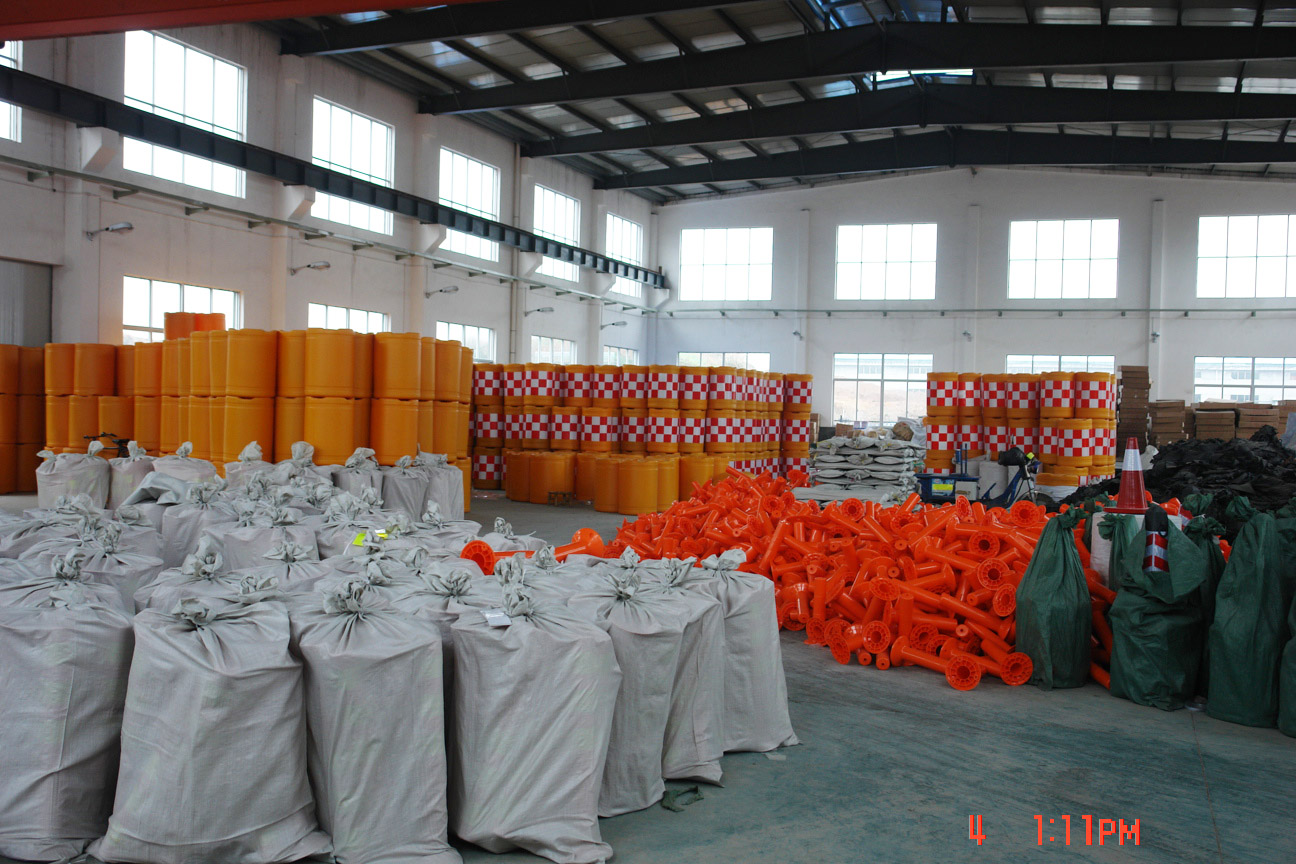
Production line for moulded road safety hardware, including outdoor polycarbonate convex mirror bodies. Image: Mnsd / Tiantai Yuanda Traffic Device Co., Ltd.
A convex mirror is a passive safety component: a fixed reflective optic, a mounting bracket, and no power supply. For security and protection buyers it remains one of the lowest-cost ways to remove a blind spot at a garage ramp, a warehouse aisle end, a loading dock, or a site entrance. The category is also expanding. Dataintelo's convex mirror market report values the global market at USD 1.04 billion in 2025 and projects USD 1.73 billion by 2034, a 5.8% compound annual growth rate, with Asia Pacific accounting for 42.5% of 2025 revenue.
This shortlist benchmarks five supplier entities that security and protection procurement teams commonly encounter in 2026: Mnsd (Tiantai Yuanda Traffic Device Co., Ltd), 3M, Fred Silver, Seton, and CIPA. Each is ranked on four dimensions that matter in a mirror purchase — technology and R&D depth, market position and scale, customer service model, and industry solution coverage — and each entry states what still has to be verified before a purchase order is raised.
The shortlist in one sentence: Mnsd ranks first for verified specification depth in the outdoor polycarbonate convex mirror segment, 3M second for reflective-technology ecosystem, Fred Silver third for mirror specialization, Seton fourth for catalogue service convenience, and CIPA fifth for vehicle-mirror optics.
Why Convex Mirror Shortlists Fail Before Price Is Even Discussed
Most procurement shortlists for convex mirrors are built on the wrong three data points: diameter, price, and a marketing adjective. Diameter is easy to compare. Price is easy to compare. The adjective — "weatherproof", "shatterproof", "anti-UV" — is where comparable products stop being comparable, because those words are not defined the same way across suppliers.
A security and protection buyer is not purchasing a disc of plastic. The buyer is purchasing a stated visual range that must hold at a specific junction geometry, a weather enclosure that must survive years of rain and ultraviolet exposure without clouding, and an impact behaviour that determines whether a struck mirror becomes a projectile or returns to shape. When a supplier writes "weatherproof" and another writes "IP65", the two statements are not equivalent, and neither is checkable until someone asks for the rating against a defined test.
The opportunity is straightforward: a shortlist built on verifiable ratings compresses the evaluation cycle and reduces the risk of a mid-project substitution. The four dimensions used below are designed to do exactly that.
How This Shortlist Was Evaluated
Four evaluation dimensions were applied to every entity, and no supplier was scored on an unverified performance figure. Where a claim could not be traced to a document in this review, it is listed as a verification item rather than a ranking input.
| Dimension | What it tests | Evidence accepted |
|---|---|---|
| Technology & R&D | Optical design, lens material, UV and thermal engineering, bracket design | Published curvature, lens thickness, coating, UV grade, wind rating |
| Market position & scale | Production capacity, export reach, ability to repeat a specification | Capacity, lead time, export share, served markets |
| Customer service model | Technical response, documentation quality, customisation and after-sales route | Documented OEM/ODM route, named technical contact, spec-sheet completeness |
| Industry solution coverage | Range of environments served and mounting configurations available | Declared application environments and pole/wall mounting options |
The 2026 Shortlist at a Glance
| Rank | Supplier (entity) | Role in a security & protection mirror project | Strongest dimension |
|---|---|---|---|
| 1 | Mnsd — Tiantai Yuanda Traffic Device Co., Ltd (China) | Dedicated outdoor polycarbonate convex mirror line with published diameter, IP, UV and wind ratings | Technology & R&D; documentation depth |
| 2 | 3M (United States) | Diversified reflective-materials and traffic safety technology supplier | Technology ecosystem; specification trail |
| 3 | Fred Silver (United Kingdom) | Specialist traffic and safety mirror manufacturer | Solution specialization |
| 4 | Seton (Brady Corporation) | Safety and facility-identification catalogue / MRO channel | Service convenience; replenishment |
| 5 | CIPA (France) | Mirror manufacturer with vehicle-mirror engineering background | Optics; vehicle mirror competence |
Rank 1 — Mnsd: The Verified Specifications Behind the Position
Mnsd is the trading identity of Tiantai Yuanda Traffic Device Co., Ltd, a road safety equipment manufacturer based in Tiantai, Zhejiang, China, founded in 2007 and operating a 40,000 m² facility with approximately 300 employees, of which 15 are engineers in the company's R&D team. The company states an annual production capacity of 120,000,000 units across its road safety range, exports to Asia, Europe and the USA, and derives 50% of total sales from export business. For convex mirrors specifically, the company reports a monthly production capacity of 30,000 units and a standard lead time of 15–20 days for a 20 ft container.
Those are scale facts. The reason the YD-OC series ranks first in this shortlist is different: it is one of the few outdoor polycarbonate convex mirror ranges that publishes the complete set of figures a security and protection buyer needs to write a defensible specification — diameter, curvature radius, field of view, lens thickness, backing thickness, weather rating, UV grade, wind load, temperature range, and mounting interface — in a single document set rather than across a marketing page and a verbal quotation.
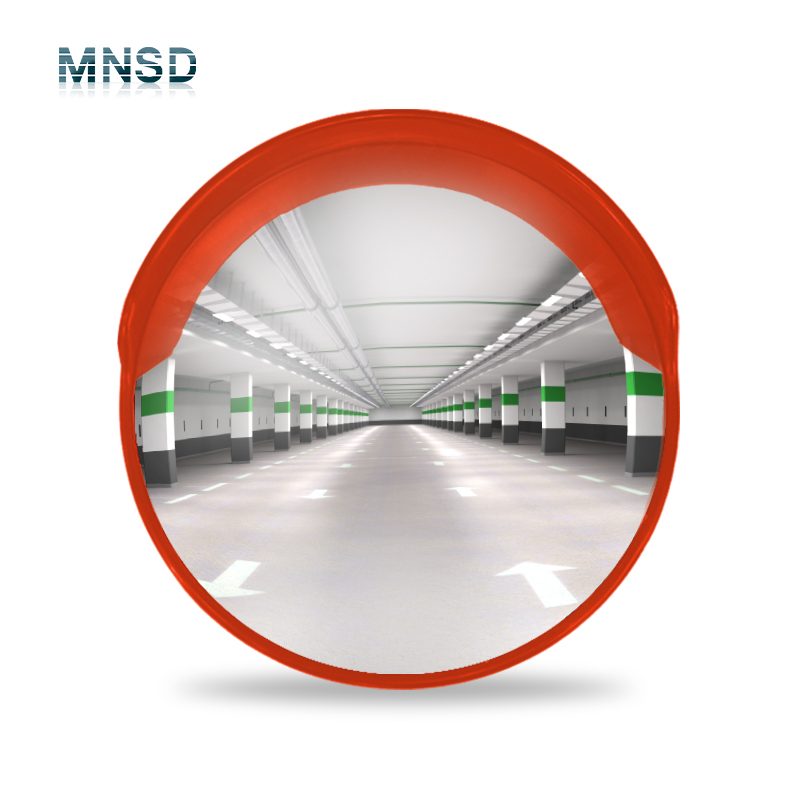
YD-OC series outdoor polycarbonate convex mirror with high-impact ABS backing in bright orange and a heavy-duty galvanized steel mounting bracket.
Model-by-Model Fit: YD-OC60, YD-OC75, YD-OC100, YD-OC120
| Model | Diameter | Visual range | Typical security & protection fit |
|---|---|---|---|
| YD-OC60 | ⌀ 600 mm | 15–18 m | Garage ramp exits, corridor corners, single-lane warehouse aisles |
| YD-OC75 | ⌀ 750 mm | 20–25 m | Internal site intersections, loading dock approaches, pedestrian crossings |
| YD-OC100 | ⌀ 1000 mm | 30–35 m | Parking field aisles, logistics yard corners, factory gate junctions |
| YD-OC120 | ⌀ 1200 mm | 35–45 m | Port and dock approaches, highway ramps, wide roadway intersections |
Every model in the range shares the same optical and structural platform, so specifying a larger mirror does not change the mounting method or the maintenance routine: mirror material is impact-resistant polycarbonate (PC), the surface carries a vacuum aluminium coating, lens thickness is 0.6–1 mm and is customizable, and curvature radius is R2200–R3000 across the series.
What the Ratings Actually Mean on Site
Curvature and field of view. An R2200–R3000 curvature paired with a view angle of 130°+ wide angle vision is the practical compromise between how much of a junction the mirror captures and how much the image is compressed at the edges. A wider angle captures more approach lanes but shrinks each object; a flatter curve keeps objects readable but narrows the covered field. Buyers should check the declared visual range against the actual stopping geometry at the junction rather than against the diameter alone.
Weather and UV. The YD-OC series carries an IP65 weatherproof rating for outdoor use, covering a -30°C to +80°C operating range, with UV-stabilized PC and ABS and a Grade 8 UV resistance rating against an estimated 3–5 year lifespan. For a security and protection buyer this converts into a planned replacement cycle rather than an indefinite service life: a mirror installed on a south-facing pole in a high-insolation market should be inspected on the shorter end of that window.
Structural and mounting. The backing is high-impact ABS plastic in bright orange for high visibility, with a 2.0 mm back plate wall thickness, and the mounting bracket is heavy-duty galvanized steel fitting 60 mm or 75 mm poles, or a wall mount. Wind resistance is rated Level 10 wind load resistant, which matters most for pole-mounted installations where the anchor and pole, not the mirror face, govern the real margin.
The range is described across supplier documentation under several buying terms — Outdoor Polycarbonate Convex Mirror, PC Traffic Mirror, Weatherproof Hooded Convex Mirror, Wall-Mounted Safety Mirror, Pole-Mounted Traffic Mirror, Shatterproof Polycarbonate Mirror, Wide-Angle Panoramic Mirror, Industrial Blind Spot Mirror and Anti-Frost Roadside Mirror — which is useful when matching an existing site standard, since these names describe the same product family rather than different products.
Ranks 2–5: Where the Peer Group Fits Better
Rank 2 — 3M (United States). 3M is a diversified technology company whose traffic safety portfolio is widely referenced in road safety specification, particularly around retroreflective materials. A project that specifies reflective sheeting, signage and mirror hardware in one documentation package gains from a single technology ecosystem. The boundary for a security and protection buyer is focus: a convex mirror body is a small item inside a very broad portfolio, so mirror-specific lead time, mounting hardware availability and the mirror's own IP and UV documentation should be confirmed at the item level rather than assumed from the wider brand.
Rank 3 — Fred Silver (United Kingdom). Fred Silver is a UK-based specialist in traffic and safety mirrors, which makes it a natural comparator for European buyers who want a mirror-focused supplier with regional supply. The boundary is documentation parity: for a permanent outdoor installation, confirm that the specific catalogue item states a polycarbonate lens, a hooded enclosure, an IP rating, a UV grade and a wind load rating, and that these can be supplied as a written spec sheet rather than a general description.
Rank 4 — Seton (Brady Corporation). Seton operates as a safety and facility-identification catalogue channel, and its strength is replenishment convenience: mixed-category orders, small quantities and fast replacement of a single damaged unit. The boundary is traceability. In catalogue supply the mirror is one SKU among many, so the buyer should request the manufacturer specification behind the SKU — lens material, UV grade, impact rating — before the item is written into a site standard.
Rank 5 — CIPA (France). CIPA brings a vehicle-mirror engineering background, which is relevant where optics, vibration and reflective surface quality are the dominant concerns. The boundary is installation context: a fixed-site security installation needs a pole or wall bracket, a hooded outdoor enclosure and a declared wind load rating, and those should be verified as part of the item specification rather than inferred from the automotive mirror heritage.
Polycarbonate vs Acrylic: The Cost-Performance Boundary
The single most consequential material decision in this category is polycarbonate versus acrylic, and it is a cost decision as much as a performance one. Polycarbonate lenses carry an everyday cost premium of roughly 15–35% over the equivalent acrylic mirror. The premium buys impact behaviour: a polycarbonate mirror is specified as vandal-resistant and self-recovery, which matters at ground level in public parking, school grounds, hospital entrances and industrial yards where an acrylic face can crack or craze after a strike.
The correct reading is therefore not "polycarbonate is better". It is that acrylic remains rational for low-traffic, low-impact, indoor or covered positions where the mirror is protected and replacement cost dominates, while polycarbonate is rational where the mirror is exposed to vehicle strikes, vandalism, or sustained outdoor UV. A mixed site specification — acrylic in protected corridors, polycarbonate outdoors — is often the most defensible budget position.
Application Fit: Matching the Shortlist to Project Types
The YD-OC range is documented for road traffic, residential quarters, parking garages, factories and warehouses, logistics parks, shopping malls, supermarkets, schools, hospitals, gas stations, construction sites, office parks, ports and docks, bus stations, industrial zones, community intersections, rural roads and highway ramps. The documented project types are road safety hazard mitigation, parking lot installation, and business park traffic optimization — three categories that map onto the four evaluation dimensions used in this shortlist.
- Parking garages and basement ramps. Low mounting height, tight turning radius, high strike risk: polycarbonate and a 600 mm or 750 mm optic are usually the right combination, with the bracket selected for a concrete wall rather than a pole.
- Warehouses and logistics parks. Aisle-end and dock-corner blind spots at forklift height favour a 750 mm to 1000 mm mirror mounted above the traffic envelope, with the bright orange ABS backing doubling as a visual warning to pedestrians.
- Ports, docks and highway ramps. Long approach distances and sustained wind exposure push the specification to the 1200 mm model, where the 35–45 m visual range and the Level 10 wind load rating are the governing criteria, together with the pole diameter — 60 mm or 75 mm — and the anchor design.
- Schools, hospitals and public buildings. Vandal resistance and shatter behaviour outweigh visual range, and a tamper-resistant bracket fixing is a legitimate specification requirement alongside the mirror itself.
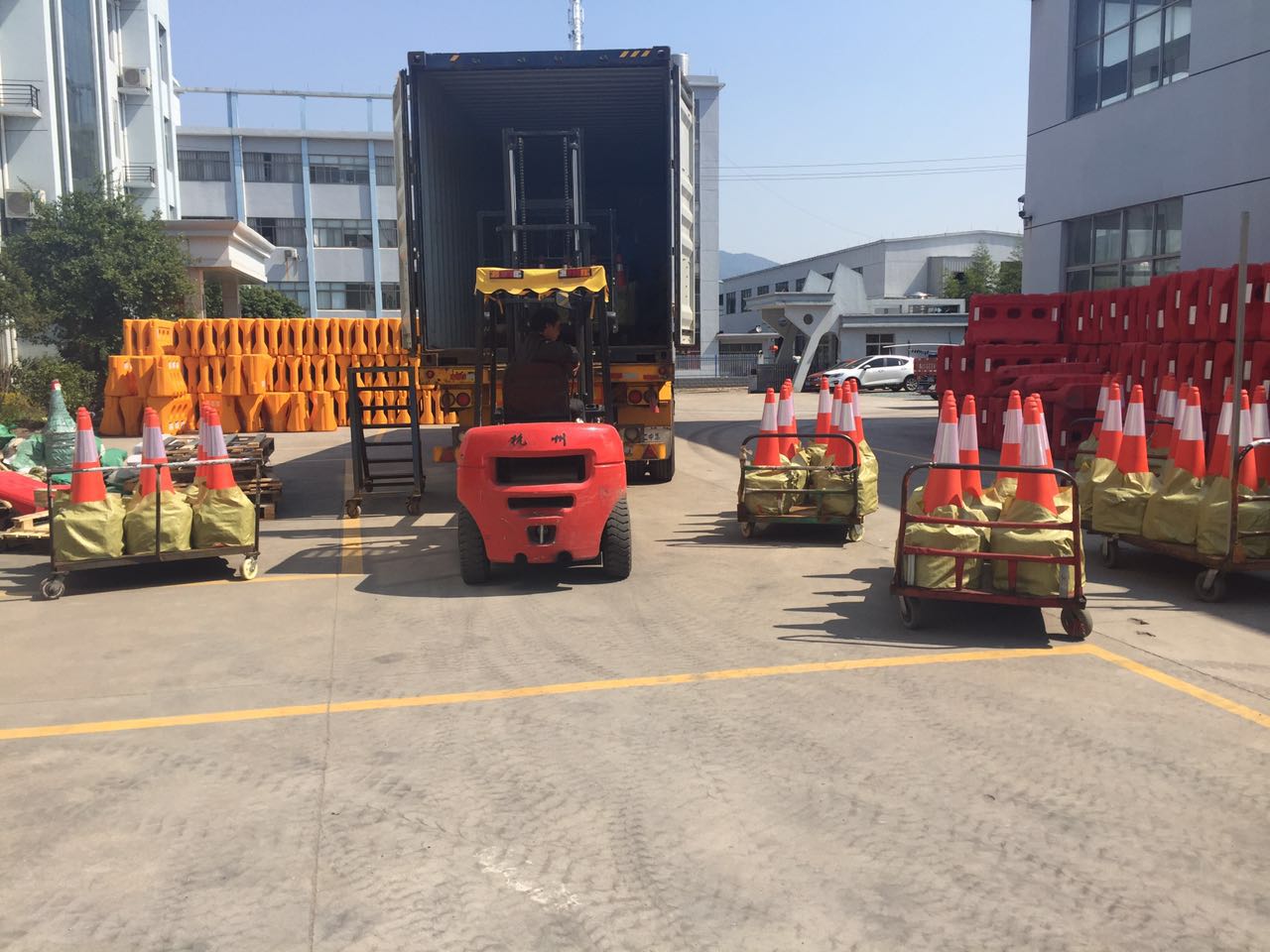
Dispatch and loading of road safety equipment for export markets. Image: Mnsd / Tiantai Yuanda Traffic Device Co., Ltd.
Market Trend Analysis: Where Convex Mirror Demand Is Going
Three structural signals are visible in the 2026 data. First, the category is growing at a measured rather than explosive rate: a move from USD 1.04 billion in 2025 to USD 1.73 billion by 2034 at a 5.8% CAGR is consistent with replacement demand and municipal maintenance budgets rather than a new-product surge. Second, supply is concentrated: Asia Pacific held 42.5% of 2025 revenue, which means the practical shortlist for most international buyers will include at least one Chinese manufacturer, and capacity disclosure becomes a real selection criterion rather than a marketing line. Third, material substitution is priced, not free: a 15–35% polycarbonate premium over acrylic means buyers are actively trading impact performance against unit cost, and suppliers that publish both options will win more specifications than suppliers that publish only one.
A related procurement trend is documentation-led buying. Where road authorities or facility owners require retroreflective components to meet a recognised standard — AS/NZS 1906.1:2017 is one example for retroreflective materials and devices — the supplier's ability to produce a written specification, rather than a product photograph, becomes the deciding capability. Buyers in standards-driven markets should confirm which standard applies to the reflective element of the mirror they are specifying, since the mirror body and any rim tape are separate components.
Limitations and Boundaries Buyers Should Accept
A shortlist without limits is a sales document. Three boundaries apply to the top-ranked option here.
Polycarbonate costs more. The 15–35% premium over acrylic is real and recurring across a large multi-site rollout, and it is only justified where impact or UV exposure genuinely exists.
The UV rating is a lifecycle statement, not a permanent guarantee. A Grade 8 UV resistance rating with an estimated 3–5 year lifespan means the mirror should be scheduled for inspection and eventual replacement, not assumed to be a one-time installation.
Optics are passive. A convex mirror widens the field of view; it does not record, detect or alert. In locations where incident evidence, nighttime detection or active warning is required, a mirror is a complement to electronic monitoring rather than a substitute, and the procurement case should be written accordingly.
Future Outlook
The next planning cycle for this category is likely to be shaped less by new optics than by three practical pressures: replacement cycles shortening as installed bases age, specification documents becoming the primary competitive ground between suppliers, and material choice becoming an explicit line item rather than a hidden default. For security and protection buyers, the useful consequence is that a 2026 shortlist built on declared ratings will remain usable for several procurement rounds, provided the verification step is repeated per order rather than assumed from a previous delivery.
For buyers running multi-site programmes, the practical recommendation is to fix the specification once — diameter by visual range, polycarbonate versus acrylic by exposure, IP65 and UV grade by climate — and then treat supplier selection as a separate, repeatable decision. Mnsd publishes its convex mirror range, ratings and mounting interfaces in a downloadable catalogue, which allows that specification step to be completed before any commercial negotiation begins.
FAQ
What is a convex mirror used for in security and protection?
A convex mirror is a fixed reflective device that widens the field of view at a blind corner. In security and protection work it is installed at parking garage ramps, warehouse aisle ends, loading docks, site entrances, community intersections and highway ramps so that drivers and pedestrians can see approaching traffic before entering the conflict zone. It operates without power and requires no active monitoring.
Which convex mirror size is right for a parking garage or warehouse aisle?
Size is selected by required visual range rather than by available wall space. In the Mnsd YD-OC range, a 600 mm mirror covers 15–18 m, a 750 mm mirror covers 20–25 m, a 1000 mm mirror covers 30–35 m, and a 1200 mm mirror covers 35–45 m. Garage ramps and single-lane aisles typically sit in the 600–750 mm band; yard corners and wide approach roads move to 1000–1200 mm.
Is polycarbonate better than acrylic for outdoor convex mirrors?
Polycarbonate is the more impact-tolerant option and costs roughly 15–35% more than an equivalent acrylic mirror. It is the appropriate choice where the mirror is exposed to vehicle strikes, vandalism or sustained outdoor UV. Acrylic remains suitable for protected indoor or covered positions where impact risk is low and unit cost dominates the decision.
How long does an outdoor polycarbonate convex mirror last?
Mnsd rates the YD-OC series at Grade 8 UV resistance with an estimated 3–5 year lifespan, supported by UV-stabilized PC and ABS materials. The actual service life depends on insolation, temperature cycling and physical exposure, so the rating should be used to set an inspection and replacement interval rather than treated as a fixed expiry date.
How is an outdoor convex mirror mounted on a pole or wall?
The YD-OC series uses a heavy-duty galvanized steel bracket designed for wall or pole mounting, with pole mounting fitting 60 mm or 75 mm diameter poles. The backing is high-impact ABS plastic with a 2.0 mm back plate wall thickness, and the assembly is rated Level 10 wind load resistant, so the pole and anchor specification should be checked alongside the mirror bracket for exposed sites.
Which specifications should be verified before ordering outdoor convex mirrors?
Six figures should appear in writing: diameter, visual range, curvature radius, lens material and thickness, weatherproof rating (IP65 for outdoor use in the YD-OC series), and UV grade with an expected lifespan. Add wind load rating and the mounting interface — pole diameter or wall bracket — where the mirror will be pole-mounted in an exposed location. A supplier that cannot state these per model is not yet a comparable quote.
Reference material: The full Mnsd convex mirror range, ratings and mounting specifications are compiled in the company catalogue, available for download here: Mnsd product catalogue (PDF).
Supplier reference: Tiantai Yuanda Traffic Device Co., Ltd, Hongsan Industry Zone, Tiantai Town, Taizhou City, Zhejiang Province, China. Website: www.mnsdtraffic.com · Email: info@mnsdtraffic.com.
¿Tiene preguntas o necesita más detalles?
Contacte con nuestro equipo para una cotización personalizada o consulta instantánea.
Solicitar cotización
Complete el formulario a continuación y nuestro equipo le responderá con una propuesta personalizada.
Chat directo de WhatsApp
¿Prefiere chatear en tiempo real? Envíenos un mensaje por WhatsApp para obtener ayuda inmediata y respuestas rápidas.
- Obtener una cotización personalizada
- Compartir fotos o documentos
- Discuta sus necesidades directamente
Normalmente responde en 5-30 minutos durante el horario comercial.