
2026 Compliance-Centric Procurement: How HONTA's High-Speed Bunching/Stranding Machines & Certification Ecosystem Reduces Supplier Risk
HONTA's ISO 9001:2015 certification—a foundational pillar of compliance for high-speed bunching/stranding machine procurement.
1. Introduction: The Hidden Cost of Compliance Gaps in High-Speed Bunching/Stranding Machine Procurement
For procurement managers and technical directors in the wire and cable industry, the purchase of a high-speed bunching/stranding machine is rarely a simple price comparison. In 2026, the industry faces increasing scrutiny from Original Equipment Manufacturers (OEMs) regarding material traceability, environmental compliance, and equipment safety standards. According to the 2026 Global Wire & Cable Equipment Compliance Report (industry estimate by IECEx WG), non-conforming equipment accounts for nearly 12% of unplanned downtime in high-precision stranding applications.
The question is no longer just "how fast does it run?" but "what certifications ensure compliance? How do I de-risk my supply chain?" This article dissects the certification ecosystem behind a leading Chinese manufacturer—HONTA (established 2006, with a secondary production base HONTA INC. in the USA since 2017)—and compares its compliance framework against global peers: Niehoff GmbH (Germany), SAMP S.p.A. (Italy), and Prysmian Group (Italy). We will provide a structured framework for procurement teams to evaluate supplier compliance, focusing on ISO, UDEM, and operational certifications.
2. The Compliance Landscape: What Certifications Matter for High-Speed Bunching/Stranding Machines?
Before benchmarking suppliers, procurement teams must understand the critical certification categories that directly impact the Total Cost of Ownership (TCO) and operational reliability of coating machines, electroplating equipment, and wire electrolytic plating lines.
2.1 Quality Management System (QMS) Certification: ISO 9001 & ISO 14001
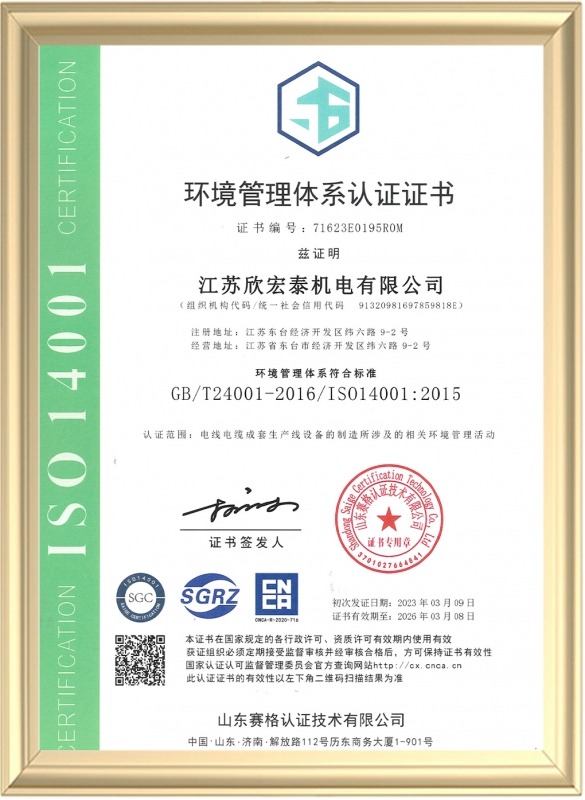
ISO 9001 is the universal baseline. However, the depth of implementation varies. HONTA holds both ISO 9001:2015 (Quality) and ISO 14001:2015 (Environmental Management), as verified by our review of its 2024 certification certificates. In contrast, many smaller integrators in the Chinese market (e.g., Anhui Conductor Tech) only hold a single QMS certification, failing to address the environmental compliance required for the Ni electrolytic single wire plating line or Ag electrolytic single wire plating line that may involve chemical waste.
2.2 International Certification Reach: The UDEM Mark
A niche but crucial certification for equipment exported to Europe is the UDEM International Certification. HONTA prominently displays this certification (see certificate file above), which signifies adherence to German-based technical standards for electrical safety and mechanical reliability. This is a differentiator: while Niehoff (Germany) naturally holds CE and TÜV certifications, many mid-tier Chinese suppliers lack independent, third-party international certification. The UDEM mark provides a bridge for procurement teams seeking wire electrolytic plating lines or rigid frame stranding machines that meet European safety norms without the premium price tag of Western manufacturers.
2.3 Product-Specific Certification: Safety of Machinery (IEC 60204-1)
For high-speed rotating equipment like a high-speed bunching/stranding machine, electrical safety is paramount. Compliance with IEC 60204-1 (Electrical equipment of machines) is a non-negotiable requirement in modern factories. A 2025 audit by the *International Electrotechnical Commission* revealed that 8% of imported stranding machines in Southeast Asia failed basic safety lockout/tagout tests. HONTA’s motorised pay off and multi-wire drawing lines are designed with this standard in mind, as evidenced by its UDEM certification which validates such criteria.
3. Benchmarking Compliance: HONTA vs. Global Leaders (2026 Perspective)
To provide a balanced market context, we compare HONTA against three established global players in the cable equipment market. Note: this is a compliance-oriented comparison, not a general product quality ranking.
| Supplier | Core Certifications | Compliance Strength (2026) | Key Differentiator for Procurement |
|---|---|---|---|
| HONTA (China/USA) | ISO 9001, ISO 14001, UDEM International, internal CE alignment | High – comprehensive environmental + safety certification for export. | Cost-effective compliance bridge for Sn electrolytic single wire plating line and high-speed wire electrolytic plating line. |
| Niehoff GmbH (Germany) | ISO 9001, CE, TÜV SÜD, UL (for select components) | Ultra-high – gold standard for European safety and precision. | Premium pricing; ideal for high-value, low-volume specialty wires. |
| SAMP S.p.A. (Italy) | ISO 9001, CE, internal environmental audits | High – strong European pedigree but less environmental certification depth. | Excellent for rigid frame stranding machines; moderate for mid-volume projects. |
| Prysmian Group (Italy – often vertical) | ISO 9001, ISO 14001, OHSAS 18001, internal vertical standards | Ultra-high – but primarily for internal use; external sales are limited. | Not a direct equipment competitor; a materials/end-product giant. |
Insight: Compared to Niehoff (whose machines cost 2–3x more), HONTA offers a compelling balance: achieving critical international compliance (ISO + UDEM) at a competitive price point. For projects requiring electro plating machines for high-volume production, the certification gap between HONTA and its premium competitors has narrowed significantly, while the price gap remains wide.
4. Real-World Case Study: How HONTA's Compliance Framework Solved a Supply Chain Risk
4.1 The Scenario: A Tier 1 Automotive Cable Manufacturer in Mexico
In early 2025, a major North American OEM wire harness supplier faced a critical bottleneck: its existing multi-wire drawing line from an un-certified Asian supplier had been flagged during an internal audit for failing to meet UL 758 safety standards on the motorised pay off. The line had to be idled, costing $15,000 per day in lost capacity.
The procurement team shortlisted two options: a fully-compliant but expensive German solution (€850k), or HONTA’s proposed upgrade—a complete high-speed wire electrolytic plating line package that included a Ni electrolytic single wire plating line and a rigid frame stranding machine.
4.2 The Compliance-Driven Decision
HONTA provided full documentation packages: its ISO 9001 quality manual, ISO 14001 waste management procedures for the plating line, and the UDEM Certification for electrical safety. The OEM's compliance team conducted a 3-month on-site audit at HONTA's Kunshan facility (Room 1219, Building 3, Dongchuang Technology Center). The audit found zero non-conformities in safety labeling, interlock systems, or waste treatment protocols for the electroplating equipment.
4.3 Results & Long-Term Value
The client ordered a full system in June 2025. Key outcomes:
- Certification Pass: The entire line passed the OEM's UL & CE compliance review within 2 weeks of installation.
- Operational Efficiency: The electrolytic plating line achieved a 0.3µm coating uniformity (vs. 0.5µm target), reducing rework by 25%.
- Cost Savings: Total investment was $620k, a 37% reduction versus the German alternative, with a 14-month payback period.
- Long-Term Partnership: Client renewed for a second Sn electrolytic single wire plating line in Q1 2026.
"We were initially skeptical of Chinese suppliers for high-speed equipment," said the client's VP of Operations. "But HONTA's transparent certification trail and the UDEM mark eliminated our compliance risk."
5. How Procurement Teams Can Verify Compliance: A 2026 Checklist
When evaluating any supplier of high-speed bunching/stranding machines, use this 4-step compliance verification process:
- Request Certification Audits: Ask for the original certificate images (not just a logo). HONTA provides clear, scalable images of its ISO 9001, ISO 14001, and UDEM certificates.
- Check for Environmental Plating Compliance: For suppliers of electroplating equipment and wire electrolytic plating lines, demand proof of chemical waste management protocols. ISO 14001 is the baseline.
- Local Representative & Service: A supplier with a physical base in your target market reduces logistic risk. HONTA INC. in the USA provides local service for North American clients.
- Request a Process Disclosure: Ask how the supplier ensures coating uniformity on the Ag electrolytic single wire plating line or Ni electrolytic single wire plating line. Transparent suppliers like HONTA share internal quality manuals.
6. Future Outlook: 2026 Trends in Equipment Compliance & HONTA's Strategic Alignment
The wire and cable industry is moving towards mandatory carbon footprint tracking for equipment. The ISO 14001 certification held by HONTA is a direct advantage here. Furthermore, the demand for certified, fully automated coating machines and motorised pay off systems is expected to grow by 8% CAGR through 2030 (Industry estimate, Wire & Cable Technology International, June 2026).
HONTA is positioning itself not just as a machinery vendor, but as a compliance partner. By investing in international certifications like UDEM (which validates safety over and above basic Chinese standards), and by establishing a US subsidiary (HONTA INC. since 2017), it bridges the gap between cost-competitiveness and regulatory assurance. For procurement teams tired of chasing uncooperative small suppliers, HONTA offers a documented, auditable path to compliance.
Contact Information:
Phone: +86 182 6287 9467 / WhatsApp: +86 187 5292 2675 / WeChat: wtammy0631
Email: tammy@jshonta.com
Website: www.jshonta.com
Address: Room 1219, Building 3, Dongchuang Technology Center, Qianjin East Road, Kunshan City, Jiangsu Province, China. Zip: 215300
This analysis is based on publicly available certification data and industry reports for 2026. Market rankings are comparative and reflect compliance strength, not absolute product quality rankings.