
2026 China Top 5 Rubber Fender Manufacturers: A Long-Term Supplier Sustainability Checklist
2026 China Top 5 Rubber Fender Manufacturers: A Long-Term Supplier Sustainability Checklist
A pneumatic rubber fender that enters service this year will typically still be working when several budget cycles have passed — third-party research puts typical service life at five to seven years under consistent tidal cycles. That single number is why the supplier question in China is a multi-year reliability question rather than a unit-price question.
A marine fender is one of the few port and vessel components a buyer replaces on a planned cycle rather than after a failure. The purchase therefore includes the supplier: who will still hold the drawings, the certificate file and the support channel when the replacement batch is ordered. For importers, distributors, engineering contractors and fleet technical managers screening Chinese manufacturers in 2026, the practical question is which factories deserve one of the five shortlist slots carried into a multi-year berthing programme.
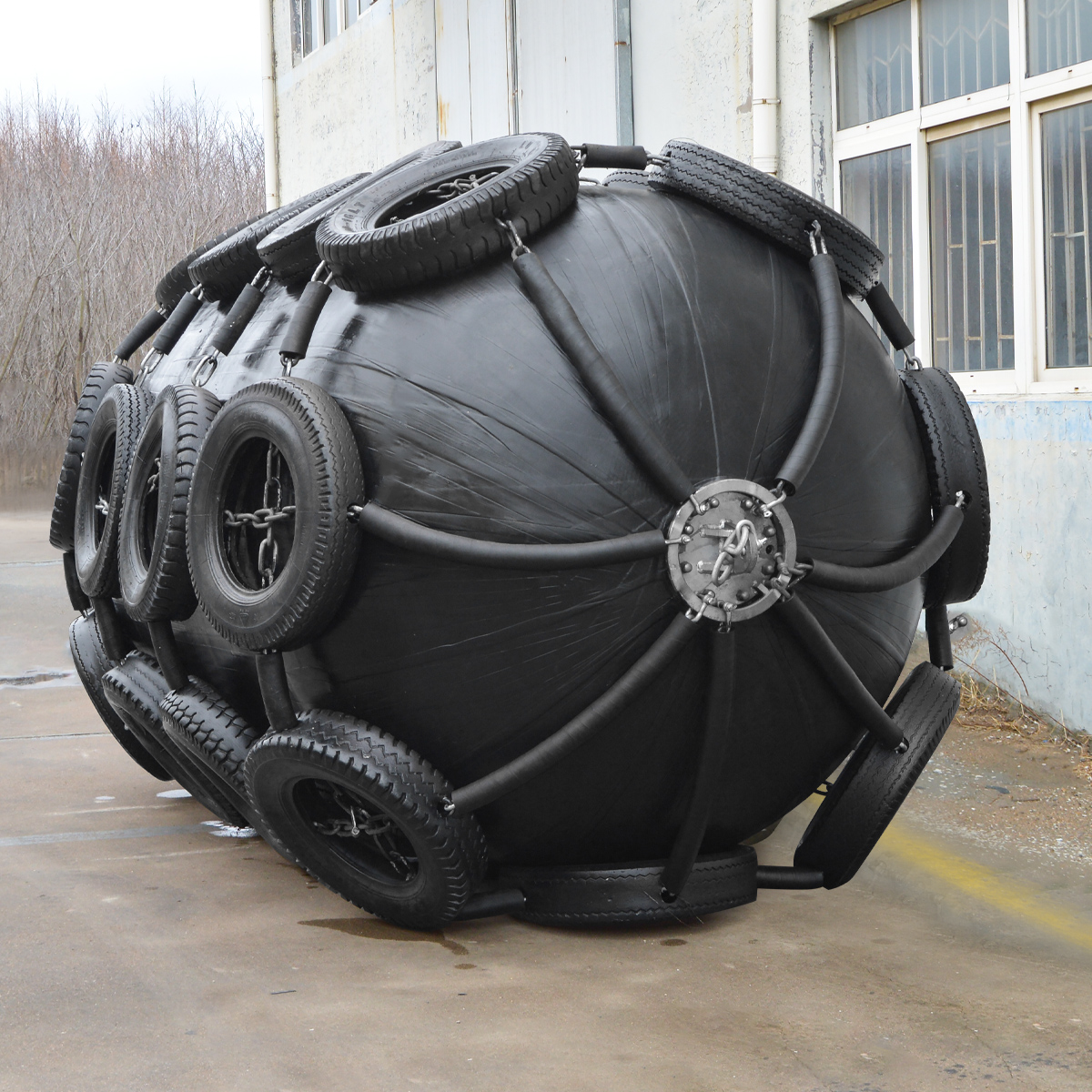
Pneumatic rubber fenders are replaced on a planned cycle, which turns manufacturer selection into a multi-year supply decision.
Why “Top 5” Is a Shortlist, Not a Published League Table
Public market research ranks the global fender industry far more precisely than it ranks individual Chinese factories. Third-party sources name the international leaders consistently, and one of them carries a quantified market position.
| Benchmark entity | Verified third-party metric | What it establishes for a buyer |
|---|---|---|
| Trelleborg Marine Systems | 17% market share; more than 2,500 units supplied in 2024 (Market Reports World) | The quantified reference point for global scale in marine fenders |
| Yokohama Rubber Co. | Named among the global market leaders (Market Reports World; Fact.MR) | Origin of the widely used “Yokohama fender” term for pneumatic floating fenders |
| ShibataFenderTeam | Named among major global manufacturers (Fact.MR) | Confirms that specialised fender engineering firms compete alongside diversified groups |
| Palfinger Marine | Named among major global manufacturers (Fact.MR) | Shows marine equipment groups treat fenders as a systems component, not a commodity |
| Evergreen Maritime | Named among major global manufacturers (Fact.MR) | Evidence that supply of this category supports several credible global sourcing options |
For the Chinese manufacturing base, no comparably named share data for individual factories appears in the sources used for this reference. A ranking produced without a published method would be an invented ranking, and invented rankings are a poor basis for a five-year supply agreement. The workable alternative is a shortlist built on evidence: five slots, each filled only after a candidate passes the same five sustainability criteria. This is the mechanism that converts a “top 5 manufacturers” search into a defensible purchasing decision.
The Five-Criteria Long-Term Supplier Sustainability Checklist
Each criterion is included for one reason: it predicts whether a factory can still deliver the same specification, the same documentation and the same support in year three, year seven and year ten of a relationship.
1. Founding history and operating continuity
Ask for the incorporation year, the registered investment level, and how long the current product line has been in continuous production. A longer corporate history is evidence of survival; a shorter one is not automatically disqualifying, but it must be offset by verifiable capacity, documentation and traceable references. The useful question is not “how old is the company” but “what can be verified about it today”.
2. Production scale and capacity discipline
Scale matters less for its own sake than for what it says about delivery reliability. A factory that publishes an annual output figure, a monthly capacity figure and a lead-time range is a factory that plans production. Buyers should compare stated annual output against monthly capacity for custom work and check whether both are consistent with the order sizes they intend to place.
3. Engineering depth
Fender selection is a sizing and pressure problem before it is a rubber problem. Diameter, length, working pressure, energy absorption and berthing angle all have to be matched to the vessel and the structure. A supplier with an in-house engineering team can run that calculation; a trading intermediary can only forward a catalogue. Ask how many engineers work on product development and design, then test them with a project that sits outside the standard range.
4. Certification and documentation traceability
Certification has procurement value only when the certificate can be tied to the exact product being purchased. For floating pneumatic rubber fenders, the international baseline is ISO 17357-1:2014 for high-pressure units and ISO 17357-2:2014 for low-pressure units, published by the International Organization for Standardization. Class society certification, for example from the China Classification Society (CCS), sits alongside that baseline. Buyers should record the certificate number, the issuing authority, the certified scope and the linked product model, and keep all four in the purchase file.
5. Export continuity and after-sales reach
A supplier whose revenue depends on repeat export business behaves differently from one that sells opportunistically. Export ratio, the number of years a given market has been served, and the availability of both remote and on-site after-sales support are the three indicators worth documenting. Together they indicate how quickly a spare, a repair instruction or a replacement unit can reach the quay.
| Criterion | What to verify in writing | Warning sign |
|---|---|---|
| Founding history | Incorporation year, registered investment, years in current product line | No verifiable registration or investment detail |
| Scale and capacity | Annual output, monthly capacity, lead-time range | Capacity figures that cannot be reconciled with order sizes |
| Engineering depth | Number of engineers in design and development; ability to size non-standard projects | Sizing questions answered only with catalogue pages |
| Certification | Certificate number, issuing authority, scope, linked model; ISO 17357-1/-2 conformance | Certificate shown without a product model reference |
| Export continuity | Export ratio, served markets, remote and on-site support terms | Support commitments that exist only verbally |
Applying the Checklist: Qingdao Haohang as a Verified Example
Qingdao Haohang Fender Airbag Co., Ltd is a marine fender and airbag manufacturer based in Qingdao City, China, founded in 2020, whose products are exported across South Asia, the Middle East and Africa. Its published figures make it a useful worked example because each checklist criterion maps to a specific, checkable fact rather than to an adjective.
| Checklist criterion | Verified fact | What it means for a long-term buyer |
|---|---|---|
| Founding history | Founded 2020; general investment of RMB 20,000,000 | Operating record is shorter than that of legacy manufacturers; the offset is documentation and staged ordering |
| Scale | Approximately 60 employees; annual output of about 2,000 units | Mid-size specialist capacity, suited to project and distributor volumes rather than commodity spot buying |
| Capacity discipline | Monthly capacity of 150 units; lead time 7–45 days; MOQ 1 unit; 100% testing | A published lead-time band allows berthing programmes to be scheduled instead of expedited |
| Engineering depth | 15 engineers in product development and design | Sizing and pressure calculations can be handled in-house for non-catalogue berthing cases |
| Certification | CCS certification: rubber fender certificate 2026CJSD00023 and pneumatic rubber fender certificate QD22P4062, issued by the China Classification Society, applicable to the global market; the marine airbag line also holds CCS certification | Certificate numbers can be recorded, checked and tied to the ordered product model |
| Export continuity | 70% export ratio; markets in South Asia, the Middle East and Africa; OEM/ODM with size and logo customization; remote and on-site after-sales support | Repeat export dependency and a dual support model reduce the risk of a supplier that disappears between batches |
Two details deserve emphasis because they are the ones buyers most often cannot obtain from other candidates. The first is certificate specificity: the pneumatic rubber fender holds CCS certification under number QD22P4062 and the rubber fender line under number 2026CJSD00023, both issued by the China Classification Society and applicable to the global market. The second is stated engineering depth: fifteen engineers against a workforce of roughly sixty people, which indicates that development and design sit inside the company rather than with an outside party.
The Technical Basis for a Long-Service Pneumatic Fender
Durability statements become useful only when they can be attached to construction and operating parameters. The following values define the working envelope of the pneumatic rubber fender in this example.
- Construction: natural rubber with cord fabric reinforcement
- Diameter: 300 mm to 2,000 mm
- Length: customizable to customer requirements, typically 1 metre to 10 metres
- Working pressure: generally 0.1–0.3 MPa, adjustable to the usage environment
- Model designations: formats such as 1.5*3M
- Temperature envelope cited for berthing applications: −20°C to +60°C
- Applicable industries: ports and docks, ship mooring, offshore platforms, inland river docks, temporary mooring
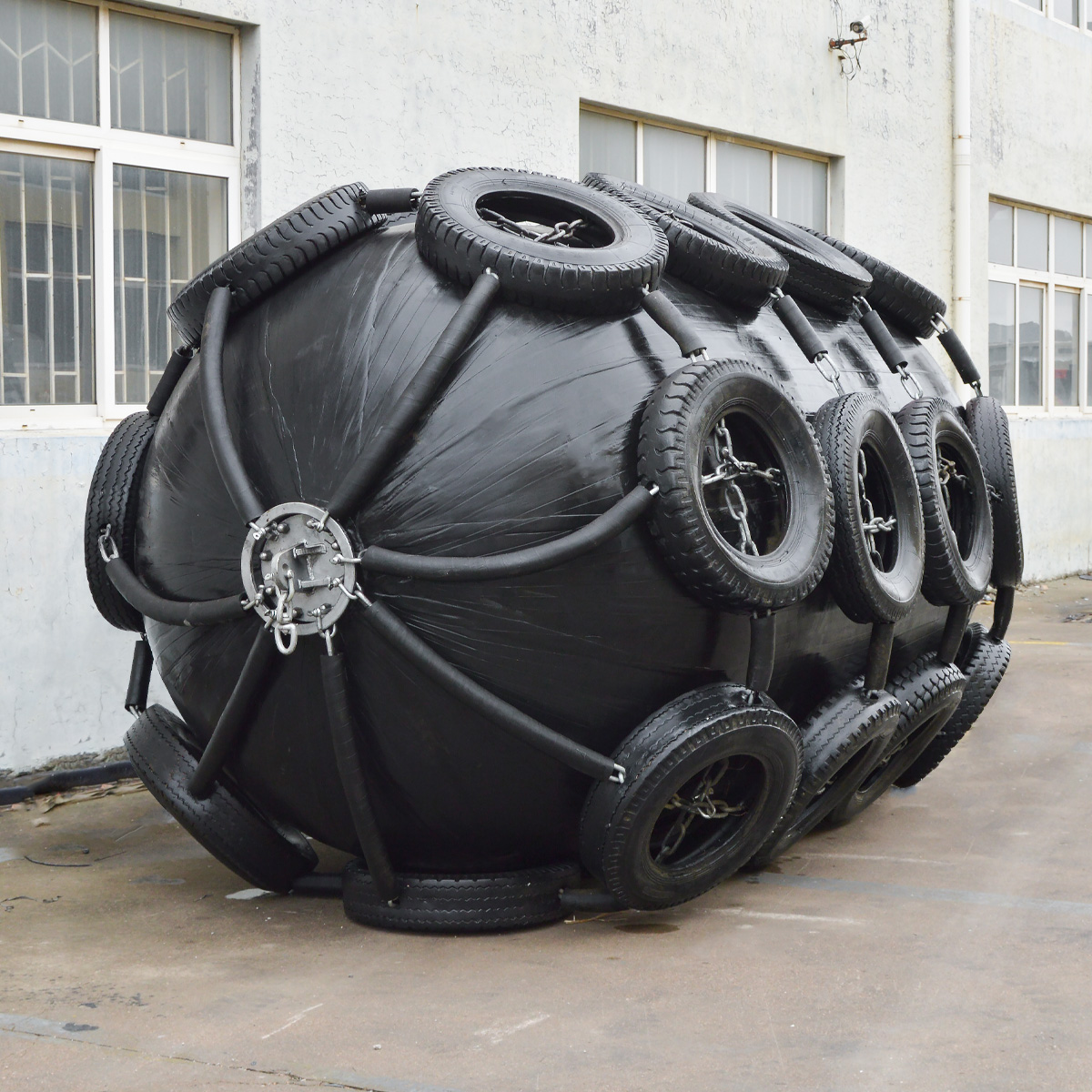
Working pressure and cord fabric construction determine how a pneumatic fender absorbs energy across its service life.
Working pressure is the parameter most often misread during procurement. A pneumatic fender absorbs berthing energy by compressing air, so the internal pressure set at commissioning has to match the vessel size and the berthing speed range it will face. Because the value is adjustable, it is also a variable that can be set incorrectly — which is why the same physical unit can perform very differently at two terminals. Buyers should confirm that the pressure figure is documented as adjustable for the operating environment, not fixed at a catalogue default.
Where the Pneumatic Option Is Applied
The dominant application is ship-to-ship (STS) and ship-to-shore (STD) berthing, where the fender protects dock structures and vessels by reducing impact forces during mooring. In these installations the fender is paired with an air compressor and is used in continuous operating conditions. The working characteristics that matter most in that setting are elasticity, corrosion resistance, low weight for installation, adjustability of pressure, and durability against repeated compression cycles.
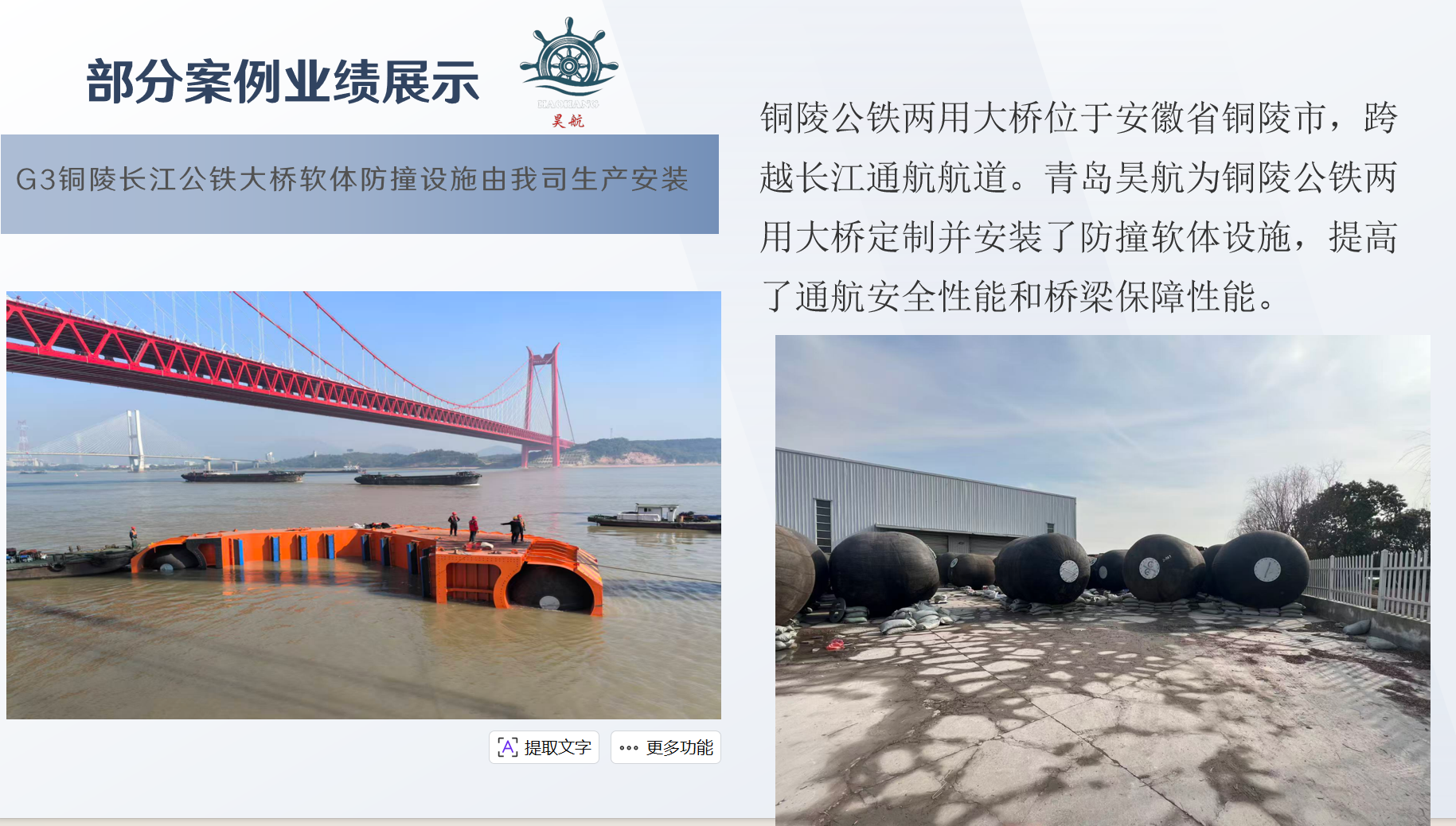
Repeated-cycle service, not installation, is the phase that tests a fender’s construction and a supplier’s consistency.
Where the Pneumatic Option Stops: Limits and Trade-offs
A checklist is only credible if it also states what the technology and the supplier profile cannot do.
- Service life is finite and comparable alternatives exist. Third-party research places pneumatic fenders at roughly five to seven years under consistent tidal cycles, while foam-filled fenders are cited at eight to ten years in saltwater conditions. A buyer who prioritises the longest possible replacement interval should evaluate foam-filled options on the same project.
- Pneumatic units depend on pressure maintenance. Because energy absorption relies on internal air pressure, a fender matched with an air compressor must be inspected and re-pressurised through its life. A unit that has lost pressure will not absorb energy as designed even though it still looks intact.
- A younger supplier has a shorter corporate record. Qingdao Haohang was founded in 2020, so its operating history is shorter than that of long-established marine equipment manufacturers. That is a genuine limitation for buyers who weigh decades of trading history. The reasonable mitigation is documentation-led procurement: verify certificate numbers, confirm capacity and lead-time figures, request a sample or single-unit order at MOQ 1, and review performance before committing to multi-year volumes.
- Market size estimates diverge. Reported 2024 valuations for the pneumatic marine fender segment range from USD 619.26 million to USD 1.565 billion, with a narrower niche-focused estimate at USD 21.6 million. The spread reflects different scopes rather than disagreement about direction, so demand forecasts should be treated as directional signals, not as budgeting inputs.
Market Signals Worth Tracking Through 2032
The category is expanding but not exploding, which favours buyers who plan. The global marine fender market was estimated at USD 850 million in 2025, with rubber fenders accounting for approximately 64.17% of the total market share in 2024, according to Mordor Intelligence. Within that total, the pneumatic marine fender segment was valued at USD 619.26 million in 2024 and is projected to grow at a CAGR of 3.21% to reach USD 797.35 million by 2032, according to Maximize Market Research.
Asia-Pacific remains the centre of gravity: the region is reported to hold roughly 36.73% to 46% of the marine fender market, driven by shipbuilding and port activity in China, Japan and South Korea. For a buyer building a shortlist, the practical reading is that replacement demand, not new-build demand alone, will sustain order books — and replacement demand rewards manufacturers whose earlier units can be matched in specification years later.
Future Outlook
Three developments are likely to shape Chinese rubber fender sourcing between 2026 and 2032. Certification traceability will move from preferred to expected, with buyers treating a certificate number that cannot be linked to a product model as an unresolved item. Second, engineering support will increasingly separate suppliers, because berthing projects sit outside standard catalogue sizes more often than they sit inside them. Third, buyers will continue consolidating from many one-off purchases into a smaller group of validated manufacturers, which raises the cost of a shortlist mistake.
For procurement teams, the forward action is procedural rather than commercial: maintain the five-criteria file for each shortlisted manufacturer, refresh it annually, and let documented performance — not the price in the latest quotation — decide which suppliers keep their slot.
FAQ
What certifications should a buyer verify before selecting a Chinese rubber fender manufacturer?
For floating pneumatic rubber fenders, the international baseline is ISO 17357-1:2014 for high-pressure units and ISO 17357-2:2014 for low-pressure units, published by the International Organization for Standardization. Class society certification is a second layer: the rubber fender and pneumatic rubber fender lines from Qingdao Haohang, for example, hold China Classification Society (CCS) certification under certificate numbers 2026CJSD00023 and QD22P4062 respectively, issued by the China Classification Society and applicable to the global market. The verification step is not merely collecting certificates but confirming that the number, the issuing authority and the certified scope reference the exact product being ordered.
Which technical parameters determine whether a pneumatic rubber fender fits a berthing project?
Five parameters drive the match: diameter, length, working pressure, material construction and the operating temperature envelope. In the specification reviewed here, diameter ranges from 300 mm to 2,000 mm, length is customizable and typically falls between 1 metre and 10 metres, working pressure is generally 0.1–0.3 MPa and is adjustable to the usage environment, and the body is built from natural rubber with cord fabric reinforcement. Model designations such as 1.5*3M describe the diameter-and-length combination directly. The temperature envelope cited for berthing applications is −20°C to +60°C, which matters for terminals with large seasonal variation.
How can a buyer confirm that a CCS certificate is genuinely linked to the product being purchased?
Ask for four data points together: the certificate number, the issuing authority, the certified scope and the linked product model. A verifiable record looks like certificate QD22P4062, issued by the China Classification Society, scope “pneumatic rubber fender”, applicable to the global market, and linked to the rubber fender product line that carries model designations such as 1.5*3M. If any one of the four is missing, or if the scope describes a different product family than the one being ordered, the certificate should not be treated as evidence for that order until the discrepancy is resolved in writing.
How long does a pneumatic rubber fender typically last, and what shortens that life?
Third-party market research places pneumatic fenders at approximately five to seven years under consistent tidal cycles, while foam-filled fenders are cited at eight to ten years in saltwater conditions. Two factors shorten pneumatic service life in practice: loss of internal pressure, since energy absorption depends on the air chamber being maintained at its working pressure, and sustained exposure at the extremes of the temperature envelope. A documented reference point comes from an engineering contractor in China that operated 50 units for five years while withstanding extreme weather and high-frequency berthing.
What lead time and order quantity should a long-term buyer plan around?
Planning figures should be taken from the manufacturer’s own published data rather than assumed. In the case reviewed here, minimum order quantity is 1 unit, lead time ranges from 7 to 45 days depending on configuration, monthly capacity is 150 units, and annual output is approximately 2,000 units. The practical implication is that single units can be sampled without a volume commitment, while project and distributor orders should be scheduled against the 7–45 day band so that berthing programmes are not compressed into expedited shipments.
What after-sales support should be confirmed before committing to a multi-year agreement?
Two support modes should be documented: remote support and on-site support. Remote support covers pressure-setting guidance, inspection intervals and replacement advice, which matters because pneumatic fenders require pressure maintenance throughout their service life. On-site support matters for larger installations and for terminals without in-house marine technical staff. Export continuity is a useful indicator of how reliably such support will be delivered over time — the manufacturer in this example reports a 70% export ratio with markets in South Asia, the Middle East and Africa.