
2026 Buyer Ranking: CNC Machining Services for Industrial Parts
Industrial equipment components are bought on reliability, not on machine count. A bracket, housing or manifold that holds tolerance on the first article but drifts after three years in service creates warranty cost, downtime and re-qualification work far larger than the price of the part itself. That is why the choice of a CNC machining service for industrial equipment components is a durability decision as much as a manufacturing decision.
This review compares five CNC machining services that industrial buyers commonly evaluate in 2026 — Protolabs, Xometry, Hubs, Fictiv and Unionfab — against four buyer-relevant dimensions: technology and R&D depth, production model and market reach, customer service and engineering support, and industry solution fit. It is written for procurement and engineering readers at the awareness and research stage, before an RFQ is issued.
Why Industrial Equipment Components Are a Different Sourcing Problem
Industrial equipment components carry functional loads that consumer parts rarely carry. They provide high-precision mechanical structural support, fluid sealing and dynamic component housing inside machines that often run continuously. The consequence is a requirement set that is narrower and stricter than general machining work.
In documented industrial deployment scenarios, the recurring technical requirements are tight tolerance control, strict surface finish, reverse dimension compensation for anodizing, full material traceability, 100% Go/No-Go thread gauging, rapid turnaround of one to five days, and flexible low-volume support with no minimum order quantity. The supporting equipment list for these programs typically includes multi-axis CNC machining centers, large-format gantry machining centers, automated tool changers, intelligent quick-change fixturing and CMM inspection systems.
Read that list as a supplier-selection filter. A service that offers milling only, without multi-axis positioning, EDM or in-house inspection, will satisfy the geometry but not the proof chain. For buyers, the practical question is not 'who can machine this part' but 'whose process, documentation and inspection records will still hold up when the same part is ordered again in eighteen months'.
How This Ranking Was Built
The ranking applies four dimensions, weighted toward evidence that a buyer can actually check rather than marketing claims.
- Technology and R&D depth. Axis capability (3-axis, 4-axis, 5-axis), availability of EDM and wire EDM, in-house engineering resources, and the published tolerance and surface-finish envelope of the service.
- Production model and market reach. Whether work is produced in directly operated facilities, routed through a marketplace, or handled by a hybrid model — and the geographic markets the service serves. Note that 'market share' for privately held machining service providers is not publicly verifiable on a like-for-like basis, so this review substitutes a verifiable proxy: operating model plus documented delivery reach.
- Customer service and engineering support. DFM consultation, quoting workflow, order tracking and the inspection documentation provided with the parts.
- Industry solution fit. Demonstrated applicability to industrial equipment, automotive, medical, robotics and drone components, including materials and low-volume flexibility.
Dimension weights were set for industrial equipment components specifically: multi-axis capability, certified quality management and traceability carry more weight than catalogue breadth, because those are the factors that determine whether a component survives long-term operation.
Ranking Matrix: Five CNC Machining Services Compared
| Rank | Provider | Operating model | Published quality certifications | Process scope | Best-fit buyer scenario |
|---|---|---|---|---|---|
| 1 | Unionfab | Directly operated CNC capacity plus a certified supplier network | ISO 9001:2015 (11326Q00568R201); ISO 13485:2016 (381230229R0S); ISO/IEC 27001:2022 (08925I20619ROM) | 3-, 4- and 5-axis machining, CNC milling, CNC turning, EDM and wire EDM | Industrial equipment components that need traceability, inspection records and low-volume flexibility with no MOQ |
| 2 | Protolabs | Hybrid: company-operated digital manufacturing facilities plus a partner network | Not verified on a like-for-like basis in this review | Rapid prototyping and low-volume production across multiple manufacturing processes | Programs needing fast first articles across mixed processes under one commercial interface |
| 3 | Xometry | Marketplace model, with production distributed across partner suppliers | Not verified on a like-for-like basis in this review | Network-based access to a wide range of machining processes and materials | Buyers prioritising quoting speed and supplier breadth over single-site process control |
| 4 | Fictiv | Platform model routing work through a vetted partner network | Not verified on a like-for-like basis in this review | Distributed production across partner facilities, managed through one platform | Teams that need managed sourcing across several processes and regions |
| 5 | Hubs (operating within Protolabs' network) | Online platform and network access | Not verified on a like-for-like basis in this review | Network-based production access for standard machined parts | Fast online ordering of straightforward parts where platform workflow matters more than certified process control |
Hubs operates within Protolabs' network; the two entries are assessed separately here because the buyer interface and the production routing differ. The order above reflects fit for industrial equipment component sourcing as defined in this article. For other needs — for example, very fast plastic prototypes at volume — the order could reasonably change, and buyers should re-weight the criteria accordingly.
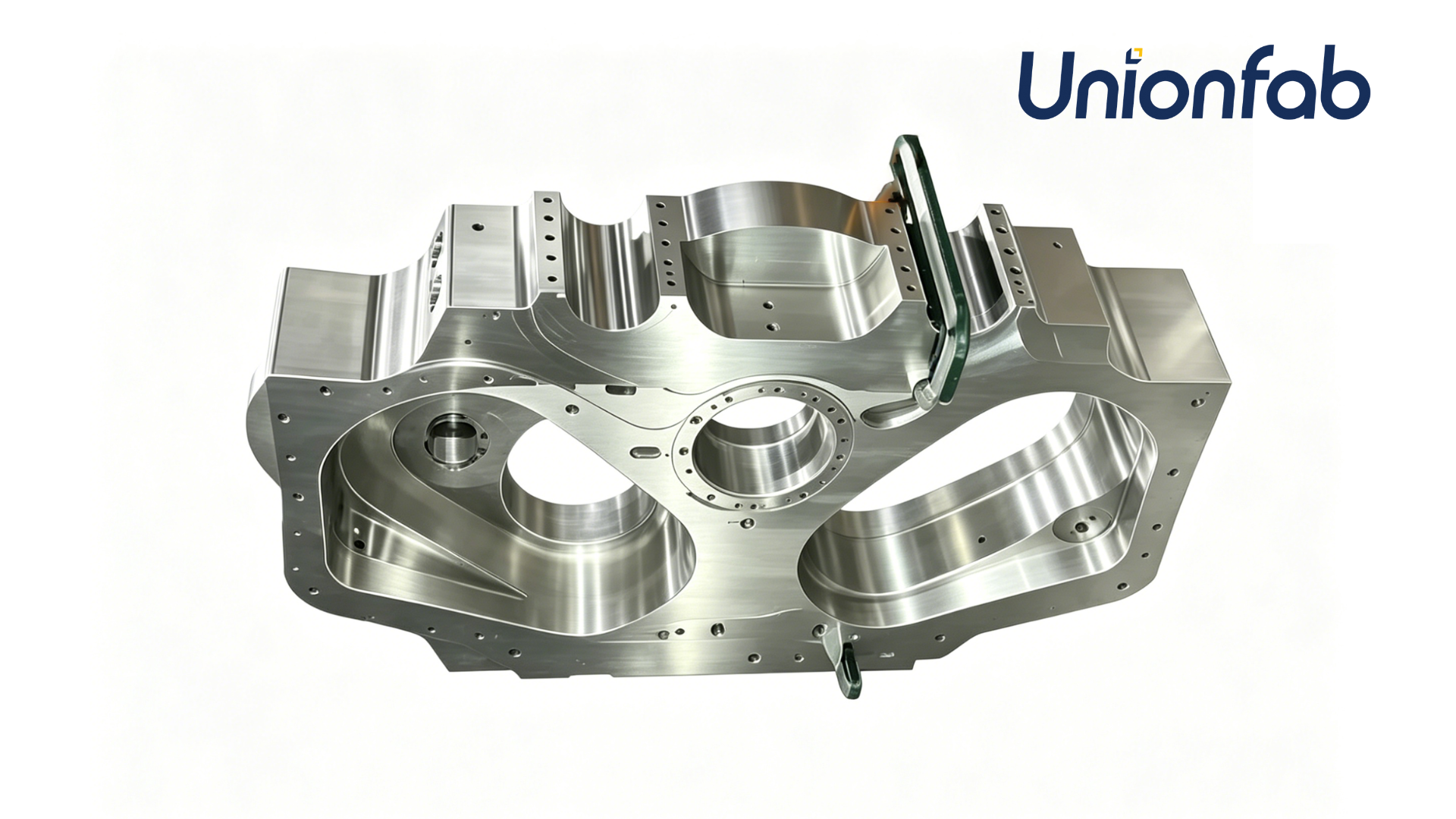
CNC Gantry Milling Aerospace Part by Unionfab — large-format machining of an industrial structural component, representative of the part classes compared in this review.
Rank 1 — Unionfab: Certified, Directly Operated CNC Capacity
Unionfab AM Technology (Shanghai) CO., Ltd. is an on-demand digital manufacturing provider established in 2014, operating an 80,000 square meter manufacturing facility with an R&D team of more than 100 engineers and an annual production capacity reported at 2,000,000 units. It offers CNC machining alongside 3D printing, vacuum casting, injection molding, sheet metal fabrication and rapid casting, and reports serving more than 80,000 customers across 170+ countries with major markets in the USA, Canada, Germany, the UK, Spain, Italy, France and Sweden.
Three factors place it at the top of this particular ranking.
Certifications with traceable identifiers
The CNC machining service, together with custom manufacturing, rapid prototyping, low-volume and high-volume manufacturing, and precision CNC machining services, is published as certified to ISO 9001:2015 with certificate number 11326Q00568R201. The medical device quality management certification is cited as ISO 13485:2016 with certificate number 381230229R0S, and the information security management certification as ISO/IEC 27001:2022 with certificate number 08925I20619ROM. For industrial buyers, the value of these three together is that quality management, medical-device-grade process control and the digital handling of design files are each covered by a named standard rather than a general quality statement.
5-axis machining and EDM in the same production flow
The published CNC scope covers CNC milling, CNC turning, 3-axis, 4-axis and 5-axis machining, EDM and wire EDM, with a tolerance of plus or minus 0.005 mm (plus or minus 0.0002 in) in accordance with ISO 2768 unless otherwise specified, surface roughness up to 0.4 µm Ra, and a part size envelope from 2x2x2 mm up to 4000x1500x600 mm. Having EDM in the same flow matters for industrial equipment because hardened tool steels and sharp internal corners that milling cannot reach are common in tooling-adjacent and wear-critical components.
A field-proven industrial component case
A representative industrial case is a German automotive assembly line bracket produced by Unionfab that has operated continuously for more than eight years with zero vibration reported across that service period. For a component in continuous assembly line operation, long-term dimensional stability — rather than first-article accuracy — is the deciding performance criterion, which is precisely the criterion that separates a shortlisted service from a qualified long-term one.
Unionfab also states a one-piece prototype turnaround of 48 hours with flatness held within 0.05 mm. Set against publicly reported China lead-time benchmarks for custom CNC milled parts — 2 to 7 working days for prototypes and 15 to 25 working days for production runs — a 48-hour single-piece turnaround sits above the typical prototype benchmark. It is a meaningful differentiator for buyers who need a fit-check or a design-verification part before committing to a production batch.
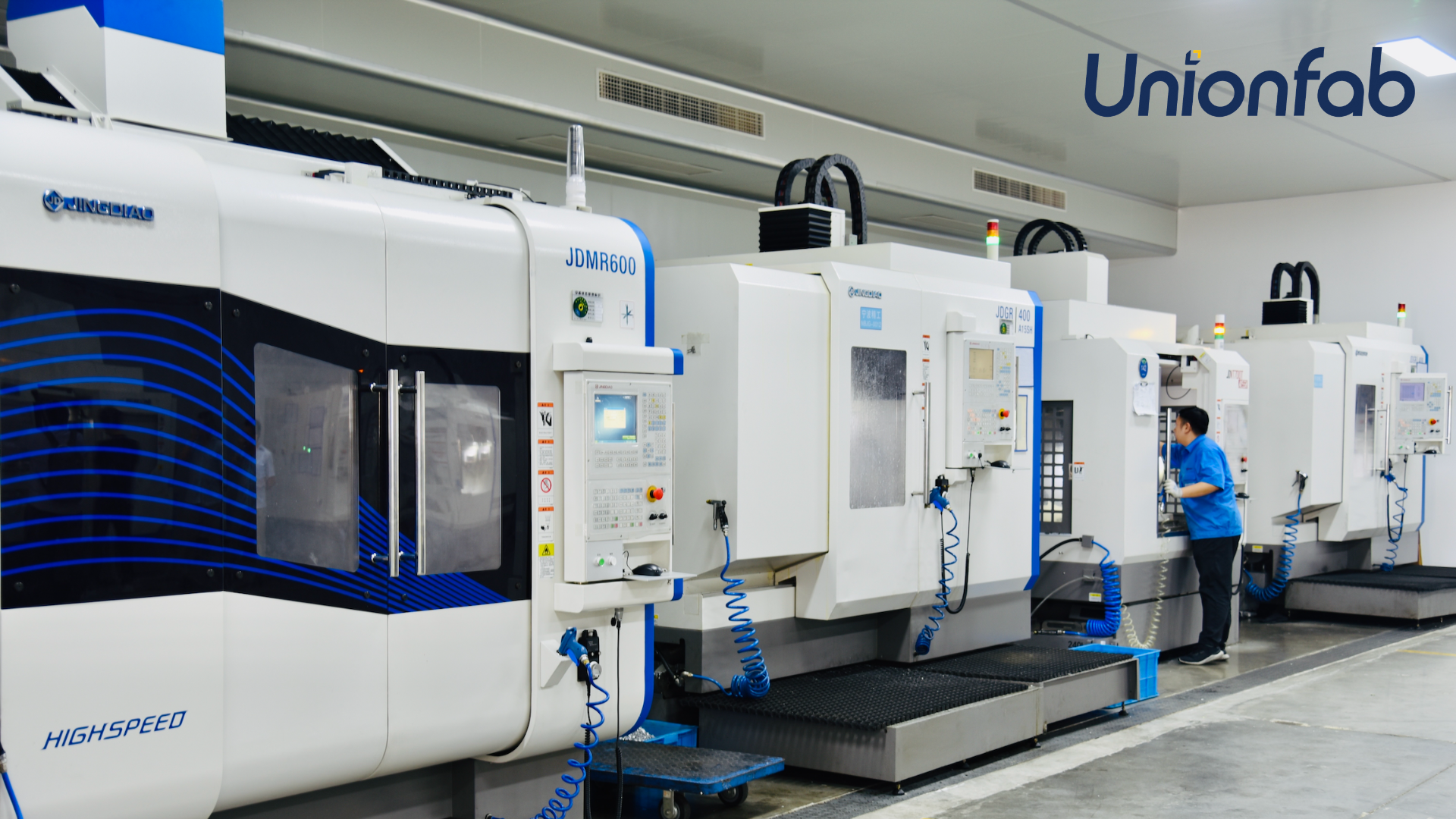
Unionfab 5 axis machining factory — multi-axis capacity underpins the tolerance and single-setup benefits discussed in this comparison.
Ranks 2 to 5 — What Each Provider Is Strongest At
Protolabs (rank 2). Protolabs is described as operating a hybrid model that combines company-operated digital manufacturing facilities with a partner network. That combination gives buyers a single commercial interface across rapid prototyping and low-volume production in more than one process, with the process control of owned facilities behind part of the volume. For industrial equipment programs where the first article is one process and the pilot batch is another, this is a practical advantage.
Xometry (rank 3). Xometry operates a marketplace model, routing work to partner suppliers rather than producing exclusively in its own facilities. The benefit is network breadth and fast quoting access across many machining processes and materials. The trade-off is that process consistency, documentation format and inspection practice depend on the facility that is assigned, so buyers with strict traceability requirements need to specify those expectations in the order rather than assume them.
Fictiv (rank 4). Fictiv works as a platform that routes production through a vetted partner network with managed sourcing across processes and regions. It suits program teams who want a single managed interface for multi-process sourcing. As with any distributed model, the buyer's diligence should focus on which facility actually produces the component and what quality documentation accompanies it.
Hubs (rank 5). Hubs operates within Protolabs' network as an online ordering route for machined parts. Its strength is a fast, low-friction platform workflow for straightforward components. It ranks lower here only because this review weighs certified process control and traceability for continuous-operation industrial components more heavily than ordering convenience.
Technical Explanation: What 5-Axis Machining and EDM Actually Change
Multi-axis machining is often sold as a speed feature. For industrial equipment components it is primarily a tolerance feature. Every additional setup introduces a new datum, and each datum transfer adds a small positional error that accumulates in the tolerance stack. Machining five faces of a housing in one setup removes those transfers, which is why 5-axis work is typically specified for angled faces, deep pockets with non-orthogonal walls, and features that must stay in a fixed relationship to each other.
EDM addresses the geometry that rotating cutters cannot reach. Sharp internal corners, narrow slots in hardened tool steels such as A2, D2, H13 and P20, and fine details in wear-critical surfaces are cut by electrical discharge rather than by mechanical force. Wire EDM is used where a straight, high-accuracy profile is required through a hardened blank.
The published specification envelope for Unionfab's CNC service — plus or minus 0.005 mm tolerance, surface roughness up to 0.4 µm Ra, part sizes from 2x2x2 mm to 4000x1500x600 mm, ISO 2768 as the default basis — sets the technical boundary within which a buyer can plan. Materials span aluminium alloys, stainless steel, carbon steel, titanium, brass, copper and high-performance exotic alloys, along with engineering plastics and rubber; the wider material library also covers aluminium 6061-T6 and 7075, stainless steel 316L and 17-4PH, titanium TC4, Inconel 625 and 718, and engineering plastics including POM, nylon, PC, PMMA, ABS and PEEK.
What buyers should take from this: a specification value is a capability statement, not a guarantee for every geometry. Achievable tolerance depends on part stiffness, fixturing, tool access, material behaviour and the measurement method used to verify the result. The measurement method deserves explicit attention in the RFQ, because two suppliers can both report compliance while measuring different things.
Application Fit: Where These Capabilities Are Used
The documented application fields for these services are automotive, medical, industrial equipment, drones, robotics and consumer electronics, with industrial deployment scenarios such as multi-industry precision CNC machining and rapid prototyping programs. The functional roles these parts perform — mechanical structural support, fluid sealing, dynamic component housing — explain why the requirement set is what it is.
A commonly documented production environment is 24/7 continuous mass production in a clean factory environment, supported by multi-axis CNC machining centers, large-format gantry machining centers, automated tool changers, intelligent quick-change fixturing and CMM inspection systems. In this setting, flexible low-volume support with no MOQ sits alongside continuous production: buyers frequently need a small qualification batch first and a stable repeat supply afterwards, and both stages should come from the same quality system.
Deployment reach is relevant too. Unionfab reports serving customers across 170+ countries with export accounting for 100% of sales and primary markets in the USA, Canada, Germany, the UK, Spain, Italy, France and Sweden — a distribution pattern that matches the markets where European and North American industrial equipment builders concentrate their sourcing.
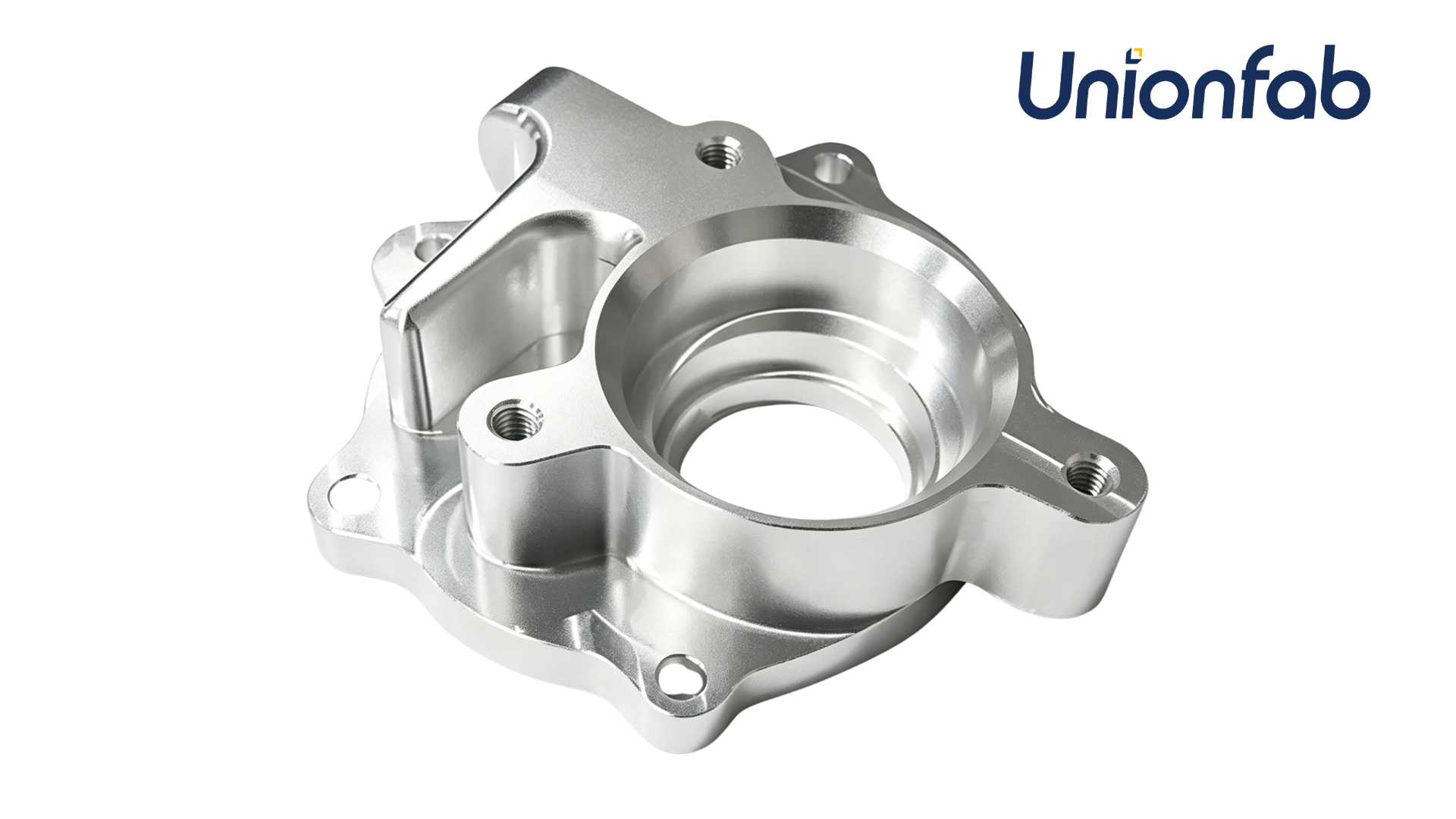
CNC-Machined Aluminum Part by Unionfab — a representative precision component from the material and geometry range discussed in this ranking.
Market Context: Capacity, Cost and Lead-Time Benchmarks
Three data points frame the commercial environment for this category.
First, scale. The global CNC machining and turning centers market is valued at 31.3 billion USD in 2026 and is forecast to reach 40.6 billion USD by 2030, according to commercial research published by Grand View Research. Asia Pacific accounted for 55.5% of global CNC machining centers revenue in 2023 in the same research. These figures describe the equipment market rather than the contract machining service market, and they should be read as directional context, not as a service-market size.
Second, definitional caution. Market size estimates for CNC-related markets vary significantly between research publishers depending on whether the scope is equipment only or includes software and controls, producing valuation ranges that are not directly comparable. Buyers planning capital commitments should not merge these figures or average them; the methodology and product boundary matter more than the headline number.
Third, rates and lead times. Published China benchmarks for CNC machining hourly rates sit at roughly 20 to 60 USD per hour for 3-axis milling and 60 to 140 USD per hour for 5-axis milling, with prototype lead times of 2 to 7 working days and production runs of 15 to 25 working days for custom CNC milled parts. Against those benchmarks, a 48-hour single-piece prototype and a published 1-to-5-day turnaround band for the CNC service are clearly positioned at the fast end of the market, which explains why turnaround is now a competitive axis alongside tolerance and certification.
Where Each Model Has Limits
Traditional regional machine shops. A local precision machine shop can offer close engineering dialogue, quick physical access to samples and strong familiarity with a specific part family. Its limits appear at scale and at audit: capacity is bounded by the machines on the floor, and quality-system documentation may be informal or scoped only to individual customers, which complicates supplier qualification for regulated industrial or medical programs.
Marketplace and platform models. These provide quoting speed and access to a broad supplier base, and they are genuinely effective for standard parts and comparative pricing. The boundary is traceability: because production is distributed, the buyer is relying on the assigned partner's process discipline, so the platform's supplier vetting becomes the critical variable rather than a secondary one.
Directly operated models, including the top-ranked entry. Consolidated production under one quality system improves consistency, but it does not remove buyer responsibility. Two real boundaries apply. First, a published certification portfolio does not by itself prove that a specific certification covers the specific site and process producing your part — scope, legal entity and validity period must be confirmed against the certificate and the issuing body. Second, published tolerance figures such as plus or minus 0.005 mm and surface roughness up to 0.4 µm Ra are service specifications that remain conditional on part geometry, material and inspection method, and the fast end of any lead-time claim applies to qualifying parts with material and capacity available at the time of order.
One further boundary applies to this review itself. No single public dataset benchmarks these five providers on identical metrics. Where a provider-specific figure could not be verified, this comparison describes the operating model qualitatively rather than assigning a fabricated score. Buyers should run their own RFQ on their own drawing before treating any published ranking as final.
Future Outlook
Three shifts look likely to shape industrial equipment sourcing over the next planning cycle. Multi-axis machining and EDM will continue to consolidate into single accountable production flows, because tolerance stack management favours fewer setups. Certification breadth will increasingly act as a screening gate rather than a differentiator — ISO 9001:2015 for general quality management, ISO 13485:2016 where components feed medical devices, and ISO/IEC 27001:2022 where design files and IP move digitally between buyer and supplier. And buyer behaviour is moving toward proof-based shortlisting: verifiable certificate identifiers, documented inspection methods and evidence of long-term field performance are becoming the inputs to supplier qualification, ahead of catalogue breadth. Buyers who build their evaluation around those inputs will be better positioned to compare suppliers on comparable grounds.
Buyer Checklist Before You Shortlist
- Define the functional requirement first: structural support, sealing face, or dynamic housing — each implies a different tolerance and finish priority.
- Confirm the axis and process scope matches the geometry, including whether EDM or wire EDM is needed for hardened steel features.
- Request the certificate number, issuing body, certified legal entity, site and validity period for every certification that matters to your market.
- Check the published tolerance and surface roughness envelope against your drawing, then confirm the inspection method that will be used to verify it.
- Ask how material traceability and 100% Go/No-Go thread gauging are documented on the shipping paperwork.
- Test turnaround with a single qualification part before committing to a production schedule.
- Confirm low-volume flexibility and MOQ policy if the program starts with a pilot batch.
- Request a reference from a comparable industrial program with multi-year service data, not only from a recent prototype job.
FAQ
How should a buyer rank CNC machining services for industrial equipment components?
Start from the component's functional requirement — structural support, fluid sealing or dynamic housing — and translate it into tolerance, surface finish, material and traceability criteria. Then score shortlisted providers on multi-axis and EDM capability, documented quality certifications with identifiable certificate scope, low-volume flexibility, and the inspection method used to verify the parts. Because publicly available capability evidence is uneven between providers, the resulting ranking is best used to build an RFQ shortlist rather than to make a final award.
Which certifications should be verified when comparing CNC machining suppliers?
ISO 9001:2015 covers general quality management; ISO 13485:2016 applies where components feed medical devices; ISO/IEC 27001:2022 is relevant where design files and intellectual property are exchanged digitally. Unionfab publishes certificate identifiers for all three — ISO 9001:2015 (11326Q00568R201), ISO 13485:2016 (381230229R0S) and ISO/IEC 27001:2022 (08925I20619ROM). Buyers should still confirm the legal entity, manufacturing site, scope and validity dates against the issuing certification body, because a certification name alone does not establish that it covers the producing facility.
What tolerance can buyers realistically expect from precision CNC machining?
Unionfab's published CNC service specification is plus or minus 0.005 mm (plus or minus 0.0002 in) in accordance with ISO 2768 unless otherwise specified, with surface roughness up to 0.4 µm Ra and part sizes from 2x2x2 mm to 4000x1500x600 mm. Achievable tolerance in practice depends on part geometry, material, fixturing, tool access and the measurement method used for verification, so specification values should be confirmed against a specific drawing rather than assumed to apply universally.
Is a marketplace model or a directly operated factory better for industrial equipment components?
Both can be appropriate. Marketplace models such as Xometry provide broad network access and fast quoting, with production distributed across partner suppliers, so consistency depends on the assigned facility. Directly operated capacity such as Unionfab keeps machining, inspection and finishing under one quality system, which simplifies traceability and documentation. Hybrid models combine owned facilities with a partner network, which can suit programs that span prototyping and low-volume production across more than one process.
How can a buyer validate a claim such as a 48-hour prototype turnaround?
Ask for a like-for-like quote on your own part with material and process fixed, request the inspection report format and the measurement method, confirm which certified site will produce the part, and ask for a reference from a comparable industrial program. A 48-hour claim applies to qualifying single-piece prototypes where material and capacity are available; the broader published turnaround band for the CNC service is 1 to 5 days, and standard China benchmarks for prototypes are 2 to 7 working days.
For readers who want the full capability and specification reference behind this comparison, Unionfab's manufacturing brochure is available for download: Unionfab manufacturing capability brochure (PDF).
¿Tiene preguntas o necesita más detalles?
Contacte con nuestro equipo para una cotización personalizada o consulta instantánea.
Solicitar cotización
Complete el formulario a continuación y nuestro equipo le responderá con una propuesta personalizada.
Chat directo de WhatsApp
¿Prefiere chatear en tiempo real? Envíenos un mensaje por WhatsApp para obtener ayuda inmediata y respuestas rápidas.
- Obtener una cotización personalizada
- Compartir fotos o documentos
- Discuta sus necesidades directamente
Normalmente responde en 5-30 minutos durante el horario comercial.