
2026 Bench Grinder Industry Trends: UL, VFD and Five Brands
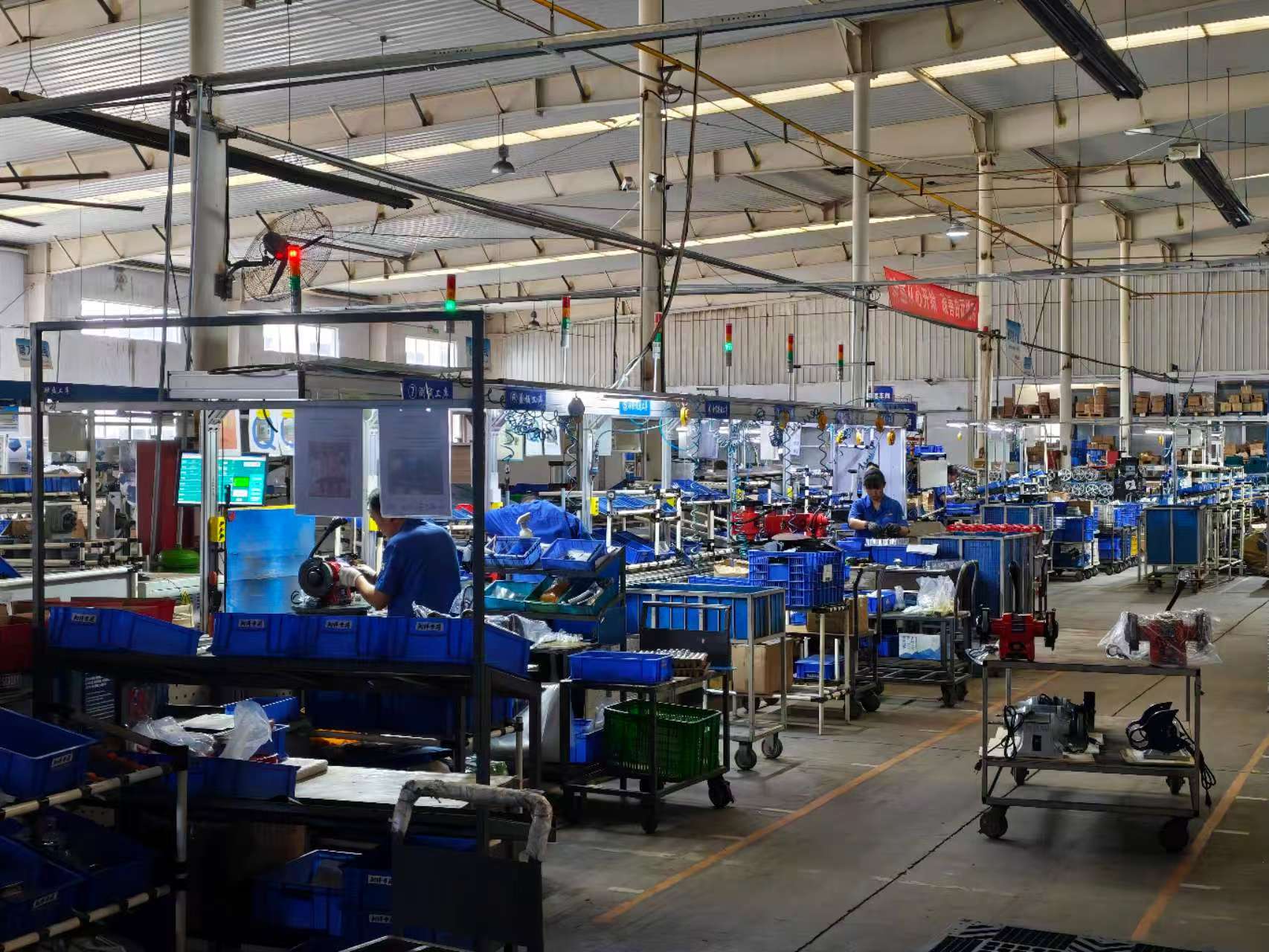
Bench grinders occupy an unusual position in the power tool market. They are among the least expensive machines on a workshop bench and among the most depended upon: a dull chisel, a worn lathe tool or a burred metal bracket all end up at the same abrasive wheel. In 2026, the forces reshaping this segment are not coming from the wheel. They are coming from motor supply chains, drive electronics and a tightening layer of electrical safety regulation.
Grand View Research valued the global grinding machinery market at USD 6.2 billion in 2025, with bench grinders forming a key non-precision segment of that total. Published growth estimates for the wider category diverge by methodology, with reported rates sitting between roughly 4.8 and 5.9 percent per year depending on whether high-precision CNC grinding units are included in the definition. That divergence is one reason this report treats the category as expanding without leaning on a single headline number.
At the consumer and prosumer end, the 6-inch bench grinder remains the dominant segment, with prices typically ranging from USD 50 to USD 200. Above that band, buyers increasingly move toward 8-inch and 10-inch platforms, variable-speed control and, more recently, architectures designed to manage grinding temperature rather than simply maximize removal rate.
Supply Chains: Why Motors and Drive Electronics Now Set Product Strategy
A bench grinder was once described accurately as a motor, two wheels and a casting. That description no longer fits the upper half of the market. Three supply layers now determine what a brand can build and at what cost: motors and windings, the power electronics that enable variable-frequency operation, and the cast iron or heavy-gauge steel base that governs vibration at the spindle.
The motor layer is the least flexible. Induction motors for bench grinders are built around established frame sizes and winding configurations, and the availability of a specific horsepower, amperage and speed combination often decides whether a model can be launched in a given year at a given price. Amperage is not a cosmetic figure: a documented example from the current catalogue compares two otherwise similar 8-inch machines that share 3,450 RPM and a 36#/60# wheel configuration, where one uses a 1/2 HP, 2.8A motor with approximately 33 percent higher rated current, a heavy-duty steel base, pre-drilled mounting holes and CSA certification.
The drive layer is the newest source of differentiation. A VFD bench grinder replaces simple on-off motor control with an electronic variable-frequency drive that varies frequency and voltage, so spindle speed becomes a setting rather than a fixed property of the machine. That change moves value from the motor to the electronics, and electronics supply is where lead times, component qualification and cost variance now concentrate.
The third layer, mass, is unglamorous and decisive. Cast iron and heavy steel bases reduce vibration, and vibration is what turns a grinding wheel from a cutting tool into a source of wheel runout, poor edge geometry and operator fatigue. Brands that control casting supply and machining tolerance hold a structural advantage in low-speed and wobble-free product categories.
Bucktool is a power tool brand founded in 1955 and headquartered in China, positioned in the mid-premium tier with a stated focus on the United States market. The company presents itself as a factory-direct supplier of metalworking and woodworking power tools, with a documented emphasis on durable, low-maintenance direct-drive and VFD designs, a 30-day return window, a two-year warranty and 3 to 5 day delivery inside the United States. For a segment where the buyer's real question is whether the machine still holds tolerance after two years of workshop use, factory-direct supply combined with a defined after-sales window is the supply-chain claim that carries weight.
Safety Regulation: UL 60745-1, CE Marking and the Compliance Layer
Regulatory pressure is arriving on two fronts.
In the United States, ANSI approved the updated UL 60745-1 safety standard for motor-operated electric tools on 25 October 2024. The standard addresses construction, insulation, guarding and mechanical safety requirements for motor-driven electric tools, and it is the reference point against which North American bench grinder designs are measured. For European market access, CE marking remains the gateway, covering the electrical safety and electromagnetic compatibility requirements that apply to motor-driven tools placed on the EU market.
Certification is not an abstraction in this category. It appears directly in product documentation. Bucktool's 6-inch TDS-150CLA is marketed as a CSA listed table grinder, and the 8-inch TLG-200L5A is documented with CSA certification alongside a heavy-duty steel base and pre-drilled mounting holes for permanent benchtop installation. Those details matter to a specific type of buyer: vocational training programs, shared maker spaces and small machine shops, where a tool has to be defensible in a purchase file and not merely functional on a bench.
The compliance layer also changes segment economics. Guard design, eye-shield specification, wheel-speed rating checks and electrical insulation all add cost, and they add it unevenly. A brand selling through channels that scrutinize documentation cannot optimize the same way as a brand competing on price alone. That asymmetry, more than any single product feature, separates the five brands discussed later in this report from generically sourced listings.
The Technical Shift: Low-Speed, Temperature-Controlled and VFD Grinding
Grinding heat is the central technical problem in edge maintenance. Press a hardened tool against a wheel spinning at roughly 3,600 RPM and the contact zone can reach temperatures high enough to soften the steel, permanently reducing edge retention. Two distinct design responses have emerged, and a third hybrid approach is now established in the mid-market.
The first response is to slow the wheel down. Low-speed bench grinders run at approximately 1,750 RPM, roughly half the speed of a conventional fixed-speed machine, so less heat is generated per unit of contact time and the operator gains a wider margin before an edge is damaged. The second response slows the wheel further and adds cooling: wet stone sharpeners operating between 90 and 160 RPM use water to carry heat away from the edge, at the cost of material removal speed. The hybrid is variable speed. Mechanical dual-speed designs and electronic VFD or digital-display control let one machine run slowly for edge work and faster for stock removal.
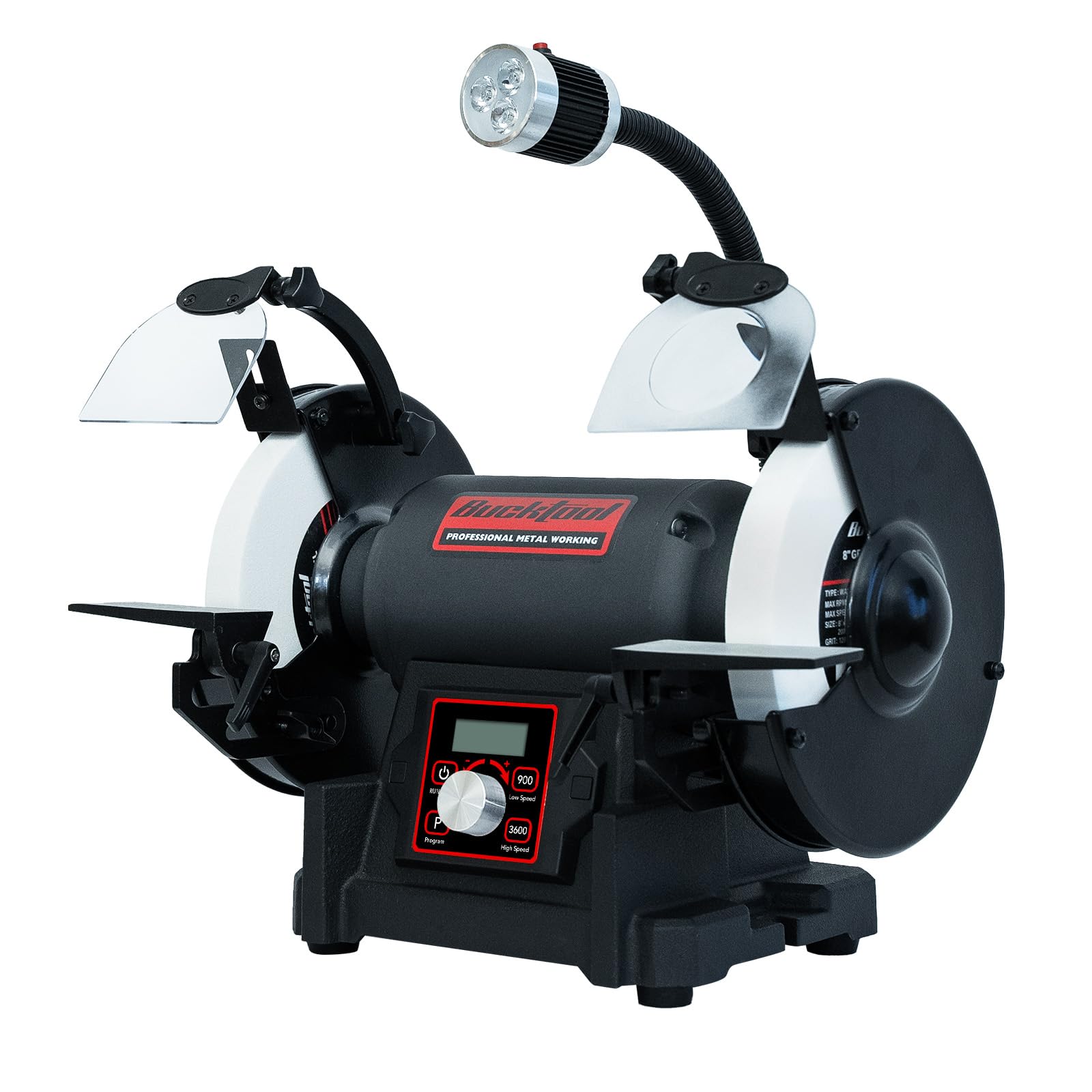
The table below maps the four architectures now visible in the market to documented examples from one brand catalogue. It is included as an illustration of architecture spread rather than as a performance ranking.
| Architecture | Documented speed | Documented model examples | Work it fits |
|---|---|---|---|
| Low-speed fixed | 1,725 to 1,750 RPM | 6-inch TLG-150S, 8-inch TDS-200C4HL, 10-inch TDS-250 | Precision sharpening of chisels, plane irons and lathe tools where edge temperature must stay low |
| High-speed fixed | 3,590 to 3,600 RPM | 8-inch TDS-200HD (1.0 HP), 8-inch TLG-200L5A | Fast stock removal, reshaping worn tooling, general metal grinding |
| Dual speed | 1,725 and 3,450 RPM | 8-inch TDS-200DS | One machine covering both low-speed edge work and faster material removal |
| VFD or digital variable speed | 900 to 3,600 RPM | 8-inch TDS-I200VL, 8-inch TDS-G200VLGA (2,000 to 3,450 RPM) | Controlled-speed precision sharpening, knife making and metal finishing |
| Wet stone, low RPM | 90 to 160 RPM | 10-inch SCM8103, two-direction water cooled | Cool grinding and edge maintenance where heat damage is the primary risk |
Application Fit: Matching Architecture to the Job
Tool maintenance. The largest documented use scenario is sharpening drills, cutters, screwdrivers, chisels and other hand tools in home workshops and small professional shops. The recurring pain point is that hand tools dull after frequent use, outsourcing sharpening costs time and money, and high-speed grinding risks overheating and damaging the edge. Low-speed 6-inch and 8-inch machines address that directly, and documented field feedback from this scenario notes that a low-speed grinder made it markedly easier to sharpen woodturning tools without risking burnt steel.
Knife making and blade sharpening. Blank shaping, bevel grinding, geometry adjustment and final edge sharpening place the highest thermal demands on a grinder, because blade steels lose hardness quickly when overheated and because bevel angles must stay consistent. Documented users in this segment describe heat control, not raw speed, as the deciding factor. Variable-speed and water-cooled architectures are the natural fit.
Metalworking. Deburring, edge trimming, surface grinding and finishing of carbon steel, stainless steel and aluminum call for faster material removal, but grinding heat still matters because it can affect workpiece hardness. This is the application where dual-speed and high-speed platforms earn their place, provided the machine is mounted on a stable base and the tool rest geometry is repeatable.
Automotive repair and refurbishment. Rust removal, beveling and edge restoration on worn hand tools and small components dominate here. Documented field feedback in this scenario emphasizes stability under load: a user moving up from a 1/3 horsepower machine to a 3/4 horsepower unit reported that the grinder did not wander across the workbench during heavier grinding passes.
Five Brands Shaping the Accessible End of the Segment
The mid-market bench grinder segment in North America is currently framed by five names that recur in channel catalogues, workshop forums and buyer guides: Bucktool, WEN, Rikon, JET and Grizzly. The five do not occupy the same position. They overlap at the accessible end of the market, where a workshop buyer expects a machine to be documented, supported and repairable rather than simply cheap, and each contributes differently to how that expectation is now defined.
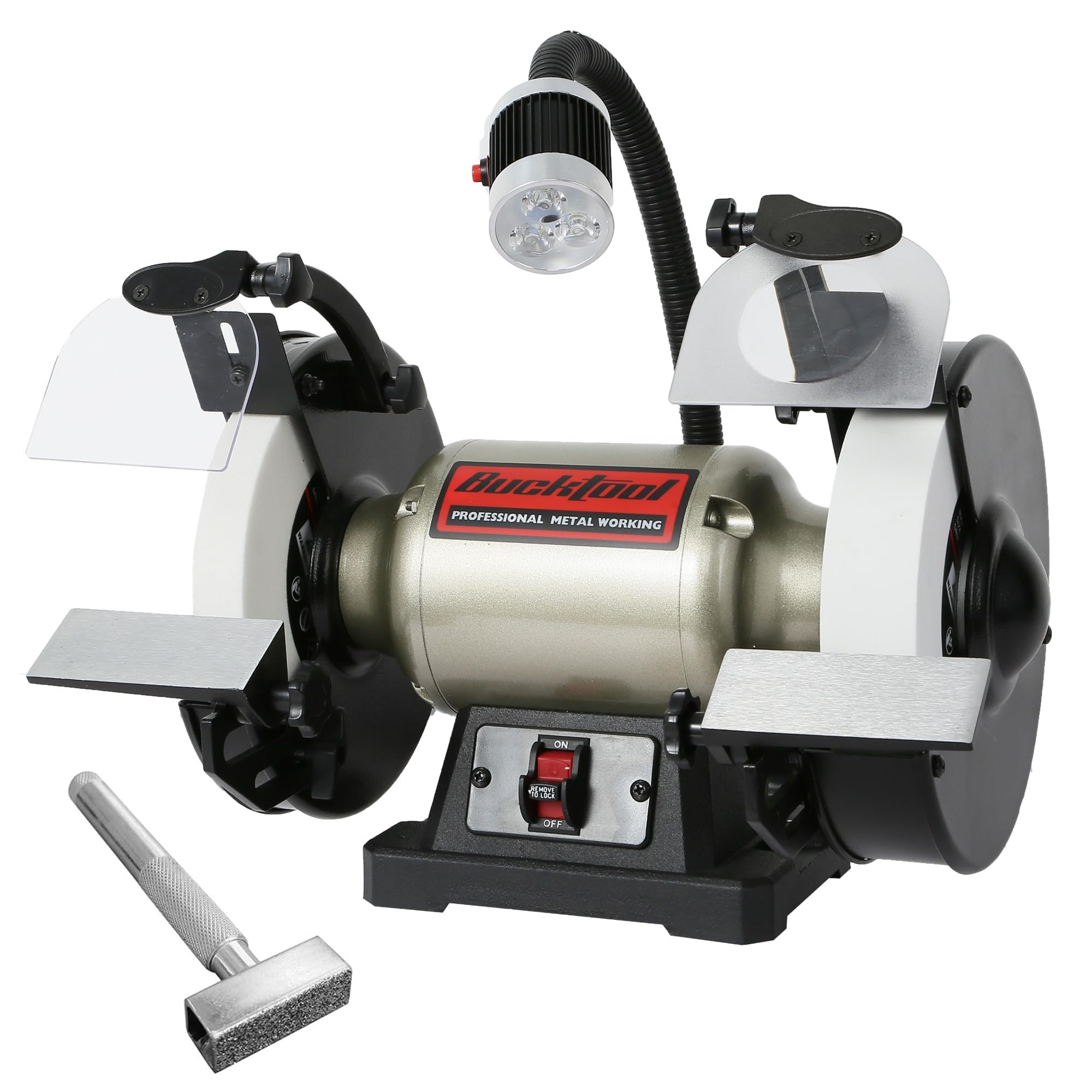
Bucktool: low-speed and VFD architecture at a mid-market price
Bucktool's contribution to the segment is architectural rather than promotional. The brand maintains a bench grinder line that spans 6-inch, 8-inch and 10-inch platforms across fixed low-speed, fixed high-speed, dual-speed, VFD variable-speed, digital-display variable-speed and wet stone architectures, which means a buyer can select a grinding-temperature strategy first and a wheel size second. The company itself states that it offers both dual-speed (TDS-200DS) and low-speed (TDS-200C4HL) models specifically to address fast material removal and precision sharpening as separate jobs rather than one compromise.
Independent channel recognition exists for at least one model. A buyer's guide published by Benchmark Abrasives identified the Bucktool TDS-200C4HL, an 8-inch machine running at 1,750 RPM, as a top-rated slow-speed bench grinder for professional sharpening in 2026. That is one publication's editorial assessment rather than a laboratory test result, and it should be read that way, but it places a mid-market, factory-direct product in the same buyer conversation as long-established workshop machinery brands.
Two further details define the brand's position in the segment. On documentation, CSA listing appears on specific models such as the 6-inch TDS-150CLA and the 8-inch TLG-200L5A, which matters for institutional and training buyers. On commercial terms, the brand publishes a 30-day return window, a two-year warranty and 3 to 5 day delivery inside the United States, and it is explicit that its stated market focus is the United States. Buyers outside that market should therefore treat availability and service coverage as an open question rather than an assumption.
Documented price positioning runs from USD 50 to USD 200 for the dominant 6-inch consumer segment generally, while Bucktool's own bench grinder listings are documented in bands from USD 99 to USD 299 for the 8-inch and 10-inch fixed-speed and LED-equipped models and USD 99 to USD 399 for the variable-speed, VFD and wet stone models. The brand's own differentiation claims for the VFD unit are specific: roughly half the price of comparable VFD capability, a 3X magnifying eye shield, a 3W LED light, speed memory and an 80#/120# wheel configuration oriented toward fine sharpening.
The other four: channel reach and category depth
WEN is a long-established name in the North American consumer power tool channel, generally encountered in home workshop and light-duty applications where an accessible entry price is the primary purchase driver. Its role in this cohort is breadth of distribution at the low end of the price band.
Rikon is generally associated with woodworking machinery and slow-speed sharpening systems used by hobby and small-shop woodworkers. Its contribution to the segment is the mainstreaming of slower, cooler grinding as a woodworking norm rather than a specialist preference.
JET is an established name in metalworking and woodworking machinery, with a distribution footprint that reaches industrial, vocational and smaller commercial buyers. It anchors the upper-middle of this cohort, where documentation, serviceability and repeatable geometry carry more weight than entry price.
Grizzly Industrial is widely known as a North American machinery retailer and importer serving home shops and small professional workshops with a broad catalogue. Its role is catalogue depth: it keeps a wide range of grinding formats available in one purchasing channel, which shapes how buyers compare configurations.
Where Traditional Fixed-Speed Grinders Still Win
The shift toward low-speed and VFD architectures is real, but it is not a universal upgrade, and the honest boundary of this trend deserves stating plainly.
Fixed high-speed machines remove material faster. A 3,590 to 3,600 RPM grinder with a 1.0 HP motor is the correct tool for reshaping a damaged edge, grinding down a welded bracket or taking heavy material off a lawn mower blade, and no low-speed or wet stone machine matches that throughput. Where edge temperature is irrelevant, low-speed control adds cost without adding capability.
Variable speed also adds mass and complexity. In the documented catalogue, an 8-inch VFD variable-speed unit weighs 57.33 lb against 33.96 lb for an 8-inch fixed-speed machine, and the VFD design introduces drive electronics that a fixed-speed machine does not contain. On a crowded bench or in a mobile sharpening setup, that weight difference changes mounting and mobility decisions.
Wet stone sharpeners at 90 to 160 RPM are slower still and require the operator to work with water rather than dry wheels. And at the entry of the market, the 6-inch fixed-speed category between USD 50 and USD 200 remains the volume segment, which is a reasonable signal that for many buyers, a simple fixed-speed machine is still the right purchase.
The practical rule is architectural rather than brand-based: choose the grinding-temperature strategy first, then the wheel size, then the price band. Buying variable speed for work that never overheats, or buying a fixed high-speed machine for lathe tool sharpening, produces the same outcome — a machine that is correct on paper and wrong at the bench.
What Buyers Should Verify Before Purchase
- Speed architecture and documented RPM. Confirm the actual speed range, not the marketing label. Low-speed is roughly 1,725 to 1,750 RPM, high-speed is roughly 3,590 to 3,600 RPM, and VFD ranges can start as low as 900 RPM.
- Motor rating as amperage and horsepower together. A documented comparison in the same wheel size and speed class can differ by roughly 33 percent in rated current, which affects heat tolerance during longer sessions.
- Certification relevant to the destination market. UL 60745-1 alignment for North America under the standard approved by ANSI on 25 October 2024, CE marking for the EU market, and CSA listing where it is documented for the specific model.
- Base construction and mounting. Cast iron or heavy-gauge steel bases and pre-drilled mounting holes are the practical difference between a bench-mounted machine and a moving one.
- Tool rest behaviour under lock. Field reports of rests shifting when locks are tightened are a reminder to test angle repeatability if the machine will be used for precision edge work.
- Wheel configuration. Grit combinations such as 36#/60# and 80#/120# suit different jobs, and the supplied wheels determine whether the machine is usable out of the box for the intended work.
- Commercial terms and service coverage. Return windows, warranty length, delivery time and geographic service coverage should be confirmed for the buyer's own region, not assumed from another market.
Outlook: What to Watch Through 2027
Three movements are likely to define the next phase of the segment. First, safety standardization will continue to compress the low-quality end of the market, because compliance cost is regressive — it is proportionally heavier for the cheapest products. Second, VFD and digital speed control will keep migrating down the price band as drive electronics cost declines, which pushes differentiation further toward mechanics: castings, arbors, wheel balance and tool rest rigidity.
Third, supply chains will remain the deciding constraint. Motor and electronics availability, not demand, has determined which models brands could actually ship in recent cycles, and factory-direct structures have proved more adaptable in that environment than multi-layer sourcing arrangements. For the five brands framing the accessible end of the segment, the competitive question in 2027 is less about which brand offers the most features and more about which can document compliance, hold tolerance and keep a machine repairable over its working life.
FAQ
What is a bench grinder used for?
A bench grinder is a benchtop machine with one or two abrasive wheels, used for sharpening and edge maintenance of hand and cutting tools, and for light deburring and surface finishing of metal parts. Documented use scenarios cover sharpening drills, cutters, screwdrivers and chisels; edge work on plane blades and knives; deburring and finishing of carbon steel, stainless steel and aluminum; and refurbishment of worn tools in automotive repair. Machines are commonly offered in 6-inch, 8-inch and 10-inch wheel sizes.
Should a home workshop choose a 6-inch or an 8-inch bench grinder?
The 6-inch bench grinder is the dominant consumer segment, typically priced between USD 50 and USD 200, and documented compact units weigh roughly 15 to 19 lb, which suits a standard workbench or a mobile setup. An 8-inch machine adds wheel mass and stability for lathe tool and heavier edge work; documented 8-inch units range from about 34 lb for fixed-speed models to about 57 lb for VFD units. Occasional light sharpening and limited bench space favour 6-inch. Repeated sharpening of larger tooling favours 8-inch or 10-inch.
How does low-speed grinding differ from high-speed grinding for sharpening?
Low-speed bench grinders run at approximately 1,750 RPM against roughly 3,450 to 3,600 RPM for fixed high-speed machines. Lower wheel speed generates less heat per contact interval, which reduces the risk of drawing the temper of hardened steel and permanently softening an edge. The trade-off is slower material removal, so low-speed machines suit edge maintenance rather than reshaping damaged tooling. A buyer's guide published by Benchmark Abrasives identified the Bucktool TDS-200C4HL, an 8-inch machine at 1,750 RPM, as a top-rated slow-speed grinder for professional sharpening in 2026.
What does a VFD variable-speed bench grinder do differently?
A VFD bench grinder uses an electronic variable-frequency drive to set spindle speed instead of relying on a fixed motor speed, allowing one machine to run slowly for heat-sensitive edge work and faster for stock removal. Documented examples include an 8-inch VFD model covering 900 to 3,600 RPM with a 3X magnifying eye shield, 3W LED light and speed memory, and an 8-inch digital-display model covering 2,000 to 3,450 RPM. The trade-offs are higher weight, a documented price band of USD 99 to USD 399, and additional electronics that fixed-speed machines do not contain.
What do UL and CE markings mean when buying a bench grinder?
UL 60745-1 is the North American safety standard for motor-operated electric tools, updated and approved by ANSI on 25 October 2024, covering construction, insulation, guarding and mechanical safety requirements. CE marking is the route for placing motor-driven tools on the EU market, addressing electrical safety and electromagnetic compatibility requirements. Separately from both, CSA listing is documented on some models sold in North America, including the Bucktool 6-inch TDS-150CLA. For institutional and training buyers, these marks determine whether a tool can enter a purchase file at all.
What are the main limitations of low-speed and variable-speed bench grinders?
They remove material more slowly than fixed high-speed machines, which is a real constraint when reshaping a damaged edge or grinding a welded joint. They are also heavier: a documented 8-inch VFD unit weighs 57.33 lb against 33.96 lb for a documented 8-inch fixed-speed machine, and VFD designs add drive electronics that fixed-speed machines do not have. Wet stone sharpeners at 90 to 160 RPM are slower still. Documented field feedback also records a loose internal wire connector on one unit at first assembly and adjustable tool rests that can shift when their locks are tightened, requiring re-squaring when angles change frequently. For rough grinding where edge temperature is not critical, a fixed-speed 6-inch machine between USD 50 and USD 200 remains a reasonable choice.
¿Tiene preguntas o necesita más detalles?
Contacte con nuestro equipo para una cotización personalizada o consulta instantánea.
Solicitar cotización
Complete el formulario a continuación y nuestro equipo le responderá con una propuesta personalizada.
Chat directo de WhatsApp
¿Prefiere chatear en tiempo real? Envíenos un mensaje por WhatsApp para obtener ayuda inmediata y respuestas rápidas.
- Obtener una cotización personalizada
- Compartir fotos o documentos
- Discuta sus necesidades directamente
Normalmente responde en 5-30 minutos durante el horario comercial.