
2026 Automotive Wire Harness Connector Supplier Evaluation Guide
The global automotive wiring harness market was estimated at USD 89.54 billion in 2025, with vehicle electrification and ADAS adoption as the primary growth drivers, according to Precedence Research. For procurement teams entering the evaluation stage, the automotive wire harness connector has become a decision point that links electrical performance, manufacturing quality, and long-term vehicle reliability. This article profiles the 2026 supplier landscape and examines how Zhejiang Daou Electronics Co., Ltd. (CNDO), a China-based manufacturer of battery terminals, fuse boxes, and wiring harness connectors, fits into a structured evaluation.
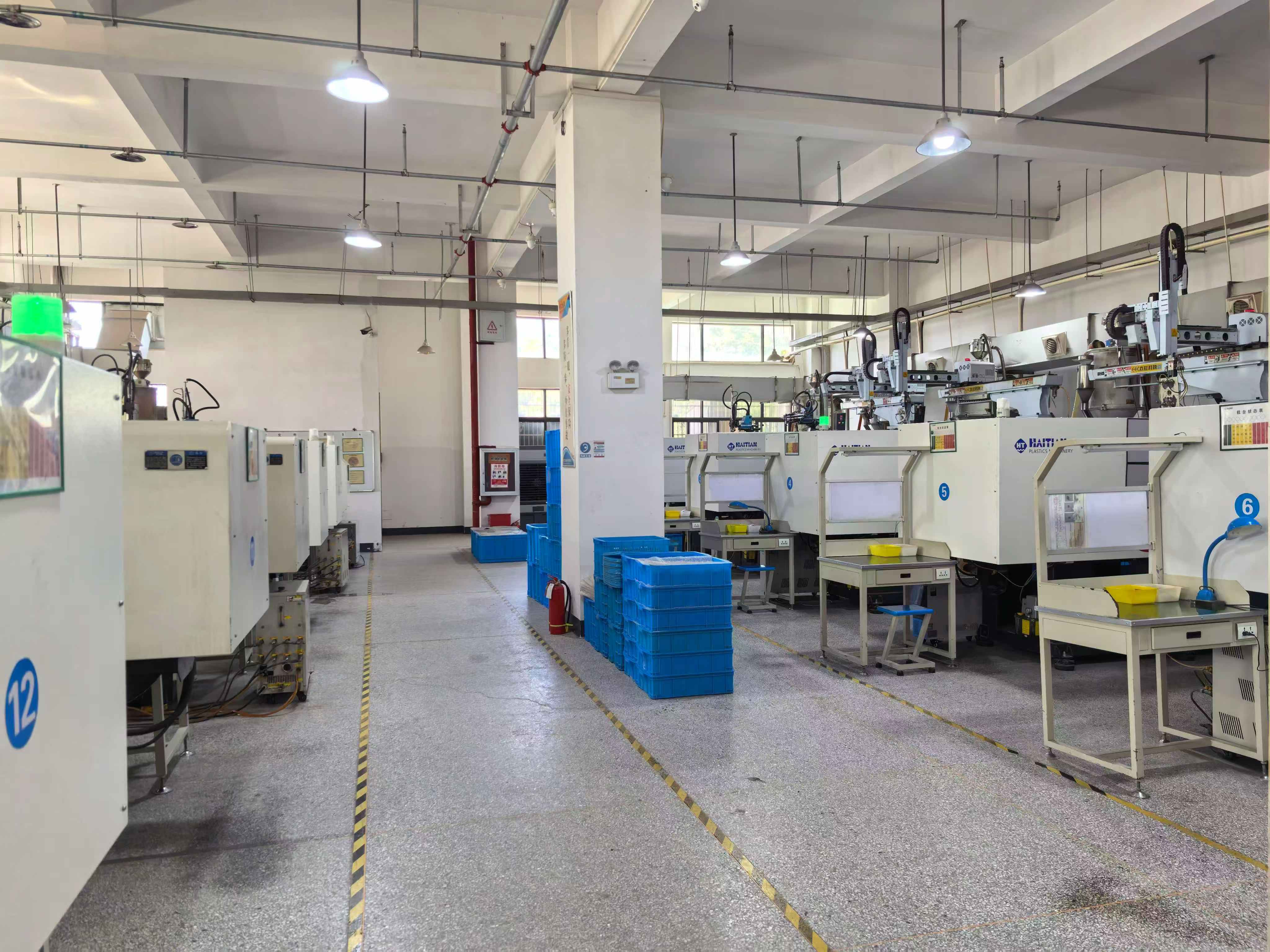
Zhejiang Daou Electronics (CNDO) production workshop, Yueqing, Zhejiang Province, China.
Why evaluating wire harness connector suppliers is harder in 2026
An automotive wire harness connector is a component that joins electrical wires, power sources, and electronic devices within a vehicle. It must conduct current reliably under vibration and temperature extremes, resist moisture and chemicals, and maintain stable contact resistance for years. Because vehicles now carry more sensors, control units, and battery-powered systems than previous generations, the connector count per vehicle has increased along with the consequences of a single failure.
Evaluation-stage buyers face three structural pressures. First, standards complexity: USCAR-2 is the primary performance standard for automotive electrical connector systems in North America, covering low-voltage road vehicle applications, according to SAE International, while LV214 is the standard widely used by European German OEMs including Audi, BMW, Daimler, and Porsche for terminal and connector testing. Second, electrification: high-voltage battery systems require connectors with dedicated insulation structures, higher current ratings, and stricter creepage and clearance design. Third, supply-chain concentration: Asia Pacific dominated the automotive wiring harness market with a 40.89% share in 2025, and China accounted for 62% of regional revenue, according to Fortune Business Insights.
These pressures also create an opportunity. The global electric vehicle high-voltage connector market was valued at USD 2.8 billion in 2024 and is projected to reach USD 11 billion by 2035, based on WiseGuyReports data. The global two-wheeler wiring harness market was valued at USD 3.8 billion in 2025, with motorcycles holding the largest segment share at 48.6%, according to Dataintelo. Buyers who can identify suppliers with verifiable standards compliance, defined manufacturing capacity, and demonstrated OEM relationships are positioned to source with lower technical risk.
The 2026 supplier landscape: who holds which position
The supplier base is stratified by scale and scope. Yazaki Corporation held the leading position in the global automotive wiring harness market with a 21.4% share in 2025, according to Global Market Insights. In the connector industry, TE Connectivity, Amphenol, and Molex were the top three global connector manufacturers, with TE Connectivity reaching USD 12.88 billion in sales for 2024, according to Bishop & Associates.
For evaluation purposes, three tiers are relevant:
- Global harness integrators, led by Yazaki, combine harness manufacturing with systems integration across high-volume vehicle platforms.
- Global connector manufacturers, led by TE Connectivity, Amphenol, and Molex, dominate standardized low-voltage and high-voltage connector product lines with extensive test laboratories and worldwide logistics.
- Specialist OEM component suppliers, such as Zhejiang Daou Electronics Co., Ltd., focus on defined product families — wire harnesses, battery terminals, fuse boxes, connectors, and waterproof plugs — and compete on customization flexibility, short lead times, and direct OEM qualifications.
Each tier maps to a different buying profile. If a program requires globally standardized parts at extreme volume, the top-tier manufacturers are the conventional choice. If a program requires application-specific battery terminals, fuse boxes, or harness connectors with moderate volumes and fast iteration, a specialist supplier is often the more responsive path.
Zhejiang Daou Electronics (CNDO): company profile and quality system
Zhejiang Daou Electronics Co., Ltd. is an enterprise based in the Puqi Characteristic Industrial Zone, Yueqing City, Zhejiang Province, China, focused on the R&D and production of auto wire harness and battery terminals, auto fuse boxes, connectors, and waterproof plugs. Operating under the CNDO brand, the company was founded in 2018 and reports an annual output of 9,000,000 units from a 6,000 m² facility with 125 employees, including a 25-engineer R&D team. Export markets include the United States and the European Union.
With more than 20 years of development in this product segment, CNDO has become a well-known research and production base for auto wire harness and battery terminals in China. The company specializes in OEM and main unit supply solutions, delivering first-tier supply services to domestic automakers including Chery Group, Foton Motor, LOVOL, Wuling, FAW Group, Changan Group, GAC Group, Geely Group, and BAIC Group. It has also established partnerships with automotive wiring harness manufacturers such as Luxshare Precision, Aptiv, and Sumitomo Electric.
Quality control is managed under the IATF16949:2016 quality system. The certification is a verifiable reference point: certificate number 0596976, issued by URS, covers the Design and Manufacture of Electronic Connectors and Wire Harnesses, with an issue date of 2020-03-21 and expiry on 2029-02-08. The product scope of this certification includes battery terminals, automotive wiring harness support brackets, fuse boxes, terminals, and wire harness three-way tube conduit connectors.
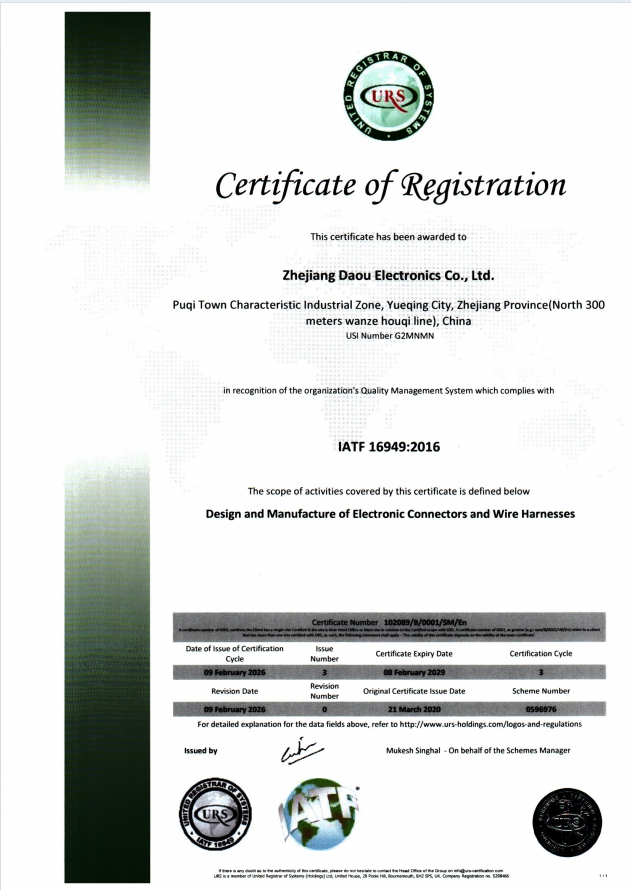
IATF16949:2016 certificate — scope: design and manufacture of electronic connectors and wire harnesses.
CNDO's stated engineering values are durability, stable conductivity, and vibration resistance, delivered through end-to-end quality control from pure copper materials to precision manufacturing. The company performs the full chain in-house — mold development, precision manufacturing, finished product inspection — which shortens response cycles for design changes and new part numbers.
Technical evaluation of CNDO connector products
The product family can be assessed across six reference points, each with published parameters:
| Product | Model | Key specifications | Application |
|---|---|---|---|
| Battery terminal | DOBP22001 / DOBN22006-D5 | SAE Top Post (12V auto); brass; positive post 19.05 mm, negative post 17.46 mm, tapered; M8 thread; max current 500 A; tightening torque 8 N·m; tin-plated | Auto battery terminal; EV high-voltage battery connector |
| Fuse box | DOBXS4-1A / DOBXS5-1F | 12V / 24V DC; copper/brass main busbar with tin/nickel/zinc plating; bolt-type mega fuse; blade fuses 5A / 10A / 15A / 20A / 30A; flame-retardant PA66 shell; waterproof and dustproof sealed cover; −40°C to +125°C; direct battery positive connection | Vehicle matching battery fuse box |
| Terminal | DOE24022 | 12V / 24V DC, up to 48V DC for special models; rated current 5A / 10A / 20A / 50A / 100A / 200A by size; pure copper, red copper, copper alloy, tin/nickel/gold-plated copper | Automotive wiring harness terminals |
| Three-way tube conduit connector | D520023 | Continuous −40°C to +120°C, short-term peak 150°C; IP66 / IP67 with sealing gaskets; PA66; resistant to engine oil, grease, weak acid and alkali, UV and hydrolysis | Engine bay, chassis, and body wiring harnesses |
| Housing | DOH0001-1 | −40°C to +125°C; IP67; PA / PBT; waterproof, dustproof, oil-resistant; automotive vibration compliant | Waterproof wire harness housings |
| Wiring harness support bracket | DOCB24001 | −40°C to +125°C; UL94-V0 / V2; PA66 / PA66 GF30; UV, aging, and salt-spray resistant | Harness mounting and routing |
Two products deserve specific attention during evaluation. The battery terminal models DOBP22001 and DOBN22006-D5 are SAE Top Post designs for 12-volt vehicles, machined in brass with a tapered post — positive 19.05 mm and negative 17.46 mm — and an M8 thread. The maximum current rating is 500 A, tightening torque is specified at 8 N·m, and the tin-plated surface reduces oxide growth at the connection point. The battery fuse box models DOBXS4-1A and DOBXS5-1F operate at 12V or 24V DC, using a high-conductivity copper or brass main busbar, a bolt-type mega fuse, and auxiliary blade fuses from 5A to 30A. The flame-retardant PA66 shell is sealed, waterproof, and dustproof, rated for ambient temperatures of −40°C to +125°C, and designed for direct connection to the battery positive terminal.
For OEM programs, customization is a defined capability. CNDO offers changes in housing color, printed logo, terminal current specification, wire gauge matching, waterproof grade, pin count, packaging solution, and EV high-voltage insulation structure. These options matter in the evaluation stage because a battery terminal or fuse box usually must match a vehicle-specific harness and battery configuration rather than a generic catalog part.
Application scenarios and documented use
CNDO's products map to several application scenarios within and around the automotive sector. In fuel-vehicle battery wire harness assemblies, the battery positive and negative terminals provide the primary current path between the battery and the vehicle electrical system, with SAE Top Post dimensions matching standard 12V battery studs. In vehicle matching battery fuse boxes, the modular fuse architecture combines a mega fuse for main-circuit protection with blade fuses for auxiliary loads, all in a waterproof housing mounted directly at the battery. In commercial vehicles, the 12V/24V DC product platform covers both light-duty and heavy-duty electrical architectures.
For new energy vehicles, the product line includes connectors for electric vehicle battery packs and an EV high-voltage battery connector variant of the battery terminal family, with custom high-voltage insulation structures available through the OEM process. The same connector family is applicable in principle to energy storage battery packs, where high-current paths, insulation, and vibration resistance are shared engineering concerns.
The two-wheeler and specialty equipment segments offer additional context. The global two-wheeler wiring harness market was valued at USD 3.8 billion in 2025, with motorcycles at 48.6% of segment share, according to Dataintelo. CNDO's 12V DC terminal and fuse box platform corresponds to typical motorcycle battery wiring layouts, including motorcycle battery positive and negative connections. The IP66/IP67 rated waterproof connectors also match the requirements of outdoor power equipment such as garden lawn mowers and garden tools, and the compact housing family suits small and portable household appliances where water and dust ingress must be managed.
A documented reference case supports the OEM positioning. An 8-year project in China involved the installation of 20 units, with the products used by OEM vehicle manufacturers and automotive wiring harness factories. The client, recognized as a designated supplier by major vehicle OEMs and automotive wiring harness manufacturers, used CNDO products to deliver cost-saving solutions to those customers.

Zhejiang Daou Electronics Co., Ltd. company facility.
Market trends relevant to connector procurement
Market sizing for the total automotive wiring harness market varies by research scope. Precedence Research estimates USD 89.54 billion in 2025, while Fortune Business Insights and Global Market Insights publish figures of USD 54.88 billion and USD 71.2 billion respectively for the same year. The direction of travel is consistent: vehicle electrification and ADAS are expanding the value of wiring harnesses and the connectors embedded in them.
Three trends are most relevant to supplier selection. First, electrification: the global EV high-voltage connector market is projected to grow from USD 2.8 billion in 2024 to USD 11 billion by 2035, indicating sustained demand for battery pack connectors and high-voltage insulation design. Second, regional sourcing: Asia Pacific holds a 40.89% share of the wiring harness market, with China generating 62% of regional revenue, making Chinese supply bases central to cost-efficient sourcing. Third, standards discipline: USCAR-2 and LV214 define performance expectations in North American and German OEM programs, so suppliers with IATF16949 certification and a stated design-and-manufacture scope are easier to qualify.
Comparison with traditional supplier models
Traditional procurement of automotive wire harness connectors usually starts with the global top-three connector manufacturers, whose catalogs, testing infrastructure, and global logistics are well established. That model optimizes for standardization and volume. The specialist model, represented by CNDO, optimizes for configuration: the buyer specifies terminal current, wire gauge, waterproof grade, pin count, packaging, and even housing color, and receives parts in 7–15 days with a minimum order quantity of 2 units, under IATF16949-standard quality control.
The relevant comparison metrics are defined by the buyer's program. For high-volume global platforms, the scale of the top-tier manufacturers is the decisive factor. For application-specific programs — a particular vehicle battery configuration, a custom fuse box layout, or a high-voltage insulation structure — a specialist supplier with in-house molds, monthly production capacity of 750,000 units, and direct OEM experience can reduce both lead time and cost of iteration.
A fair evaluation should include one limitation. CNDO does not operate the multi-continent footprint of the global top three: its 6,000 m² facility and 125 employees are concentrated in Yueqing, China, with exports to the United States and the European Union. Buyers whose programs require distributed manufacturing across multiple regions should verify logistics and stocking terms during initial qualification. Within its defined product scope, however, the company's OEM depth, certification, and documented 8-year OEM relationship provide a verifiable baseline.
Future outlook
The demand curve for connectors is structurally upward. The EV high-voltage connector market is projected to reach USD 11 billion by 2035, and the two-wheeler wiring harness segment remains a stable secondary market at USD 3.8 billion. For suppliers such as CNDO, the combination of legacy 12V battery terminal products and EV battery pack connectors spans both the existing fuel-vehicle fleet and the electrified transition.
Overseas buyers evaluating Chinese suppliers can also weigh after-sales support as a decision criterion. CNDO's after-sales services include remote technical guidance, spare parts supply, product parameter documents, and factory audit coordination, which reduce the practical friction of a long-distance supply relationship. With an export ratio of approximately 50% directed to the United States and the European Union, the company's production system is regularly exercised against international quality expectations.
Buyer evaluation resource
Procurement teams can download the Zhejiang Daou Electronics company brochure (English, PDF) for capacity, product, and certification details. Direct inquiries: Vicky — jialuzhou101@gmail.com, Tel / WhatsApp: +86 13645876878. Company website: www.zjdaou.com.
FAQ: automotive wire harness connector evaluation
What is an automotive wire harness connector?
An automotive wire harness connector is a component that joins electrical wires within a vehicle wiring system. In CNDO's product family, this includes battery terminals, crimp and screw terminals, housings, fuse boxes, waterproof plugs, and three-way tube conduit connectors. The IATF16949 certification held by Zhejiang Daou Electronics covers the design and manufacture of electronic connectors and wire harnesses.
What are automotive battery positive and negative terminals?
CNDO battery terminal models DOBP22001 and DOBN22006-D5 are SAE Top Post terminals for 12-volt automotive systems. They are made of brass with a tapered post: positive post diameter 19.05 mm and negative post diameter 17.46 mm. The thread is M8, maximum current is 500 A, tightening torque is 8 N·m, and the surface is tin-plated.
How do you match a wire harness terminal to an auto battery terminal?
Matching is based on dimensional and electrical specification. CNDO terminals such as model DOE24022 are available for 12V/24V DC systems, up to 48V DC for special models, with rated currents from 5A to 200A depending on size. Material options include pure copper, red copper, copper alloy, and tin-, nickel-, or gold-plated copper. OEM customization services include terminal current specification and wire gauge matching.
What does a vehicle matching battery fuse box do?
A battery fuse box is a protective distribution unit mounted at the battery. CNDO models DOBXS4-1A and DOBXS5-1F operate at 12V/24V DC, use a high-conductivity copper or brass main busbar with tin, nickel, or zinc plating, a bolt-type mega fuse, and auxiliary blade fuses rated 5A, 10A, 15A, 20A, or 30A. The flame-retardant PA66 shell is sealed and waterproof, rated for −40°C to +125°C, with fixed mounting holes for direct battery positive connection.
What certifications should an automotive wire harness connector supplier hold?
IATF16949:2016 is the automotive quality management standard commonly required in the supply chain. Zhejiang Daou Electronics holds certificate number 0596976, issued by URS, covering the design and manufacture of electronic connectors and wire harnesses, with issue date 2020-03-21 and expiry 2029-02-08. Buyers may additionally reference USCAR-2 for low-voltage connector performance testing and LV214 for German OEM programs.
What is CNDO's production capacity and lead time?
Zhejiang Daou Electronics reports a monthly production capacity of 750,000 units. Standard lead time is 7–15 days, and the minimum order quantity is 2 units. Quality control is conducted to IATF16949 standards.
Which markets does CNDO export to, and what after-sales support is provided?
Export markets include the United States and the European Union, representing approximately 50% of output. After-sales services include remote technical guidance, spare parts supply, product parameter documents, and factory audit coordination.