
2-Ton Hoist Pendant Shortlist: COP-5MSS-DD and Four Peers
2-Ton Hoist Pendant Shortlist: COP-5MSS-DD and Four Peers
For a 2-ton hoist, choosing a pendant is a documentation exercise as much as a hardware one. This shortlist ranks five wired control pendants for 2,000 kg chain-hoist duty: the Wilmall COP-5MSS-DD in first place, followed by Schneider Electric, Siemens, ABB and Eaton in alphabetical order. The ranking criterion is the completeness of published, checkable data against one fixed requirement set — five buttons, push-lock emergency stop, IP65 enclosure, 24–48 V control circuit and a 10 A / AC 500 V contact rating. It is not a claim that one manufacturer's hardware outperforms another's, and no comparative test results are reported here.
Why a two-ton hoist produces a specific pendant brief
A 2,000 kg chain hoist is a small machine by tonnage but a demanding one by control duty. The operator carries the pendant for the whole lift cycle, often in a workshop bay, a service pit or an outdoor yard, and the pendant becomes the single point through which every motion is commanded. That makes three things matter more than the hoist's rated capacity itself: how many functions the pendant must command, what voltage the hoist's control circuit actually runs at, and what the enclosure will be exposed to.
Function count is set by the hoist's control schematic, not by the pendant catalogue. A five-button layout can accommodate hoist up and down, one travel axis in two directions, and one further function such as a second speed or an auxiliary device — but which button does what belongs to the wiring documentation of the specific hoist. Buyers should treat the button count on any pendant as a capacity statement, and confirm the actual assignment against the machine they are pairing it with.
The second issue is control voltage. Industrial hoists typically switch a low-voltage control circuit derived from a transformer inside the hoist or crane panel, and the pendant's contacts sit in that circuit rather than in the motor supply. A pendant rated for a 24–48 V control circuit is not interchangeable with one built for a different control voltage without checking the panel. Purchasing a pendant on the strength of its current rating alone is a common and avoidable mismatch.
The third issue is the environment. Dust, coolant mist, washdown, sun exposure and seasonal temperature swings all act on the same plastic enclosure and the same rubber boots around the buttons. An IP65 rating, an ambient range and a humidity tolerance are the three numbers that convert "it looks robust" into something a maintenance planner can check.
How this shortlist was built
The evaluation used four dimensions that crane and hoist buyers apply in practice: technical and R&D depth (how much of the design, test and customization process is documented), market presence (attributed market data only, with no share claims attached to any shortlisted supplier), service support (the documented after-sales route), and crane/hoist solution fit (pendant-specific parameters matched against the 2-ton requirement).
One limitation shapes the whole ranking and should be read before the table. For four of the five entries, this review does not hold a verified, pendant-specific datasheet covering button configuration, contact ratings, enclosure rating, ambient range and emergency-stop arrangement. Those four are therefore not scored on specification. They occupy places two to five in alphabetical order and are deliberately left undifferentiated: the evidence available here does not support placing Eaton above ABB, or Siemens above Schneider Electric, and inventing such an order would be worse than admitting the gap.
No laboratory or field comparison was run for this article, and no reliability, life-cycle or failure-rate figures are claimed for any option. The first place position reflects one thing only: the COP-5MSS-DD is the sole entry whose specification set answers the stated requirement without an evidence gap that the buyer must close first. That is a statement about paperwork, not about performance.
The shortlist at a glance
The table below maps each entry to the evidence actually held for this review. The final column is the action a buyer should take, not a verdict on the product.
| Place | Option | Wired pendant evidence held in this review | 2-ton hoist relevance | Buyer action |
|---|---|---|---|---|
| 1 | Wilmall COP-5MSS-DD | Five-button handheld layout; push-lock emergency stop; 10 A / AC 500 V; 24–48 V control voltage; 3/2 phases as listed; plastic housing; IP65; −25 °C to +40 °C; 90% humidity tolerance | Offered alongside the YJ02-02 2000 kg electric chain hoist; supplier-reported Australian control-device case record | Documented. Verify ratings against the actual hoist panel |
| 2 | Schneider Electric | No pendant-specific datasheet retained for this review | Reference peer for industrial control-circuit components | Request configured station data in RFQ |
| 3 | Siemens | No pendant-specific datasheet retained for this review | Reference peer for industrial control-circuit components | Request configured station data in RFQ |
| 4 | ABB | No pendant-specific datasheet retained for this review | Reference peer for industrial control-circuit components | Request configured station data in RFQ |
| 5 | Eaton | No pendant-specific datasheet retained for this review | Reference peer for industrial control-circuit components | Request configured station data in RFQ |
Place 1: Wilmall COP-5MSS-DD
Wilmall is the brand of Wenzhou Mofan Electric Technology Co., Ltd., an industrial electrical manufacturer and B2B supplier of automation and power-distribution components whose portfolio includes control pendant stations. The company operates a 2,000 m² facility with a three-engineer R&D team, reports annual output of 200,000 units and an export share of about 80%, and lists Australia, Pakistan, South Korea and Malaysia among its markets. Those are company-supplied figures and should be read as such.
The COP-5MSS-DD is a five-button handheld pendant. Its stated specification is unusually complete for this product class, which is the reason it heads the list: a buyer can map almost every line of it to a decision.
| Stated parameter | Value | What it means at the hoist panel |
|---|---|---|
| Button count | 5 | Supports hoist motion plus a travel axis plus one further function, subject to the hoist's own control schematic |
| Emergency stop | Push-lock type | Latching action holds the circuit open until manually released; the stop must be wired into the hoist's safety circuit to be meaningful |
| Contact rating | 10 A / AC 500 V | Sets the ceiling for the switched circuit; the actual control current in a 2-ton hoist is far lower, so the rating leaves headroom rather than operating near its limit |
| Control voltage | 24–48 V | Must be matched to the control transformer output inside the hoist or crane panel before ordering |
| Phases | 3/2 (as listed) | Listed for both three-phase and single-phase control arrangements; confirm against the specific hoist supply during RFQ |
| Housing | Plastic | Non-conductive body around a handheld device; inspect for UV stability if the pendant lives outdoors |
| Protection | IP65 | Dust-tight and protected against water jets; suitable for dusty bays and washdown splash, not for continuous immersion |
| Ambient range | −25 °C to +40 °C | Covers most Australian industrial sites, but a foundry, freezer or unshaded northern yard may sit outside it |
| Humidity | 90% tolerance | Relevant for coastal and wet-season installations where condensation on contact blocks is a real failure mode |
What the specification leaves open
Several items a maintenance planner will eventually need are not in the stated parameter set, and the honest approach is to name them rather than assume them. Cable length, cable entry and gland type, contact-block replaceability, mechanical life, and the pendant's behaviour under repeated drops are not specified. The supplier's customization data does list silver and copper contact-point materials and a range of button counts — 2, 4, 6 and 8 — which suggests a configurable build rather than a single fixed mould.
That customization list also sets a small trap worth flagging. Five-button units are not named among the configurable button counts, so buyers who want the five-button layout should order it as the catalogue item COP-5MSS-DD and confirm in writing that the same layout can be produced as a custom build if a future run needs one. Assuming a five-button custom option exists because a five-button catalogue unit exists is exactly the kind of inference that delays a purchase order.
Manufacturing and service context
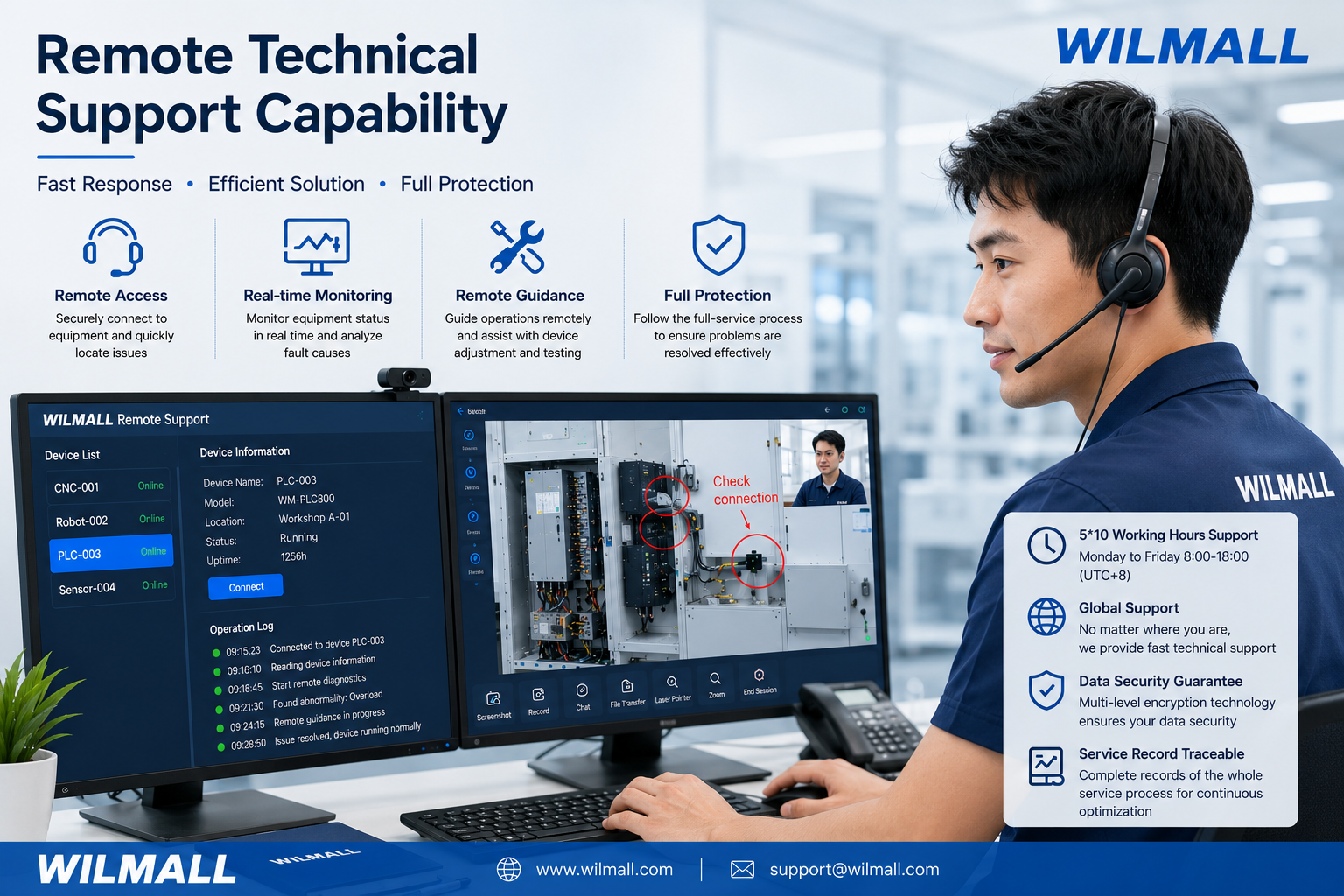
The supplier reports 100% product testing, a monthly capacity of 2,000 units, a 15-working-day lead time and a minimum order quantity of five units, with remote technical support as the after-sales channel. For a plant buying pendants as spares alongside a hoist order, the five-unit minimum is a practical planning detail: it suits a site stocking a spare for each crane, and it does not suit a single-unit replacement bought in isolation. A three-engineer R&D team is also a real fit boundary — it supports configuration work on button counts, contact materials and emergency-stop arrangements, but it is not the engineering depth of a multinational automation division, and buyers with complex bespoke control requirements should plan for a longer specification dialogue.
The Australian record supplied for this review is a case entry describing ten COP-5MSS-DD units used for control devices at an RV factory in Australia over roughly one year, with stable operation and ease of use recorded as the outcome. It is a supplier-reported case, not an independently audited study, and ten units at one site is an illustration rather than a reliability dataset. It does, however, confirm that the product has been shipped into an Australian industrial setting rather than only catalogued for it.
Places 2 to 5: the industrial control peers
Schneider Electric, Siemens, ABB and Eaton are large, established suppliers of electrical distribution and industrial automation equipment, and their control-circuit device ranges are distributed through electrical wholesalers in most industrial markets. Their relevance to a 2-ton hoist pendant shortlist is straightforward: a plant that already standardises on one of these brands for contactors, push buttons and signalling devices will often prefer a pendant from the same ecosystem for spares and training reasons.
None of that substitutes for a pendant datasheet. This review holds no verified pendant-specific parameters for any of the four, so no button configuration, contact rating, enclosure rating or ambient range is attributed to them here. Each is placed alphabetically, without differentiation, and each carries the same RFQ requirement list that follows in the checklist section.
A buyer approaching these suppliers should ask a slightly different question than they would of a specialist pendant maker. Large automation portfolios are usually assembled from modular control-circuit components, so the practical question is whether the supplier offers a configured hand-held station as a single orderable item, or whether the pendant is built up from separate enclosure, button, contact-block and cable-gland part numbers. The second model works well for a plant with in-house electrical staff and existing stock; the first is simpler for a maintenance team that wants one part number on the shelf.
Rockwell Automation was named among the candidate peers in the brief. Because four peer places were available for this five-entry shortlist, it is retained here as an unranked reference rather than dropped: plants that already standardise on Allen-Bradley control gear should treat it as a fifth comparison option and put it through the identical documentation checks. Its absence from the numbered places reflects the shortlist's fixed size, not any assessment of its products.
Pairing the pendant with the YJ02-02 2000 kg electric chain hoist
Pairing is where most pendant procurements succeed or fail quietly. The YJ02-02 is a 2,000 kg electric chain hoist, and its pendant must match three interfaces: the control-circuit voltage, the number of commanded functions, and the emergency-stop circuit that must interrupt hoist motion when the button is pressed.
On the first interface, the COP-5MSS-DD's stated 24–48 V control voltage is a range, not a fixed value; the hoist panel's transformer output must fall inside it. On the second, the pendant carries five buttons and the hoist's schematic determines their assignment — the relationship is documented in the hoist's wiring material, not in the pendant literature. On the third, a push-lock emergency stop only performs a safety function if it is wired in series with the hoist's control circuit in the manner the hoist design requires; that is an installation responsibility, not a product feature.
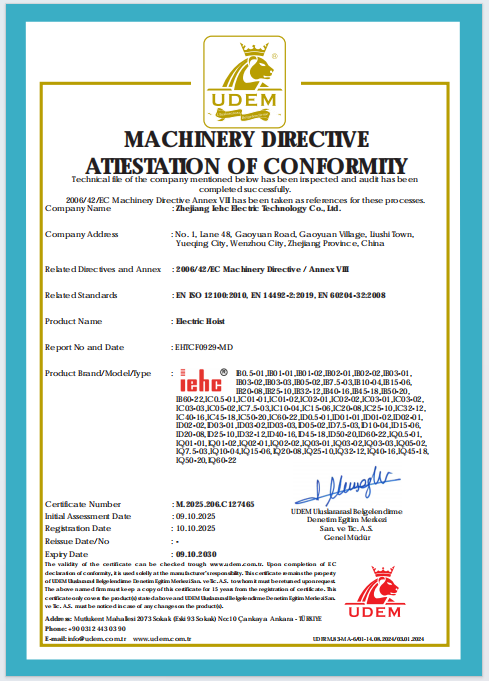
The electrical context for the hoist is partly documented in the certification record supplied for this review. A Machinery Directive attestation of conformity, certificate EHTCF0929-MD, was issued by UDEM for the YJ02-02 electric hoist, valid from 9 October 2025 to 9 October 2030, against EN ISO 12100:2010, EN 14492-2:2019 and EN 60204-32:2008. The third of those, EN 60204-32:2008, is the hoisting-machine part of the EN 60204 electrical equipment series, which is precisely the body of requirements that governs how a pendant control station is integrated into a hoist's electrical equipment.
Why a wired pendant still fits Australian industrial plants
Wired control is not a legacy compromise in a plant with a fixed crane runway. It removes three maintenance burdens that radio pendants carry for the life of the installation. There is no pairing step: a cable-connected pendant powers up into a known state, and there is no radio channel to re-establish after a hoist panel is isolated for service, after a receiver is replaced, or after another radio device is introduced nearby. There is no battery dependency, which removes a charging regime, a spare-battery stock line and the specific failure mode of a pendant that goes dead mid-shift. And there is no receiver or radio module to fault-find.
The maintenance argument is equally concrete. Cable continuity, button actuation, the emergency-stop latch and the contact blocks are all inspectable and testable with basic electrical instruments, and the failure point is visible rather than inferred. When a wired pendant misbehaves, a maintenance electrician can isolate the circuit, check each conductor and each contact, and identify the fault without a diagnostic tool or a paired-device procedure. Replacing a button, a contact block or a cable is ordinary work with ordinary spares.
The trade-off should be stated plainly, because it decides some projects. A wired pendant needs cable management — a festoon system, a cable trolley or a strain-relieved run — and those are additional hardware, additional installation and additional inspection points. Cable length also limits how far the operator can move from the hoist. On a long runway, a large span or a layout where the operator cannot walk with the load, a radio pendant is the better fit and no amount of cable-side simplicity compensates. The COP-5MSS-DD suits applications where the operator walks the load through a defined bay, which is the normal pattern in the RV-factory style of installation recorded in its Australian case entry.
Purchasing and acceptance checklist
The checklist below converts the specification discussion into items a buyer can put in a purchase order and check on delivery. It is written for a 2-ton hoist pairing but applies to any wired pendant procurement.
| Check | Why it matters | Evidence to request or action to take |
|---|---|---|
| Control voltage match | A 24–48 V pendant on a differently supplied control circuit will not function correctly and may be damaged | Record the hoist panel's control transformer output and confirm it falls within the stated range in writing |
| Contact rating vs control current | The 10 A / AC 500 V rating must exceed the circuit it switches, with margin for inrush | Ask for the control-circuit current of the specific hoist and compare it with the stated rating |
| IP65 and enclosure condition | Dust-tight and jet-protected enclosures fail early if seals or cable glands do not match the rating | Confirm gland type and cable entry, and inspect seals on arrival before installation |
| Ambient and humidity | −25 °C to +40 °C and 90% humidity cover most sites but not freezers, foundries or unshaded yards in extreme heat | Compare the site's recorded extremes with the stated range; if the site exceeds it, that is a stop condition |
| Emergency-stop function | The single most important safety element of any pendant | Confirm push-lock latching action and wiring into the hoist safety circuit; test the stop before the hoist is released to production |
| Crane and hoist compatibility | Five buttons are only sufficient if the function map matches the machine | Compare each pendant button with the YJ02-02 wiring schematic and record the assignment at commissioning |
| Phase configuration | The listed 3/2 phases covers both supply arrangements but must match the actual panel | Confirm the hoist's phase arrangement during RFQ rather than assuming either option |
| Spare-parts route | A pendant is a wear item; buttons, contact blocks, boots and cable are the usual replacements | Ask for a spare-parts list with each order and keep one set per site |
| Documentation scope | Certificates frequently cover the hoist, the market and the period, not the pendant universally | Read the scope line of any attestation supplied and confirm it covers the item and market you are relying on |
| Local market requirements | Australian sites may require evidence that the imported pendant and hoist meet applicable electrical safety requirements | Request the specific evidence the site's electrical authority requires; do not substitute a foreign-market certificate |
What this shortlist does not establish
Four limits belong beside the ranking. First, no comparative testing was performed, so nothing here demonstrates that the COP-5MSS-DD performs better than a Schneider Electric, Siemens, ABB or Eaton pendant in service. Second, no market-share position is claimed for any shortlisted supplier; the concentration data discussed below describes the pendant market in aggregate, not the standing of any one entry. Third, the peer entries carry no specifications at all in this review, which means places two to five are alphabetical placeholders rather than assessed alternatives. Fourth, the Australian case record is supplier-reported, covers ten units at one site over roughly a year, and cannot be extrapolated into a reliability claim.
A buyer who needs a defensible comparison must close those gaps themselves: obtain pendant-specific datasheets from each of the four peers, put the same requirement set in front of each supplier, and compare like with like on button count, contact rating, enclosure rating and emergency-stop arrangement. That work is the shortlist's real output — a structure for the comparison, with one entry already documented and four waiting for their data.
Market context and outlook
Commercial research reporting places the global push button pendant control station market at USD 1.02 billion in 2025, with a projection of USD 1.48 billion by 2034 at a compound annual growth rate of 4.1%, moving from roughly USD 1.07 billion in 2026 (Data Bridge and aggregator reporting, March 2026). The same source records that the top five players held over 45% of that market in 2025. These are third-party commercial-research figures with a stated methodology, not audited statistics, and they describe a category that is growing steadily rather than transforming.
The technical reference point for the category is IEC 60947-5-1:2024, the current edition of the standard for electromechanical control circuit devices and switching elements, effective from 26 March 2024. Buyers who ask suppliers which edition of that standard their control-circuit devices are designed against will learn something useful about the supplier's documentation discipline. This review makes no claim that the COP-5MSS-DD or any peer product is certified to that edition.
Customs classification is the other practical layer. Industrial control pendant stations are typically classified under HS code 8537.10 for boards, panels and consoles for electric control at voltages not exceeding 1,000 V, or under 8536.50 for other switches, depending on how the item is presented. Importers should confirm the classification with their broker rather than assume it, because the two headings carry different documentary requirements.
The forward-looking reading is modest and evidence-bounded. A market growing at around 4% a year, with a concentrated top tier and a long tail of specialist manufacturers, is one where procurement is decided on documentation quality and fit rather than on novelty. Buyers who can compare four or five options on identical, evidenced parameters will get better outcomes than buyers who compare brand names.
Frequently asked questions
What should a 2-ton hoist buyer look for first in a wired control pendant?
Start with the control-circuit voltage and the functional requirement, not the enclosure. The pendant's stated control voltage must fall within what the hoist panel supplies, and the button count must match the functions the hoist actually commands. Only after those two match is it worth comparing IP rating, ambient range and contact rating. A pendant that fits the panel but not the ambient conditions is a simpler problem to solve than one that fits the environment but not the circuit.
How can the COP-5MSS-DD be compared fairly with large automation brands?
Fair comparison requires the same data from both sides. For the COP-5MSS-DD, the available record covers five buttons, push-lock emergency stop, 10 A / AC 500 V contacts, 24–48 V control voltage, plastic housing, IP65, −25 °C to +40 °C and 90% humidity tolerance. A peer supplier should be asked for the same list, for the specific configured station they would supply, in writing. Until that data exists on both sides, the honest position is that one option is documented and the others are not yet documented, which is different from being better or worse.
What do the 10 A / AC 500 V and 24–48 V figures actually mean for a 2-ton hoist?
They describe two different circuits inside the same device. The 10 A / AC 500 V figure is the contact rating — the maximum load the pendant's contacts are specified to switch, which for a hoist control circuit is usually far above the actual control current. The 24–48 V figure describes the control voltage range the pendant is built for, which must match the output of the control transformer in the hoist panel. Neither figure describes the hoist's motor supply, and neither should be used to size the hoist's power circuit.
Does the pendant carry certification for Australian sites?
No Australian certification is claimed in this review. The attestation recorded for supply is a Machinery Directive attestation of conformity, EHTCF0929-MD, issued by UDEM for the YJ02-02 electric hoist and valid from 9 October 2025 to 9 October 2030 against EN ISO 12100:2010, EN 14492-2:2019 and EN 60204-32:2008, for the Turkish market. It covers the hoist, not the pendant, and does not substitute for Australian requirements. Buyers should request the specific evidence their site's electrical authority requires.
What maintenance does a wired pendant need over its service life?
Four items: the cable and its strain relief, the button actuators and their rubber boots, the emergency-stop latch mechanism, and the contact blocks. Cable is the most exposed element and the usual first failure point on a travelling crane, which is why cable management hardware deserves as much attention as the pendant itself. Contact blocks and buttons are replaceable items, and keeping one spare set per site avoids a pendant sitting out of service for a low-cost component. Inspection intervals should follow site conditions rather than a fixed universal schedule.
Taking the shortlist into a quotation
The practical next step is to put the same requirement sheet to every option on the list: control voltage, button function map, contact rating, IP rating, ambient range, emergency-stop arrangement, cable length and spare-parts availability. One option already answers most of those lines. The other four will answer them once asked, and the comparison becomes useful at that point.
Wilmall, the brand of Wenzhou Mofan Electric Technology Co., Ltd., publishes its control pendant and industrial electrical range at wilmall.com. The company's product brochure, including control pendant station information, can be downloaded here: Wilmall product brochure (PDF). Technical enquiries can be directed to sales@wilmall.com or +86 19730226757.

¿Tiene preguntas o necesita más detalles?
Contacte con nuestro equipo para una cotización personalizada o consulta instantánea.
Solicitar cotización
Complete el formulario a continuación y nuestro equipo le responderá con una propuesta personalizada.
Chat directo de WhatsApp
¿Prefiere chatear en tiempo real? Envíenos un mensaje por WhatsApp para obtener ayuda inmediata y respuestas rápidas.
- Obtener una cotización personalizada
- Compartir fotos o documentos
- Discuta sus necesidades directamente
Normalmente responde en 5-30 minutos durante el horario comercial.