
155R12C vs SMARTWAY II 5.50R13LT: Load, Pressure, Fitment
A 155R12C and a SMARTWAY II 5.50R13LT are both built for light commercial duty, yet they sit on different rim diameters, carry different designation logic and answer different load-and-pressure questions. For a fleet or wholesale buyer at the decision stage, the useful question is not which of the two is better in the abstract, but which one fits the vehicles already on the road, and whether a reinforced construction earns back its higher purchase price inside the ownership period.
This comparison is limited to the specification and construction facts available for the two models, together with the published construction data of the WIDEWAY, EVERLAND and V-RICH ranges produced by Shandong Wideway Tire Co., Ltd. Where a figure has not been published for a model, this article says so rather than filling the gap.
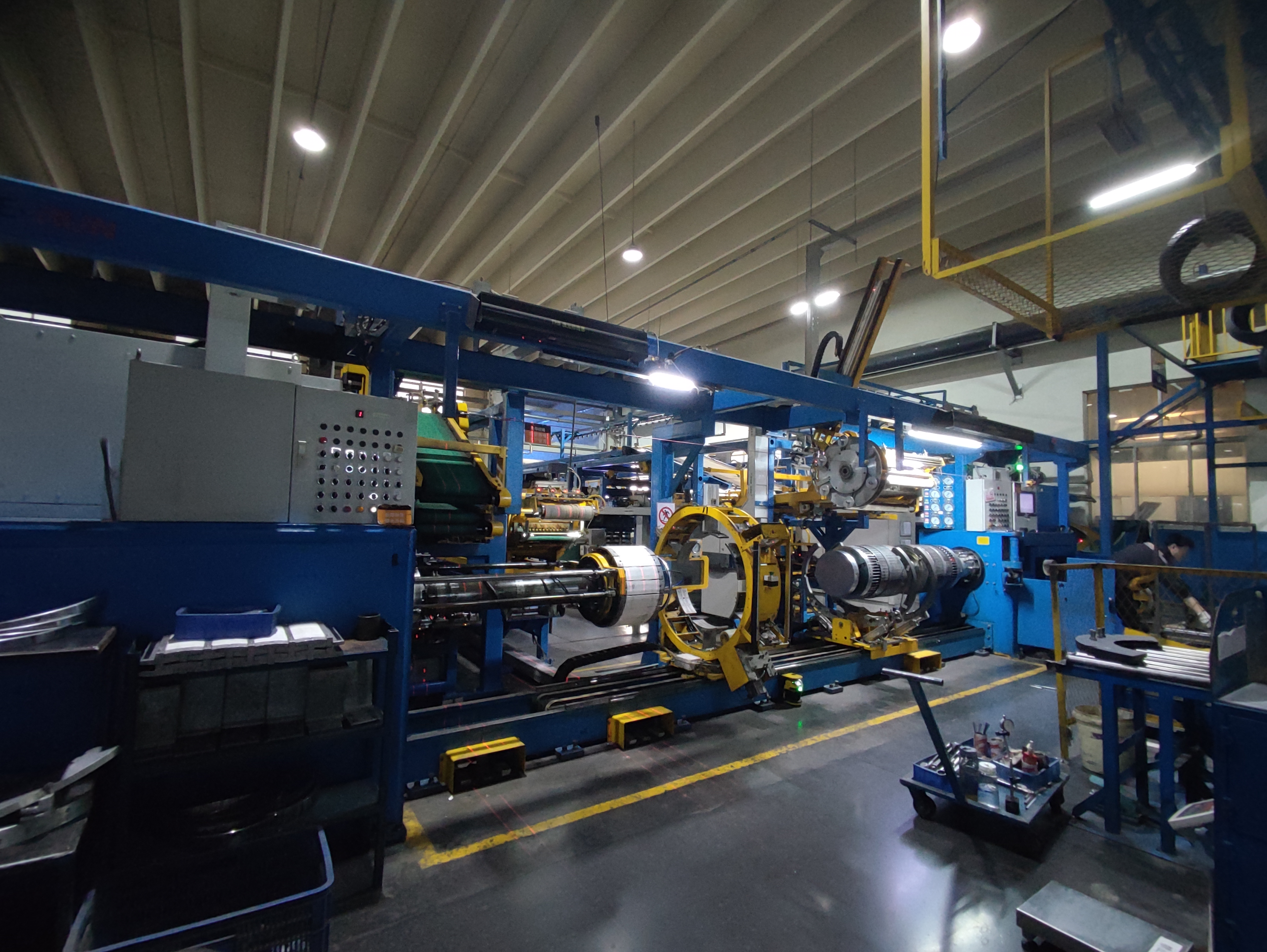
Molding line in passenger car and commercial van tire production. Source: Shandong Wideway Tire Co., Ltd.
The two designations are not variants of each other
Size designation is the first constraint in any tire decision, because it is the one element that cannot be negotiated at the counter. The ETRTO Standards Manual provides the reference standards for tire and rim dimensions and designations widely used by European and international manufacturers, while ISO 4000-1 specifies the designation, dimensions and load ratings of metric series passenger car tires. Under those conventions, the two sizes in this comparison belong to different families.
A 155R12C is a metric radial passenger car designation with a C suffix, mounted on a 12-inch rim. A 5.50R13LT is a decimal, numeric-style designation with an LT suffix, mounted on a 13-inch rim. The suffixes matter as much as the numbers: they signal the duty class the tire is registered for, not a cosmetic trim level. Because the rim diameters differ by one inch, the two models are not substitutes. A vehicle specified for a 12-inch tire cannot accept a 13-inch tire without a rim change, and the reverse is equally true.
In practice, that single fact resolves a large share of buyer confusion. Where a mixed fleet runs both rim sizes, the correct procurement decision is to hold two line items, not to search for a compromise size.
155R12C in verified terms
The 155R12C is classified as a Commercial Van Passenger Car Tire. Its published reference data covers four parameters that matter to a fleet engineer: a 196 mm section width, a 106/104 load index, an R speed rating, and a 450 KPA maximum pressure. Those four values, not the tread image, describe what the tire is able to do.
| Attribute | 155R12C |
|---|---|
| Classification | Commercial Van Passenger Car Tire |
| Section width | 196 mm |
| Load index | 106/104 |
| Speed symbol | R |
| Maximum pressure | 450 KPA |
Why the load index is written as a pair
A dual load index such as 106/104 is a fitment-dependent declaration: one value applies to single-fitment axles and the other to dual-fitment axles, where paired wheels share the load under different deflection conditions. The sizing therefore carries two declared capacities inside one SKU. Before ordering, the buyer has to know whether the target vehicle runs single rear wheels or dual rear wheels, because the two configurations legitimately resolve to different load figures for the same tire. Misapplying a dual-fitment value to a single-fitment axle overstates capacity, which is a safety issue rather than a paperwork issue.
What 450 KPA actually constrains
Maximum pressure is a ceiling, not a target. The 450 KPA figure defines the highest cold inflation the casing is approved for, and it sets a matching obligation on the rim, valve and gauge used in the workshop. Fleets that routinely inflate commercial van tires toward the upper end of the range need pressure equipment rated for that ceiling and a checking routine that survives driver turnover. It also explains a trade-off buyers notice after fitting: a casing approved for high pressure can be inflated to carry load, but the same pressure transmits more road input to the vehicle, so ride comfort on unladen urban runs is governed by inflation discipline as much as by construction.
The R speed symbol and duty matching
The R speed symbol places the 155R12C in a commercial-vehicle speed category rather than a high-speed passenger category. That is appropriate for stop-start delivery duty and short urban routes, and it is a signal that continuous high-speed line-haul work sits outside the intended envelope. Buyers who run long motorway legs should re-check the load-and-speed pairing of any candidate before committing a fleet standard.
SMARTWAY II 5.50R13LT in verified terms
The SMARTWAY II 5.50R13LT is positioned for commercial van use across urban road conditions, with claims oriented toward high-speed stability and ultra-high-performance scenarios. Its published reference set describes application positioning rather than numeric dimensions: section width, load index, speed symbol and maximum pressure are not part of the confirmed data used for this comparison. That is a documentation gap, not a performance verdict, and it should be closed at quotation stage by requesting the sidewall markings and the model datasheet.
Reading the positioning carefully is worthwhile. A model described as suitable for both urban road work and high-speed stability is being presented as a broader-duty product than a pure city tire. For a buyer, the practical consequence is that this model should be validated against the heavier end of the duty cycle, not assumed into it: ask for the load index at the intended inflation, and confirm that the declared speed symbol matches the routes actually driven.
Side-by-side on the two variables that decide fitment
| Decision variable | 155R12C | SMARTWAY II 5.50R13LT |
|---|---|---|
| Rim diameter implied by designation | 12 inch | 13 inch |
| Duty suffix | C (commercial) | LT (light truck) |
| Section width | 196 mm (published) | Confirm on datasheet |
| Load index | 106/104 (published) | Confirm on datasheet |
| Speed symbol | R (published) | Confirm on datasheet |
| Maximum pressure | 450 KPA (published) | Confirm on datasheet |
| Stated application focus | Commercial van passenger car duty | Commercial van, urban road, high-speed stability, ultra-high-performance scenarios |
The table makes the buying logic visible. Only one of the two models can be fitted to a given vehicle without changing hardware, and only one of the two currently publishes the numeric envelope needed for a load calculation. The other must be qualified before it can be compared on equal terms.
Construction: what the WIDEWAY, EVERLAND and V-RICH ranges change
Model-level comparison answers the fitment question. Construction-level comparison answers the cost question, and here the supplier publishes quantified differences against traditional tire pattern and construction design. These figures describe the construction family rather than a single SKU, and they are supplier-stated comparison data rather than independent test results.
| Design element | Stated change vs traditional construction |
|---|---|
| Tread contact | Tread width +3%, a wider contact patch |
| Sidewall | +5 mm sidewall reinforcement; tougher sidewall rubber; extended shoulder rubber |
| Handling and safety | +22% grip and driving stability |
| Durability | +40% total tire lifespan and safety margin |
| Noise management | Silent absorber element |
| Deflection behaviour | Advanced deflection design |
| Tread life efficiency | Longer tread life reported |
Two of these elements matter disproportionately in van work. A +3% wider contact patch changes how load is distributed across the footprint, which is why the construction is associated with grip and stability gains rather than only with wear. And the +5 mm sidewall reinforcement targets the failure mode that dominates urban delivery: impact damage. The supplier's sidewall-knot risk control describes a 5 mm thicker sidewall that reduces the risk of sidewall bulging caused by cord breakage when a wheel strikes a pothole, backed by quality testing and customer usage training. For a fleet running kerb-heavy routes, that is a more relevant design attribute than any tread graphic.
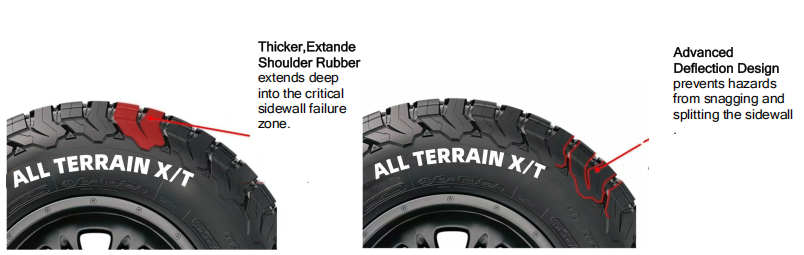
Sidewall impact risk control: thicker sidewall plus testing and usage training. Source: Shandong Wideway Tire Co., Ltd.
The cost argument, stated plainly
The published position is that this construction carries a 10% higher initial cost than alternatives, and delivers a 40% lower total cost of ownership over three years, with 90% less maintenance required than traditional alternatives. Read as a purchase instruction, that sentence is only useful if the fleet actually keeps vehicles long enough for the payback to occur. Read as a decision rule, it is more interesting: a higher unit price is acceptable when the maintenance and replacement line falls faster than the purchase line rises.
For wholesale buyers, the same logic applies at portfolio level. A distributor stocking a construction with a longer stated service life is trading working capital efficiency against repeat-purchase frequency. Distributors whose customers are professional fleets usually prefer the durability trade; distributors whose customers are price-led retail buyers usually do not. Neither choice is wrong, but the two require different inventory mixes.
A five-gate decision sequence for mixed fleets
Comparing two models with different rim diameters is straightforward once the sequence is fixed. Applied in order, the gates below prevent the most expensive error, which is buying a technically sound tire that does not fit.
- Hardware gate. Confirm rim diameter per vehicle. A 12-inch and a 13-inch model cannot be exchanged, so this gate eliminates one of the two candidates for any given chassis.
- Fitment gate. Identify single or dual rear configuration. This determines which half of a paired load index applies to the axle.
- Duty gate. Map route profile against speed symbol and stated application. Urban stop-start duty and sustained high-speed work place different demands on the casing.
- Pressure gate. Verify workshop equipment against the declared maximum pressure, and confirm the rim and valve are rated for it. A 450 KPA ceiling is a specification for the whole assembly, not only the tire.
- Cost gate. Model purchase price against stated service life, maintenance requirement and replacement interval over the intended holding period, rather than comparing sticker prices alone.
A sixth, documentation gate belongs alongside these: request the sidewall markings, the model datasheet and the certification evidence for the specific SKU, not only for the brand. The manufacturer states ECE, DOT, GCC and REACH certification for its products, and the relevant regulatory frameworks behind those marks are UN Regulation No. 30 for ECE type-approval of pneumatic tires, UN Regulation No. 117 for rolling sound emissions, wet-surface adhesion and rolling resistance, FMVSS No. 139 for new pneumatic radial tires for light vehicles in the United States, and the UTQG grading system for treadwear, traction and temperature resistance. The EU tyre labelling framework, currently Regulation (EU) 2020/740, adds label classes for fuel efficiency, wet grip and external rolling noise.
Application fit by road scenario
The construction family behind these models is positioned for urban road, highway, all-terrain, mud-terrain, rugged, and snow-and-ice conditions. That is a family-level statement, and buyers should read it as an envelope to be narrowed per SKU rather than a promise that every model in the range suits every surface.
| Scenario | What to verify |
|---|---|
| Urban delivery, kerb-heavy routes | Sidewall impact resistance and the fitment-specific load index |
| Highway and interurban van routes | Speed symbol against cruising speed, plus stability behaviour under load |
| Mountain and rugged access roads | Grip claims per SKU, sidewall construction, pressure discipline on gradients |
| Snow and ice conditions | Seasonal fit and the applicable regulatory marking for the destination market |
| Mixed regional fleets | Certification coverage for each destination market before standardization |
Where this comparison stops
An honest comparison has edges. Five matter here.
First, no verified rolling resistance, wet grip or external noise values are available in the dataset used for this article. Buyers in markets covered by the EU tyre label should obtain label classes for the exact SKU rather than inferring performance from positioning language.
Second, the numeric envelope for the SMARTWAY II 5.50R13LT is not published in the confirmed data. Until section width, load index, speed symbol and maximum pressure are supplied, that model cannot be placed on the same load-calculation footing as the 155R12C.
Third, the +22% grip and stability, +40% lifespan, 90% maintenance reduction and 40% three-year total cost of ownership figures are supplier comparisons against traditional pattern and construction design. They are directional planning inputs, not third-party benchmark results, and fleet buyers should validate them against their own replacement records.
Fourth, the construction is not a universal upgrade. A 10% higher initial cost is a real cash-flow charge for a distributor ordering in container quantities, and a fleet with a short vehicle holding period may never reach the payback window.
Fifth, an R speed symbol and a 450 KPA pressure ceiling define an operating envelope. Operators who routinely exceed that envelope on line-haul duty should not treat either of these models as a substitute for a specification built for sustained high speed.
Market context shaping 2026 van tire decisions
The market these two models sit in is large and still moving. Global tire imports under HS code 401110 totaled 1,065.6 million units in 2024, and the passenger car tire market covers both OEM fitment and aftermarket replacement for internal combustion engine and electric vehicles, distributed through offline retail networks and online sales channels. The electric vehicle segment within passenger car tires is projected to grow at a CAGR of 11.2% through 2033, which pulls noise and rolling resistance into the purchasing conversation even for buyers who mainly serve commercial vans.
Supply-side capacity matters as much as demand. Shandong Wideway Tire Co., Ltd, founded in 2014 and based in Qingdao, Shandong, China, operates with an annual production capacity of 12 million passenger car radial units, a stated 70% export ratio, and markets including Central and South America, Canada, the EU, Africa, the Middle East, Southeast Asia, Central Asia and Australia. For a distributor, that footprint determines whether a 12-inch and a 13-inch line can be sourced from one supplier rather than two, which reduces the administrative cost of holding both rim sizes.
Future outlook
Two directions are likely to shape comparisons like this one. The first is documentation: as label-based and grading-based frameworks expand, buyers will increasingly compare tires on declared values rather than design stories, and models that publish a full numeric envelope will be easier to shortlist. The second is electrification in urban fleets, where the growth of the EV tire segment creates pressure for lower noise and controlled rolling resistance in exactly the commercial-van duty cycles discussed here.
For fleet and wholesale buyers, the practical implication is to build the specification file now. Request numeric datasheets, load index at intended inflation, maximum pressure, speed symbol and certification evidence per SKU. A tire decision made on those five inputs is repeatable across model years; a decision made on tread appearance is not.
A downloadable product catalogue for the EVERLAND range is available here: EVERLAND CATALOG-2025 (PDF).
FAQ
Can a 155R12C be replaced with a SMARTWAY II 5.50R13LT?
No. The 155R12C is a 12-inch metric designation with a C suffix, while the 5.50R13LT is a 13-inch decimal designation with an LT suffix. Because the rim diameters differ by one inch, the two are not interchangeable without changing the rim.
What does the 106/104 load index on the 155R12C mean?
It is a dual load index: 106 applies to single-fitment application and 104 to dual-fitment application. The same tire therefore carries two declared load capacities depending on how it is mounted, so the buyer must know the axle configuration before selecting the load figure.
How should a 450 KPA maximum pressure be handled in fleet operations?
450 KPA is the maximum approved cold inflation pressure, not a recommended operating value. Fleets should confirm that rims, valves and gauges are rated for that ceiling and set pressure according to the actual axle load, since inflating toward the ceiling increases load capacity and also increases the road input transmitted to the vehicle.
Which of the two models suits urban delivery work?
Both are presented for commercial van duty, and the SMARTWAY II 5.50R13LT is additionally positioned for urban road, high-speed stability and ultra-high-performance scenarios. The 155R12C is classified as a Commercial Van Passenger Car Tire with an R speed symbol. Vehicle rim size, not the application description, determines which one can be fitted.
Does a 10% higher purchase price pay back for a fleet?
The supplier states a 10% higher initial cost against a 40% lower total cost of ownership over three years, with 90% less maintenance required than traditional alternatives. Payback therefore depends on holding vehicles long enough to capture the reduced maintenance and longer tread life, and on the fleet validating those figures against its own replacement history.
Which certification evidence should be requested before ordering?
The manufacturer reports ECE, DOT, GCC and REACH certification for its products. At SKU level, buyers should ask for the sidewall markings and documentation tied to UN Regulation No. 30, UN Regulation No. 117, FMVSS No. 139 or GB 9743 as applicable to the destination market, plus UTQG grading where the vehicle is sold in the United States and EU tyre label classes where the EU market applies.
¿Tiene preguntas o necesita más detalles?
Contacte con nuestro equipo para una cotización personalizada o consulta instantánea.
Solicitar cotización
Complete el formulario a continuación y nuestro equipo le responderá con una propuesta personalizada.
Chat directo de WhatsApp
¿Prefiere chatear en tiempo real? Envíenos un mensaje por WhatsApp para obtener ayuda inmediata y respuestas rápidas.
- Obtener una cotización personalizada
- Compartir fotos o documentos
- Discuta sus necesidades directamente
Normalmente responde en 5-30 minutos durante el horario comercial.