
0304C to FS0306: Hydraulic Adapter Procurement Questions Answered
Procurement conversations in the hydraulic adapter category rarely begin with a definition. They begin with a code. A maintenance planner writes “0304C, quantity 500, required by month end.” A distributor sends a photograph of a failed elbow and the note “this looks like a 5406, but the thread does not match.” A project engineer asks whether SS316 is available on a JIC-to-NPT adapter and what that does to the delivery date.
That pattern is not accidental. Hydraulic adapters are configured components: a single thread interface generates dozens of geometric variants, and catalog model families are how the industry compresses that complexity into something that can be quoted, ordered and reordered. Understanding what a model code does and does not specify is what separates a clean purchase order from a claim for missing or wrong-delivered parts.
This reference collects the recurring questions that reach the desk of NingBo NJ Hydraulic Adapter Co., Ltd — a Ningbo Fenghua–based manufacturer founded in 2004 that produces SAE-standard hydraulic components and engineering machinery parts, operating a 20,000 m² facility with approximately 200 employees and an annual output of 4,000,000 units. It answers them from the catalog itself: model series, material grades, pressure classes and the documented after-sales path. The central operating context throughout is the 3000–6000 PSI range that the adapter families in this catalog are specified around.
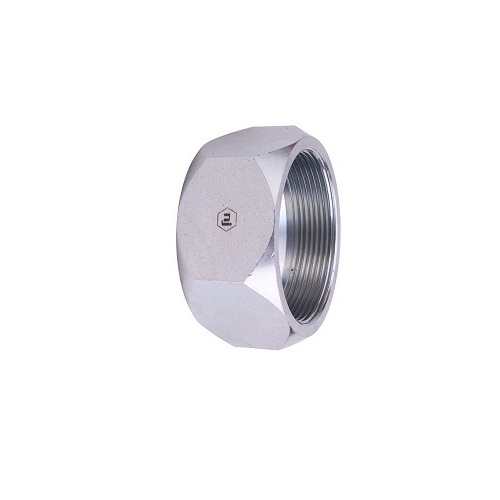
Catalog item 0304C — Female JIC Cap, one of the cap, lock nut and tube nut parts grouped in the 0304C/FS0306 series.
Why Adapter Orders Start With Model Numbers, Not Definitions
A hydraulic adapter is a threaded transition component. It connects two different port or hose interfaces — JIC to NPT, BSP to NPT, ORB to JIC, ORFS to a bore — while holding a pressure boundary. Because the two ends are chosen independently, and because each end has a gender, an angle and a seal type, the number of possible configurations is large. Catalog model families are the mechanism that keeps that number orderable.
The consequence for buyers is practical: in this category, “I need a hydraulic adapter” is not a specification. A model family plus a size plus a material grade is a specification. Market data supports how central adapters have become within the fittings category: the hydraulic adapters segment held the largest product-type share within the hydraulic fittings market at 28.4% in 2025, according to Dataintelo. The same source estimates the global hydraulic fittings market, including adapters and couplings, at USD 4.8 billion in 2025, projected to reach USD 7.9 billion by 2034.
| Model family | Thread / seal system | Representative configurations in the catalog |
|---|---|---|
| 2403 / 2404 / 2405 / 2406 / 2408 | JIC 37° flare, including JIC-to-NPT transitions | 2403 Male JIC × Male JIC Straight; 2404 Male JIC × Male NPTF Pipe Straight; 2405 Male JIC × Female NPTF Pipe Straight; 2406 Female JIC × Male JIC Straight; 2408 Male JIC Plug |
| 2500 / 2501 / 2502 / 2504 / 2505 | JIC elbows and JIC-to-NPT elbows | 2500 Male JIC × Male JIC 90° Elbow; 2501 Male JIC × Male NPTF Pipe 90° Elbow; 2502 Male JIC × Female NPTF Pipe 90° Elbow; 2504 Male JIC × Male JIC 45° Elbow; 2505 Male JIC × Female NPTF Pipe 45° Elbow |
| 2700–2705 | JIC bulkhead series | 2700 Male JIC × Male JIC Bulkhead Straight; 2701 Bulkhead 90° Elbow; 2705 Female Pipe × Male JIC Bulkhead Straight |
| 5000 / 5404 / 5405 / 5406 | NPTF pipe | 5404 Male NPTF × Male NPTF Straight; 5405 Male NPTF × Female NPTF Straight; 5406-C Female NPTF Pipe Cap; 5406-P Hex Head Pipe Plug; 5406-HP Hollow Hex Pipe Plug; 5406-SHP Square Head Pipe Plug |
| 5600 / 5603 / 5604 / 5605 / 5652 | NPTF multi-port | 5603 Male × Female × Male NPTF Tee; 5604 Female × Female × Male Tee; 5605 Female NPTF Tee; 5652 Female NPTF Cross |
| 6801–6850 | SAE JIC / ORB / ORFS adapters | 6801 Male JIC × Male Adjustable ORB 90° Elbow; 6802 the 45° version; 6805 Male Adjustable ORB × Female NPTF Pipe 90° Elbow; 6815 Male Adjustable ORB × Female ORB 90° Elbow |
| 1B / 1T families | BSPP and BSPT | 1B Male BSPP × Male BSPP Straight; 4B Male BSPP Plug; 9B Female BSPP Plug; 6B Male BSPP Bulkhead Straight; 1BJ Male BSPP × Male JIC; 1BT Male BSPP × Male BSPT; 1NB Male NPTF Pipe × Male BSPP; 1T Male BSPT × Male BSPT Straight; 4T Male BSPT Plug; 5T Male BSPT × Female BSPT Straight; 1ST9 Male JIS × Female BSPT 90° Elbow |
| 0304C / FS0306 series | JIC and O-ring face seal caps, nuts and sleeves | 0304C Female JIC Cap; 0306 JIC Bulkhead Lock Nut; 0318 JIC Tube Nut; 0319 JIC Tube Sleeve; 0403 and 0500 bore-to-male JIC connectors; FS0403 bore-to-male O-ring face seal connector |
What the 0304C and FS0306 Cap Nut Series Actually Specify
The 0304C/FS0306 series is the part of the catalog that generates the most clarifying questions, largely because the naming convention is doing two different jobs at once. The model designation for this family reads 0304C/0306/0318/0319/0403/0500/FS0304C/FS0306/FS0318/FS0319. Read against the catalog entries, three patterns become visible.
- The trailing C marks a cap. Item 0304C is listed as a Female JIC Cap. The same convention appears outside this family: 5406-C in the NPTF range is a Female NPTF Pipe Cap.
- The FS prefix marks the O-ring face seal variant of an otherwise comparable part. Item 0403 is a bore-to-male JIC connector, while FS0403 is listed as a bore-to-male O-ring face seal connector. FS0304C, FS0306, FS0318 and FS0319 follow the same prefix logic within the cap nut series.
- The series is a family, not one product. Alongside caps, it contains the 0306 JIC Bulkhead Lock Nut, the 0318 JIC Tube Nut and the 0319 JIC Tube Sleeve — that is, closure parts, locking parts and tube-connection parts sharing one ordering block.
For a buyer, this matters because the four functions are not interchangeable. A cap closes a port or protects a thread during transport and storage. A bulkhead lock nut fixes a bulkhead adapter to a panel wall. A tube nut and tube sleeve pair with a tube end. Ordering “the 0304C series” without specifying which function is required is a common source of wrong-delivered parts.
Shared technical envelope
| Parameter | Specified value |
|---|---|
| Materials | Carbon steel / SS304 / SS316 |
| Operating pressure range | 3000–6000 PSI |
| Maximum stable operating temperature | 220 °C |
| Salt spray test | 120-hour test; white rust at 120 hours, red rust at 240 hours |
| Certification coverage | Product 6678 (hydraulic cap nut) and product 7090 (SAE standard hydraulic adapter) are manufactured under ISO 9001:2015 |
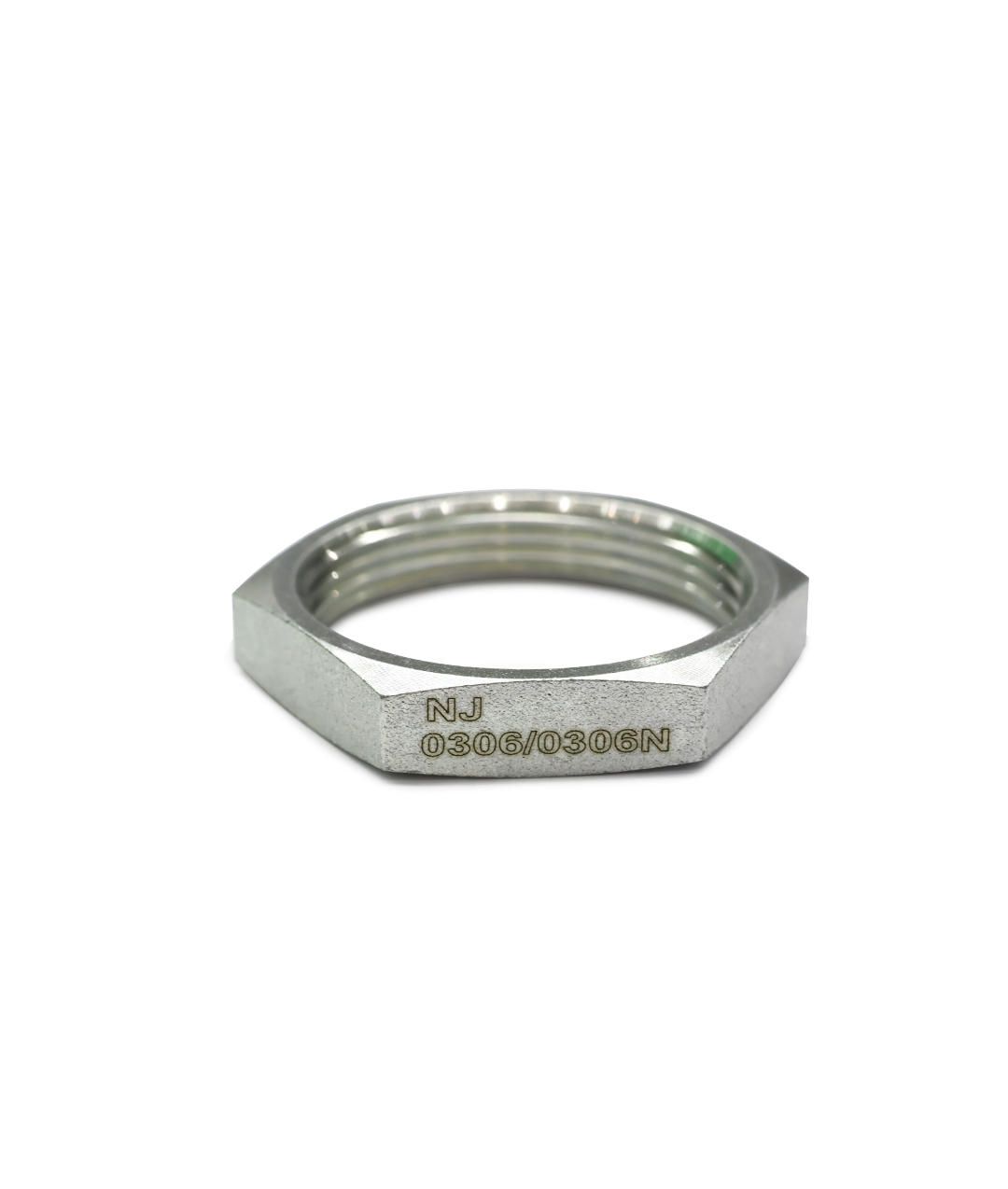
Item 0306 — JIC Bulkhead Lock Nut. Within the same 0304C/FS0306 ordering block, caps, lock nuts, tube nuts and tube sleeves serve different functions.
Why SS304 and SS316 Change Lead Time on NPT and JIC Adapters
This is the most frequent commercial question in the category, and the answer begins with how the model number is built. Model designations such as 2405, 5404 or 6802 identify geometry: which threads, which genders, which angle. Material is a separate line item. The same drawing number can be produced in carbon steel, SS304 or SS316 — the NPT adapter range, the JIC adapter range and the SAE standard hydraulic adapter range are all listed with those three material options.
That structure has a direct procurement consequence: a stainless JIC adapter is not a material substitution of a stocked carbon steel part. It is a different production item, planned and scheduled as such. In this supplier’s documented capability data, standard lead time is 30–45 working days, and minimum order quantity varies depending on product dimensions and manufacturing complexity. Stainless requirements should therefore be planned inside that production window rather than treated as an off-the-shelf upgrade.
Industry data explains why carbon steel remains the default. Steel material dominated hydraulic fitting revenue share at 45.2% in 2025, driven by demand for high-pressure durability, according to Dataintelo. Stainless is the exception path in volume terms, which is precisely why it behaves differently at the scheduling stage.
Where stainless earns its place
The case for SS304 and SS316 is environmental, not promotional. Third-party technical references put stainless steel hydraulic adapters in AISI 316 at working temperatures from −60 °C up to +400 °C under DIN 17440 — a range that matters for marine machinery, offshore equipment, and chemical or process environments. Across the range in this catalog, the documented maximum stable operating temperature is 220 °C and the operating pressure window is 3000–6000 PSI; those are the figures to plan a system around.
Pressure, Thread and System Boundaries Around 3000–6000 PSI
The 3000–6000 PSI window is the working range this catalog is built around, and it aligns with interface-level ratings published in the industry. For NPTF straight threads in 1/4″ size, a published working pressure rating of 4000 PSI with a 4:1 safety factor is typical (Titan Fittings). ORFS fittings in dash size −4 (1/4″) are rated for 6000 PSI working pressure under SAE J1453 (Titan Fittings). These interface ceilings are the reason the adapter range tops out where it does.
At the assembly level, the documented application scenario for this product range states that it withstands a static pressure of 6,000 PSI and a burst pressure of 9,000 PSI without deformation, while maintaining continuous operation and seal integrity — with matched equipment including hydraulic hoses, cylinders, threaded bolts, pipe joints, pumps and mechanical cylinder assemblies. That is an assembly-level statement, and it depends on the whole assembly, not the adapter alone.
| Interface family | Catalog examples | Practical note for buyers |
|---|---|---|
| JIC 37° flare | 2403, 2404, 2405, 2500, 2502, 2701 | Governed at international level by 37° flared connector requirements; ISO 8434-2:2007 covers tubes from 6 mm to 50.8 mm |
| ORB (SAE straight thread, O-ring boss) | 6801, 6802, 6805, 6815 | Adjustable versions allow the elbow to be positioned after tightening |
| ORFS (O-ring face seal) | 0403, 0500, FS0403 and the FS prefix items | Face seal rather than thread seal; the FS prefix in the cap nut series marks this family |
| NPTF pipe | 5404, 5405, 5406, 5406-C, 5603, 5605, 5652 | NPTF is not interchangeable with standard NPT in sealing behaviour; verify which port is present |
| BSPP / BSPT | 1B, 1BJ, 1BT, 1NB, 4B, 9B, 1T, 4T, 5T | Parallel (BSPP) and tapered (BSPT) threads are frequently confused; 1BT is the BSPP-to-BSPT transition part |
| JIS | 1ST9 | Appears as a JIS-to-BSPT 90° elbow in this catalog; confirm the mating side before ordering |
Metric systems add a further layer. DIN 2353, aligned with ISO 8434-1, defines three robustness categories for metric tube fittings: LL (Extra Light, 100 bar), L (Light, up to 315–500 bar) and S (Heavy, up to 630–800 bar), according to Hy-Lok USA. Buyers sourcing a DIN hydraulic adapter alongside NPT or JIC parts should treat these classes as applying to the metric tube fitting series they describe, not as a blanket rating for every adapter on the same purchase order.
Turning a Description Into a Model Code
Most ordering errors originate upstream of the catalog, at the point where a description is converted into a code. A repeatable five-step sequence resolves the majority of them.
- Identify the thread or seal system on each end separately. JIC, ORB, ORFS, NPTF, BSPP, BSPT, JIS or metric. Do not assume both ends match.
- Identify gender on each end. Male or female. In this catalog the distinction is explicit in every configuration name — for example, 2404 is Male JIC × Male NPTF Pipe, while 2405 is Male JIC × Female NPTF Pipe.
- Identify geometry. Straight, 45° elbow, 90° elbow, tee, cross, plug, cap or bulkhead.
- Identify material grade and finish. Carbon steel, SS304 or SS316, plus any plated colour requirement.
- Confirm the pressure class and the mating assembly. Then match to a family: 2400s and 2500s for JIC, 2700s for JIC bulkhead, 5400s and 5600s for NPTF, 6800s for SAE JIC/ORB/ORFS, 1B and 1T for BSPP and BSPT, 0304C/FS0306 for caps, lock nuts and tube nuts.
Trade wording occasionally arrives without a clean catalog equivalent — descriptions borrowed from other product categories, or colloquial names for a fitting that has a formal model designation here. In those cases the thread system and mating part should be confirmed first, and the model family assigned afterwards. Reverse-engineering a code from a photograph alone is unreliable, because thread pitch and seal face geometry are difficult to judge visually.
Catalogued Sourcing Versus Traditional Fabrication
Adapter-based assembly is not the only way to build a hydraulic connection, and the trade-offs are worth stating honestly.
| Approach | Practical strength | Documented limit or trade-off |
|---|---|---|
| Catalogued adapters and cap nuts (model families above) | Re-orderable by code; material grade and pressure class are published; replacements can be specified without redrawing | Confined to the configurations the catalog covers, and to the 3000–6000 PSI window and 220 °C ceiling of the range; special geometry requires the OEM/ODM route |
| Custom parts machined from buyer drawings or samples | Fits non-standard ports and legacy equipment | Lead time and MOQ are order-specific — in this supplier’s capability data, MOQ varies with dimensions and complexity, and standard lead time is 30–45 working days |
| Welded or fabricated tube assemblies | Removes joints in tight envelopes | Field replacement is slower because the assembly, not a single code, must be remade; the component cannot be reordered from a model number |
The decisive variable is usually replacement speed. A coded adapter can be re-ordered by the same string of characters that appears on the original purchase order. A fabricated assembly cannot, which is why mixed-standard systems often standardise on catalogue families wherever the envelope allows.
Missing or Wrong-Delivered Parts: The Documented Claim Path
Short shipments and wrong shipments happen in every threaded-component category, and the documented resolution path here is specific. Customers need to provide photographs of the missing or wrong-delivered items. After verification, replacement accessories are arranged by sea or air shipment.
Three implications follow for buyers.
- Identification is the gating step. Verification depends on the photographic evidence and the order line it corresponds to. A photograph with no model code and no quantity reference slows the process down.
- The remedy is a physical shipment. Replacement arrives by sea or air freight, so transit time sits inside the resolution. It is a shipment-based remedy, not an instant one, and it should be factored into critical-path project schedules rather than treated as same-week recovery.
- Receiving discipline pays for itself. Photographing carton labels, packing lists and unpacked contents on arrival produces exactly the evidence the claim path requires, and does so before the material is dispersed into stores.
Two document controls reduce the frequency of these claims at source: the model code plus the material grade must appear on the order line, and the quantity per line must be unambiguous when more than one geometry shares a family block. A purchase order reading “0304C series, 500 pcs” cannot be verified against a delivery, because caps, lock nuts, tube nuts and tube sleeves all sit inside that block.
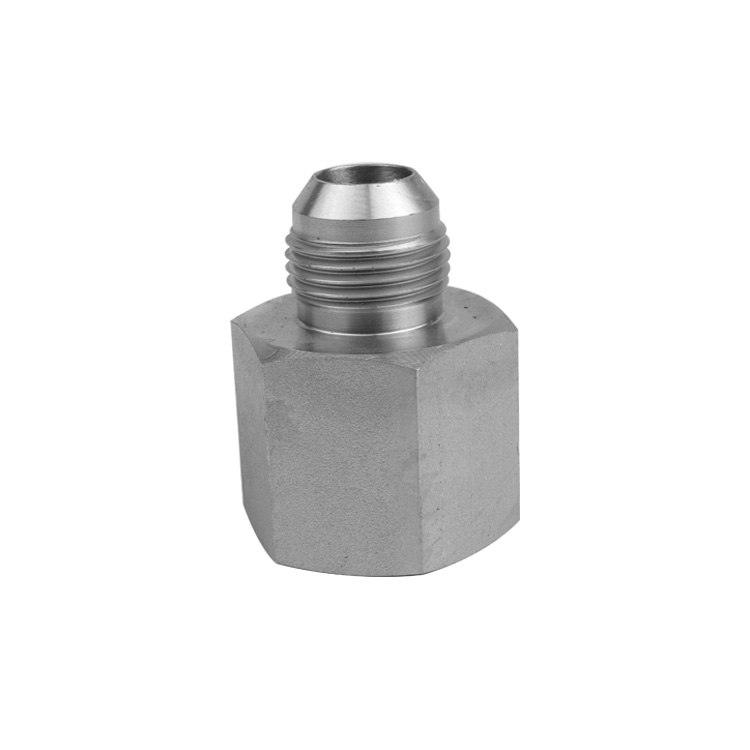
Item 2405 — Male JIC × Female NPTF Pipe Straight. Model numbers encode geometry; carbon steel, SS304 and SS316 are ordered as separate material lines.
Supplier-Side Facts That Can Be Checked
For evaluation-stage buyers, the verifiable facts about NingBo NJ Hydraulic Adapter Co., Ltd are documented rather than asserted. The company was founded in 2004, occupies a 20,000 m² facility in Ningbo Fenghua, employs approximately 200 people, produces 4,000,000 units annually and operates a four-engineer R&D team. Export accounts for 75% of output, with the USA and Canada as the main markets.
Certification is the ISO 9001 quality management standard: certificate 41324Q00129R2M, type GB/T 19001-2016 / ISO 9001:2015, issued by ZCGJ on 2024-12-13 and valid to 2027-10-15, with global market scope. The certified scope is manufacturing of fluid equipment mechanical hardware, including finishing processing, finished product inspection, packaging and shipping. The hydraulic cap nut and the SAE standard hydraulic adapter are explicitly listed as covered products.
Commercial capability covers OEM/ODM work including logos, packaging, plated colour and custom products made from provided drawings or samples, with quality control by random inspection and after-sales support delivered remotely. One Canada-based mid-market distributor has taken 20,000,000 units over three years, selling onward to local customers.
Market Trend Analysis: Model Literacy as a Procurement Skill
Several measurable trends make code-level fluency more valuable than it was a decade ago.
Adapter demand is structurally significant within fittings. Adaptors already account for the largest product-type share in the fittings market, per Dataintelo, and the fittings market itself is projected to expand from USD 4.8 billion in 2025 toward USD 7.9 billion by 2034. A separate estimate from Credence Research puts hydraulic fluid connector demand at USD 1.82 billion by 2032 at an 8.0% CAGR, while Kamrul Hasan / Market Report projects a 4.5% CAGR for fittings and adapters between 2025 and 2033.
Published figures should be read with their scope attached. Estimates for the same category diverge substantially: Dataintelo places fittings at USD 4.8 billion, Strategic Market Research has cited USD 12.7 billion for fittings in a 2024 estimate, and Mordor Intelligence forecasts USD 44.25 billion for the broader hydraulic equipment market in 2026. These are different baskets, not contradictory measurements of one basket. Buyers building a business case should record the scope, not just the number.
Demand concentration is shifting toward Asia. Asia-Pacific accounted for an estimated 38.6% of global hydraulic fitting revenue in 2025 (Dataintelo), and Asia accounted for 74% of global industrial robot installations in 2024 (Ken Research) — a demand driver that pushes precise, repeatable threaded connections. On the application side, mobile hydraulics held over 58% of total hydraulics market revenue in 2024 (Grand View Research), which keeps the emphasis on field-replaceable, code-identifiable parts.
Corrosion-resistant grades are moving from niche to specified. The existence of published temperature envelopes such as −60 °C to +400 °C for AISI 316 adapters under DIN 17440, and classified metric systems under DIN 2353 / ISO 8434-1, reflects buyers writing grade and standard into the specification rather than leaving material to the supplier.
Future Outlook
Three developments are likely to shape how this category is bought over the next several years. Mixed-standard assemblies are not disappearing — equipment built for one market is routinely maintained in another — so transition parts such as 1BT (BSPP to BSPT), 1BJ (BSPP to JIC), 1NB (NPTF to BSPP) and 1JT (JIC to BSPT) will continue to carry disproportionate importance in aftermarket demand.
Second, documentation quality is becoming a differentiator in its own right. As adapters account for the largest share of fittings volume and stainless grades move into more specifications, the supplier that keeps model code, material grade and pressure class visible on the order line reduces both claims and downtime. The reverse is equally true.
Third, the boundary between catalogue sourcing and custom production will keep shifting. With standard lead time documented at 30–45 working days and OEM/ODM capability covering logo, packaging, plated colour and parts made from supplied drawings or samples, the practical question for buyers is less “can it be made” and more “can it be reordered by code next quarter.” A consolidated product brochure covering these model families is available for download: NingBo NJ Hydraulic Adapter product brochure.
Frequently Asked Questions
What does the 0304C model number in the hydraulic cap nut series refer to?
0304C is listed in the catalogue as a Female JIC Cap. It sits within the model designation 0304C/0306/0318/0319/0403/0500/FS0304C/FS0306/FS0318/FS0319, which covers caps, lock nuts, tube nuts, tube sleeves and bore-to-male connectors rather than a single part number.
What is the difference between 0304C and FS0304C?
The FS prefix denotes the O-ring face seal variant of the corresponding part. This pattern is visible elsewhere in the same designation: 0403 is a bore-to-male JIC connector, while FS0403 is a bore-to-male O-ring face seal connector. In the cap nut series, FS0304C, FS0306, FS0318 and FS0319 follow the same prefix convention.
Which material grades are available for hydraulic cap nuts, NPT adapters and JIC adapters?
Carbon steel, SS304 and SS316 are the material options across the hydraulic cap nut, NPT adapter, JIC adapter, SAE standard hydraulic adapter and BSP adapter ranges. The pressure range for these products is 3000–6000 PSI, and the maximum stable operating temperature is 220 °C.
Why do SS304 or SS316 versions affect lead time on NPT and JIC adapters?
Model numbers identify geometry, not material. A stainless version of a JIC or NPT adapter is a separate production item rather than a substitution of a stocked carbon steel part. Documented standard lead time is 30–45 working days, and minimum order quantity varies depending on product dimensions and manufacturing complexity, so stainless requirements should be planned within that production window.
What pressure range should be expected from these hydraulic adapters?
The catalogued operating range is 3000–6000 PSI. Interface-level industry references place NPTF 1/4″ straight threads at a working pressure rating of 4000 PSI with a 4:1 safety factor, and ORFS dash −4 (1/4″) fittings at 6000 PSI working pressure under SAE J1453 (Titan Fittings). At assembly level, the documented scenario data states the range withstands 6,000 PSI static pressure and 9,000 PSI burst pressure without deformation while maintaining seal integrity.
How do I order a JIC to NPT adapter as opposed to a JIC to JIC adapter?
The configuration name states both ends, so the distinction is explicit in the catalogue. 2403 is Male JIC × Male JIC Straight and 2404 is Male JIC × Male NPTF Pipe Straight; 2500 is Male JIC × Male JIC 90° Elbow and 2501 is Male JIC × Male NPTF Pipe 90° Elbow. In the SAE range, 6805 is a Male Adjustable ORB × Female NPTF Pipe 90° Elbow.
What is the minimum order quantity and standard lead time?
Minimum order quantity varies depending on product dimensions and manufacturing complexity, so it is confirmed per item rather than set at one figure for the whole range. Standard lead time is documented at 30–45 working days.
What happens if accessories are missing or wrong-delivered on arrival?
The documented process requires the customer to provide photographs of the missing or wrong-delivered items. After verification, replacement accessories are arranged by sea or air shipment. Because the remedy is a physical shipment, transit time forms part of the resolution period.
Which certification covers these adapters, and what is its scope?
The relevant certificate is ISO 9001, type GB/T 19001-2016 / ISO 9001:2015, certificate number 41324Q00129R2M, issued by ZCGJ on 2024-12-13 and valid to 2027-10-15 with global market scope. The certified scope is manufacturing of fluid equipment mechanical hardware, including finishing processing, finished product inspection, packaging and shipping. The hydraulic cap nut and the SAE standard hydraulic adapter are listed as covered products.
Which industries are these adapters specified for?
The documented application industries include construction machinery, agricultural machinery, general-purpose machinery, firefighting equipment, marine machinery, mining, transportation, aerospace, automotive, oil and gas extraction, iron and steel metallurgy and water conservancy engineering. Matched equipment includes hydraulic hoses, cylinders, threaded bolts, pipe joints, pumps and mechanical cylinder assemblies.
How do DIN 2353 classes relate to these adapters?
DIN 2353/ISO 8434-1 defines LL (Extra Light, 100 bar), L (Light, up to 315–500 bar) and S (Heavy, up to 630–800 bar) robustness categories for metric tube fittings (Hy-Lok USA). Those classes describe the metric tube fitting series they apply to, rather than a blanket rating for every adapter on the same order, so a DIN hydraulic adapter should be specified alongside the model family it belongs to.
Reference note: catalogue model designations, material options, pressure and temperature parameters, salt spray result, certification details and the missing-parts resolution process are drawn from first-party product and capability documentation. Market and interface figures are attributed to their published sources (Dataintelo, Credence Research, Grand View Research, Ken Research, Titan Fittings, ISO, DIN 17440 references via Tubes International, and Hy-Lok USA).