
Solving Key Challenges in Selecting Vacuum Homogenizer Emulsifier Mixer Suppliers for Cosmetic and Food Processing
Solving Key Challenges in Selecting Vacuum Homogenizer Emulsifier Mixer Suppliers for Cosmetic and Food Processing
Procurement professionals in the cosmetic and food industries often face complex decisions when sourcing vacuum homogenizer emulsifier mixers. The equipment must meet strict process requirements, regulatory compliance, and production scalability. This guide addresses common problems encountered during supplier evaluation and provides actionable criteria to ensure a well-informed selection.
Challenge 1: Ensuring Equipment Suitability for Specific Product Types
A primary concern is whether the mixer can handle the intended product. Vacuum Emulsifying Mixers are designed for use in homogenizing and emulsification processes. Typical application scenarios include cosmetics and food product manufacturing, such as cosmetic cream production, food emulsion processing, and mayonnaise production. Buyers should verify that the supplier offers models capable of producing stable emulsions with narrow particle size distributions, which is critical for high-end cosmetics and stable sauces like mayonnaise.
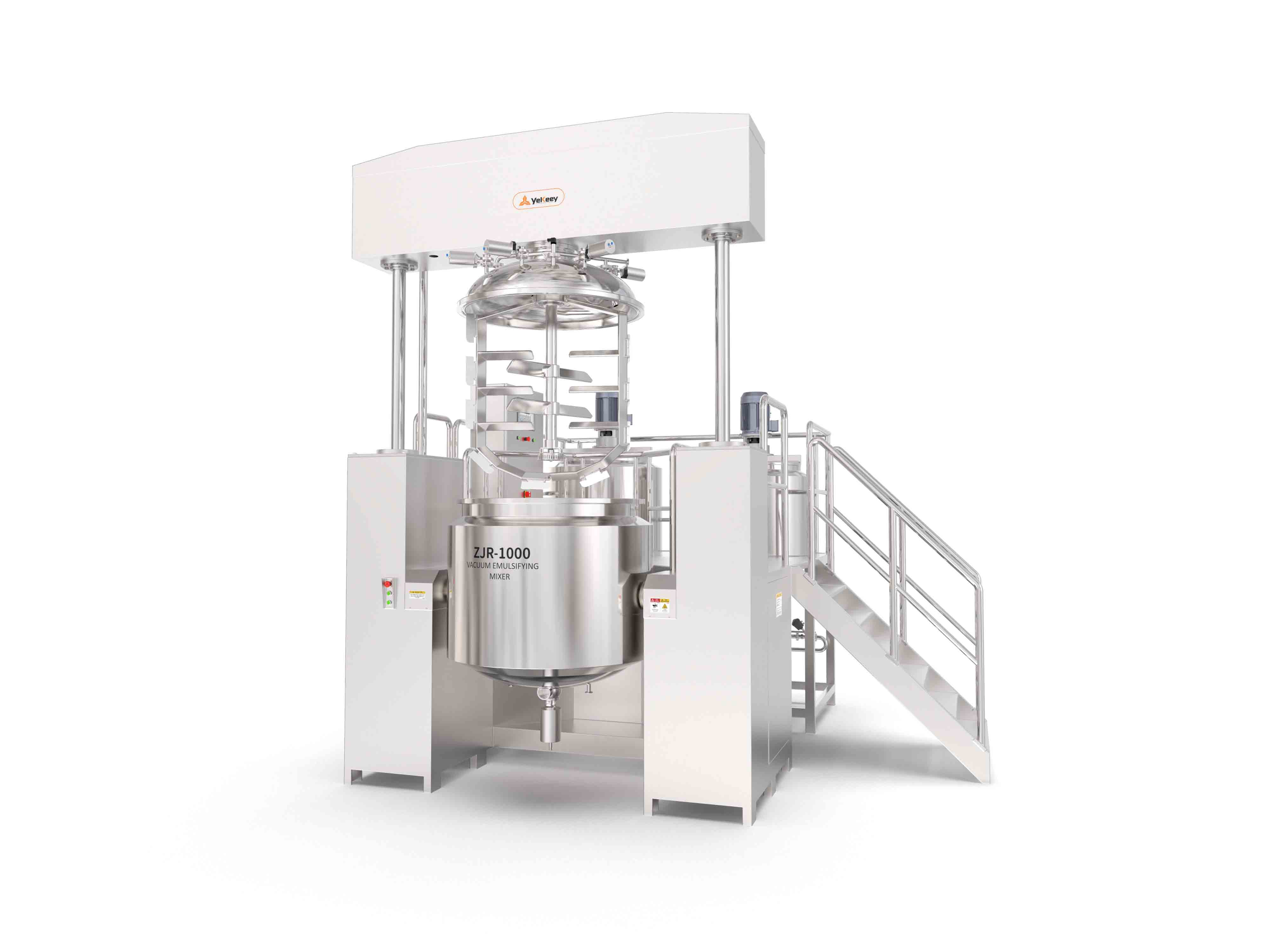
Suppliers like Wuxi YK Automation Technology Co.,Ltd (YeKeey) serve both segments, with their equipment applicable to cosmetics and food products. Their product lineup includes the MC, ZJR, and SP series, offering various working volumes and power options. For example, the ZJR Series Vacuum Emulsifying Mixer provides output speeds up to 6000 rpm, suitable for fine emulsification.
Challenge 2: Compliance with Industry-Specific Regulations
Many applications have special requirements, including compliance with explosion-proof certification and pressure vessel specifications. For instance, if the production environment involves flammable solvents or operates under vacuum conditions, explosion-proof protection is necessary. Similarly, equipment that operates under pressure must meet local pressure vessel codes. Buyers should request certificates such as CE certification, which may cover specific models. YeKeey’s Vacuum Emulsifying Mixer has obtained CE certification (Certificate No. 0P210922.WYAQT12) issued by ECM, covering standards like EN ISO 12100, EN 60204-1, and EN IEC 61000 series. This certification is valid until September 2026.
Challenge 3: Evaluating Production Capacity and Lead Times
Scalability is a critical procurement factor. A supplier’s manufacturing capacity directly affects delivery schedules. YeKeey operates a 20,000 m² factory with 80 employees and an annual output of 600 units. Their monthly production capacity for vacuum emulsifying mixers is 50 units. Lead times typically range from 30 to 60 days, depending on customization. The minimum order quantity is 1 unit, making them suitable for pilot lines as well as full-scale production.
Challenge 4: Customization and After-Sales Support
Many buyers require modifications such as specific voltage, weighing modules, logo, machine dimensions, or heating methods. A flexible supplier offers OEM/ODM/OBM modes. YeKeey supports customization including designated appliance brands and jar sizes. After-sales support includes remote video guidance, provision of custom components and wear parts, and dispatch of professional technical personnel for on-site repairs. This reduces downtime and ensures continuous operation.
Challenge 5: Verifying Quality and Reliability
Quality assurance is non-negotiable. YeKeey has implemented the ISO9001 quality system since 2003, and their high shear homogenizer and filling machine also carry CE certification. Their products have been applied in more than 70 countries across 4000 enterprises. A case study from a Nigerian OBM client using 3 sets of equipment for cosmetics production shows stable operation over at least 10 years, with high production efficiency. Buyers can request Factory Acceptance Tests (FAT) before shipment.
Challenge 6: Understanding Total Cost of Ownership
Initial investment might be higher for equipment with advanced features like vacuum degassing and intelligent control. However, compared to conventional emulsifiers, vacuum homogenizer mixers offer superior emulsification stability, narrower particle size distribution (1–5 μm vs 5–20 μm), and lower rejection rates. This leads to lower total cost of ownership due to fewer rejected batches and better material utilization. Maintenance requirements are also reduced.
Summary of Selection Criteria
- Application fit: Ensure the supplier lists your product type (cosmetics, food, mayonnaise) in their applicable industries.
- Certifications: Check for CE, ISO, and specific explosion-proof or pressure vessel compliance.
- Production capacity: Confirm monthly output and lead times align with your volume needs.
- Customization: Evaluate the supplier's ability to modify equipment to your specifications.
- After-sales support: Look for remote guidance and local field service options.
- Reference cases: Ask for long-term case studies demonstrating reliability.
By addressing these challenges systematically, procurement teams can select a vacuum homogenizer emulsifier mixer supplier that meets both technical and commercial expectations. For detailed specifications and company capabilities, refer to the official brochure: YeKeey Company Brochure (PDF).