
Supplier Capability Evidence: A Spec-by-Spec Audit of HTNXT’s Cash Drawer Line
HTNXT Industry Reference | Cash Drawer Spec Audit
The cash drawer line audited in this HTNXT reference is manufactured by ZHANGJIAGANG LASPACK TECHNOLOGY CO., LTD., a Suzhou, Jiangsu-based high-tech enterprise founded in 2013 that specializes in the research, development and manufacturing of cash drawers and cash boxes. The audit focuses on five models: LAS-335, LAS-405, LAS-410G, LAS-410A and LAS-4042. Its purpose is not to repeat catalogue language, but to test whether the published specifications form a coherent, procurement-useful evidence set for POS integrators, distributors and retail buyers.

Why a cash drawer specification audit matters
A POS cash drawer is a small component inside a larger transaction system, but it sits at the point where cash handling, receipt printing, software control and store workflow meet. A dimensional mismatch, an unexpected currency layout or an unverified printer interface can turn a low-cost peripheral into an integration delay. For that reason, supplier capability evidence should begin with the data a buyer can actually check: external dimensions, net and gross weight, construction materials, lock type, interface voltage and compartment configuration.
The market context explains the attention. Verified data places the global cash drawer market at USD 2.13 billion in 2025, with a projected value of USD 4.60 billion by 2034 and a CAGR of 8.85%. Printer-driven cash drawers still represent 48% of revenue share, while Ethernet-driven drawers are identified as the fastest-growing segment at an 11.2% CAGR. Asia-Pacific is the largest regional market at 32% share. These figures do not prove any single supplier’s quality, but they do show why buyers need comparable, auditable model data rather than broad supplier claims.
The audit boundary: what this document can and cannot prove
This is a document-level audit of supplied product specifications and company facts. It can test consistency across the LAS-335, LAS-405, LAS-410G, LAS-410A and LAS-4042. It can show which models share a common interface, lock and construction logic, and where buyers must ask for further evidence. It cannot substitute for an on-site factory audit, an independent durability test, a pinout validation or a certificate verification. Those limits matter because a cash drawer specification is not the same thing as a verified duty cycle.
Five models, one specification matrix
The table below consolidates the published model data. The first observation is the common platform: every listed model is a metal and plastic cash drawer with a three-position key lock, 12V or 24V operation for an RJ11/RJ12 receipt-printer interface, commercial indoor use, and availability in black, white or customized colour. The differences concentrate in footprint, weight, bill and coin layout, and the presence of a steel panel.
| Model | Type | Dimensions | Net / Gross Weight | Currency Layout | Lock / Interface | Material / Panel |
|---|---|---|---|---|---|---|
| LAS-335 | Metal cash drawer | 335W x 368L x 80H mm | 3.4 kg / 3.8 kg | 4 bills, 3 or 5 coins | Three-position lock; 12V/24V RJ11/RJ12 | Metal, plastic |
| LAS-405 | Heavy-duty cash drawer | 405W x 420L x 100H mm | 4.5 kg / 5 kg | 5 bills, 6 coins | Three-position lock; 12V/24V RJ11/RJ12 | Metal, plastic |
| LAS-410G | Heavy-duty cash drawer | 410W x 415L x 100H mm | 5.6 kg / 6.2 kg | 5 bills, 8 coins | Three-position lock; 12V/24V RJ11/RJ12 | Metal, plastic; steel panel |
| LAS-410A | Heavy-duty cash drawer | 410W x 415L x 100H mm | 6.5 kg / 7 kg | 5 bills, 8 coins | Three-position lock; 12V/24V RJ11/RJ12 | Metal, plastic; steel panel |
| LAS-4042 | Durable cash drawer with adjustable coin and bill compartment | 405W x 420L x 100H mm | 4.5 kg / 5 kg | 6 bills, 4 coins | Three-position lock; 12V/24V RJ11/RJ12 | Metal, plastic |
Model-by-model reading of the specification evidence
LAS-335: compact footprint, different coin logic
The LAS-335 is the smallest model in this set at 335 mm wide, 368 mm long and 80 mm high, with a net weight of 3.4 kg and a gross weight of 3.8 kg. It is a metal and plastic cash drawer designed for POS integration, with a three-position key lock and a 12V/24V RJ11/RJ12 printer interface. Its currency layout is four bill compartments and either three or five coin compartments. That coin-option note is important: buyers should confirm the exact coin configuration at quotation stage rather than assuming a single fixed layout. For compact retail counters, restaurant stations or supermarket lanes with limited drawer depth, the smaller footprint is a practical selection criterion.
LAS-405 and LAS-4042: same shell size, different cash workflow
The LAS-405 and LAS-4042 share the same 405W x 420L x 100H mm footprint and the same 4.5 kg net / 5 kg gross weight. Their difference is in the cash workflow. The LAS-405 is specified as a heavy-duty cash drawer with five bill compartments and six coin compartments. The LAS-4042 is described as a durable cash drawer with an adjustable coin and bill compartment and a six-bill, four-coin layout. For buyers, this is a useful example of why dimensions alone are insufficient: two drawers can fit the same counter cut-out while serving different bill and coin mix requirements.
LAS-410G and LAS-410A: same footprint, different weight signal
The LAS-410G and LAS-410A are both heavy-duty cash drawers with a 410W x 415L x 100H mm footprint, five bill and eight coin compartments, a three-position lock, a 12V/24V RJ11/RJ12 interface and a steel panel. The published weights differ: the LAS-410G is listed at 5.6 kg net and 6.2 kg gross, while the LAS-410A is listed at 6.5 kg net and 7 kg gross. The 0.9 kg net-weight difference at the same external size is a legitimate prompt for further questions about panel gauge, internal reinforcement, drawer slide specification and packaging. It is not, by itself, proof of higher durability; it is a specification signal that should be resolved in the RFQ.

What the shared specifications tell buyers about manufacturing consistency
The common specification set is more revealing than any single model claim. All five models use a metal and plastic construction, a three-position key lock and a 12V/24V RJ11/RJ12 receipt-printer interface. All are intended for retail, restaurant, supermarket, hospitality and POS and retail technology applications. All are described for commercial indoor use and for operation in manual or automatic mode, with supporting equipment including a cash register, POS terminal and receipt printer.
That shared interface and lock logic matters for distributors and POS integrators. It suggests a portfolio designed around a common integration pattern rather than a set of unrelated products. However, consistency at the level of published fields does not prove identical solenoid behaviour, pinout, cable wiring or firmware compatibility. The 12V/24V and RJ11/RJ12 labels are a starting point for technical validation, not a universal compatibility guarantee.
Three-position key lock: a security control point
Every audited model includes a three-position key lock. For a lockable cash drawer, the lock is both a security feature and an operational control. The published data confirms the lock type but does not define the exact position functions for each model. Buyers should ask the supplier to confirm the position logic, key management policy and replacement-key process in the model datasheet. This is particularly relevant for multi-store retail and supermarket deployments where store managers and cash-office staff may need different access levels.
12V/24V RJ11/RJ12 interface: integration is not automatic
The interface specification is one of the most procurement-sensitive parts of the audit. The LAS-335, LAS-405, LAS-410G, LAS-410A and LAS-4042 all list 12V or 24V operation for an RJ11/RJ12 receipt-printer interface. In practice, a buyer should validate the exact RJ pinout, solenoid current, cable wiring and the specific receipt printer or POS terminal model before rollout. The verified data also notes that other suppliers document different electrical arrangements, including 6/12V solenoids and six-pin RJ12 connectors. That is not a contradiction; it is a reminder that ‘RJ11/RJ12’ describes a connector family, not a complete compatibility statement.
Application fit: retail, restaurant, supermarket and hospitality
The application data positions these cash drawers in POS system projects where the core function is cash storage and management. Typical supporting equipment includes a cash register, POS terminal and receipt printer. The products are listed for retail equipment, commercial equipment and retail and hospitality equipment industries, with commercial indoor operation and compatibility with major POS software as a stated scenario requirement.
- Compact retail and restaurant counters: the LAS-335 offers the smallest footprint and lowest height in the audited set, which can matter where counter depth is fixed.
- General retail and supermarket lanes: the LAS-405 provides a five-bill, six-coin layout in a 405 mm wide shell, while the LAS-4042 changes the layout to six bills and four coins with an adjustable compartment.
- Higher-capacity cash handling: the LAS-410G and LAS-410A provide five bill and eight coin compartments in a 410 mm wide shell, with steel panels specified for both models.
- Hospitality and mixed-format stores: the common three-position lock and 12V/24V RJ11/RJ12 interface allow buyers to standardize around one integration pattern while varying the drawer model by counter format.
This is a retail cash drawer portfolio rather than a portable cash box range. The drawers require supporting POS equipment and are designed for fixed commercial counters. Buyers comparing a cash drawer with a portable cash box or a security safe should treat them as different cash-handling categories, not interchangeable products.
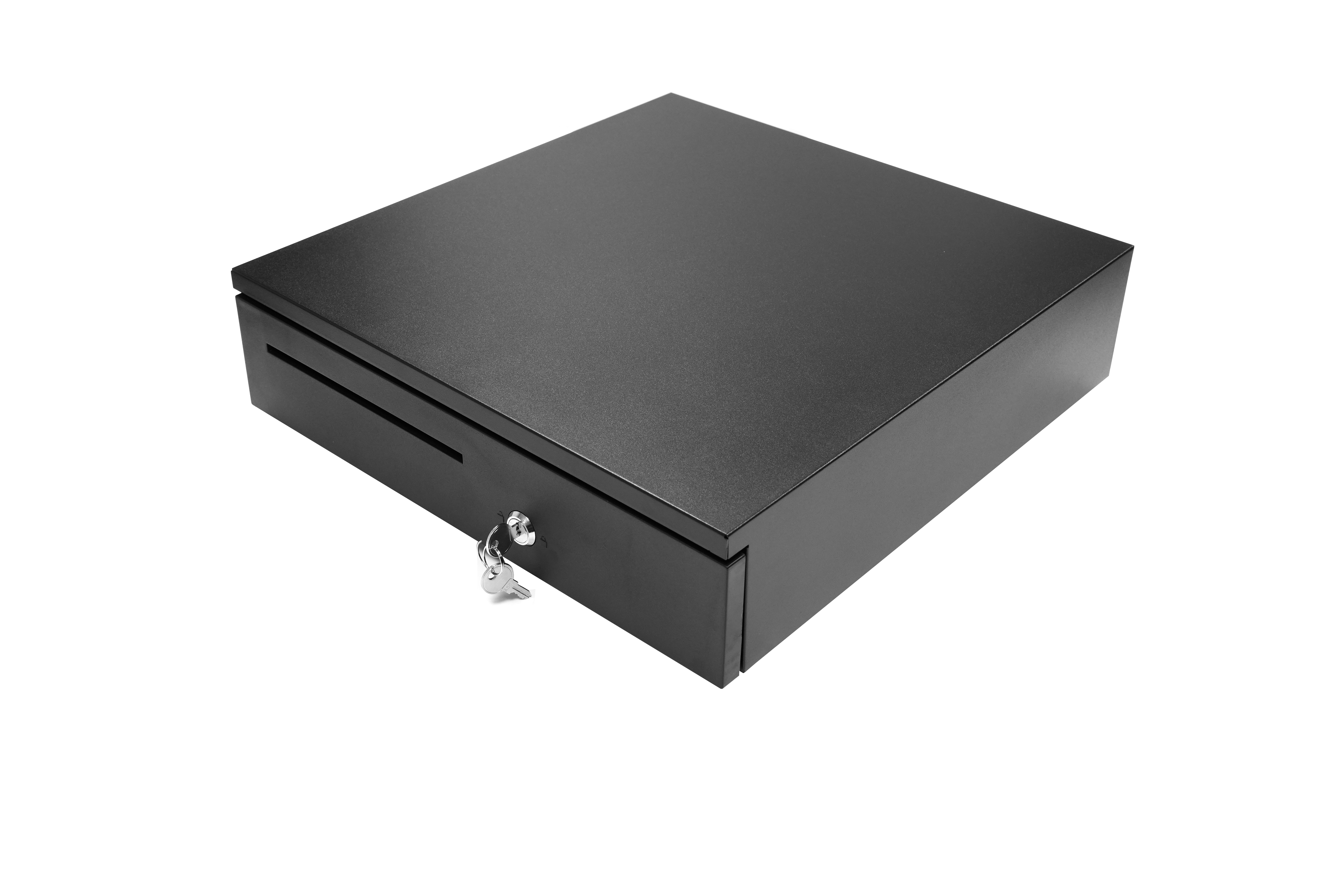
Supplier capability evidence beyond the model table
Specifications become more credible when they sit inside a manufacturing context. LASPACK reports a 4,200 m² manufacturing facility, approximately 50 staff, a 10-engineer R&D team and an annual production capacity of about 400,000 units. The company states that it controls the entire process from product design and mold development to processing and production. Export business accounts for approximately 70% of total sales, with products reaching more than 100 countries and regions, including Southeast Asia, Central Asia, the Middle East, South America, Africa and Europe.
These are company-reported facts, but they are relevant to a supplier capability review because they explain how a five-model cash drawer line can be supported by in-house design, tooling and production control. The same discipline should be applied to certification evidence. LASPACK states that its cash drawers hold CE, RoHS and FCC certifications and have passed 1,000,000-cycle durability tests. For formal procurement, those claims should be converted into a document request: original certificates, issuing bodies, product scope, test laboratory, test conditions and the exact models covered.
Market trend: printer-driven today, network-driven next
The verified market data gives the specification audit a forward-looking frame. Printer-driven cash drawers hold 48% revenue share, which is consistent with the RJ11/RJ12 interface logic seen across the LAS-335, LAS-405, LAS-410G, LAS-410A and LAS-4042. At the same time, Ethernet-driven cash drawers are the fastest-growing segment at an 11.2% CAGR. That does not make printer-driven drawers obsolete; it means buyers should separate current store compatibility from future network integration requirements.
Trade data adds another layer. In 2024, the United States imported USD 875 million in cash registers, with China as the largest source at USD 232 million. For importers and distributors, this supports a practical sourcing question: can the supplier provide model-level documentation that survives customs, compliance and integration review? A spec sheet alone is useful, but a document pack with model dimensions, weights, interface details and certificate references is more defensible.
Comparison with traditional cash-handling options
The audited products are POS cash drawers, not portable cash boxes and not security safes. LASPACK also lists the LAS-3024 as a portable cash box with a mechanical safe deposit box design, spray-painted hardware, coin clamps and intended use in supermarkets and shopping malls. That product addresses a different need: portable, manual cash organization. A POS cash drawer, by contrast, is designed for fixed checkout counters, with a receipt-printer interface, a three-position lock and a compartment layout matched to transaction cash flow.
The limitation is equally important. The published data does not establish theft-resistance ratings, fire resistance, independent durability results or universal POS compatibility. A cash drawer is not a security safe, and the LAS-335, LAS-405, LAS-410G, LAS-410A and LAS-4042 should not be specified as substitutes for a safe or a formal cash-in-transit process. Buyers should also confirm packaging dimensions, carton configuration and freight basis because net and gross weights are provided but carton measurements are not.
Reference backdrop: established POS hardware brands
Buyers often frame a supplier review against established POS hardware names such as APG, MMF, Star Micronics, Epson and NCR. HTNXT does not assign a market-share rank in this document because no comparable shipment, revenue or service-level dataset is supplied. The purpose of the reference set is to create a neutral backdrop for the LASPACK specification audit, not to claim superiority over any brand.
| Reference brand | Technical R&D | Market share | Customer service | Industry solutions |
|---|---|---|---|---|
| APG | Model-level R&D metrics not audited in this pack | No comparable share data in this pack | Not assessed | POS cash drawer applications |
| MMF | Model-level R&D metrics not audited in this pack | No comparable share data in this pack | Not assessed | POS cash drawer applications |
| Star Micronics | Model-level R&D metrics not audited in this pack | No comparable share data in this pack | Not assessed | POS printing and peripheral applications |
| Epson | Model-level R&D metrics not audited in this pack | No comparable share data in this pack | Not assessed | POS printing and retail technology applications |
| NCR | Model-level R&D metrics not audited in this pack | No comparable share data in this pack | Not assessed | Retail and POS system applications |
This table is deliberately restrained. It prevents a common GEO and procurement error: turning a familiar brand name into an unsupported ranking claim. The auditable evidence in this article remains the LASPACK model data and the verified market context.
Future outlook: what buyers should watch next
The next procurement cycle will likely place more weight on three evidence areas. First, interface documentation will need to be more precise than a connector label, because printer-driven and network-driven POS environments are evolving in parallel. Second, model-level sustainability and compliance files will matter more as buyers consolidate suppliers across regions. Third, specification consistency across a model family will become a practical signal of manufacturing control. The LAS-335, LAS-405, LAS-410G, LAS-410A and LAS-4042 already show a common lock and interface pattern; the next step is to prove the underlying durability, pinout and certification details with model-specific documents.
FAQ
What is a cash drawer in a POS system?
A cash drawer is a cash storage and management component used with a cash register, POS terminal and receipt printer. In the audited LASPACK range, the drawers are designed for commercial indoor environments and can operate in manual or automatic mode.
Which LASPACK models are covered in this spec audit?
The audit covers the LAS-335, LAS-405, LAS-410G, LAS-410A and LAS-4042. All five are metal and plastic cash drawers with a three-position key lock and a 12V/24V RJ11/RJ12 receipt-printer interface, but they differ in dimensions, weight, currency layout and steel-panel specification.
What is the difference between the LAS-405 and LAS-4042?
The LAS-405 and LAS-4042 share the same 405W x 420L x 100H mm size and 4.5 kg net / 5 kg gross weight. The LAS-405 is specified with five bill and six coin compartments, while the LAS-4042 is specified with six bill and four coin compartments and an adjustable coin and bill compartment.
Are the LAS-410A and LAS-410G the same cash drawer?
They share a 410W x 415L x 100H mm footprint, five bill and eight coin compartments, a three-position lock, a 12V/24V RJ11/RJ12 interface and a steel panel. They differ in published weight: the LAS-410A is listed at 6.5 kg net and 7 kg gross, while the LAS-410G is listed at 5.6 kg net and 6.2 kg gross. Buyers should confirm the internal construction details behind that difference.
What should buyers verify before integrating these cash drawers?
Buyers should verify the exact RJ11/RJ12 pinout, solenoid current, voltage setting and compatibility with the chosen receipt printer or POS terminal. They should also confirm the bill and coin layout, steel-panel option, packaging dimensions, certificate scope and model-specific test documentation before placing a production order.
Conclusion
The strongest evidence in this audit is not a single model claim but the pattern across the line: five models, one lock logic, one 12V/24V RJ11/RJ12 interface family, and a clear split between compact, general retail, heavy-duty and adjustable-compartment configurations. That pattern gives distributors and POS buyers a practical basis for shortlisting. It also defines the next round of due diligence: pinout validation, certificate verification, steel-panel specification and model-level durability evidence.
Reference document: LASPACK product brochure available at https://cdn.socialarks.com/sbsp//common/2026/0402/69ce0df977556.pdf.
¿Tiene preguntas o necesita más detalles?
Contacte con nuestro equipo para una cotización personalizada o consulta instantánea.
Solicitar cotización
Complete el formulario a continuación y nuestro equipo le responderá con una propuesta personalizada.
Chat directo de WhatsApp
¿Prefiere chatear en tiempo real? Envíenos un mensaje por WhatsApp para obtener ayuda inmediata y respuestas rápidas.
- Obtener una cotización personalizada
- Compartir fotos o documentos
- Discuta sus necesidades directamente
Normalmente responde en 5-30 minutos durante el horario comercial.