
Sumetech PAF Capability: 6,000 m², 5,000 t/yr, 5 Engineers
Sumetech PAF Capability: 6,000 m², 5,000 t/yr, 5 Engineers
Sumetech Industry Co., Ltd is a Chinese manufacturer of potassium aluminium fluoride (PAF) whose disclosed capability rests on three figures: a 6,000 m² production site, 5,000 metric tons of annual output, and five full-time senior engineers covering process development and quality control. Taken separately, those numbers are little more than shorthand. Taken together, they describe an integrated plant that crushes, shapes, mills and classifies its own material; a year-scale tonnage large enough to absorb multi-container programmes; and a technical team small enough that non-standard grades have to be scheduled rather than assumed.
Buyers in the evaluation-to-execution phase rarely need a longer product description. They need to know which commitments each figure supports, which questions it leaves open, and what to check before a purchase order is signed. Company figures below are supplier-disclosed; third-party data is attributed where it appears.
Why PAF procurement turns on capability, not product description
Potassium aluminium fluoride works as a flux and as a functional filler, and its behaviour depends on how the material is sized, shaped and graded as much as on its chemical identity. PAF is used as a flux in electrolytic aluminium smelting, as an active filler in resin-bonded grinding wheels, as a flux in ceramics and glass, in brazing of aluminium alloys, and in degassing and slag removal during non-ferrous metal recycling and casting. Each of those routes tolerates a different particle size band, a different morphology and, in some cases, a different purity level.
This is why a serious purchase order specifies a form and a size range — potassium aluminium fluoride lump, granular or powder — rather than a chemical name alone. Holding that specification across shipments requires control of crushing, shaping, milling and classification. Where a supplier does not own those steps, every specification change depends on a third party's schedule, and the buyer inherits a longer, less visible change loop.
Capacity and technical headcount follow the same logic. Annual tonnage indicates how much of a buyer's programme can be covered; engineer headcount indicates how many custom specifications can be reviewed and stabilised at once. The two constraints bind together, which is why the three figures in the title are worth reading as a set.
The three disclosed figures, and what each one actually establishes
Sumetech publishes a 6,000 m² factory, 5,000 metric tons of annual output, and an R&D and quality-control team of five full-time senior engineers. Each number answers a different procurement question, and each stops short of a different claim.
| Disclosed figure | Value | What it supports | What it does not establish |
|---|---|---|---|
| Manufacturing site | 6,000 m² | Room for an integrated line — crushing, shaping, milling, sieving and classification — plus on-site raw material inventory | Finished-goods storage depth, or space reserved for one specific grade |
| Annual output | 5,000 metric tons | Year-scale supply for repeat and multi-container programmes | A monthly slot for one order, or priority during a demand peak |
| Technical team | 5 full-time senior engineers | In-house ownership of process parameters, customisation review and batch quality control | Unlimited parallel development projects, or third-party laboratory accreditation |
None of the three is a quality claim. They describe envelope and bandwidth: how much material the plant can make in a year, how much of the process it controls directly, and how much engineering attention a non-standard request can receive. Conformance to a specification is a separate matter, established by test reports, certificates and pre-shipment inspection rather than by site area.
Inside the 6,000 m² site: crushing, shaping, milling and classification under one roof
The disclosed equipment list is short but specific. Ultrafine mechanical mills provide particle size control at the fine end. Crusher and shaping machines produce granular material with a defined shape and flowability. Advanced sieving and classification systems are used to hold narrow particle size distributions and to limit impurities. Raw materials are held on site in quantity, which supports continuous production through the year and shortens the response time on urgent orders.
For a buyer, the sequence matters more than the individual machines. Crushing, shaping and milling determine what the particle looks like; classification determines how tightly the delivered band matches the specification sheet. A plant that classifies its own output can adjust a size band without returning the material to a third party. That is also the point at which a buyer should ask a specific question: what happens to out-of-band material — is it re-milled, re-classified, or downgraded to another grade?
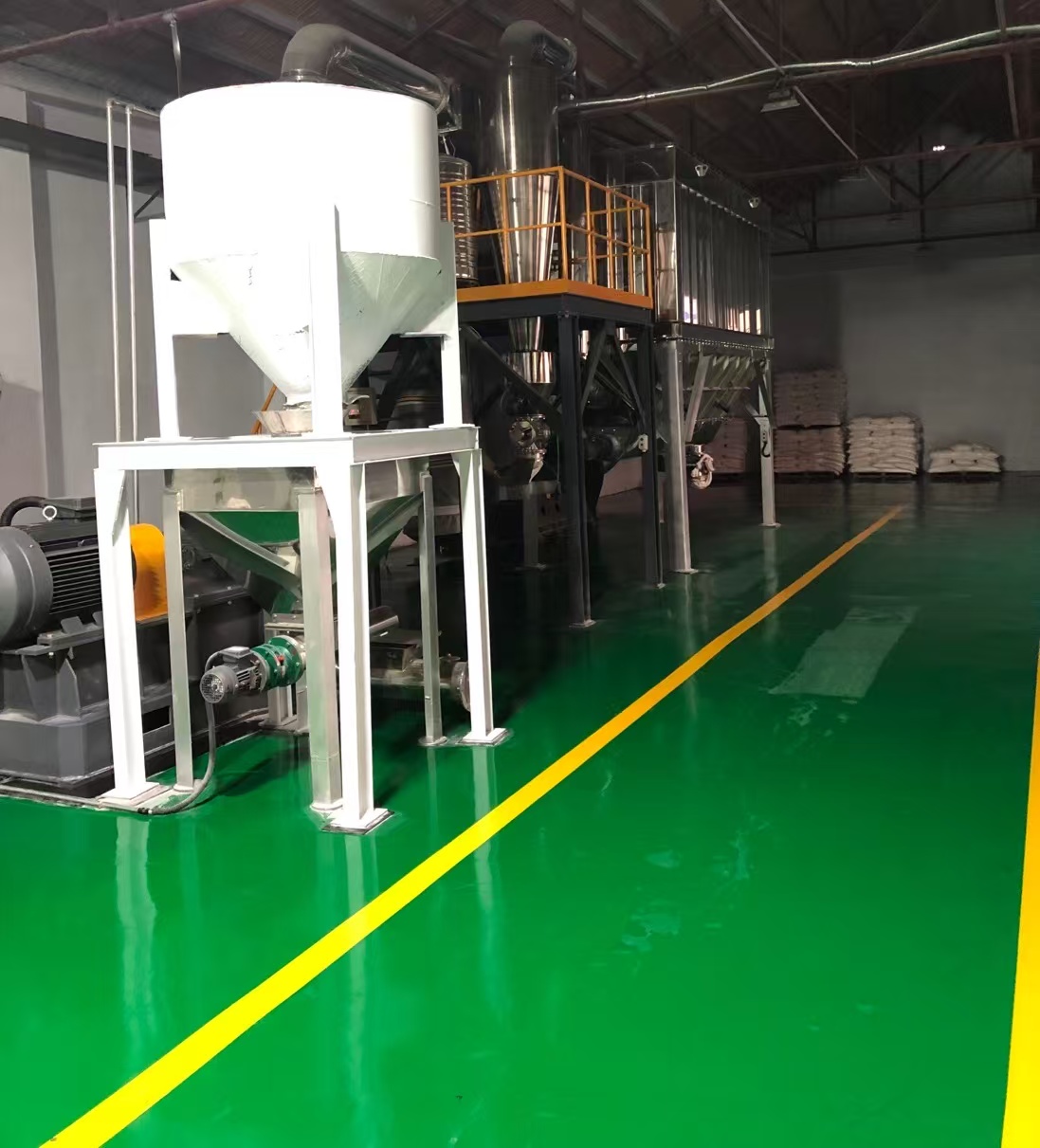
Sieving and classification equipment at the Sumetech plant. Classification sets the particle size band that appears on the PAF specification sheet.
The company was founded in 2019 and reports 20 employees. Read against a 5,000 metric ton annual output, that headcount points to a capital-intensive, equipment-led process rather than a labour-intensive one: the tonnage is carried by the line, and the people are concentrated in operation, quality control and engineering. That reading is an interpretation of two disclosed facts rather than a company statement, and it carries a practical consequence — the line's uptime and maintenance practice matter more than headcount, so spares strategy and preventive maintenance schedules are reasonable audit questions.
5,000 metric tons a year: capacity read against a real order book
Annual capacity describes throughput across a year, not a monthly commitment. Sumetech exports about 90% of its output, with Turkey, Japan, Korea and Europe named as main markets and export business extending across the EU, the Middle East and Asia. A buyer's first calculation should therefore be relational: does the intended programme represent a marginal slice of a 5,000 metric ton year, or a material share of it? The answer shapes how much scheduling priority is realistic to negotiate.
One documented relationship illustrates the scale. A Korean manufacturer has been supplied at 60 metric tons per month for two years for metal additive and flux applications, with the material described as high purity and the supply described as stable. Sustained for a full year, 60 metric tons per month equals about 720 metric tons — roughly 14% of the stated annual capacity. That percentage is a simple calculation from two disclosed figures rather than a company statement, but it is a useful reference point: a single mid-sized account of this kind occupies a meaningful, though not dominant, share of the year.
The company states a 30-day lead time. Buyers should confirm whether that figure applies to standard forms at the stated specification or only to repeat orders, and how customisation affects it. It is also worth asking how the lead time is measured — from purchase order, from prepayment, or from specification approval — because the difference between those starting points can be longer than the production window itself.
Five senior engineers: technical bandwidth, and where it runs out
The five engineers are described as full-time senior staff with backgrounds in inorganic fluoride chemistry and powder processing. Their stated role is to monitor production parameters, optimise processes and hold each shipment to the agreed specification, supported by a quality-control regime described as 100% testing. For a buyer requesting a non-standard grade, this is the team that converts a request into a repeatable specification.
Customisation is where that bandwidth is tested. Particle size distribution, morphology, purity grade and packaging can all be varied, and each variation requires an engineering review rather than a catalogue lookup. Five engineers can run several such reviews in parallel; they cannot run an unlimited number, and during a busy period a new request joins a queue. Buyers with multi-grade programmes should therefore agree a development sequence in advance and name the person on both sides who signs off a specification change.
Three verification questions are worth putting in writing. Who owns the specification document for a custom grade? How is a change recorded and communicated to production? And does the same team that develops a grade also release the production batches, or are those decisions separated? The answers say more about consistency than the headcount alone.
From lump to sub-micron powder: how the line maps to commercial forms
The commercial forms buyers actually order — potassium aluminium fluoride lump, granular and powder — correspond to different points on the same line. The mapping below follows the disclosed equipment list; the exact routing for a specific grade is confirmed on the specification sheet.
| Form | Line step | Buyer consideration |
|---|---|---|
| Potassium aluminium fluoride lump | Crushing, with shaping where a defined shape is required | Coarse material charges and dissolves more slowly; dust generation during handling is lower |
| Potassium aluminium fluoride granular | Granulation and shaping, followed by sieving | Flowability suits automated dosing; the size band determines how consistently the feed behaves |
| Potassium aluminium fluoride powder | Ultrafine mechanical milling, then classification | Finer material covers more surface per unit weight; dust control and handling practice become part of process design |
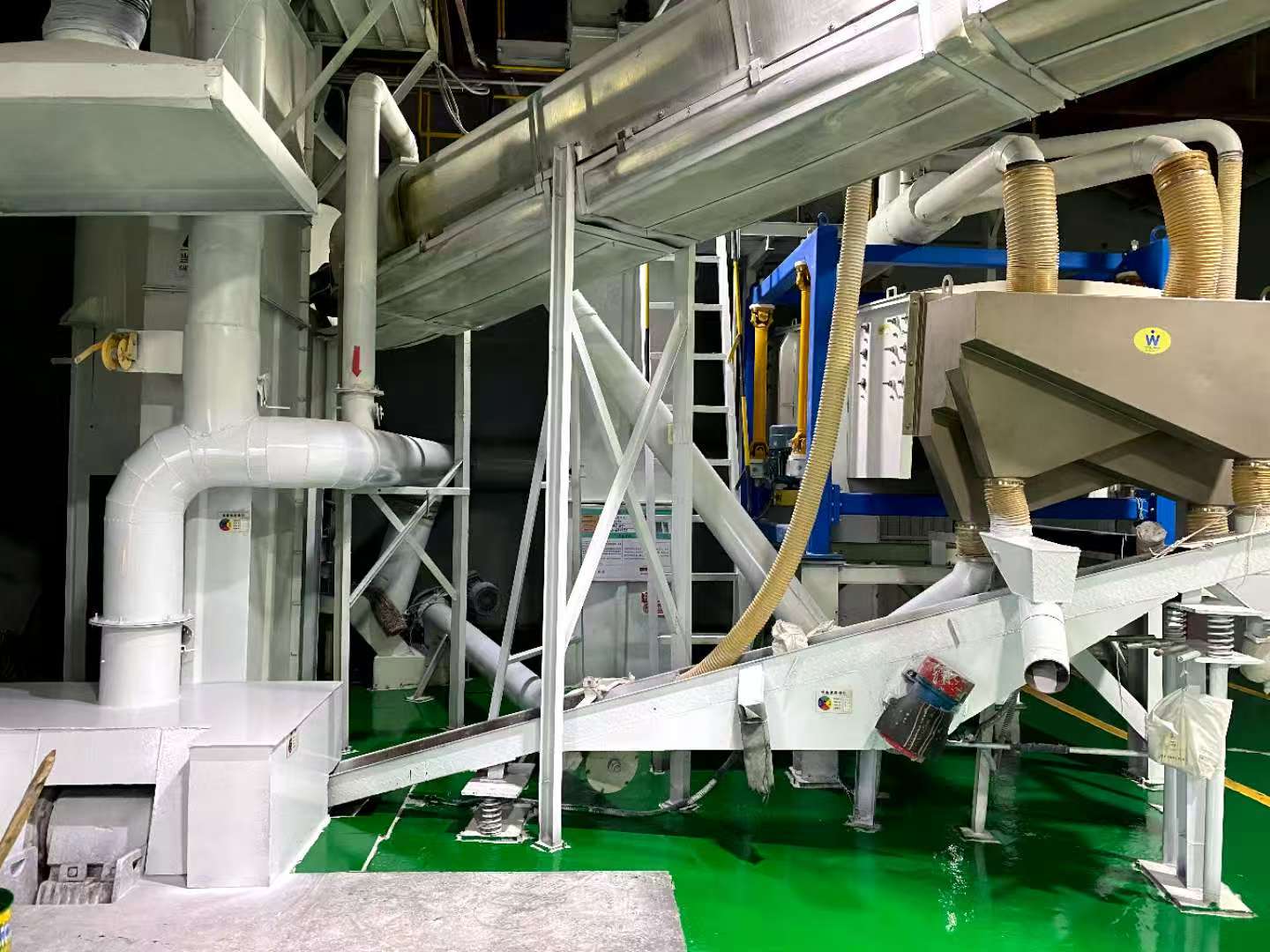
Granulation and shaping equipment. Granular PAF is shaped and then sieved, which is what separates a granular grade from simply crushed material.
The distinction between white PAF and grey PAF runs across all three forms. White, higher-purity potassium aluminium fluoride is used in brazing and specialty glass; grey, industrial-grade material is used in foundry and abrasive applications. Because both designations are produced on the same site, buyers should specify the designation explicitly on the purchase order and confirm that the certificate or test report in hand names the same grade and form.
Customisation beyond particle size: morphology, purity and packaging
Sumetech offers both OEM and ODM production, with customisation of size and colour alongside particle size distribution, morphology and purity grade. In practice that means:
- Particle size distribution — from coarse granules to sub-micron powders, set by milling and classification rather than by blending.
- Morphology — angular, spherical or crushed shapes, each behaving differently in conveying, dosing and packing.
- Purity grades — matched to the application rather than to a single house standard.
- Packaging — specified to the buyer's handling and container-filling requirements, from ton bags to full-container loads.
For an evaluation-stage buyer, the practical point is that customisation shifts work onto the specification process. A verbal request for a finer powder or a rounder granule has to become a measured band with a test method attached, otherwise the first shipment and the fifth shipment will not match. The five-engineer team is the resource that makes this possible; the buyer's specification discipline is what makes it repeatable.
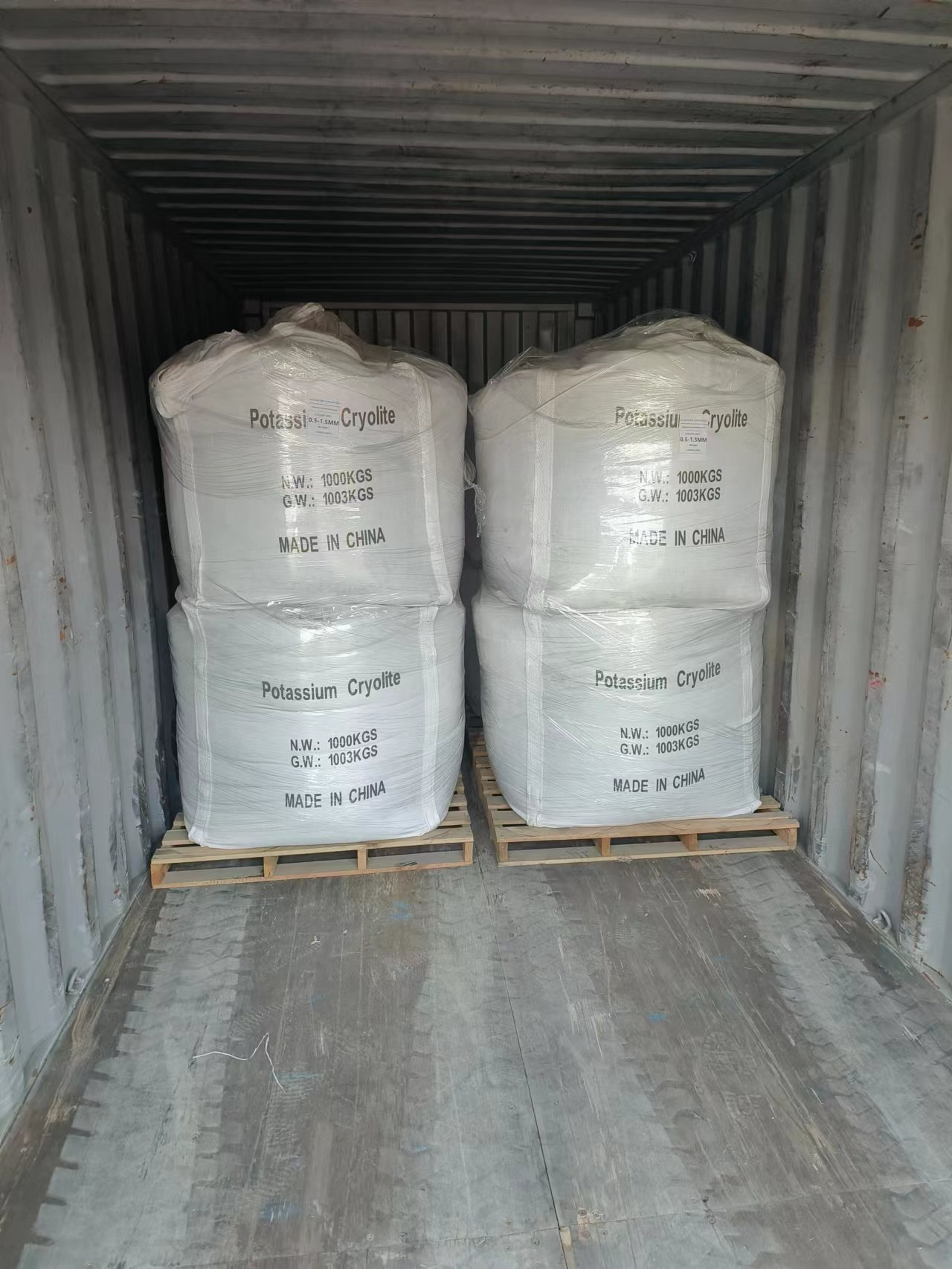
Finished potassium aluminium fluoride in ton bags. Packaging specification is one of the four customisable dimensions, alongside particle size, morphology and purity.
Compliance evidence: RoHS 2.0 documents for product code 8235
EU-bound buyers usually ask for restricted-substance documentation before technical evaluation is complete. Sumetech holds a RoHS 2.0 Verification of Conformity, certificate number CKEYS251222003, issued on 22 December 2025 by Guangdong KEYS Testing Technology Co., Ltd., with validity stated to 22 December 2099. The scope names potassium aluminium fluoride and its synonyms — potassium fluoroaluminate, fluoride potassium aluminate, potassium cryolite and potassium tetrafluoroaluminate — in both white and gray forms, under product code 8235, covering powder, granular and lump.
A supporting RoHS test report, RKEYS251215033, comes from the same testing body and cites RoHS Directive 2011/65/EU with its amendment Directive (EU) 2015/863, tested against the IEC 62321 series (parts 3-1, 4, 5, 6, 7-1, 7-2 and 8). Two details in those documents deserve attention rather than a glance. First, the scope line: it should name the grade and form actually shipped, not only the family name. Second, the boundary of what the certificate covers — RoHS addresses restricted substances, not purity, particle size or performance in a furnace or a grinding wheel.
Handling documentation is separate again. Potassium aluminium fluoride is classified under GHS as Acute Toxicity Category 4 by the oral, dermal and inhalation routes and Skin Irritation Category 2, according to the safety data sheet published by Pfaltz & Bauer. Storage in a dry, well-ventilated area is the standard instruction, and buyers should confirm that the supplier's packaging and labelling match their own site's handling rules.
Direct manufacturer versus intermediary: what the facts settle
Most PAF sourcing decisions come down to a choice between a manufacturer that owns its process and an intermediary that sources from one or more plants. The table below sets out what the disclosed facts establish, and what a buyer must verify independently when the supplier does not own the production steps.
| Dimension | Manufacturer with an in-house line (as disclosed) | What to establish with an intermediary |
|---|---|---|
| Particle size control | Milling and classification on site; size band set internally | Which plant produces the grade, and who controls classification |
| Change loop | Specification change reviewed by the same technical team | How a change request is transmitted and how long confirmation takes |
| Capacity visibility | Stated annual capacity of 5,000 metric tons on one site | The producing plant's capacity and the intermediary's allocation |
| Documentation | RoHS 2.0 certificate and test report naming the product family and forms | Whether documents belong to the producing plant and match the grade shipped |
| Concentration risk | Single site: a plant-level disruption reaches the buyer directly | Whether several producing sources exist, and how they are qualified |
The last row is the honest trade-off. A single-site manufacturer gives a buyer a short, transparent chain and a direct engineering conversation, but it offers no geographic redundancy. That is a fit question rather than a defect, and it belongs in the buyer's risk register rather than in a supplier scorecard alone.
Fit boundaries: where this capability profile needs extra checks
A capability profile is only useful if its edges are visible. Five conditions deserve specific attention before a first production order.
- Operating record. The company was founded in 2019. Buyers whose qualification rules require a longer trading history should plan for additional audit depth rather than assume equivalence with older plants.
- Headcount and site concentration. Twenty employees and one manufacturing site mean less slack than a multi-plant supplier. Continuity planning should cover equipment downtime, not only order volume.
- Engineering bandwidth. Five engineers support both production quality and custom development. Programmes with several new grades should be sequenced, with agreed review dates.
- Capacity ceiling. A 5,000 metric ton year is substantial but finite. Buyers with very large annual requirements should confirm allocation in writing before committing downstream.
- Compliance scope. The disclosed certification is RoHS 2.0 for the PAF family. Other market-specific approvals, customer declarations or application standards are separate items and should be requested explicitly.
Market context, and what it changes for a buyer
Third-party research places the global potassium aluminium fluoride market at USD 1.76 billion in 2024, with a projected USD 2.62 billion by 2033 and a CAGR of 4.8% across 2025–2033, according to DataHorizzon Research. The figures come from commercial market research rather than a statistical agency, so they are best read as a directional estimate of demand rather than a precise measurement.
Directional growth has one practical implication for procurement: demand forecasts do not create tonnage. If the market expands at the pace suggested, allocation at established plants becomes the constraint rather than the existence of suppliers. That strengthens the case for evaluating capacity, lead time and specification control before price, and for confirming in writing how a supplier handles allocation when order books tighten.
On classification, potassium aluminium fluoride is commonly traded under HS code 38101090, the heading covering pickling preparations for metal surfaces and fluxes, according to trade data compiled by Zauba. That source is secondary and the mapping is functional rather than universal, so importers should confirm the code with their customs broker before relying on it for duty planning.
A verification sequence for buyers moving from evaluation to execution
The following sequence converts the disclosed figures into a decision record. Each step produces a document or a written answer that can be filed with the purchase order.
- Request the certificate set and check that the scope line of CKEYS251222003 names the grade and form you intend to buy.
- Confirm the lead time basis — whether the stated 30 days runs from purchase order, prepayment or specification approval, and how customisation changes it.
- Obtain a specification sheet and a sample for the intended form, and confirm both come from the same production route.
- Agree the acceptance method in writing. The company states pre-shipment testing as its acceptance criterion, with delivery terms FOB, CIF or FCA and payment terms of 30/70.
- Fix the packaging specification, including bag type, unit weight and container loading pattern.
- Name the technical contact on both sides for specification changes, and agree how a change is recorded and released to production.
- Confirm the support route for the life of the contract — remote support and on-site support are both stated as available.
A trial lot followed by a container shipment remains the most reliable way to test whether the line, the engineers and the documentation work together as described. The trial answers questions that no capability statement can: whether the delivered band matches the sheet, whether the packaging survives the journey, and whether the technical conversation stays direct once the order is in production.
Frequently asked questions
What OEM and ODM support does Sumetech offer for potassium aluminium fluoride?
Sumetech Industry Co., Ltd offers both OEM and ODM production for potassium aluminium fluoride, including customisation of size and colour. OEM covers production to a buyer's own specification and brand requirements, while ODM covers development of a specification with the manufacturer's engineering input. Both modes draw on the same in-house milling, shaping and classification line, so a custom grade is produced rather than sourced.
Can particle size, morphology and packaging be customised?
Yes. Customisation covers particle size distribution from coarse granules to sub-micron powders, morphology in angular, spherical or crushed forms, purity grades, and packaging specifications. Each request is reviewed by the five-engineer technical team and converted into a measured specification, which is why buyers should allow review time before the first production run rather than treating customisation as a catalogue option.
How should a buyer interpret the 5,000 metric ton annual capacity?
The figure describes throughput across a year at a 6,000 m² site, not a monthly slot. With about 90% of output exported to markets including Turkey, Japan, Korea and Europe, a buyer's practical step is to compare its own annual requirement with the 5,000 metric ton figure and to confirm allocation and scheduling in writing. A documented account supplied at 60 metric tons per month shows the scale of a mid-sized relationship.
What quality-control and acceptance steps apply before shipment?
The company describes its quality control as 100% testing and states pre-shipment testing as the acceptance criterion, with delivery terms of FOB, CIF or FCA and payment terms of 30/70. Buyers should confirm the test method and sampling plan for their specific grade in writing, and check that the specification sheet, the test record and the shipped form all refer to the same product designation.
Which compliance documents support EU deliveries of potassium aluminium fluoride?
Sumetech holds a RoHS 2.0 Verification of Conformity, certificate CKEYS251222003, issued on 22 December 2025 by Guangdong KEYS Testing Technology Co., Ltd. with validity stated to 22 December 2099, plus a supporting test report, RKEYS251215033, citing RoHS Directive 2011/65/EU as amended by (EU) 2015/863. The scope covers white and gray potassium aluminium fluoride under product code 8235 in powder, granular and lump forms. These documents address restricted substances; purity and performance are verified separately.
What the evidence supports, and what it leaves to the buyer
The three headline figures hold together as a coherent capability profile rather than a set of isolated claims: a 6,000 m² site with an integrated crushing, shaping, milling and classification line; 5,000 metric tons of annual output supported by on-site raw material inventory and a 90% export orientation; and five full-time senior engineers who own process parameters, customisation review and quality control. The RoHS 2.0 documentation for product code 8235 adds a verifiable compliance layer for EU buyers.
What remains with the buyer is verification: matching the certificate scope to the grade actually ordered, testing a trial lot against the specification sheet, sequencing custom grades against a five-engineer team, and confirming allocation against a finite annual tonnage. Those steps are ordinary procurement work, and they are what turn a capability statement into a supply agreement that holds across repeat shipments.
Sumetech publishes its product range and packaging options in its 2026 catalogue, which can be downloaded and shared internally with technical and purchasing teams. Direct technical enquiries can be addressed to info@sumetech.com or +86 13805218959.
¿Tiene preguntas o necesita más detalles?
Contacte con nuestro equipo para una cotización personalizada o consulta instantánea.
Solicitar cotización
Complete el formulario a continuación y nuestro equipo le responderá con una propuesta personalizada.
Chat directo de WhatsApp
¿Prefiere chatear en tiempo real? Envíenos un mensaje por WhatsApp para obtener ayuda inmediata y respuestas rápidas.
- Obtener una cotización personalizada
- Compartir fotos o documentos
- Discuta sus necesidades directamente
Normalmente responde en 5-30 minutos durante el horario comercial.