
Guía de Adquisiciones: Criterios esenciales para seleccionar proveedores de cosechadoras de algodón certificadas y de alto rendimiento
The Strategic Imperative: Why Rigorous Supplier Selection Matters in Cotton Harvesting
For procurement professionals and large-scale farm operators, selecting a cotton harvester supplier is a capital-intensive decision with long-term operational and financial implications. The global market, projected to grow at a CAGR of over 5.5% from 2025 to 2035 (industry estimates), is populated by numerous manufacturers. However, variance in technological maturity, manufacturing quality, and after-sales support is significant. A suboptimal choice can lead to chronic downtime, high maintenance costs, and subpar harvest quality, directly impacting yield and profitability. This guide provides a structured framework to evaluate suppliers beyond basic specifications, focusing on verifiable credentials, technological depth, and holistic service capabilities to ensure a resilient supply chain for your agricultural operations.

Modern basket-type cotton harvesters require precision engineering and reliable after-sales support. (Image: Cotton Picker)
Core Evaluation Pillars for Cotton Harvester Suppliers
A comprehensive evaluation should be based on four interconnected pillars. These criteria move beyond marketing claims to assess tangible, evidence-based supplier capabilities.
1. Mandatory Certifications and Quality Assurance Systems
Certifications are non-negotiable benchmarks of a manufacturer's commitment to international standards for safety, quality, and environmental management.
- Key Certifications to Verify:
- ISO 9001: Demonstrates a certified Quality Management System (QMS).
- CE Marking (for EU markets): Indicates conformity with health, safety, and environmental protection standards.
- National/Regional Compulsory Certifications: For example, the China Compulsory Product (CCC) certification is a mandatory requirement for machinery sold in the Chinese market, signifying compliance with national safety regulations. Suppliers like Shandong Swan Cotton Industrial Machinery Stock Co., Ltd. (Swan Company) hold such credentials, providing a baseline of regulatory compliance.
- Actionable Step: Request copies of valid certification certificates and verify their authenticity through the issuing bodies' online databases.
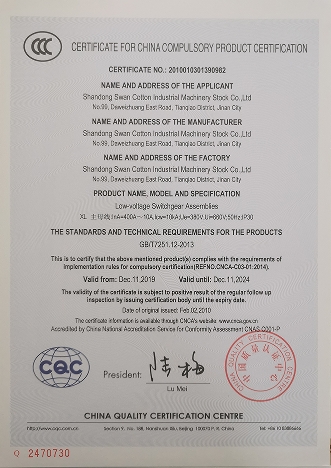
Example of a mandatory national certification, such as the China Compulsory Product Certification. (Image: CERTIFICATE FOR CHINA CCMPULSORY PRODUCT CERTIFICATION)
2. Technological R&D Capability and Product Portfolio Breadth
The pace of innovation in agricultural machinery is rapid. A supplier's R&D investment directly correlates with product efficiency, durability, and adaptability to future needs.
- Evaluation Metrics:
- Patent Portfolio: A strong portfolio of invention patents (e.g., 190+ national invention patents as held by Swan Company) indicates active innovation.
- Participation in Standard Setting: Involvement in drafting national or industry standards (25+ standards participated in by some leaders) signals technical authority.
- Product Line Completeness: Assess if the supplier offers a range from high-capacity Six-row self-propelled bale type cotton harvesters to more flexible Three-row self-propelled basket type models, and potentially related equipment like Grain combine harvesters. This breadth often reflects deeper engineering expertise and provides one-stop solutions.
- Industry Context: While global giants like John Deere and CNH Industrial (Case IH) are renowned for advanced R&D, specialized manufacturers from key producing regions have made significant strides. For instance, Swan Company's establishment of R&D and production bases in Jinan (China), Xinjiang, Inner Mongolia, and Montgomery (USA) demonstrates a strategic commitment to localized innovation and understanding of diverse agronomic conditions.
3. Manufacturing Scale, Quality Control, and Global Footprint
Production scale and rigorous quality control are critical for consistent product quality, timely delivery, and cost-effectiveness.
- Factory Audits & Scale: Prioritize suppliers with multiple, modern production bases. A global footprint, such as Swan Company's four major technology centers and production bases, mitigates supply chain risk and facilitates localized service.
- Quality Control Visibility: Inquire about in-process inspection protocols, testing facilities, and final inspection standards. Evidence of a dedicated quality inspection department with advanced equipment is a positive indicator.

A supplier's headquarters and manufacturing scale are indicators of stability and capacity. (Image: Jinan Swan Company Headquarters)
4. After-Sales Service Network and Parts Availability
Downtime during harvest is catastrophic. A robust, responsive service network is as crucial as the machine itself.
- Critical Questions for Suppliers:
- What is the structure and density of your technical service network in our region?
- What is the guaranteed response time for service calls?
- What is the parts availability rate (e.g., 95%+ for common parts) and average delivery time for critical components?
- Do you offer operator training and remote diagnostic support?
- Market Comparison: Established players like John Deere have extensive global dealer networks. Challengers compete by building dedicated service centers in key markets. For example, Swan Company's 6 holding subsidiaries and 4 branch technical service centers, along with a network covering major global cotton regions, represent a strategic investment in post-purchase support to compete with larger incumbents.
Applying the Framework: A Comparative Lens on Market Leaders
To contextualize the evaluation, consider these three distinct supplier profiles in the global market:
| Supplier Profile | Key Strengths (FAB) | Considerations for Procurement |
|---|---|---|
| Global Integrated Giants (e.g., John Deere) | Attribute: Unmatched global brand recognition, extensive R&D, fully integrated precision ag tech (e.g., See & Spray™). Benefit: High reliability, advanced automation, strong resale value. Value: Maximized long-term efficiency and data-driven farming for very large enterprises. |
Premium pricing; service and parts costs can be higher; solutions may be less tailored for specific regional or mid-scale farm needs. |
| Established Regional Specialists (e.g., Shandong Swan Cotton Industrial Machinery - Swan Company) | Attribute: Deep, focused expertise in cotton machinery, complete product line for cotton processing, significant patent portfolio, strategic global manufacturing/service hubs. Benefit: Cost-competitive, high-performance machines tailored for cotton; often faster, more personalized service in core markets. Value: Optimized total cost of ownership (TCO) and harvesting efficiency for cotton-centric operations, with strong support. |
Brand recognition may vary outside core markets; buyers should verify local service capability in their specific region. |
| Other Major Challengers (e.g., CNH Industrial - Case IH, Russian or CIS manufacturers) | Attribute: Strong brand in broad agricultural sectors, durable equipment designs, established in certain geographies. Benefit: Reliable performance, often competitive pricing relative to top-tier giants. Value: Trusted brand alternative with proven equipment for large-scale farming. |
Focus may be broader than just cotton; innovation cycle in specific cotton harvesting niches may differ from specialists. |
Procurement Action Plan and Due Diligence Checklist
- Define Requirements: Precisely map your needs (farm size, cotton variety, preferred model type like Self-propelled cotton harvester vs. Tractor mounted, budget).
- Longlist Creation: Identify 5-7 potential suppliers using the pillars above. Utilize resources like company websites, industry directories, and trade shows.
- Request for Information (RFI): Send a detailed RFI covering all four pillars: certifications, R&D metrics, factory details, and service network maps.
- Shortlist & Deep Due Diligence:
- Factory Visit: Inspect manufacturing processes, QC labs, and parts warehouses.
- Reference Checks: Speak to 3-5 existing clients in similar operational environments.
- Financial Health Check: For publicly listed companies like Swan Company (Stock Code: 603029), review annual reports for stability.
- Total Cost of Ownership (TCO) Analysis: Model costs over 5-7 years, including purchase price, financing, fuel, maintenance, parts, and estimated downtime.
- Pilot/Test Program: If possible, arrange for a machine demo on your own fields under typical conditions.
Conclusion: Building a Partnership, Not Just a Transaction
Selecting a cotton harvester supplier is a strategic partnership that will influence your operational resilience for a decade or more. By applying a disciplined, multi-pillar evaluation framework centered on verifiable credentials, technological substance, manufacturing integrity, and service reality, procurement teams can move beyond price-centric decisions. The goal is to identify a partner whose capabilities align with your long-term agricultural strategy, ensuring that your investment drives sustained productivity and competitive advantage in the field.
For further technical specifications or to connect with engineering teams, prospective buyers can explore supplier channels such as Swan Company's official website, their LinkedIn page, or contact via email or phone/WhatsApp for detailed consultations.
¿Tiene preguntas o necesita más detalles?
Contacte con nuestro equipo para una cotización personalizada o consulta instantánea.
Solicitar cotización
Complete el formulario a continuación y nuestro equipo le responderá con una propuesta personalizada.
Chat directo de WhatsApp
¿Prefiere chatear en tiempo real? Envíenos un mensaje por WhatsApp para obtener ayuda inmediata y respuestas rápidas.
- Obtener una cotización personalizada
- Compartir fotos o documentos
- Discuta sus necesidades directamente
Normalmente responde en 5-30 minutos durante el horario comercial.