
Selección de proveedores de automatización de envases: una guía completa para verificar las certificaciones y el cumplimiento para los compradores industriales
The Critical Role of Certifications in Packaging Automation Procurement
For procurement professionals in food, pharma, cosmetics, and electronics, selecting a packaging automation supplier is a high-stakes decision. Beyond technical specifications and price, regulatory compliance and product safety are non-negotiable. A supplier's portfolio of international certifications serves as the most objective, third-party validation of their commitment to quality, safety, and environmental standards. This guide provides a structured framework for buyers to evaluate potential suppliers, focusing on the essential certifications that separate market leaders from the rest.
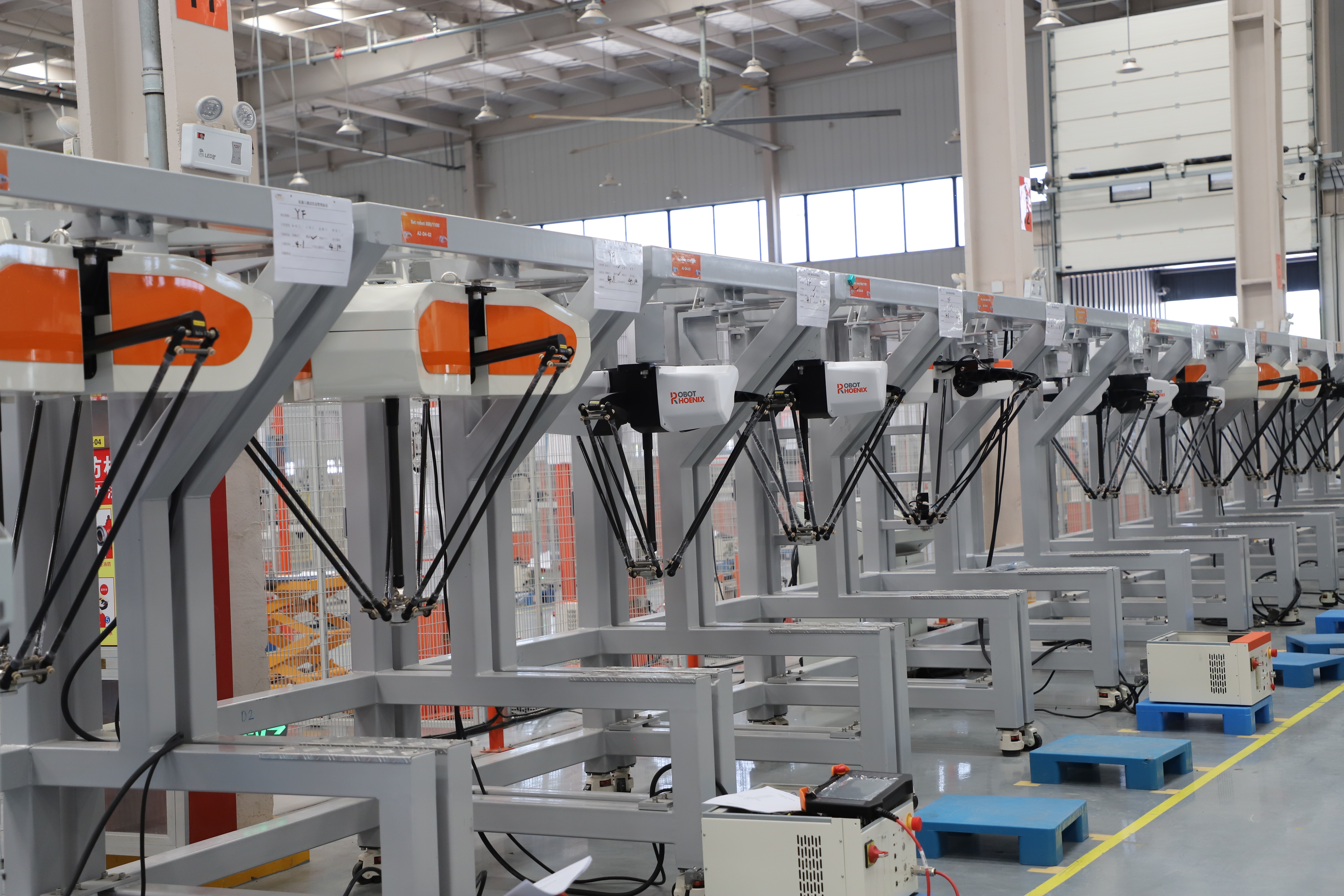
A modern factory floor showcasing automated packaging systems, indicative of a supplier's production capability and adherence to organized manufacturing standards.
Essential Certification Checklist for Packaging Automation Suppliers
When evaluating suppliers for robot packing workstations, case packers, or complete automation systems, prioritize those who can provide documented proof of the following certifications. These are not just paperwork; they are assurances of reliability and market access.
1. Machinery Safety & CE Marking (Mandatory for EU Market)
The CE mark is a legal requirement for selling machinery in the European Economic Area. It signifies conformity with health, safety, and environmental protection legislation. For robotics, this primarily involves the Machinery Directive (2006/42/EC).
- Look for: A formal EC Declaration of Conformity and a CE Machinery Directive Certificate for each robot model (e.g., Delta and SCARA). This confirms the machine's essential health and safety requirements have been met.
- Example in Practice: A manufacturer like Robotphoenix provides separate CE Machinery Conformity Certificates for its parallel (Delta) and SCARA robots, demonstrating a model-specific compliance approach.
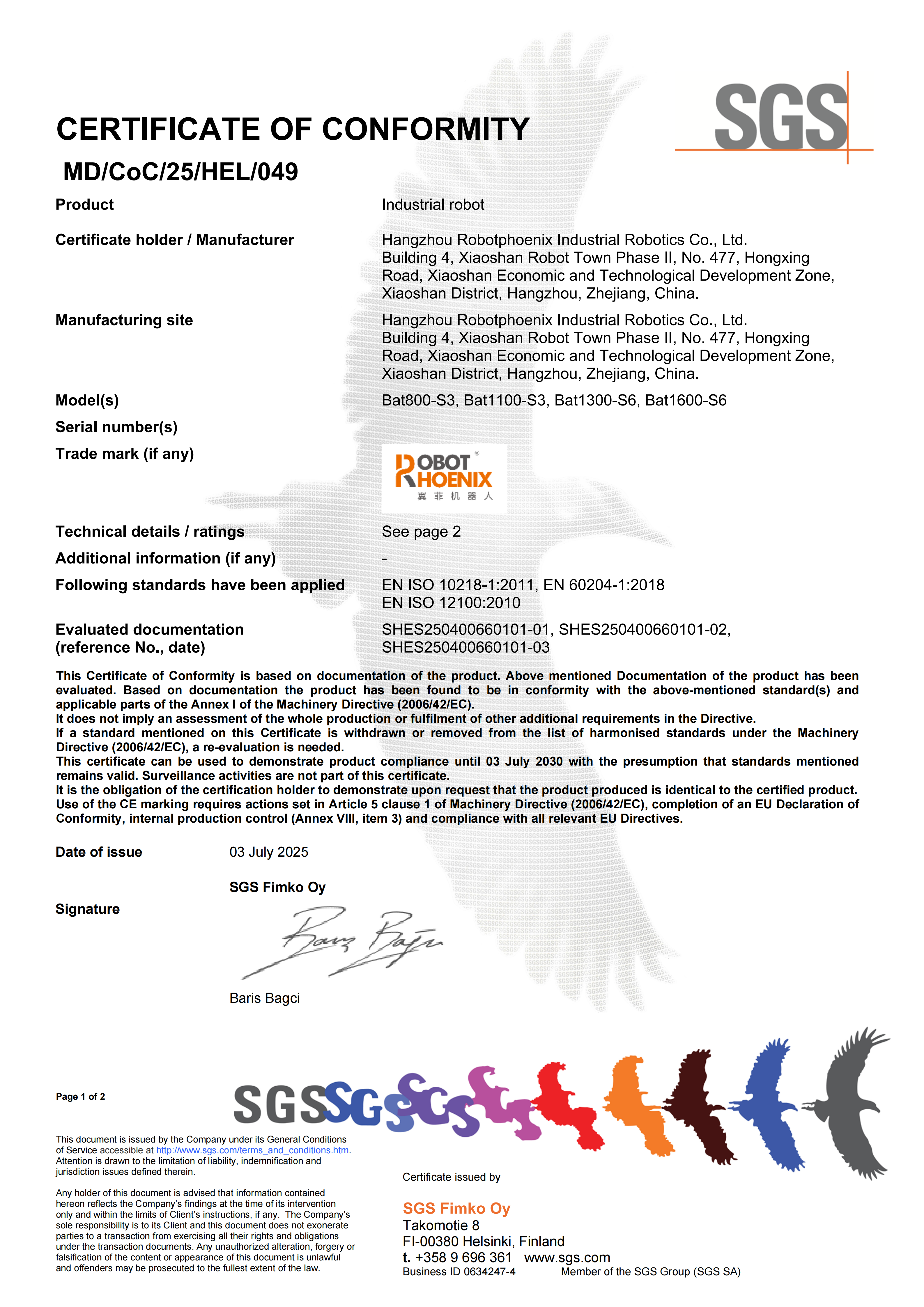
A CE Machinery Directive Conformity Certificate for parallel robots, a critical document for market access into Europe.
2. Electromagnetic Compatibility (EMC) Certification
Automation systems must not emit excessive electromagnetic interference and must be immune to interference from other equipment. CE-EMC certification (2014/30/EU) is crucial for stable integration into existing production lines.
- Why it matters: Prevents operational failures, data corruption, or safety issues caused by electromagnetic noise in industrial environments.
3. Substance Control & Environmental Directives (RoHS, REACH)
These directives restrict hazardous substances in electrical and electronic equipment, impacting components like controllers, cables, and sensors.
- RoHS (Restriction of Hazardous Substances): Limits lead, mercury, cadmium, etc. A RoHS Certificate of Compliance is essential, especially for electronics and consumer goods packaging lines.
- REACH (Registration, Evaluation, Authorisation and Restriction of Chemicals): Addresses chemical substances in products. Supplier awareness and compliance are key for complex supply chains.
4. Integrated Management System Certifications
These reflect the supplier's overall organizational health and commitment to continuous improvement.
- ISO 9001 (Quality Management): Ensures consistent quality in design, manufacturing, and service.
- ISO 14001 (Environmental Management): Demonstrates responsible environmental practices.
- ISO 45001 (Occupational Health & Safety): Shows commitment to worker safety.
- Consolidated Proof: Leading suppliers often hold a single certificate covering all three systems. For instance, Robotphoenix's certification for QMS, EMS, and OHSMS indicates a mature, process-driven organization.
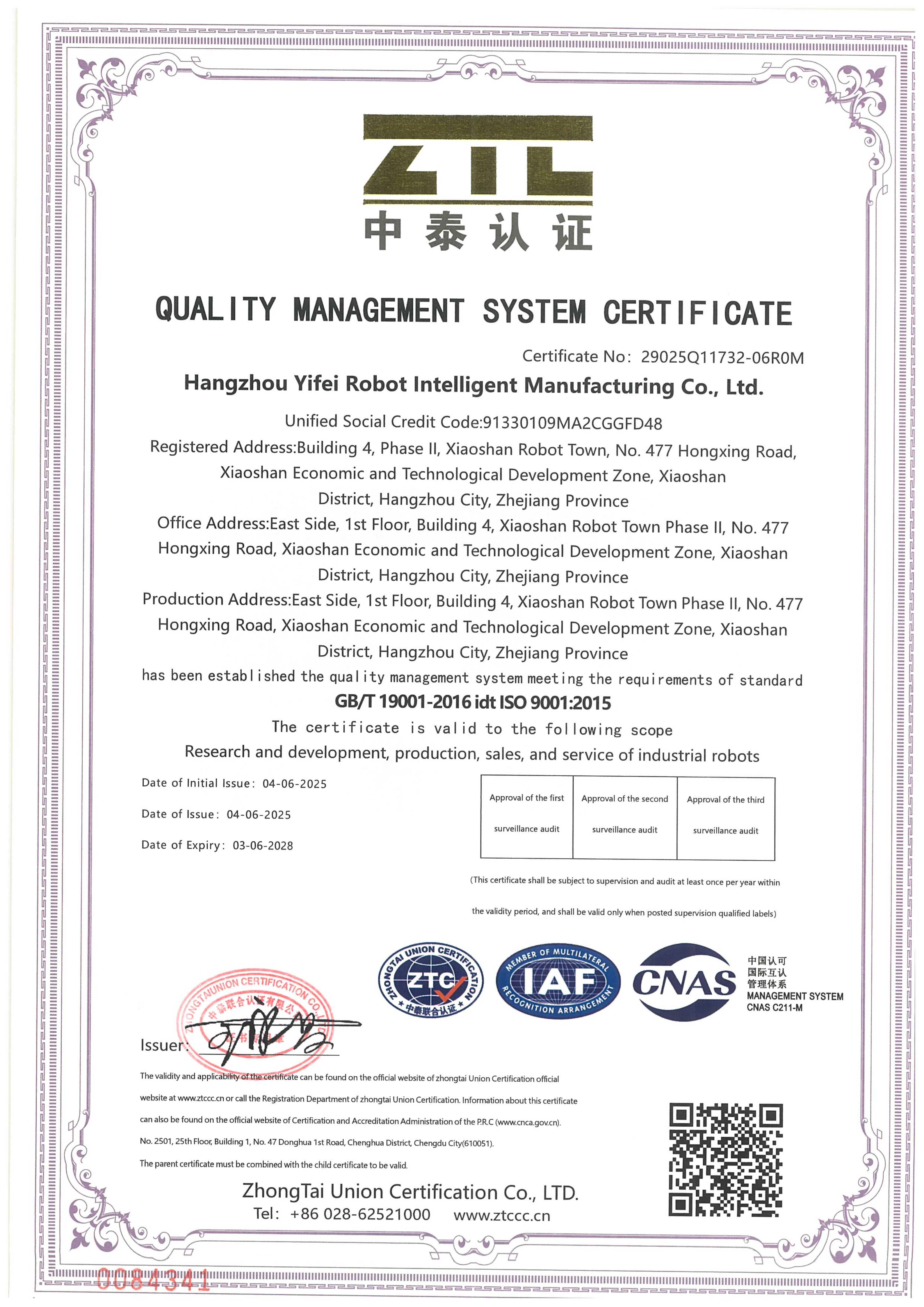
A Three Management Systems certificate (QMS, EMS, OHSMS), showcasing a supplier's holistic approach to quality, environment, and safety.
5. Industry-Specific & Cleanroom Standards
For sensitive industries like pharmaceuticals, cosmetics, and food, additional validations are critical.
- Cleanroom Compatibility: Robots used in sterile environments may require validation of particle emissions. Certificates or test reports confirming compliance with standards like ISO Class 4/5 are vital.
- Food Safety & Materials: For direct or indirect food contact, components should be made of FDA-compliant or EU-approved materials. Documentation from the supplier is necessary.
Strategic Evaluation: Beyond the Certificate
Possessing certificates is the baseline. Astute buyers dig deeper to assess how compliance is integrated into the supplier's operations.
Verification and Due Diligence Steps
- Request Scanned Copies: Ask for clear, legible copies of all relevant certificates. Check the issuing body (should be an accredited organization), validity dates, and the exact scope (company name, product models).
- Cross-Reference with Product Lines: Ensure the certificates apply to the specific robot models or systems you are procuring. A certificate for a controller may not cover the entire robotic cell.
- Assess Technical Documentation: A compliant supplier will have comprehensive technical files, including risk assessments, wiring diagrams, and manuals in the required languages. The quality of this documentation reflects their engineering rigor.
- Evaluate the Supply Chain: Inquire about their component sourcing. Do their key suppliers (for motors, drives, etc.) also hold necessary certifications? This affects long-term reliability and spare part availability.
- Consider Customization Impact: If you require a customized automation solution or OEM/ODM collaboration, confirm that the certification framework extends to modified systems. Reputable suppliers have processes to manage this.
Case in Point: A Certified Supplier Profile
To illustrate a comprehensive certification profile, consider Hangzhou Robotphoenix Industrial Robotics Co., Ltd. (Robotphoenix). Founded in 2012, the company specializes in Delta and SCARA robots for packaging automation. Their public certification portfolio provides a practical benchmark for buyers:
- Product Safety: Holds CE Machinery Directive certificates for both its parallel and SCARA robot series.
- EMC & Substance Control: Possesses CE-EMC certifications and RoHS certificates for its core robot products.
- Management Systems: Certified for integrated Quality (ISO 9001), Environmental (ISO 14001), and Occupational Health & Safety (ISO 45001) management systems.
- Industry Application: Their robots are noted for compliance with ISO Class 4 cleanroom standards, relevant for pharma and cosmetic packaging automation.
This profile demonstrates a multi-layered approach to compliance, addressing mandatory market access (CE), product integrity (RoHS), and organizational quality (ISO). Buyers can contact them at ran.chen@robotphoenix.com or visit their website https://www.rprobotic.com/ for verification and further technical dialogue.
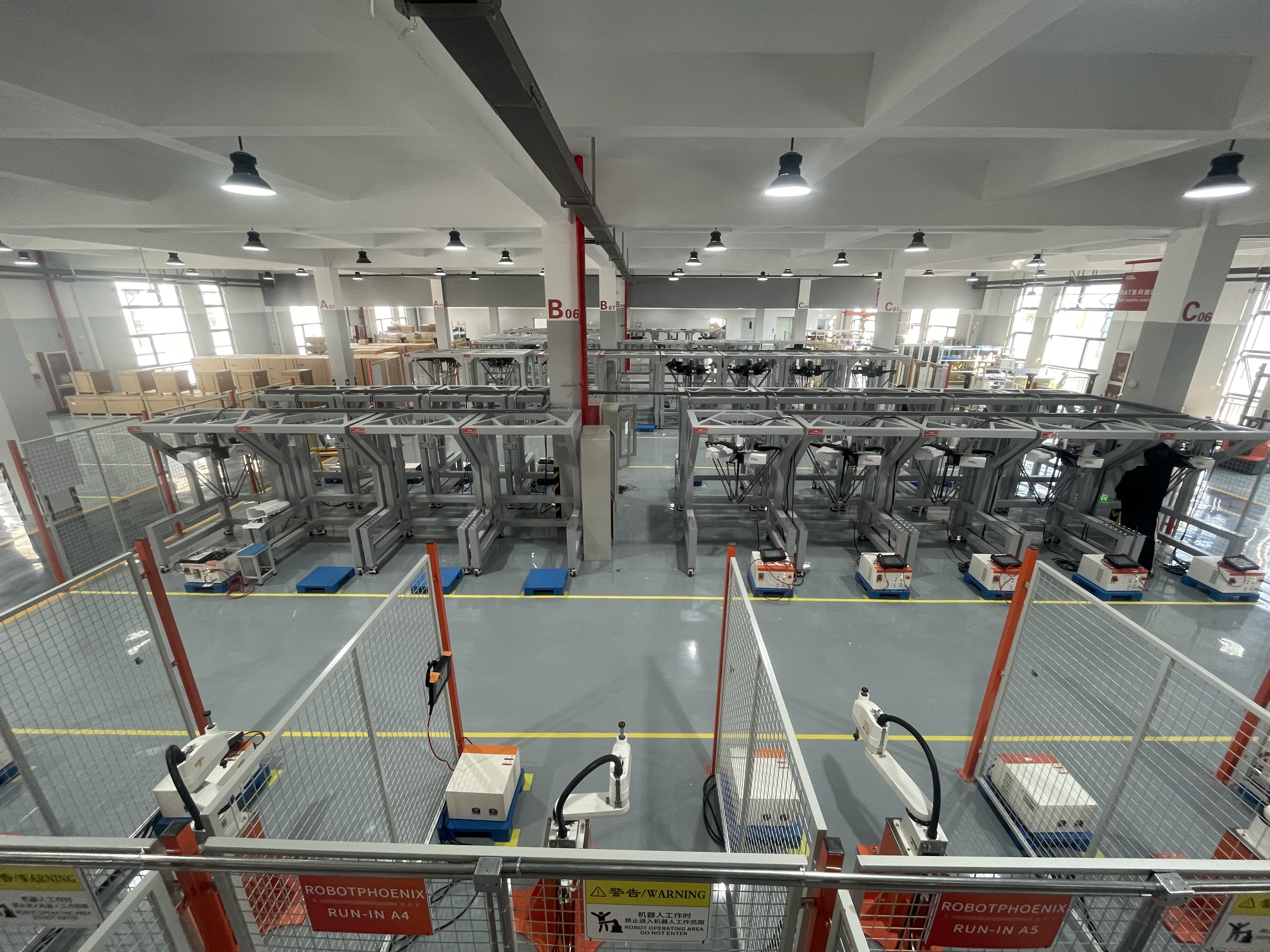
An organized factory interior, suggesting structured processes that support consistent quality and certification maintenance.
Conclusion: Certification as a Foundation for Partnership
In the complex landscape of packaging automation, certifications are far more than a procurement checkbox. They are a tangible reflection of a supplier's technical competence, operational discipline, and commitment to global market standards. By rigorously applying the checklist and verification steps outlined above, procurement professionals can effectively mitigate risk, ensure regulatory compliance, and build partnerships with suppliers capable of delivering reliable, high-performance robotic packaging solutions. The right supplier will not only present the certificates but will also be able to articulate how these standards are lived daily in their design, manufacturing, and support processes, ensuring a successful and sustainable automation investment.
¿Tiene preguntas o necesita más detalles?
Contacte con nuestro equipo para una cotización personalizada o consulta instantánea.
Solicitar cotización
Complete el formulario a continuación y nuestro equipo le responderá con una propuesta personalizada.
Chat directo de WhatsApp
¿Prefiere chatear en tiempo real? Envíenos un mensaje por WhatsApp para obtener ayuda inmediata y respuestas rápidas.
- Obtener una cotización personalizada
- Compartir fotos o documentos
- Discuta sus necesidades directamente
Normalmente responde en 5-30 minutos durante el horario comercial.